

Inflation vs Purchasing Power: What Do Tanzanians Really Feel?
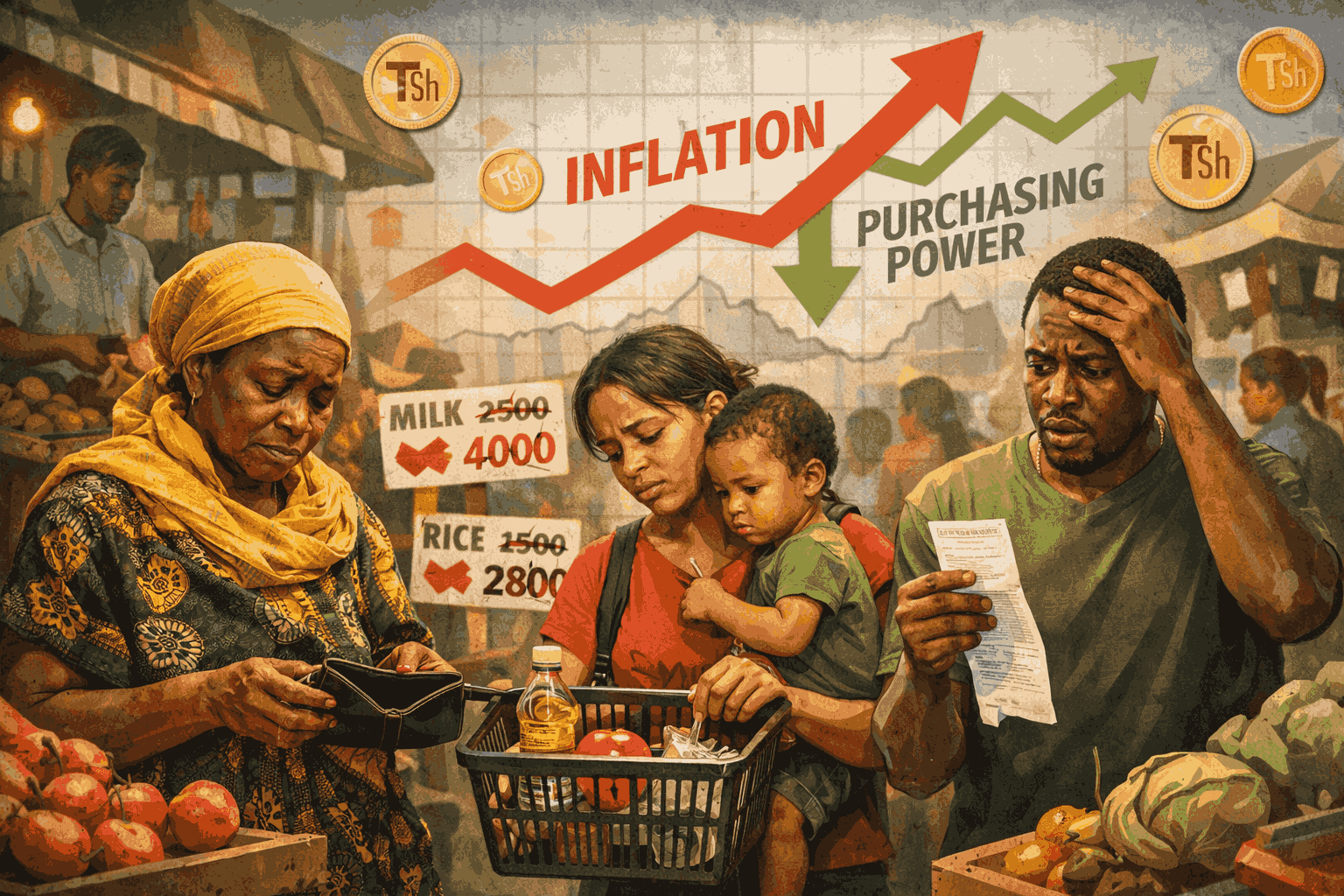
For policymakers, controlling inflation in the 3 % range is widely viewed as policy success. The Bank of Tanzania and National Bureau of Statistics have kept inflation comfortably below the target range (often between 3 % and 5 %) through prudent monetary policy.
Why stable inflation figures do not always translate into an affordable life
Tanzania is frequently highlighted as a model of price stability in sub-Saharan Africa. Official data shows that headline inflation averaged a low 3.1 % in 2024, its lowest rate in recent years, down from 3.8 % in 2023. This reflected government efforts to boost food supply and stabilize prices in the consumer basket.
Yet while the numbers suggest controlled inflation, many ordinary Tanzanians feel a different reality: daily life feels more expensive, wages are stretched thin, and financial pressure persists. This gap between aggregated inflation metrics and lived experience reveals a deeper issue: inflation alone does not capture the reality of purchasing power.
When Inflation Is Low, but Life Is Expensive
Inflation statistics measure average price changes across a standardized basket of goods and services. But what Tanzanian households actually spend food, transport, rent, cooking energy, and school expenses often behaves differently from headline figures.
Although annual inflation hovered around 3.0 %–3.5 % throughout late 2024 and 2025, food prices, critical to household welfare, rose much faster.
For example, food and non-alcoholic beverages inflation hit around 7.4 %–7.7 % in late 2025, significantly above the overall rate.
This divergence matters because food accounts for nearly a third of the consumer basket and takes up an even larger share of low-income household spending.
Purchasing Power: The Real Economic Indicator
Purchasing power reflects what people can actually buy with their income, not just what price indexes suggest.
For many Tanzanians, purchasing power weakened in 2024–25 due to:
- Slow wage growth, especially in the private and informal sectors, where pay often lags behind rising essentials
- Persistent food price volatility, borne from climate shocks, transport costs, and agricultural supply chain challenges
- High transport and fuel costs, which squeeze both urban and rural budgets
- Exchange rate pressures, making imported goods and inputs more expensive
As a result, households are adjusting quietly: buying smaller quantities, cutting back on non-essentials, delaying healthcare, stretching school costs, or relying on mobile loans.
Who Feels Inflation the Most?
Inflation is not neutral. It disproportionately affects those who spend most of their income on necessities:
- Low-income households feel price changes immediately
- Middle-class earners experience declining discretionary income and shrinking savings
- Businesses and asset holders often have more capacity to adjust prices or hedge costs
This uneven impact fuels a growing perception that economic growth is not translating into improved living standards.
Policy Blind Spot: Stability Without Welfare
For policymakers, controlling inflation in the 3 % range is widely viewed as policy success. The Bank of Tanzania and National Bureau of Statistics have kept inflation comfortably below the target range (often between 3 % and 5 %) through prudent monetary policy.
Yet inflation control alone is insufficient if it does not translate into improved purchasing power and welfare for ordinary citizens. Restoring real purchasing power requires more than price stability; it requires:
- Strengthening household incomes through wage growth and employment expansion
- Stabilizing food supply chains and improving agricultural productivity
- Reducing structural transport and energy costs
- Protecting the most vulnerable through targeted social support
Conclusion
Tanzanians do not experience inflation as a percentage, they experience it in daily choices and sacrifices. A headline inflation rate of 3 % might signal macroeconomic stability, but when essential costs rise faster than incomes, households struggle. The real economic challenge today is not just keeping prices stable, but ensuring that incomes grow faster than the cost of living. Until that happens, many Tanzanians will continue to feel that economic life is harder than the numbers suggest.
