
How to Invest in Cold-Chain Logistics for Perishable Exports in Tanzania
Ready
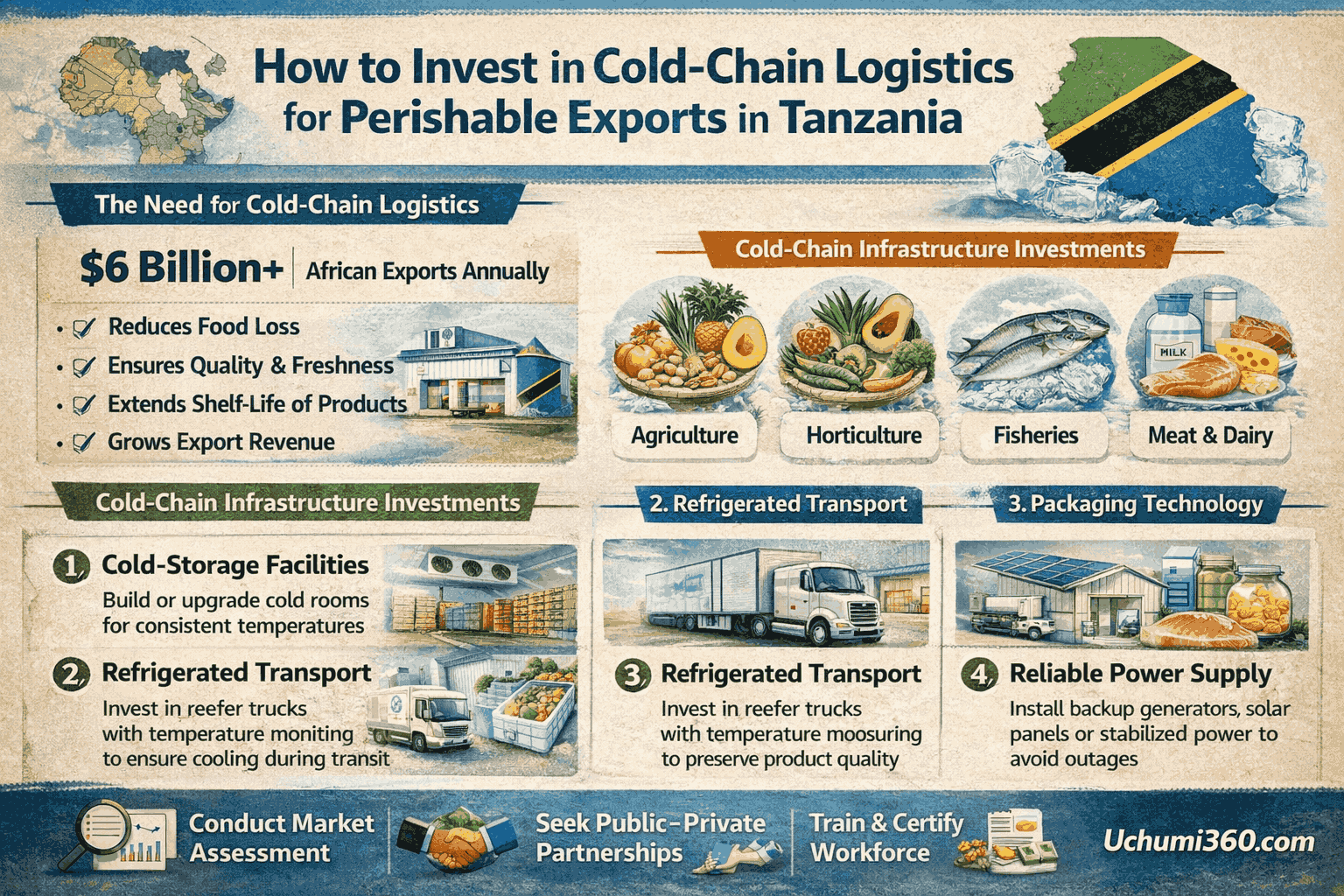
Cold-chain logistics is emerging as a critical enabler of Tanzania’s export competitiveness. With rising regional and international demand, investment in temperature-controlled storage, refrigerated transport, and pack-house facilities is becoming both commercially viable and strategically necessary.
Tanzania’s agricultural sector is growing rapidly, yet a large share of high-value perishable produce never reaches premium export markets in optimal condition. From horticulture and fish to meat and dairy, post-harvest losses remain one of the largest hidden costs in the export economy. For investors, this is not just a supply chain gap, it is a structured opportunity.
Cold-chain logistics is emerging as a critical enabler of Tanzania’s export competitiveness. With rising regional and international demand, investment in temperature-controlled storage, refrigerated transport, and pack-house facilities is becoming both commercially viable and strategically necessary.
Why Cold-Chain Investment Matters
Tanzania produces substantial volumes of fruits like (Avocados, Mangoes) Green beans, Flowers, Fish from Lake Victoria, Poultry and beef. Without proper cold storage and refrigerated transport, a significant portion of this produce loses value before reaching Dar es Salaam port or Julius Nyerere International Airport. Post-harvest losses can reach 20 - 40%, affecting: Agribusiness profitability, Farmer incomes, Export revenue, Market reputation
Cold-chain logistics strengthens: Export competitiveness, Food safety compliance, Quality certification for EU and Middle East markets, Supply chain efficiency.
For Tanzania to scale agro-processing and export diversification, logistics infrastructure must evolve alongside production growth.
Understanding the Cold-Chain Value Chain
Investors need to understand the full cold-chain ecosystem:
- On-farm pre-cooling systems
- Collection and aggregation centers
- Cold storage warehouses
- Refrigerated transport (reefer trucks)
- Airport and port cold handling facilities
- Export documentation and customs clearance
You do not need to own the entire chain. Many successful investors focus on one high-demand segment, such as pack houses or temperature-controlled warehouses near production clusters.
Entry Points for Investors
1. Solar-Powered On-Farm Cold Rooms
Regions like Arusha, Kilimanjaro, Mbeya, and Njombe are ideal for modular solar-powered cold rooms.
Benefits:
- Reduce reliance on unreliable grid electricity
- Scalable for smallholder cooperatives
- Supports rural development and climate-smart agriculture
This segment is suitable for investors seeking moderate capital exposure with measurable impact on reducing post-harvest losses.
2. Aggregation Cold Hubs
Cold storage hubs near production clusters allow:
- Grading and sorting
- Packaging for export markets
- Compliance with food safety standards
- Volume consolidation for better pricing
High-potential regions:
- Arusha (horticulture & flowers)
- Mwanza (fisheries)
- Mbeya (avocados & potatoes)
- Morogoro (fruits & vegetables)
Tips: Secure long-term supply agreements and consider PPP or joint venture models to reduce risk.
3. Refrigerated Transport Services
Reefer truck leasing remains underdeveloped in Tanzania. Reliable refrigerated transport improves:
- Supply chain reliability
- Export turnaround times
- Reduction in spoilage
- Overall logistics efficiency
Opportunity: Fleet financing or structured leasing arrangements can lower barriers for investors while meeting export demand.
Financial Considerations
Cold-chain investment requires moderate to high capital expenditure:
- Refrigeration equipment and insulated panels
- Backup power systems
- Temperature monitoring technology
- Land acquisition or facility leasing
Revenue streams are predictable due to:
- Long-term supply contracts
- Growing export demand
- Expansion of supermarkets and agro-processing
Tip: Conduct feasibility studies focusing on production volumes within a 50–100 km radius. Blended finance (equity, loans, incentives) enhances project bankability.
Regulatory and Policy Environment
Tanzania supports logistics investment through:
- The Tanzania Investment and Special Economic Zones Authority (TISEZA) incentives
- Special Economic Zones (SEZ) & Export Processing Zones (EPZ)
- Tax incentives for strategic infrastructure
- Growing AfCFTA market access
Compliance is essential for export markets:
- Tanzania Bureau of Standards (TBS)
- International food safety certifications
- Phytosanitary documentation
Investors should also assess:
- Electricity reliability
- Road and port infrastructure
- Customs and documentation processes
Risks and Mitigation
Key risks include:
- Power outages and energy costs
- Maintenance capacity
- Skilled workforce availability
- Currency fluctuations
- Seasonal production variability
Mitigation strategies:
- Hybrid solar-grid systems
- Maintenance contracts
- Workforce training programs
- Diversified client portfolios across crops
- Multi-year supply agreements
Strategic Investment Approach
- Focus on a high-output production cluster
- Partner with established exporters
- Secure supply agreements before construction
- Integrate digital temperature tracking
- Align with export financing institutions
Cold-chain logistics is not just storage, it is part of Tanzania’s broader export infrastructure strategy.
The Bigger Picture
Tanzania aims to grow non-traditional exports and strengthen its position in regional and global markets. Cold-chain investment supports:
- Agribusiness growth
- Export diversification
- Trade competitiveness
- Industrialization strategy
- Food security
With regional demand for fresh produce increasing, early investors stand to benefit from long-term structural demand. The transformation of Tanzania’s perishable exports will be driven not only by farmers, but by infrastructure investors who recognize that preservation equals profitability.
 Uchumi360
Business Intelligence
Uchumi360
Business Intelligence
Uchumi360 covers business, investment, and economic policy across East, Central, and Southern Africa.
For the serious reader
You read to the end. That places you in a small group.
Uchumi360 is built for readers who demand precision over speed, structure over sentiment, and analysis that holds uncomfortable conclusions rather than softening them. If this work sharpens how you think about Africa's economy, help us keep building the infrastructure behind it.
Institutional Partners
Commission intelligence. Shape the conversation.
Uchumi360 works with development finance institutions, investment firms, sovereign bodies, and strategic organisations across the coverage region. Institutional partnership unlocks:
- Commissioned sector and country intelligence reports
- Branded research series under your institution's authority
- Exclusive data briefings for internal strategy teams
- Speaking and editorial presence at Uchumi360 events
- Co-published investment outlooks for your markets
Support Our Work
Independent analysis has a cost. Help us bear it.
Uchumi360 does not carry advertising. It does not take editorial direction from sponsors. Every article is produced without commercial compromise. Your contribution funds the reporting, research, and editorial infrastructure that keeps this analysis free from influence.
Secure checkout: One-time and monthly support are processed securely.
Stay Connected
Keep up with every new insight.
Follow our latest analysis, policy coverage, and market intelligence as soon as it is published. If you need something specific, reach out directly and we will point you to the right research.
