
How Tanzania Slid From Africa’s Top Eight Economies to 12th, and What It Will Take to Catch Up
Ready
Tanzania was roughly Africa’s eighth largest economy in 1980 and was larger than Kenya, Ethiopia and Côte d’Ivoire. IMF projections now place it 12th, behind all three and DRC. The explanation lies less in economic collapse than in slower structural transformation, weaker export growth, low productivity, limited private sector scale and competitors that compounded faster.
Tanzania has not become a smaller economy. It has become a slower climber in a continent where several peers have expanded faster, diversified more aggressively or converted population, commodities and private investment into nominal economic scale more effectively. In 1980, World Bank data placed Tanzania’s GDP at about US$11.4 billion, making it roughly Africa’s eighth largest economy. It was larger than Côte d’Ivoire, Kenya and Ethiopia, whose economies were then valued at approximately US$10.2 billion, US$7.3 billion and US$7.0 billion respectively. The Democratic Republic of Congo was already somewhat larger at US$14.4 billion. By 2026, the order had changed sharply. IMF projections put Kenya at US$147.3 billion, DRC at US$123.4 billion, Ethiopia at US$121.5 billion, Côte d’Ivoire at US$112.1 billion and Tanzania at US$94.9 billion, leaving Tanzania 12th in Africa by nominal GDP.
That does not mean Tanzania failed to grow. Its economy has expanded many times over in absolute terms, and for much of the past two decades real GDP growth remained between 5 percent and 7 percent, a performance many countries would consider respectable. The problem is relative performance and economic structure. Ethiopia grew faster for longer, Côte d’Ivoire combined rapid growth with stronger export and private investment momentum, DRC benefited from an extraordinary expansion in copper and cobalt production, and Kenya built a deeper services, finance, technology and regional corporate base. Tanzania grew steadily, but much of that growth remained concentrated in infrastructure, low productivity agriculture, extractives, construction and domestically oriented activity. The country was moving forward while several competitors moved faster.
President Samia Suluhu Hassan acknowledged the central problem more directly than most official development documents when launching Tanzania Development Vision 2050 in July 2025. Tanzania, she said, possesses immense natural wealth, yet “nchi hii tajiri bado ina watu wengi masikini.” She also warned that the country could not reach its ambitions “kama tutaendelea kufanya kazi kwa mazoea,” and described the private sector as “mhimili wa ujenzi wa uchumi wetu.” The new Vision aims to turn Tanzania into an upper middle income economy worth US$1 trillion by 2050.
The gap between today’s US$95 billion economy and that US$1 trillion ambition is enormous. Starting from the IMF’s 2026 estimate, Tanzania would need its nominal economy measured in US dollars to expand by roughly 10.3 percent every year for the next 24 years to reach US$1 trillion by 2050. That is achievable mathematically, but only if real growth moves significantly above the recent 5 percent to 6 percent range, productivity rises, the shilling does not consistently erase domestic growth when GDP is translated into dollars, and Tanzania develops export industries capable of generating much larger foreign exchange earnings.
Tanzania Was Once Larger Than Kenya, Ethiopia and Côte d’Ivoire
The historical comparison is uncomfortable because Tanzania began from a stronger relative position than many countries now ahead of it. In 1980, Tanzania’s US$11.4 billion economy was more than 60 percent larger than Ethiopia’s, around 57 percent larger than Kenya’s and about 12 percent larger than Côte d’Ivoire’s. Only a relatively small group of African economies including South Africa, Nigeria, Algeria, Libya, Egypt, Morocco and Zaire, now DRC, were larger.
The 1980s changed that trajectory. Tanzania entered the decade with an economy still shaped heavily by state ownership, import substitution, administered prices and the legacy of the Arusha Declaration. Foreign exchange shortages, weak agricultural incentives, inefficient parastatals, oil shocks, falling commodity prices and the economic costs associated with the Uganda war placed immense pressure on public finances and production. The eventual market reforms of the second half of the decade were necessary, but they also coincided with major currency depreciation. Measured in current US dollars, Tanzania’s GDP fell from around US$11.4 billion in 1980 to just US$6.2 billion in 1990.
That decline did not mean the physical economy literally halved. Nominal dollar GDP is affected heavily by exchange rates, inflation and national accounting revisions. But rankings of Africa’s largest economies are themselves normally reported using nominal dollar GDP, which means currency performance matters. An economy can grow in local currency while appearing to stagnate or shrink in dollars if its currency depreciates rapidly.
That is one recurring part of Tanzania’s story. The shilling averaged about TSh1,991 to the dollar in 2015, TSh2,300 by 2019 and roughly TSh2,506 by 2024. Tanzania’s nominal GDP in local currency continued expanding, but part of that growth disappeared when converted into dollars. World Bank figures show nominal GDP rising from about TSh94 trillion in 2015 to more than TSh200 trillion by 2024, yet GDP in US dollars moved from about US$47.4 billion to only around US$79.2 billion over the same period.
Currency effects are not the whole explanation, but they are one reason headline African GDP rankings can change more rapidly than underlying productive capacity.
The 2000s Were Tanzania’s Strongest Catch Up Period
Tanzania actually recovered strongly after the reforms of the 1990s. From the early 2000s through much of the 2010s, real GDP growth frequently exceeded 6 percent. Macroeconomic stability improved, mining expanded, telecommunications grew rapidly, tourism developed, foreign investment increased and major urban centres became larger commercial markets. World Bank data puts nominal GDP at US$13.4 billion in 2000, US$32 billion in 2010 and nearly US$50 billion by 2016.
Exports were particularly important during the first half of that period. The World Bank estimates that Tanzania’s exports expanded 6.5 times between 2000 and 2012, pushing exports from 9.6 percent of GDP to 20.9 percent. That was the period when Tanzania looked most capable of combining domestic growth with deeper participation in external markets.
Then the pattern changed. By 2021, exports had fallen back to 14.3 percent of GDP. The composition also shifted. Agricultural goods had represented 57 percent of exports in the early 2000s, while by 2021 extractive products, primarily gold, accounted for more than half. Tanzania was exporting valuable commodities, but its economy had not developed a sufficiently broad manufacturing and tradable services base capable of pushing export earnings up at the pace seen in successful emerging economies.
This matters because a country cannot climb indefinitely through African nominal GDP rankings on domestic consumption and public investment alone. Large economies need large export engines. South Africa has mining, manufacturing and financial services. Algeria and Angola have hydrocarbons. Morocco has automotive manufacturing, phosphates, tourism and export industries. Kenya has services, tourism, horticulture, finance and technology. Côte d’Ivoire has cocoa, cashew, processing, services and increasingly hydrocarbons. DRC has copper and cobalt at extraordinary scale. Ethiopia built its expansion around a huge domestic market, infrastructure investment and periods of exceptionally rapid real growth. Tanzania has many potential engines, but few operating at sufficient scale.
Structural Transformation Slowed Just When Tanzania Needed It To Accelerate
The World Bank’s Country Economic Memorandum provides perhaps the clearest diagnosis. Between 2006 and 2014, structural transformation accounted for about 72 percent of Tanzania’s labour productivity growth. Workers were moving from lower productivity activities into sectors where each worker produced more economic value. Between 2014 and 2021, however, structural change made a negative contribution of around 5 percent to labour productivity growth.
That is a major economic warning. Development is not simply producing more maize, gold, cement or banking transactions each year. Sustained catch up requires millions of workers to move into more productive activities, from subsistence farming into commercial agriculture, manufacturing, logistics, tourism, professional services, technology, construction, processing and formal businesses.
As recently as 2021, roughly two thirds of Tanzania’s labour force was still employed in agriculture, even though agriculture generated only around one quarter of GDP. The gap between employment share and output share captures the productivity problem. Too many Tanzanians remain concentrated in activities that generate relatively little output per worker.
Manufacturing has also remained smaller than Tanzania’s industrial ambitions would suggest. World Bank data puts manufacturing at around 8 percent of GDP in 2023, while a separate World Bank assessment estimated manufacturing represented only about 8.5 percent of employment.
The country built roads, power plants, ports and railways, but the private industrial base that should use that infrastructure to manufacture, export and employ people at scale has not expanded quickly enough.
Public Investment Became Too Important To The Growth Model
Tanzania’s infrastructure push solved real constraints. The Standard Gauge Railway, Julius Nyerere Hydropower Project, roads, airports, ports and other major investments are assets that can raise productivity for decades if they are used intensively by businesses. The problem identified by the World Bank is not that Tanzania invested in infrastructure. It is that growth became increasingly dependent on public investment while private sector dynamism weakened.
World Bank estimates show gross public investment rising from around 9.1 percent of GDP in 2015 to nearly 18.7 percent by 2023. Total investment exceeded 40 percent of GDP during parts of that period, an exceptionally high level, but a large portion came through the state and public institutions.
The World Bank describes Tanzania’s recent model as increasingly driven by public infrastructure and the domestic market rather than private investment and international exposure. Its Country Economic Memorandum argued explicitly that Tanzania needed to “privatize growth,” meaning not the sale of state assets, but shifting the main engine of economic expansion towards competitive private firms capable of investing, employing workers and exporting.
That diagnosis aligns closely with President Samia’s own Vision 2050 language. “Sekta binafsi ndio mhimili wa ujenzi wa uchumi wetu,” she said when launching the Vision.
The next phase therefore depends on whether Tanzania’s expensive new infrastructure becomes a platform for private production or remains primarily a collection of public capital projects.
Ethiopia Simply Grew Faster
Ethiopia’s rise illustrates the power of sustained high growth even when the underlying economic model has serious weaknesses. In 2000, Ethiopia’s GDP was only about US$8.2 billion compared with Tanzania’s US$13.4 billion. By 2016, Ethiopia had reached US$68.5 billion while Tanzania stood at US$49.8 billion. By 2024, Ethiopia’s economy was estimated by the World Bank at nearly US$150 billion compared with Tanzania’s roughly US$79 billion. Currency reforms subsequently reduced Ethiopia’s nominal dollar GDP, but the IMF still places the country ahead of Tanzania in 2026 at about US$121.5 billion.
Ethiopia’s model produced deep problems, including foreign exchange shortages, debt pressure, inflation, conflict and a heavily controlled financial system. But for long periods it also delivered growth rates well above Tanzania’s. The IMF expects Ethiopia to grow about 9.2 percent in 2026 compared with roughly 5.9 percent for Tanzania.
Compounding explains the result. A country growing at 9 percent doubles its real economy in roughly eight years. At 6 percent, doubling takes around twelve years. Over two decades, that difference becomes enormous.
Tanzania does not need to copy Ethiopia’s state dominated model, but Ethiopia demonstrates why a stable 5 percent to 6 percent growth rate is no longer enough if the objective is to move rapidly up Africa’s economic rankings.
Côte d’Ivoire Built The Kind Of Momentum Tanzania Lost
Côte d’Ivoire provides a more relevant comparison because its population is much smaller than Tanzania’s. In 1980, Tanzania was the larger economy. Côte d’Ivoire had GDP of roughly US$10.2 billion against Tanzania’s US$11.4 billion. In 2016, Tanzania remained slightly ahead, at US$49.8 billion against Côte d’Ivoire’s US$48.4 billion. By 2018, the positions had reversed: Côte d’Ivoire reached roughly US$58.5 billion while Tanzania stood at US$57 billion. The gap has continued widening, with the IMF projecting around US$112.1 billion for Côte d’Ivoire in 2026 compared with Tanzania’s US$94.9 billion.
Côte d’Ivoire’s performance since its political crisis has been driven by sustained growth around 6 percent or higher, private investment, services, construction, agricultural exports, infrastructure and, increasingly, hydrocarbons and domestic processing. The World Bank says the country averaged 6.5 percent real growth between 2021 and 2023, 6.3 percent in 2024 and again 6.3 percent in 2025. It is also deliberately attempting to move from being merely the world’s largest cocoa and cashew producer into processing more of those commodities domestically.
There is also a currency effect. Côte d’Ivoire uses the CFA franc, which is pegged to the euro. That reduces the exchange rate volatility experienced by currencies such as the Tanzanian shilling and can help preserve nominal dollar GDP during periods when East African currencies are depreciating. But currency stability alone cannot explain the rise. Côte d’Ivoire has also compounded real growth at a faster rate and attracted substantial private capital.
DRC Has Turned Copper And Cobalt Into Enormous GDP Growth
The DRC comparison requires more nuance. Congo was already larger than Tanzania in 1980, then endured decades of economic collapse, conflict and hyperinflation during which Tanzania moved ahead. The current story is therefore a re overtaking rather than a first overtaking.
As recently as 2024, World Bank data still put Tanzania at roughly US$79.2 billion, while subsequent data show DRC reaching about US$91 billion in 2025 compared with Tanzania’s US$90.1 billion. The IMF’s 2026 projection widens that difference dramatically, placing DRC at about US$123.4 billion and Tanzania at US$94.9 billion.
Mining is the main explanation. DRC’s extractive sector has been expanding at rates far above the rest of the economy, driven by copper and cobalt production tied to the global energy transition, electronics and battery supply chains. The World Bank estimates mining output grew 10.1 percent in 2025, even while non mining sectors expanded only around 3.1 percent.
This is not necessarily a development model Tanzania should emulate wholesale. DRC remains extremely poor despite its mineral wealth, and large GDP numbers have not translated adequately into public services or broad household prosperity. But the comparison demonstrates what happens when a country operates globally important mineral assets at scale.
Tanzania has gold, graphite, nickel, uranium, rare earth prospects, natural gas and potentially enormous LNG resources. Most are still operating below the scale at which they could fundamentally change national output.
Tanzania’s Population Growth Has Diluted The Impact Of Headline GDP Growth
Another reason 5 percent or 6 percent GDP growth feels less impressive is population. Tanzania’s population is increasing at close to 3 percent annually. That means a 6 percent economy produces real GDP per capita growth of only about 3 percent before distribution is considered.
World Bank figures show average real GDP growth of around 6.3 percent during the 2010 to 2019 period, but real GDP per capita growth averaged only about 3.1 percent. After 2020, per capita growth slowed further, falling to minus 1 percent in 2020, 1.2 percent in 2021 and roughly 1.4 percent in 2022.
This matters enormously for Vision 2050 because Tanzania’s population could roughly double by then. The IMF itself says demographic pressure makes the country’s development challenge considerably harder and argues that stronger investment in education, health, skills and job creation will be essential.
Tanzania therefore needs growth above 6 percent not because 6 percent is poor, but because rapid population expansion consumes a large portion of it.
The Business Environment Has Imposed A Cost Tanzania Could Not Afford
The World Bank and IMF have repeatedly identified the same constraints: regulatory burden, access to finance, taxation, electricity reliability, infrastructure bottlenecks, skills and institutional predictability. The World Bank has specifically cited strict licensing requirements, limited credit availability and costly government arrears including delayed VAT refunds as barriers to private sector growth.
Credit illustrates the scale of the problem. Domestic credit to Tanzania’s private sector remained around 12 percent to 15 percent of GDP through much of the 2010s and early 2020s. That is a thin financial base for a country attempting large scale industrialisation. Businesses cannot build factories, logistics companies, hotels, technology firms, agribusinesses or export operations without long term finance.
Regulatory unpredictability also matters because investment decisions are cumulative. A factory that is not built in 2017 does not suddenly appear in GDP when regulations improve in 2022. Tanzania loses the production, jobs, tax revenues, supplier development and export earnings that investment would have generated during every intervening year.
The Samia administration has moved significantly in the opposite direction, reopening engagement with investors, reforming parts of the investment framework, easing foreign exchange distortions and automating public services. The IMF says these reforms have improved foreign exchange market functioning and acknowledges progress in the broader business environment. But it continues to argue that faster reform is needed in regulation, access to finance, governance and human capital.
Tanzania Also Stopped Thinking Enough About Exports
Perhaps the most consequential economic number in the World Bank diagnosis is the decline in exports from 20.9 percent of GDP in 2012 to 14.3 percent in 2021. That change represents more than trade statistics. Exports force companies to become productive enough to compete beyond their protected domestic market. They bring foreign currency into the economy, support the exchange rate, finance machinery imports and allow firms to expand beyond the purchasing power of Tanzanian consumers.
Tanzania’s domestic market is large and becoming larger, but relying too heavily on it creates a ceiling. A country of 70 million people with relatively low average incomes cannot generate the same demand as the global market.
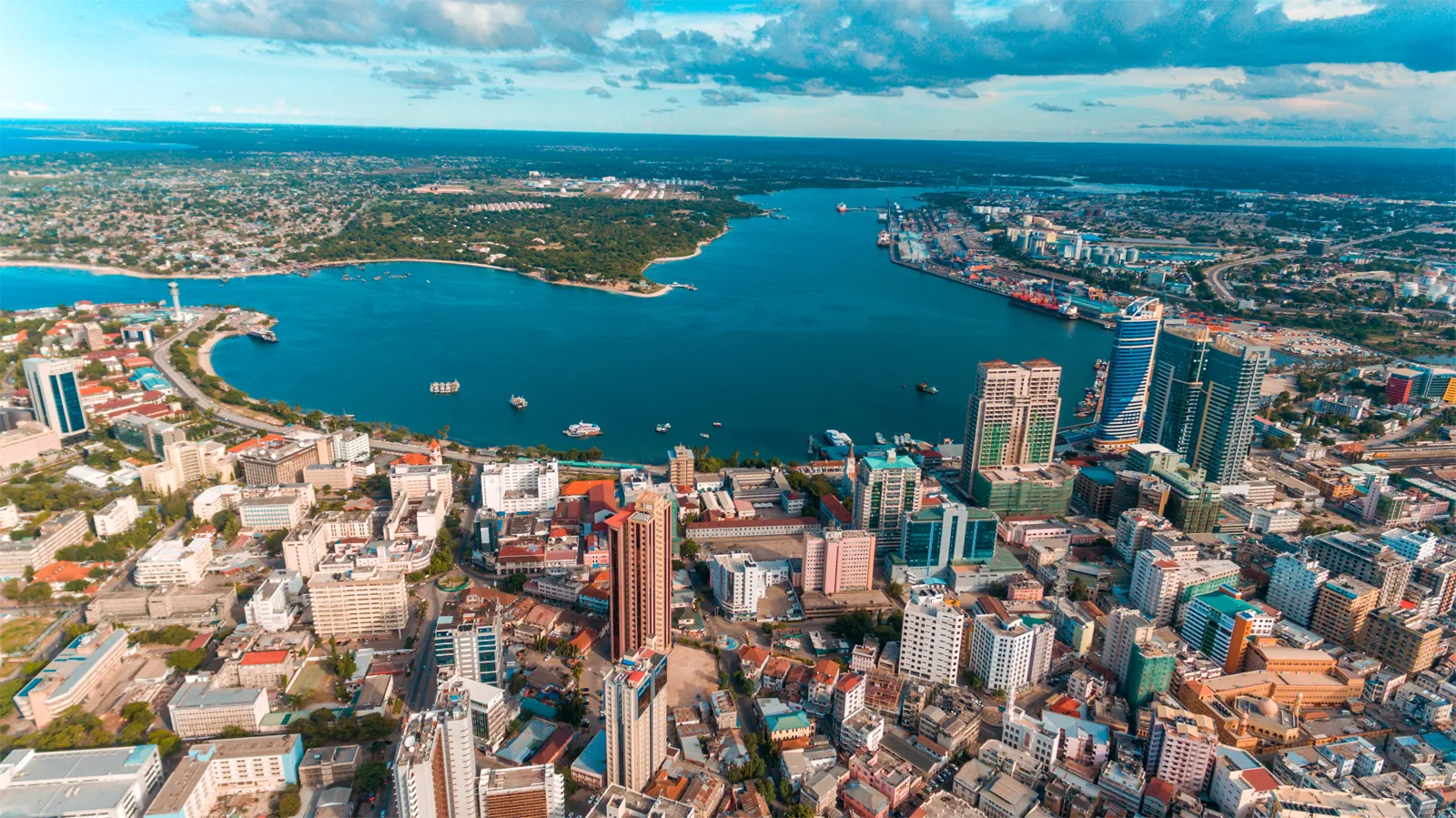
The country has geographical advantages that should make it an export platform: the Indian Ocean, Dar es Salaam port, access to eight neighbouring countries, membership in both EAC and SADC, mineral resources, tourism assets and agricultural land. Yet high logistics costs, border procedures, regulatory friction and low productivity have prevented Tanzania from converting location into export dominance.
The World Bank explicitly identifies regional integration as one of the principal opportunities Tanzania has failed to exploit fully, citing low productivity and high procedural and logistical trade costs as major obstacles.
Tanzania’s Route Back Begins With Growth Above 7 Percent
The first requirement is arithmetic. A 5.9 percent economy cannot consistently catch economies growing at 6.5 percent, 7 percent or 9 percent. Tanzania needs to push sustained real growth into the 7 percent to 8 percent range, and eventually beyond, without destabilising inflation or debt.
That would not require abandoning macroeconomic discipline. Tanzania’s relative strengths include low inflation, manageable public debt, political continuity and improving external balances. The IMF describes the medium term outlook as favourable and expects growth to rise towards 6.5 percent if reforms continue. But 6.5 percent should be treated as a floor for the Vision 2050 period rather than the destination.
The sectors capable of delivering the additional growth are already identifiable. President Samia’s Vision 2050 names agriculture, tourism, manufacturing, construction, mining, the blue economy, sports and creative industries, financial services and broader services as priority sectors, selected partly for their capacity to generate jobs, exports, domestic value addition and government revenue. The harder part is execution.
Agriculture Must Become A Business, Not Mainly A Labour Reservoir
Agriculture still contributes roughly a quarter of GDP and employs more than half of Tanzanians. In 2025, the National Planning Commission said agriculture, forestry and fishing contributed 24.3 percent of GDP while continuing to employ more than half the population.
That ratio contains the opportunity. If agricultural productivity doubles, Tanzania does not simply produce more food. It releases labour into manufacturing and services, increases rural incomes, expands agro processing, reduces food inflation and creates exportable surpluses.
The required interventions are familiar: irrigation, commercial seed systems, mechanisation, storage, cold chains, agricultural finance, extension services, land security, aggregation and processing. The economic objective should be to reduce the number of people required to produce each tonne of output while increasing the income earned by those who remain in farming.
No country becomes a US$1 trillion economy with most of its labour force remaining in low productivity agriculture.
Manufacturing Has To Move From Policy Language To Scale
Tanzania has spent decades describing industrialisation as a national objective, yet manufacturing remains around 8 percent of GDP. That is not enough for a country with Tanzania’s population, resource base and geographic position. Industrial policy should therefore become more selective. Tanzania does not need to manufacture everything. It needs several sectors capable of reaching continental or global scale.
Agro processing is an obvious candidate because Tanzania already produces cashew, coffee, cotton, tobacco, tea, livestock, grains, oilseeds and horticulture. Mining provides another: gold refining, graphite processing, fertiliser, battery minerals and metals. Construction materials, pharmaceuticals, textiles and garments, automotive components and consumer goods can also exploit the domestic and regional market.
The measurement should be exports, productivity and firm scale rather than the number of factories opened.
The Country Must Monetise Its Geography
Dar es Salaam should function economically as a port for a region of hundreds of millions of people, not only as Tanzania’s largest city. Zambia, DRC, Rwanda, Burundi, Malawi and Uganda all depend to varying degrees on external trade corridors, and Tanzania occupies one of the strongest geographic positions in Africa for servicing them.
SGR, port expansion and improved roads therefore become economically valuable when they shorten transit times, lower freight costs and cause mining companies, traders, manufacturers and logistics firms across the region to route larger volumes through Tanzania.
The country should measure corridor policy through tonnes, containers, transit times, logistics costs and foreign exchange earnings. Infrastructure becomes productive when somebody pays to use it.
Tanzania Needs Much More Private Capital
President Samia’s assertion that the private sector is the foundation of economic construction needs to become the organising principle of economic policy rather than one component of it.
Government can build the SGR, transmission lines, roads and ports. It cannot finance enough factories, farms, software companies, mines, hotels, warehouses and export firms to employ Tanzania’s growing workforce.
The regulatory framework therefore has to answer a simple question: does each major rule make it easier or harder for productive businesses to invest?
Tax collection has to increase without making compliant firms uncompetitive. Local content rules should build Tanzanian capabilities without blocking investment. Licences should protect legitimate public interests without becoming rents. Commercial disputes should be resolved quickly. VAT refunds should not become involuntary loans from companies to government. Credit markets must deepen.
The IMF’s 2025 assessment reaches essentially the same conclusion: Tanzania’s medium term outlook depends on structural reforms that improve the business environment and support a more dynamic private sector.
Human Capital Is Now An Economic Constraint, Not A Social Side Issue
Roads and railways can be built in five years. Engineers, scientists, managers, technicians and productive workers require much longer.
President Samia noted in the Vision 2050 speech that more than 76 percent of Tanzanians are below the age of 36. That can become an extraordinary productive asset or a massive employment burden depending on the quality of education and the number of businesses capable of employing them.
The IMF expects Tanzania’s population to double by 2050 and argues that education and health spending must rise in both scale and efficiency if the country is to achieve its ambitions.
A US$1 trillion economy requires a different skills structure from a US$95 billion economy. It requires technicians maintaining industrial machinery, engineers designing infrastructure, accountants financing regional companies, programmers building digital services, scientists supporting mining and agriculture, and managers capable of running firms operating across multiple countries. Human capital therefore belongs in industrial policy.
Tanzania Has Not Lost The Race, But 6 Percent Growth Will Not Win It
The 12th place ranking should not be read as evidence that Tanzania’s economy is failing. The country has maintained macroeconomic stability, avoided the debt crises affecting several peers, invested heavily in infrastructure and built a larger and more diversified economy than it had twenty years ago. The IMF expects real growth around 5.9 percent in 2026 and sees a path towards approximately 6.5 percent over the medium term.
But ranking 12th after once sitting around eighth should force a different question. Tanzania’s challenge is no longer simply to grow. It is to grow faster than the economies it wants to catch.
The 2026 numbers provide a clear benchmark. Closing the gap with Côte d’Ivoire requires overcoming roughly US$17 billion of nominal GDP. Ethiopia is about US$27 billion ahead. DRC is almost US$29 billion ahead. Kenya’s economy is more than US$52 billion larger.
Those gaps are not insurmountable over twenty years. They become difficult only if Tanzania continues compounding at approximately the same speed as the countries ahead of it.
Vision 2050 has already stated the scale of the ambition: a US$1 trillion economy, upper middle income status, stronger exports, greater domestic value addition and a private sector capable of creating jobs at scale. The President has also identified the main execution risk herself: Tanzania will not reach that destination by continuing to work in the old way.
The infrastructure base is being built. The population is large. The minerals exist. The agricultural land exists. The ports and regional geography exist. The question for the next two decades is whether Tanzania can convert those advantages into productivity, companies, exports and income faster than its competitors do. That is how Tanzania returns to the top tier of African economies.
Selected GDP Comparison
| Economy | GDP 1980 | GDP 2026 IMF | 2026 Africa Rank |
| Kenya | US$7.3bn | US$147.3bn | 7 |
| DRC | US$14.4bn | US$123.4bn | 8 |
| Ethiopia | US$7.0bn | US$121.5bn | 9 |
| Côte d’Ivoire | US$10.2bn | US$112.1bn | 11 |
| Tanzania | US$11.4bn | US$94.9bn | 12 |
The 1980 figures are World Bank current dollar data, while the 2026 figures are IMF projections. Nominal dollar GDP is sensitive to exchange rates, inflation, rebasing and statistical revisions, so ranking changes should not be interpreted as a complete measure of welfare or productive capacity.
FAQ
Is Tanzania really Africa’s 12th largest economy? Yes. IMF 2026 projections place Tanzania’s nominal GDP at about US$94.9 billion, behind Côte d’Ivoire, Ghana, Ethiopia, DRC and Kenya, making it the 12th largest economy in Africa by nominal GDP.
Was Tanzania once one of Africa’s largest economies? Yes. World Bank data for 1980 puts Tanzania at about US$11.4 billion, roughly eighth in Africa and larger than Côte d’Ivoire, Kenya and Ethiopia at the time. DRC was already somewhat larger.
When did Côte d’Ivoire overtake Tanzania? World Bank data shows Tanzania remained slightly larger in 2017, but Côte d’Ivoire moved ahead by 2018, when its GDP reached about US$58.5 billion compared with Tanzania’s US$57 billion.
Why has Ethiopia become larger than Tanzania? Ethiopia sustained much faster real economic growth for long periods, benefited from a much larger population and invested heavily in infrastructure and industrial development. By 2016 its nominal GDP was already US$68.5 billion compared with Tanzania’s US$49.8 billion.
Why has DRC moved ahead of Tanzania? DRC has experienced rapid expansion in copper and cobalt production. The World Bank estimates its mining sector grew about 10.1 percent in 2025, helping push nominal GDP above Tanzania’s.
Can Tanzania become a US$1 trillion economy by 2050? Yes mathematically, but the required pace is demanding. From around US$95 billion in 2026, GDP measured in dollars would need to expand by approximately 10.3 percent annually on average through 2050. That would require stronger real growth, higher productivity, much larger exports, sustained investment and relative currency stability.
 Uchumi360
Business Intelligence
Uchumi360
Business Intelligence
Uchumi360 covers business, investment, and economic policy across East, Central, and Southern Africa.
For the serious reader
You read to the end. That places you in a small group.
Uchumi360 is built for readers who demand precision over speed, structure over sentiment, and analysis that holds uncomfortable conclusions rather than softening them. If this work sharpens how you think about Africa's economy, help us keep building the infrastructure behind it.
Institutional Partners
Commission intelligence. Shape the conversation.
Uchumi360 works with development finance institutions, investment firms, sovereign bodies, and strategic organisations across the coverage region. Institutional partnership unlocks:
- Commissioned sector and country intelligence reports
- Branded research series under your institution's authority
- Exclusive data briefings for internal strategy teams
- Speaking and editorial presence at Uchumi360 events
- Co-published investment outlooks for your markets
Support Our Work
Independent analysis has a cost. Help us bear it.
Uchumi360 does not carry advertising. It does not take editorial direction from sponsors. Every article is produced without commercial compromise. Your contribution funds the reporting, research, and editorial infrastructure that keeps this analysis free from influence.
Secure checkout: One-time and monthly support are processed securely. Add payment credentials to enable checkout here.
Stay Connected
Keep up with every new insight.
Follow our latest analysis, policy coverage, and market intelligence as soon as it is published. If you need something specific, reach out directly and we will point you to the right research.
