
10 Things the World Bank Says Tanzania Must Fix to Make Growth Work
Ready
The World Bank’s latest Tanzania Economic Update highlights ten major issues shaping the country’s economy, from 6% growth and 95% informal employment to weak firm investment, low productivity and rapid workforce growth.
The World Bank’s latest Tanzania Economic Update: Making Jobs Work presents a mixed picture of an economy that is growing strongly but still struggling to convert that growth into better jobs, higher productivity and broader household gains. Tanzania expanded by 5.9% in 2025 and is projected to grow by 6.1% in 2026, with growth expected to average around 6.5% over the medium term. Inflation remains contained, public debt is moderate and private sector credit is expanding rapidly. Yet beneath those strengths, the report identifies a labour market dominated by informal and low productivity work, weak firm investment, limited business dynamism and a skills base that is not yet strong enough to support the scale of structural transformation Tanzania is seeking.
The report’s main message is not that Tanzania lacks economic growth. It is that the country now needs to improve the quality of that growth. These are ten of the most important issues the World Bank raises.
1. Tanzania Is Growing, but Government Spending Is Doing a Lot of the Work
Tanzania’s economy grew by 5.9% in 2025, with growth reaching 6.0% in the first quarter of 2026. The World Bank notes that more than two thirds of real GDP growth in 2025 came from government spending, compared with an average contribution of 45% between 2021 and 2024. Private investment and consumption continued to expand, but more slowly. Services, particularly finance, transport and trade, provided nearly half of sectoral growth.
The concern is not that public spending is inherently negative. Infrastructure, education, health and other state investments can support long term growth. The question is whether future expansion can become more dependent on private investment and productivity rather than sustained fiscal expansion. The World Bank’s medium term growth projection of 6.5% assumes stronger private sector activity and continued improvements in the business environment.
2. Tanzania Does Not Mainly Have a Jobs Shortage
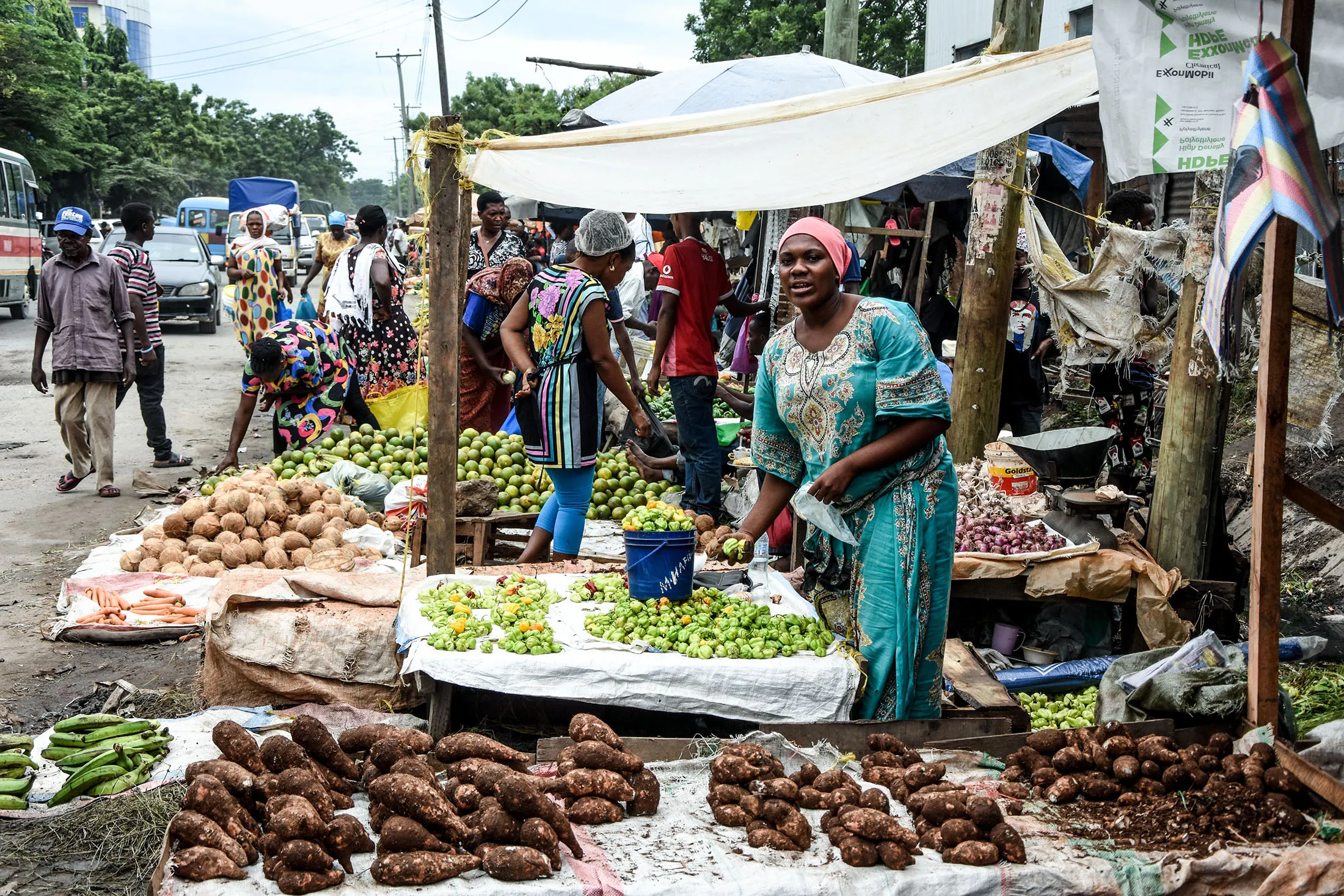
One of the report’s strongest findings is that Tanzania’s employment problem is not primarily about the number of people working. The employment to population ratio was 68.7% in 2024, meaning more than two in three working age Tanzanians were employed. The World Bank says this is among the highest employment ratios in the world.
The problem is the quality of the work. Median hourly earnings are just TZS 1,005, while most workers are either own account workers or contributing family workers. Employees account for only 8% of the workforce.
Tanzania therefore has a labour market that is very effective at absorbing people into economic activity, but far less effective at moving them into work that pays well, offers stability and produces high output per worker.
3. Around 95% of Employment Is Informal
Informality deepened from about 93% of employment in 2020 to around 95% in 2024 because the working age population expanded faster than the formal job base.
This matters because informal work is commonly associated with lower productivity, weaker social protection, lower tax participation and greater vulnerability to economic shocks. The World Bank notes that high quality jobs contribute far more strongly to public finances, with 96% of holders paying income tax compared with only 7% of regular job holders.
The issue is not simply whether workers have registration papers. Tanzania needs productive formalisation, where firms become large and productive enough to pay better wages and offer more stable employment.
4. Agriculture Still Employs More Than Half of Tanzanians
Agriculture employs 54% of the workforce, making it the largest source of employment by a wide margin. Services account for around one third, while industry employs roughly one in ten workers.
The sector’s size means Tanzania cannot raise national productivity without raising agricultural productivity. Millions of Tanzanians will continue to depend on farming for years, so better seeds, irrigation, mechanisation, fertilizer access, storage, logistics and agro processing are not only agricultural policies. They are jobs and income policies.
A country where more than half the workforce remains in low return agriculture will struggle to raise average incomes quickly unless productivity inside the sector improves substantially.
5. Good Jobs Are Extremely Rare
Using a strict definition that combines decent pay, a written contract, social security and reasonable job security, the World Bank estimates that only about 550,000 of Tanzania’s roughly 26 million jobs qualify as high quality. Only about 120,000 of those are in the private sector.
The report also finds that the strongest private sector jobs are overwhelmingly formal, urban and concentrated in larger firms. About 98% of the highest quality private sector jobs are in formal enterprises, 96% are in urban areas and 96% are in firms with at least five employees. Nearly half are located in Dar es Salaam.
This shows why the structure of the private sector matters so much. Tanzania will not create enough good jobs if the overwhelming majority of firms remain very small and low productivity.
6. Two Million Tanzanians Reach Working Age Every Year
The demographic pressure is enormous. The World Bank estimates that around two million Tanzanians reach working age every year, while only about 400,000 leave the working age population through retirement or premature mortality.
That does not mean Tanzania must create two million formal jobs annually, but it does mean the economy has to absorb a rapidly expanding workforce. If firm growth, productivity and formal employment remain weak, most new workers will continue entering agriculture, self employment and informal services.
The demographic opportunity becomes valuable only when the economy can place growing numbers of people into more productive work.
7. Too Few New Firms Are Being Created
Only 12% of Tanzania’s formal firms were classified as young firms in 2023, meaning they had started operating after 2018. Rwanda’s equivalent share was 38%, while Ghana’s was 26%.
The comparison suggests Tanzania’s private sector is producing too few new formal firms. Entry also remains informal for many businesses: 32% of firms reported beginning operations without registration, up from 25% in 2013.
The World Bank acknowledges that business registration rules have improved substantially, with Tanzania scoring strongly in the 2025 Business Ready assessment. Yet the actual process can still be time consuming and costly, particularly for foreign investors.
Tanzania therefore appears to have improved the legal framework faster than the actual rate at which productive new firms are entering the economy.
8. Tanzanian Firms Are Investing Much Less Than Before
One of the most serious findings in the report is the collapse in firm level investment. The World Bank says the average Tanzanian firm now invests only 11% of what it did a decade ago. Technology adoption, research spending and innovation also trail regional peers.
This matters because firms raise productivity through investment. Machinery, software, factories, new production methods and product development determine how much value workers can produce. An economy can continue growing for a period through population expansion, construction and government spending, but long term income growth requires private firms to become more productive. Weak investment therefore sits directly behind Tanzania’s jobs quality problem.
9. Access to Finance and Land Is Still Holding Businesses Back
The World Bank finds that one in three firms is credit constrained and that 58% of large firms identify access to land as a major obstacle.
This is important because Tanzania’s banking system is not weak in aggregate. Private sector credit was growing by 28.1% year on year in June 2026, while non performing loans remained below the prudential ceiling.
The problem is therefore not simply the total volume of bank lending. Businesses need the right kind of capital, particularly long term financing for machinery, factories and expansion. They also need land that can be acquired, transferred and developed with legal certainty. Without these conditions, businesses can survive without scaling.
10. Skills Are Not Matching the Economy Tanzania Wants to Build
The World Bank estimates that learning adjusted schooling among Tanzanian adults averages only about 4.5 years. More than half of workers face both low readiness and limited market opportunities, while only around 40% of secondary school age children are enrolled.
The report finds that education has a direct effect on earnings and business performance. Workers with lower secondary education earn 22% to 30% more in formal private sector jobs than those with only primary education, while entrepreneurs with stronger basic education are much more likely to hire paid workers.
Tanzania’s labour market problem is therefore not solved simply by creating vacancies. Workers need stronger foundational education, technical skills, credentials and better information connecting them to available opportunities.
What Is the World Bank Really Saying About Tanzania?
The report does not describe Tanzania as an economy in crisis. Quite the opposite. Growth is strong, inflation is contained, government revenue has performed well and public debt remains moderate at around 49% of GDP. Its warning is more structural.
Tanzania has demonstrated that it can grow. It has also demonstrated that it can keep a large share of its population economically active. The next challenge is much harder: making businesses more productive, making workers more skilled and making employment more rewarding.
The country’s economic success over the next two decades will therefore depend less on whether GDP remains above 6% and more on whether that growth changes the productivity of the average Tanzanian worker.
If firms continue investing less, if informality remains close to 95% and if most new workers enter low return activities, Tanzania can become a much larger economy without becoming proportionately richer at household level.
If firm investment rises, new businesses enter faster, agriculture becomes more productive and workers acquire stronger skills, the same 6% growth rate can produce a very different result.
The World Bank’s message is ultimately simple: Tanzania does not need only more economic activity. It needs more productive economic activity.
FAQ
What is the main message of the World Bank’s Tanzania report? The report argues that Tanzania’s main employment problem is job quality rather than job quantity. Most working age people are employed, but many work in low productivity and low income activities.
How fast is Tanzania’s economy growing? The World Bank estimates growth of 5.9% in 2025 and projects 6.1% in 2026, rising to around 6.5% over the medium term.
What percentage of Tanzania’s employment is informal? The World Bank estimates that informality reached around 95% of employment in 2024.
How many Tanzanians reach working age each year? Around two million Tanzanians reach working age annually, while roughly 400,000 leave the working age population.
How many high quality jobs does Tanzania have? The World Bank estimates that only about 550,000 of roughly 26 million jobs clearly meet its high quality criteria, with around 120,000 in the private sector.
What does the World Bank recommend Tanzania focus on? The report emphasises stronger firms, more investment, easier business entry and exit, long term finance, better land access, stronger education and skills, labour market information and social protection that helps workers move into better jobs.
 Uchumi360
Business Intelligence
Uchumi360
Business Intelligence
Uchumi360 covers business, investment, and economic policy across East, Central, and Southern Africa.
For the serious reader
You read to the end. That places you in a small group.
Uchumi360 is built for readers who demand precision over speed, structure over sentiment, and analysis that holds uncomfortable conclusions rather than softening them. If this work sharpens how you think about Africa's economy, help us keep building the infrastructure behind it.
Institutional Partners
Commission intelligence. Shape the conversation.
Uchumi360 works with development finance institutions, investment firms, sovereign bodies, and strategic organisations across the coverage region. Institutional partnership unlocks:
- Commissioned sector and country intelligence reports
- Branded research series under your institution's authority
- Exclusive data briefings for internal strategy teams
- Speaking and editorial presence at Uchumi360 events
- Co-published investment outlooks for your markets
Support Our Work
Independent analysis has a cost. Help us bear it.
Uchumi360 does not carry advertising. It does not take editorial direction from sponsors. Every article is produced without commercial compromise. Your contribution funds the reporting, research, and editorial infrastructure that keeps this analysis free from influence.
Secure checkout: One-time and monthly support are processed securely. Add payment credentials to enable checkout here.
Stay Connected
Keep up with every new insight.
Follow our latest analysis, policy coverage, and market intelligence as soon as it is published. If you need something specific, reach out directly and we will point you to the right research.
