
World Bank Report: Tanzania’s 6% Growth Is Barely Reducing Poverty
Ready
Tanzania has averaged 5.7% economic growth for two decades and is projected to grow 6.1% in 2026. Yet poverty has barely moved since 2018 and real private consumption per person grew only 0.2% annually between 2018 and 2025. The World Bank’s latest report explains why productivity is now the central economic challenge.
Tanzania has spent much of the past two decades among Africa’s faster growing economies, averaging about 5.7% real GDP growth a year. The World Bank expects growth to reach 6.1% in 2026 and average around 6.5% over the medium term. Yet its latest Tanzania Economic Update: Making Jobs Work presents a much less comfortable measure of economic progress: the share of Tanzanians living below the $4.20 a day poverty line is estimated at 69.8% in 2026, barely below 70% in 2018, while real private consumption per person increased by an average of only 0.2% a year between 2018 and 2025. Tanzania is producing considerably more economic output, but that expansion is translating into household welfare far more slowly than the headline growth rate would suggest. World Bank
The World Bank does not argue that Tanzania’s growth is artificial. The economy expanded by 5.9% in 2025, inflation remained within the Bank of Tanzania’s 3% to 5% target range, domestic revenue exceeded budget projections and public debt remained moderate at about 49% of GDP. These are meaningful macroeconomic strengths. The report instead raises a more difficult question about the quality of growth. Tanzania has generated activity, investment and employment, but productivity gains have been insufficient to produce equally strong improvements in incomes. The Bank says growth over the past two decades has been driven primarily by accumulation of resources rather than productivity advances, while productive employment, agricultural productivity and human capital have yet to shift sufficiently to change the poverty trajectory. World Bank
This may be the most important economic message in the entire report. Tanzania’s next development problem is no longer simply how to maintain 6% growth. It is how to make 6% growth produce substantially larger gains in income per worker and consumption per household.
Why Has Tanzania’s Strong GDP Growth Reduced Poverty So Slowly?
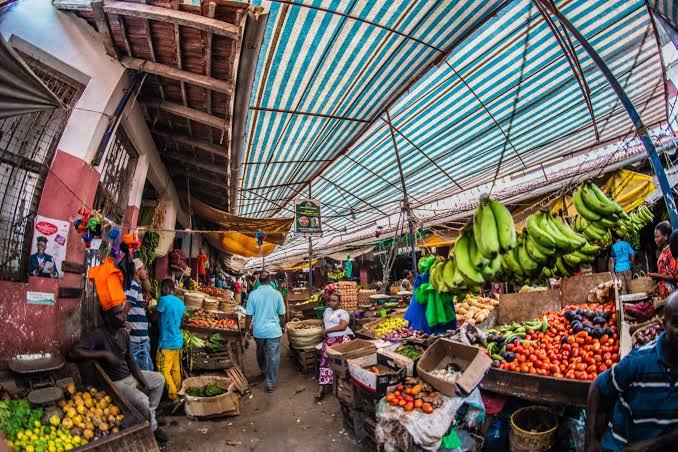
The disconnect begins with the type of work most Tanzanians perform. Nearly 69% of working age Tanzanians are employed, one of the highest employment ratios globally, yet the median hourly income from work is only TZS 1,005. Agriculture still employs 54% of workers, 75% are own account workers and another 17% are contributing family workers. Employees make up only 8% of the workforce. Tanzania therefore has a large working population, but much of that labour is concentrated in activities that produce relatively little income per worker. World Bank
A household does not experience GDP through the national accounts. It experiences the economy through wages, business income, agricultural earnings, prices and access to public services. If GDP rises because more people are working, more land is cultivated, government spending expands or capital projects are constructed, national output increases. Household incomes rise much faster when each worker also becomes more productive.
The difference is central to Tanzania’s recent development pattern. Adding another worker to a low productivity activity increases aggregate production but can leave output per person almost unchanged. A smallholder farming an additional piece of land increases GDP, but poverty falls much faster when yields per hectare, market access and farm income rise. A new informal trader adds economic activity, but household welfare improves far more when the business gains capital, expands sales and begins employing others.
Tanzania’s growth has therefore been stronger in aggregate than in conversion. The economy has become larger faster than the average household has become richer.
What Does 0.2% Consumption Growth Tell Us About Living Standards?
Average real private consumption per capita increased by only 0.2% annually between 2018 and 2025, according to the World Bank. That figure gives the GDP discussion a household dimension because consumption measures the goods and services people are actually able to purchase after accounting for inflation. World Bank
The contrast with headline GDP growth is stark. An economy expanding around 5% or 6% annually while consumption per person barely increases is telling us that the gains from aggregate growth are not reaching households at the same pace. Population growth explains part of the difference, because total GDP must rise faster simply to increase output per person in a rapidly expanding population. The structure of employment explains another part, because much of Tanzania’s labour force remains in activities with low returns.
This is why per capita indicators matter. Tanzania can add billions of shillings to national output while also adding millions of people to the population. What determines living standards is how much additional output is available per person and how broadly the income generated by that production is distributed through wages, profits and farm incomes.
The 0.2% consumption figure does not mean Tanzanians are universally no better off than in 2018. Household experiences vary considerably by location, occupation and income. It does show that the average improvement in consumption has been remarkably slow relative to the pace of national economic expansion.
Are Tanzania’s Jobs Too Unproductive to Reduce Poverty Faster?
The World Bank’s strongest explanation is job quality. Tanzania has work, but too little of it generates enough productivity and income to pull households rapidly upwards.
Using a strict definition combining decent pay, a written contract, social security and reasonable job security, the Bank estimates that only about 550,000 of Tanzania’s roughly 26 million jobs can be clearly classified as high quality. Only around 120,000 of those are in the private sector. World Bank
The scarcity is important because better jobs transmit economic growth directly into household welfare. Workers receiving higher and more stable incomes consume more, save more, invest more in children and become less vulnerable to shocks. Formal high quality employment also strengthens public finances: the report estimates that 96% of holders of the highest quality jobs pay income taxes, compared with only 7% of regular job holders. World Bank
A low productivity labour market weakens this transmission. When most workers are self employed in subsistence or very small commercial activities, economic growth can occur without wages rising strongly. Productivity becomes the missing bridge between output and poverty reduction.
Why Has Agriculture Not Converted Growth Into Higher Rural Incomes?
Agriculture matters disproportionately because it employs more than half of Tanzania’s workforce. Any strategy for accelerating poverty reduction must therefore improve the productivity of people already working in agriculture rather than relying exclusively on workers moving into cities and formal employment.
The World Bank identifies input market inefficiencies, fertilizer access and broader productivity constraints as continuing problems. Tanzania also imports about 40% of its fertilizer from Gulf countries, making agricultural costs vulnerable to energy and shipping disruptions. Higher global input prices can therefore reduce farm margins even when domestic production remains relatively strong.
The poverty consequences are direct. A large share of lower income Tanzanians depend on agriculture both for income and food consumption. Productivity gains in farming can raise household income, reduce food costs, release labour into more productive sectors and create additional activity in storage, transport and agro processing. Weak productivity does the opposite: large numbers of people remain economically active without generating enough surplus to accumulate assets or finance significant improvements in living standards.
Tanzania’s poverty story is therefore partly an agricultural productivity story.
Why Are Firms Not Generating More Income Growth?
The report finds similar productivity constraints inside Tanzania’s formal private sector. Labour productivity among firms with at least five employees is estimated to be about 49% lower in services and 70% lower in manufacturing than the average among Sub Saharan African comparator economies. Businesses producing less value per employee have less room to pay higher wages while remaining profitable. World Bank
The weakness extends into investment. The share of firms buying fixed assets fell from 40% in 2013 to 22% in 2023, while average firm investment declined from about $116,000 to $24,000 in constant 2009 dollars. The World Bank estimates that the average firm now invests only 11% of what it did a decade earlier. Technology adoption, research spending and product innovation also trail regional comparators.
This creates a reinforcing cycle. Low productivity limits profits and wages. Low investment slows improvements in productivity. Weak productivity then constrains the ability of firms to grow, hire and pay more.
If Tanzania wants GDP growth to reach households more strongly, firm productivity becomes one of the main transmission mechanisms. A worker moving into a business that produces considerably more value per employee can earn substantially more than the same worker remaining in a survival activity.
Why Are So Few Productive Firms Emerging?
Only 12% of Tanzania’s formal firms were classified as young firms in 2023, compared with 38% in Rwanda and 26% in Ghana. Among formal firms younger than five years, just 20% had above median productivity, roughly half the share found among comparator economies. World Bank
The numbers suggest that Tanzania needs not only more businesses but more productive businesses. An economy can create thousands of micro enterprises without producing a large rise in productivity if most remain very small, operate in identical low margin markets and employ few people.
Dynamic private sectors continually produce new firms, allow successful companies to scale and permit unsuccessful ones to exit so that labour and capital can move elsewhere. Tanzania’s report identifies obstacles at every stage: registration and licensing remain cumbersome in practice, insolvency mechanisms are weak, long term finance is scarce and land access remains difficult for many larger firms.
The consequence eventually reaches households. Fewer growing firms mean fewer opportunities for workers to move from low productivity activities into businesses capable of paying higher incomes.
Is Tanzania’s Growth Too Dependent on Government Spending?
The composition of 2025 growth adds another dimension. Public expenditure accounted for more than two thirds of real GDP growth during the year, considerably above its average contribution during the preceding period. Recurrent expenditure also increased ahead of the October 2025 elections. World Bank
Government spending can support growth and provide essential infrastructure and services. The question is whether it creates enough productive private activity to sustain growth after the expenditure occurs. A government financed road contributes directly to GDP during construction, but its larger economic return comes later if firms use it to lower transport costs, reach markets and expand production. Education spending matters when improved learning raises future worker productivity. Electricity infrastructure produces a stronger economic return when manufacturers and commercial users invest around it.
The World Bank expects Tanzania’s growth to rise towards 6.5% over the medium term on the assumption of stronger private sector activity. That assumption is important. Sustained poverty reduction becomes much harder if future growth continues to rely heavily on government expenditure without an accompanying increase in private investment and productivity.
Public spending builds the platform. Private activity has to use it.
Why Does Population Growth Make Poverty Reduction Harder?
Tanzania’s population structure raises the hurdle for converting GDP growth into higher living standards. About two million Tanzanians reach working age each year while only around 400,000 leave it. World Bank
A rapidly expanding working age population can become a powerful source of growth if new workers enter productive employment. It can also dilute improvements in average income if the economy creates low productivity work faster than it creates high productivity work.
The same logic applies at household level. GDP may grow 6%, but if population expands rapidly, the increase in GDP per person is substantially smaller. If the additional workers then enter activities with low returns, household consumption can increase even more slowly.
Tanzania therefore needs productivity growth not only because it wants to become richer, but because population growth constantly raises the amount of output required merely to improve average living standards.
Why Human Capital Is an Economic Growth Constraint
The report identifies human capital as one of the strongest long term determinants of whether Tanzania can change this pattern. Learning adjusted schooling among Tanzanian adults averages only about 4.5 years, while only around 40% of secondary school age children are enrolled. Large numbers of workers therefore enter the labour market without the educational foundation required for more productive employment.
The World Bank finds that workers with lower secondary education earn between 22% and 30% more in formal private sector jobs than workers with only primary education. Entrepreneurs with stronger foundational education are also more likely to hire workers, while technical training produces substantially higher earnings gains among people who already possess basic education.
Education therefore affects poverty through both sides of the labour market. Better educated workers can perform more productive jobs, while better educated entrepreneurs are better positioned to build businesses that create those jobs.
The report’s recommendation that human capital should be treated as a major public spending priority is therefore an economic argument rather than only a social one. Tanzania cannot continuously upgrade its production structure while large parts of the future workforce enter employment with weak foundational skills.
Why 6% Growth Still Matters
None of this makes Tanzania’s growth record irrelevant. Sustained growth creates the resources needed to improve infrastructure, education, health and private investment. A stagnant economy would make every problem described in the report more difficult.
The danger lies in treating the growth rate as the outcome rather than the input.
Six percent GDP growth can create the conditions for poverty reduction, but it does not guarantee it. The conversion happens through productivity, wages, profitable businesses, commercial agriculture, human capital and public services. Tanzania’s experience shows that a country can maintain impressive aggregate growth while those mechanisms strengthen much more slowly.
The objective should therefore not be to replace the growth agenda with a redistribution agenda. It is to deepen the growth model so that productivity becomes a larger source of expansion.
What Would Make Tanzania’s Growth Reach Households Faster?
The World Bank’s recommendations form a connected productivity agenda. Firms need easier entry and exit, more predictable regulation, secure access to land and more long term investment finance. Workers need stronger foundational education, relevant skills, better information about employment and social protection that allows them to move between livelihoods without catastrophic income loss. Agriculture needs higher productivity, while businesses need stronger incentives to invest, adopt technology and scale.
These reforms converge on one economic objective: increasing the value produced by each worker. If agricultural workers produce more per hectare, rural income rises. If manufacturers produce more per employee, firms gain room to increase wages and exports. If micro enterprises grow into larger businesses, workers gain access to more formal employment. If education raises worker capability, companies can adopt more sophisticated production methods.
Poverty then falls because the economy is producing higher incomes, not simply because more economic activity is being recorded.
The World Bank’s report therefore changes the most useful question about Tanzania’s economy. The question is no longer whether 6% growth is good. It clearly is.
The question is why twenty years of strong growth have not yet translated into equally strong improvements in household welfare, and what must change so that the next twenty years do.
Tanzania has already demonstrated that it can grow. Its next economic test is whether it can make that growth reach the Tanzanian household. GDP measures how much an economy produces. Development is ultimately measured by how much that production changes the lives of the people inside it.
FAQ
How fast is Tanzania’s economy growing? The World Bank estimates Tanzania grew by 5.9% in 2025 and projects growth of 6.1% in 2026, rising to an average of around 6.5% over the medium term. World Bank
Has poverty fallen significantly in Tanzania? The World Bank estimates that the share of Tanzanians living below the $4.20 a day poverty line declined only marginally, from 70% in 2018 to 69.8% in 2026. World Bank
How much has household consumption increased? Average real private consumption per person grew by only about 0.2% annually between 2018 and 2025, according to the World Bank. World Bank
Why is Tanzania’s GDP growth not reducing poverty faster? The report points to low productivity employment, weak agricultural productivity, limited firm investment, widespread informality and human capital constraints as reasons growth is translating slowly into higher household incomes.
How many Tanzanians have high quality jobs? Using a strict measure combining adequate pay, a written contract, social security and job security, the World Bank estimates about 550,000 of roughly 26 million jobs qualify as high quality. Only around 120,000 are in the private sector. World Bank
What does the World Bank recommend for Tanzania? The report emphasises higher firm productivity, stronger investment, better access to long term finance, improved human capital, more productive agriculture, better labour market systems and reforms that allow productive firms to enter and expand.
 Uchumi360
Business Intelligence
Uchumi360
Business Intelligence
Uchumi360 covers business, investment, and economic policy across East, Central, and Southern Africa.
For the serious reader
You read to the end. That places you in a small group.
Uchumi360 is built for readers who demand precision over speed, structure over sentiment, and analysis that holds uncomfortable conclusions rather than softening them. If this work sharpens how you think about Africa's economy, help us keep building the infrastructure behind it.
Institutional Partners
Commission intelligence. Shape the conversation.
Uchumi360 works with development finance institutions, investment firms, sovereign bodies, and strategic organisations across the coverage region. Institutional partnership unlocks:
- Commissioned sector and country intelligence reports
- Branded research series under your institution's authority
- Exclusive data briefings for internal strategy teams
- Speaking and editorial presence at Uchumi360 events
- Co-published investment outlooks for your markets
Support Our Work
Independent analysis has a cost. Help us bear it.
Uchumi360 does not carry advertising. It does not take editorial direction from sponsors. Every article is produced without commercial compromise. Your contribution funds the reporting, research, and editorial infrastructure that keeps this analysis free from influence.
Secure checkout: One-time and monthly support are processed securely. Add payment credentials to enable checkout here.
Stay Connected
Keep up with every new insight.
Follow our latest analysis, policy coverage, and market intelligence as soon as it is published. If you need something specific, reach out directly and we will point you to the right research.
