
Africa Agriculture Outlook: With Growing Population and Urbanisation, Will Africa Be Able to Feed Its Population in the Next Century?
Ready
The next century will punish agricultural romanticism. Speeches about fertile land will not feed cities. Slogans about youth will not irrigate farms. Import bans will not create productivity. Subsidies without systems will not build resilience. Food security will come from disciplined investment, hard infrastructure, science, private capital, farmer organisation and regional markets.
Africa’s food question is no longer whether the continent has enough land. It is whether it has enough productive systems.
The continent has the natural assets, demographic energy and market size to feed itself and potentially become one of the world’s most important food suppliers. But on its current trajectory, Africa risks becoming a larger food market before it becomes a stronger food producer. That is the central economic tension of African agriculture in the 21st century.
The continent’s population is rising faster than any other region’s. According to analysis based on United Nations population projections, Africa’s population is expected to reach about 3.8 billion people by 2100 under the medium-variant scenario. Today, about 28% of the world’s people under 25 live in Africa, and by 2100 that share is projected to rise to 46%. That means Africa’s food system is not being asked to feed a static population. It is being asked to feed the world’s youngest, fastest-growing and increasingly urban consumer base.
That would be difficult even for a highly mechanised, irrigated, integrated food economy. Africa is not yet that.
The continent’s food-security position is already fragile. The 2025 State of Food Security and Nutrition in the World report by the Food and Agriculture Organization, International Fund for Agricultural Development, United Nations Children’s Fund, World Food Programme and World Health Organization shows that global hunger declined modestly in 2024, but continued rising in most subregions of Africa and western Asia. Globally, about 673 million people experienced hunger in 2024, yet Africa moved against the improving global trend. Food-price inflation, conflict, climate shocks and weak purchasing power remain central drivers.
That is the first hard truth: Africa’s agricultural challenge is not merely production. It is affordability.
A continent can produce food and still have hungry people if distribution is weak, household incomes are low, post-harvest losses are high, urban food prices are volatile, conflict disrupts supply, and imports expose consumers to currency and global price shocks. Feeding Africa is therefore not only a farming question. It is a systems question: production, storage, processing, logistics, energy, finance, trade, nutrition, climate resilience, land governance and income.
The demographic pressure is enormous. The Organisation for Economic Co-operation and Development and the Food and Agriculture Organization project that Sub-Saharan Africa’s population will reach about 1.5 billion by 2033, accounting for 17% of the world’s population. Urbanisation is accelerating: half of the region’s population could live in urban areas by 2033, up from 43% in the 2021–2023 base period and only 32% two decades earlier. At the same time, the rural population is still growing in absolute terms.
This creates a double demand shock. Africa will have more urban consumers demanding processed, convenient, diverse and protein-rich foods. It will also have more rural households needing viable farm incomes, land access and productivity improvements. If agriculture does not modernise, cities will import more food, rural poverty will persist, and governments will spend more foreign exchange stabilising food markets.
The current productivity picture is not strong enough. The Organisation for Economic Co-operation and Development and Food and Agriculture Organization note that Sub-Saharan Africa holds 19% of the world’s agricultural land but accounts for only 7% of global agricultural output value. That gap is the region’s food challenge in one statistic. Africa has land. It lacks yield, irrigation, mechanisation, logistics, finance, research systems and value-chain depth at the scale required.
The African Development Bank has long warned that rising food demand and changing consumption patterns driven by population growth and urbanisation are pushing Africa toward rapidly rising net food imports. That import growth is not only a trade issue. It is a sovereignty issue. A continent that imports too much of its wheat, rice, edible oils, poultry inputs, fertilizer, processed foods and animal feed becomes vulnerable to currency depreciation, wars, export bans, shipping disruptions and global commodity speculation.
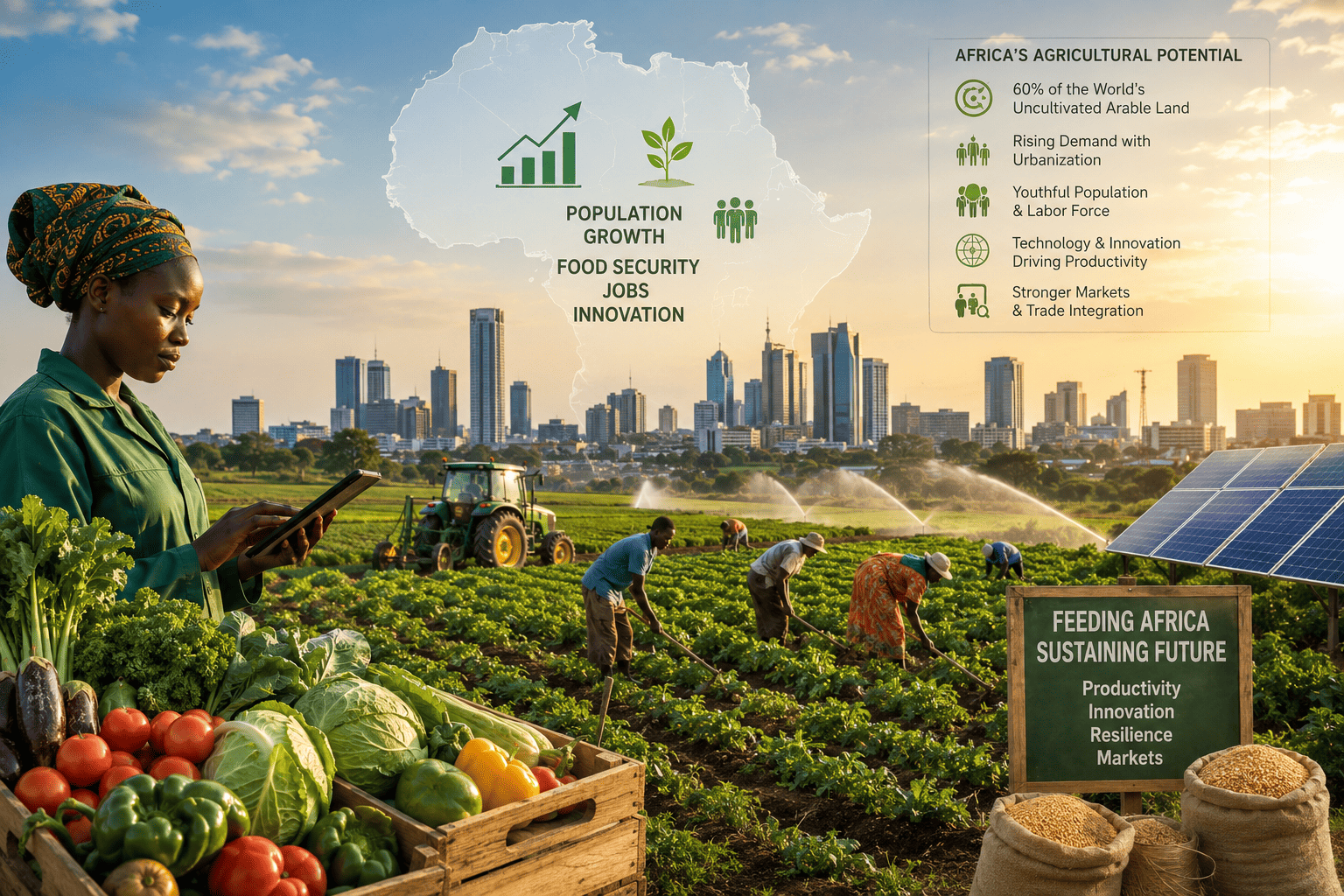
The continent’s agricultural paradox is sharp. Africa holds roughly 60% of the world’s uncultivated arable land, according to the Food and Agriculture Organization’s Africa office, yet many of its countries are net food importers. This does not mean Africa should simply clear more land. That would be economically lazy and environmentally dangerous. The future of African food security cannot be built on horizontal expansion alone. It must be built on productivity, water control, soil health, climate-smart farming, better seeds, storage, processing and efficient markets.
The irrigation gap is one of the clearest constraints. World Bank work has estimated that more than 95% of cultivated land in Sub-Saharan Africa is rain-fed, and less than 5% benefits from agricultural water-management practices. Older World Bank analysis puts irrigated area as only about 6% of cultivated land in Africa, compared with 37% in Asia. This is one reason the Green Revolution largely bypassed Africa.
Rain-fed farming is not inherently backward, but it is highly exposed. Climate change is making rainfall less predictable. Droughts, floods, heat stress and shifting growing seasons are damaging yields and increasing risk. A farmer who depends entirely on rainfall cannot plan production with the same confidence as one connected to irrigation, weather data, water harvesting, drought-resistant seeds and insurance.
Climate change is now the structural risk in African agriculture. It affects rainfall, pests, disease, livestock health, soil moisture, water availability, fish stocks and rural migration. It also makes food inflation more politically dangerous. When a drought hits a major producing region, urban consumers feel it through higher prices. When floods destroy roads, farmers cannot reach markets. When heat reduces labour productivity, planting and harvesting suffer. Climate change turns agriculture from a rural-sector issue into a macroeconomic risk.
Soil fertility is another constraint. Much of African agriculture is conducted on soils that require careful fertility management, but fertilizer use remains low in many countries because of cost, availability, credit constraints and weak extension. Organic matter depletion, erosion and nutrient mining reduce productivity over time. The solution is not simply more fertilizer; it is smarter soil management: soil testing, balanced fertilizer, organic matter, compost, legumes, liming where needed, water retention and locally adapted agronomy.
Finance remains a binding constraint. Most African farmers are smallholders, and many operate without affordable credit, crop insurance, storage finance or reliable input financing. Banks often view agriculture as risky because weather, price volatility and land tenure uncertainty make repayment less predictable. Yet without finance, farmers cannot buy improved seed, fertilizer, irrigation equipment, mechanisation services or storage. The result is a low-investment trap: low finance leads to low productivity, which leads to low income, which reinforces low finance.
Infrastructure is equally decisive. Food must move. Roads, cold chains, warehouses, storage facilities, ports, rail, power and market centres are part of food security. A continent-wide study of food-market accessibility using open data found that rural and poorer populations face higher travel times, limited market access and weaker market redundancy. That means food insecurity is not only about production volume. It is also about physical access to markets.
Post-harvest loss is another underpriced crisis. Food can be produced and still lost before it reaches consumers because of poor storage, pests, weak cold chains, delayed transport, lack of processing, and poor packaging. The Organisation for Economic Co-operation and Development and Food and Agriculture Organization estimate that halving food loss and waste by 2030 could reduce global agricultural greenhouse-gas emissions by 4% and cut the number of undernourished people by 153 million. For Africa, reducing losses is one of the fastest ways to increase effective food supply without expanding land.
The urbanisation shift changes the entire food economy. Urban consumers do not only demand raw maize, cassava, rice or beans. They demand bread, dairy, poultry, eggs, fruit juice, cooking oil, snacks, meat, fish, vegetables, processed foods, ready-to-cook products and reliable food safety. This creates a major opportunity for agro-processing, packaging, cold chains, supermarkets, digital food distribution, restaurants and logistics companies. But if African producers and processors fail to meet this demand, imports will fill the shelves.
That is already happening in many markets. African countries export cocoa, coffee, cashew, sesame, tea, fish, fruits and vegetables, but often import processed food, wheat, rice, milk powder, cooking oils, poultry feed, sugar products and packaged consumer goods. The continent is still too often selling agricultural raw material and buying finished food value. This is not food security. It is value-chain leakage.
The livestock and protein challenge deserves special attention. As incomes rise and cities grow, demand for meat, dairy, eggs and fish usually increases. Africa’s livestock systems are culturally and economically important, but they face feed shortages, disease pressure, weak veterinary systems, low productivity and climate stress. If the continent does not build stronger feed industries, animal health systems, pasture management, cold chains and processing, it will import more animal protein and feed inputs.
Fisheries and aquaculture also matter. Africa’s lakes, rivers and coastlines are major food sources, but overfishing, illegal fishing, pollution and climate change threaten supply. Aquaculture has potential, but it requires feed, hatcheries, water management, disease control and market systems. A food-secure Africa cannot rely only on crops.
The policy problem is that agriculture is often treated as a poverty sector rather than an industrial sector. Governments promise to support farmers, but budgets frequently underfund research, extension, irrigation maintenance, rural roads, storage and market systems. Too many interventions are seasonal and political: input subsidies before elections, export bans during shortages, price controls during inflation and ad hoc imports during crises. These may provide short-term relief, but they do not build a food system.
Africa needs a different agricultural state: one that treats food as strategic infrastructure.
This means predictable investment in research institutions, seed systems, irrigation, rural roads, storage, power, market information, insurance, quality standards and food safety. It means making farming profitable enough for young people to enter it as entrepreneurs, not as a last resort. It means shifting from subsistence farming to commercial smallholder systems, cooperative aggregation, medium-scale farming, contract farming, agro-processing and regional food trade.
The opportunity is large. Africa has land, water basins, young labour, local food knowledge, urban demand and regional markets. The African Continental Free Trade Area can help build continental food value chains if countries stop using borders as food-security panic buttons. A drought in one country should be cushioned by surplus in another. A maize surplus in Tanzania, Zambia or Uganda should move efficiently to deficit markets. Rice, wheat, dairy, poultry, horticulture, fish, livestock and processed foods should be part of regional trade strategy, not only national self-sufficiency campaigns.
But continental trade will not work without standards, logistics and trust. Countries impose export bans because they fear domestic shortages. Traders avoid formal routes because borders are expensive. Farmers lose value because grading and storage are weak. Processors import because regional supply is inconsistent. The food market is regional in logic but still national in policy.
There are lessons from other continents.
Asia’s Green Revolution shows the power of state-backed productivity: improved seeds, irrigation, fertilizer, extension, rural roads, procurement systems and agricultural research. But Africa should not copy Asia blindly. Asia’s model delivered food security in many countries but also caused groundwater depletion, chemical overuse, biodiversity loss and unequal benefits in some regions. Africa needs an African Green Revolution that is more climate-smart, water-efficient and nutrition-sensitive.
Latin America shows the power and risk of commercial agriculture. Brazil turned the Cerrado into one of the world’s major agricultural production zones through research, soil correction, mechanisation, logistics and agribusiness development. But the Latin American lesson also includes deforestation, land concentration and environmental conflict. Africa should learn the productivity lesson without importing the ecological damage.
Europe shows how policy can stabilise farmers and food supply through subsidies, standards and rural development. But Europe’s model is expensive and difficult for African budgets to replicate. The lesson is not to copy the Common Agricultural Policy. It is to understand that agriculture needs predictable rules, quality standards, farmer support and market institutions.
North America shows the power of scale, technology, mechanisation, storage, futures markets, insurance and logistics. But Africa’s farm structure is different. The continent cannot simply leap into large-scale mechanised agriculture everywhere. It needs a mixed model: productive smallholders, commercially viable medium-scale farms, responsible large-scale investment, and strong agro-processing.
The Middle East and North Africa show the danger of structural food-import dependence. Some countries have high incomes and can afford imports; many African economies cannot. Depending heavily on imported wheat, rice or edible oils without strong foreign-exchange buffers exposes countries to global shocks. The lesson is clear: trade is necessary, but import dependence without domestic and regional production capacity is dangerous.
The answer to whether Africa can feed itself over the next century is therefore conditional.
Africa can feed itself if productivity rises faster than population, if food systems become climate-resilient, if rural infrastructure improves, if irrigation expands intelligently, if post-harvest losses fall, if agro-processing grows, if regional trade becomes functional, if farmers gain finance, and if governments treat agriculture as strategic economic infrastructure.
Africa may fail to feed itself if it continues with low yields, rain-fed exposure, fragmented markets, conflict, weak public investment, poor storage, climate vulnerability, land governance problems, low farmer finance, and urban food systems increasingly supplied by imports.
The future will not be decided by land availability. It will be decided by productivity per hectare, income per farmer, calories per dollar, nutrition per household, storage per harvest, water per crop, roads per producing zone, and processing capacity per region.
The continent’s agricultural future should be organised around ten economic priorities.
First, raise yields without destroying ecosystems. Africa must close productivity gaps through improved seeds, soil health, fertilizer efficiency, mechanisation services, extension and data.
Second, build water control. Irrigation, water harvesting, groundwater governance, small dams, solar pumps and climate-smart water systems must become core agricultural infrastructure.
Third, reduce post-harvest losses. Storage, cold chains, warehouses, packaging and processing can increase food supply without expanding farmland.
Fourth, finance farmers and agribusinesses. Credit, insurance, warehouse receipts, input finance and equipment leasing must become normal features of African agriculture.
Fifth, make regional trade work. The continent needs fewer food export bans, better standards, faster borders and stronger cross-border logistics.
Sixth, industrialise food. Agro-processing should be treated as manufacturing, not as a side activity of farming.
Seventh, protect land rights. Farmers invest when they have secure rights, transparent leases and fair dispute systems.
Eighth, build climate resilience. Seeds, irrigation, insurance, early-warning systems and adaptive extension must respond to drought, floods and heat.
Ninth, make agriculture attractive to youth. Technology, finance, mechanisation, processing, logistics and digital platforms can turn agriculture into business.
Tenth, make nutrition central. Feeding Africa is not only about calories. It is about healthy diets: proteins, fruits, vegetables, pulses, dairy, fish and micronutrients.
The continent’s food future is therefore neither doomed nor guaranteed. Africa has enough assets to feed itself. It also has enough structural weaknesses to fail if policy remains shallow.
The next century will punish agricultural romanticism. Speeches about fertile land will not feed cities. Slogans about youth will not irrigate farms. Import bans will not create productivity. Subsidies without systems will not build resilience. Food security will come from disciplined investment, hard infrastructure, science, private capital, farmer organisation and regional markets.
Africa can feed its population. But only if it stops treating agriculture as tradition and starts treating it as the continent’s largest unfinished industry.
 Uchumi360
Business Intelligence
Uchumi360
Business Intelligence
Uchumi360 covers business, investment, and economic policy across East, Central, and Southern Africa.
For the serious reader
You read to the end. That places you in a small group.
Uchumi360 is built for readers who demand precision over speed, structure over sentiment, and analysis that holds uncomfortable conclusions rather than softening them. If this work sharpens how you think about Africa's economy, help us keep building the infrastructure behind it.
Institutional Partners
Commission intelligence. Shape the conversation.
Uchumi360 works with development finance institutions, investment firms, sovereign bodies, and strategic organisations across the coverage region. Institutional partnership unlocks:
- Commissioned sector and country intelligence reports
- Branded research series under your institution's authority
- Exclusive data briefings for internal strategy teams
- Speaking and editorial presence at Uchumi360 events
- Co-published investment outlooks for your markets
Support Our Work
Independent analysis has a cost. Help us bear it.
Uchumi360 does not carry advertising. It does not take editorial direction from sponsors. Every article is produced without commercial compromise. Your contribution funds the reporting, research, and editorial infrastructure that keeps this analysis free from influence.
Secure checkout: One-time and monthly support are processed securely. Add payment credentials to enable checkout here.
Stay Connected
Keep up with every new insight.
Follow our latest analysis, policy coverage, and market intelligence as soon as it is published. If you need something specific, reach out directly and we will point you to the right research.
