
Tanzania’s Cash-Crop Export Story Needs a Domestic Value Revolution
Ready
That argument matters because agriculture is still bigger than many of the sectors that dominate policy headlines. In 2024, agriculture accounted for 26.3% of Tanzania’s GDP, with crop cultivation alone contributing 16.1%. Manufacturing, by comparison, accounted for 7.3%, while mining and quarrying contributed 10.1%.
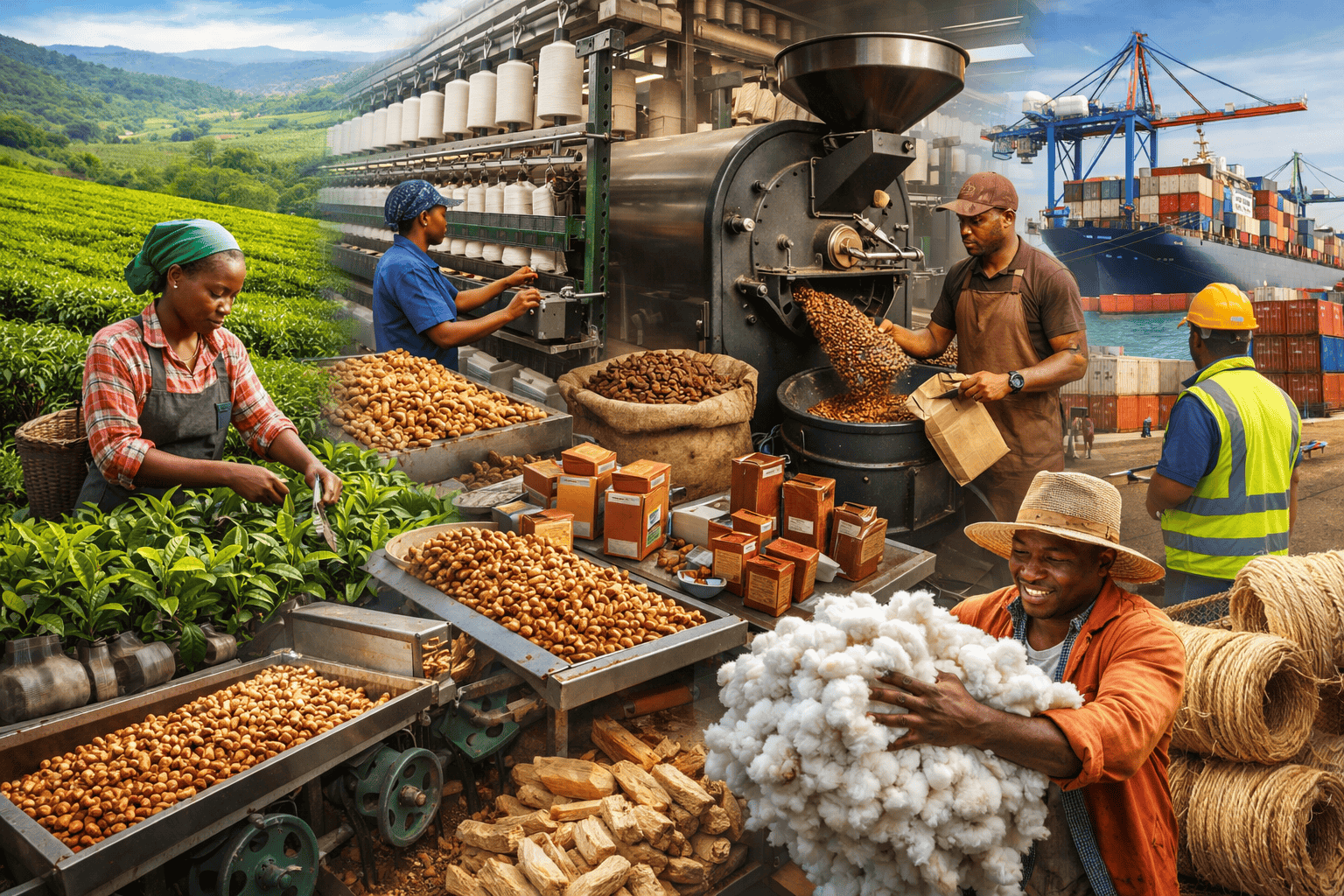
The nostalgic version of Tanzania’s cash-crop economy is easy to picture: vast tea estates, sisal fields, cotton zones, and coffee-growing highlands feeding export markets and anchoring rural towns. But the numbers say the country cannot simply try to recreate that old model. In 2024, merchandise exports rose to $9.12 billion, yet traditional exports accounted for just 16.2% of the total, while non-traditional exports made up 79.2%. In other words, the era when agricultural exports overwhelmingly defined Tanzania’s external trade has passed. The case for reviving cash crops today is not that they can turn the clock back. It is that they can do something more powerful: become the base for domestic industrialization, rural incomes, and local enterprise growth.
That argument matters because agriculture is still bigger than many of the sectors that dominate policy headlines. In 2024, agriculture accounted for 26.3% of Tanzania’s GDP, with crop cultivation alone contributing 16.1%. Manufacturing, by comparison, accounted for 7.3%, while mining and quarrying contributed 10.1%. That gap is the real clue. If Tanzania wants faster industrial growth, it does not need to look away from agriculture. It needs to treat agriculture, especially cash crops, as industrial feedstock. The country’s major traditional cash crops produced 1.49 million tonnes in 2024, up 22.1% from 2023, a rebound driven by better farm practices. The scale is there. What has lagged is the conversion of farm output into domestic value.
The weakness is not production alone. It is structure. Tanzania’s Ministry of Agriculture says agro-processing raises farmer prices, creates jobs, reduces post-harvest losses and extends shelf life, yet much of the country’s output is still exported raw because processing capacity remains weak. The ministry counts about 120 crop value chains in the country, but the commercial architecture around them is still thin. That means Tanzania often captures the lowest-margin segment of the value chain, while other countries capture the premium layers: milling, spinning, roasting, blending, packaging, manufacturing and branding.
That is where the old plantation logic needs a rewrite. Tanzania has fewer than 4,000 large-scale commercial farms, while more than 80% of farmers operate on less than five hectares. Even so, the Ministry says half of those smallholders already engage in commercial transactions, selling between a quarter and half of their output for cash. That makes the smartest model neither a pure estate revival nor a purely smallholder story. It is a hybrid system: large farms where scale matters, smallholder supply where inclusion matters, and processors, warehouses, financiers and manufacturers in the middle. Tanzania also has room to expand that system. Of its 44 million hectares of arable land, only about 10.8 million hectares are under crop production, leaving about 33.2 million hectares, or 76%, available for further investment; irrigation potential is estimated at 29.4 million hectares.
Cotton shows how this can work. Production reached 282,510 tonnes in 2023/24, and the crop is a vital income source for about 600,000 farmers. At the same time, cotton export earnings in calendar 2024 fell to $69.3 million from $101.9 million partly because domestic demand increased. That should not be read only as a setback. It can also be read as a signal that local industry can absorb more fiber if the country builds the missing links. The Ministry itself identifies those gaps clearly: warehouses, ginneries, spinning mills, textile factories and garment factories. The benchmark, then, should not be how much lint leaves Tanzania. It should be how much cotton stays long enough to become yarn, fabric, uniforms, apparel and industrial textiles inside Tanzania.
Cashew is even more blunt. Production reached 310,787 tonnes in FY2023/24, and export earnings in calendar 2024 jumped to $541.7 million. Yet the Ministry says 90% of cashew nuts are still exported unprocessed and that more processing factories are needed. That is the kind of contradiction Tanzania can no longer afford: world-scale output with limited domestic capture. A serious cashew strategy would not stop at orchards and auction floors. It would extend into shelling, grading, roasting, packaging, edible oils, snack manufacturing and domestic retail brands. Every one of those steps creates smaller businesses around the crop, from transporters and machine technicians to printers, packaging firms and wholesalers.
Coffee and tea offer a different kind of lesson. Coffee production reached 77,417 tonnes in 2023/24; the industry employs more than 450,000 households and benefits an estimated 2.4 million Tanzanians. Tea production reached 22,337 tonnes, while the sector supports about 50,000 direct jobs and roughly 2 million indirect livelihoods. Those are not minor side industries. They are labor systems. Which is why Tanzania should stop treating them mainly as raw commodities. The higher-value opportunity lies in roasting, soluble coffee, branded retail packs, local café supply chains, tea blending, specialty packaging and tourism-linked consumption. A tonne of coffee or tea processed, branded and sold locally circulates through many more hands than a tonne shipped out early in the chain.
Sisal may be the clearest symbol of missed industrial value. Production reached 61,215.6 tonnes in 2023/24, and the crop supports about 475,000 people, including 120,000 direct jobs. Yet the Ministry says less than 4% of the total value of the sisal plant is being realized and points to opportunities in industrial products such as alcohol from sisal juice and construction boards. That is a reminder that crop policy should not be written only by export statisticians. It should be written by industrial strategists. Sisal is not just a fiber crop. It is a manufacturing input waiting for a broader market logic.
The broader economic case is straightforward. The World Bank has argued that agriculture and related value chains drive about two-thirds of all jobs in Tanzania and three-quarters of jobs for the poor. So the right national test is not whether cash crops can restore a romantic export era. It is whether they can raise village incomes, support small-town industry, widen the tax base, deepen manufacturing and create more non-farm employment around farming. That means policy should reward local processing, fix rural logistics, expand warehouse and cold-chain capacity where relevant, crowd in finance for crop-linked manufacturing, and use public procurement and trade policy to help Tanzanian processors scale. The old plantation economy created extraction. The next version should create circulation. Tanzania does not need bigger harvests alone. It needs longer value chains that end in Tanzanian factories, Tanzanian brands and Tanzanian paychecks.
 Uchumi360
Business Intelligence
Uchumi360
Business Intelligence
Uchumi360 covers business, investment, and economic policy across East, Central, and Southern Africa.
For the serious reader
You read to the end. That places you in a small group.
Uchumi360 is built for readers who demand precision over speed, structure over sentiment, and analysis that holds uncomfortable conclusions rather than softening them. If this work sharpens how you think about Africa's economy, help us keep building the infrastructure behind it.
Institutional Partners
Commission intelligence. Shape the conversation.
Uchumi360 works with development finance institutions, investment firms, sovereign bodies, and strategic organisations across the coverage region. Institutional partnership unlocks:
- Commissioned sector and country intelligence reports
- Branded research series under your institution's authority
- Exclusive data briefings for internal strategy teams
- Speaking and editorial presence at Uchumi360 events
- Co-published investment outlooks for your markets
Support Our Work
Independent analysis has a cost. Help us bear it.
Uchumi360 does not carry advertising. It does not take editorial direction from sponsors. Every article is produced without commercial compromise. Your contribution funds the reporting, research, and editorial infrastructure that keeps this analysis free from influence.
Secure checkout: One-time and monthly support are processed securely. Add payment credentials to enable checkout here.
Stay Connected
Keep up with every new insight.
Follow our latest analysis, policy coverage, and market intelligence as soon as it is published. If you need something specific, reach out directly and we will point you to the right research.
