
Tanzania’s Sisal Production Collapsed 91% From Its 1964 Peak, but a Recovery Is Taking Shape
Ready
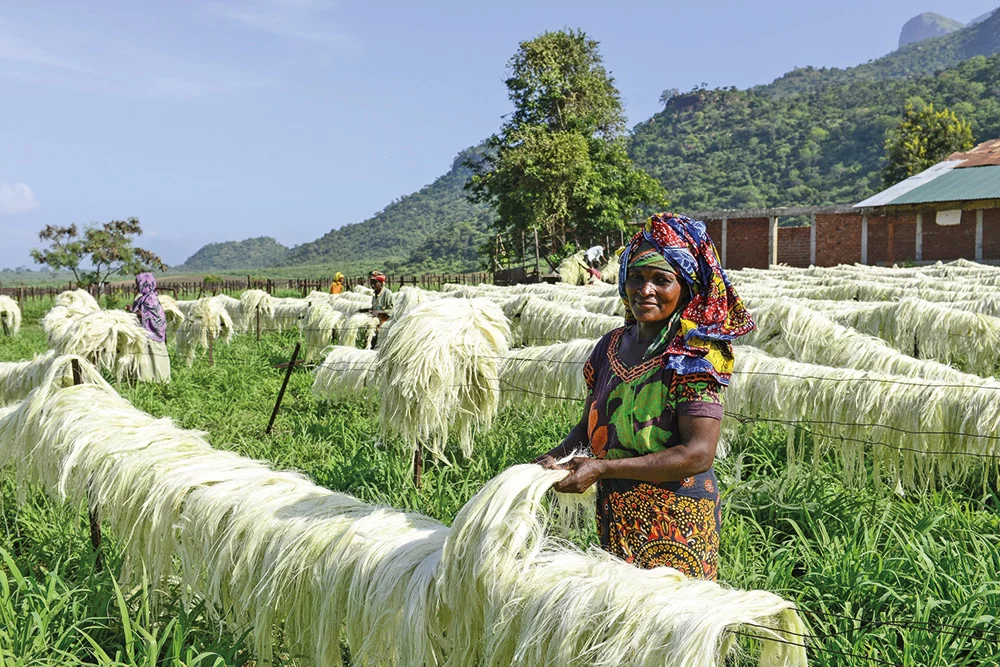
Tanzania was once the world's leading sisal producer, reaching a record 230,000 tonnes in 1964 before output collapsed by 91% to just 20,489 tonnes in 2000. Historical production data from the Tanzania Sisal Board reveal how synthetic fibres, declining global prices, plantation deterioration and changing state policies contributed to the decline of an industry that once accounted for nearly one third of Tanzania's export earnings. Production has since recovered to 61,216 tonnes in 2024, supported by renewed investment, smallholder cultivation and processing expansion. Yet the industry's raw fibre exports have grown much faster than manufactured sisal products, raising questions about Tanzania's ability to rebuild the industrial capacity that once accompanied one of its most valuable agricultural exports.
Tanzania produced 230,000 tonnes of sisal fibre in 1964, when the crop was among the country's largest sources of foreign exchange. Production fell to just 20,489 tonnes by 2000 as synthetic fibres displaced natural rope and twine, export markets weakened and plantations deteriorated. More than six decades after its peak, Tanzania is rebuilding the industry, with output reaching 61,216 tonnes in 2024. Historical records from the Tanzania Sisal Board reveal the scale of the collapse, the economics behind it and the challenges confronting the industry's recovery.
The sisal industry is recovering from one of the most substantial agricultural production declines in the country's modern economic history, having increased output to 61,216 metric tonnes in 2024 after decades of contraction that reduced production by more than 90% from its historical peak. Records published by the Tanzania Sisal Board show that the country produced 230,000 tonnes of sisal fibre in 1964, compared with only 20,489 tonnes in 2000, when production had fallen to its lowest recorded level since the early decades of commercial cultivation.
The recovery has accelerated in recent years. Production increased from 39,484 tonnes in 2021 to 48,359 tonnes in 2022, 56,773 tonnes in 2023 and 61,216 tonnes in 2024, equivalent to growth of approximately 55% over three years. Nevertheless, the latest output remains only 26.6% of the volume Tanzania produced in 1964, when its sisal industry operated on a scale unmatched by any other country.
The 126-year historical production record that Uchumi360 has seen, extending from 1898 to 2023, offers an unusually detailed account of Tanzania's changing position in international agricultural markets. It documents the emergence of sisal under German colonial administration, expansion under British rule, the industry’s dominance during the first years of independence, the collapse following competition from synthetic fibres and several decades of unsuccessful attempts to restore production.
A second Tanzania Sisal Board dataset, covering production, fibre exports, domestic sales and manufactured sisal products through 2024, provides evidence of how the industry has changed commercially. While raw fibre production and exports have recovered, the volume of finished sisal products manufactured and sold internationally has fallen substantially from earlier levels, suggesting that Tanzania's renewed output has not been accompanied by a comparable expansion of downstream manufacturing.
The distinction matters because sisal historically supported an extensive network of plantations, factories, transport operations, rope manufacturers and export businesses, particularly in Tanga and other coastal growing regions. Its decline affected much more than agricultural production. It weakened an established industrial activity that supplied foreign exchange, employment and manufactured products for both domestic and international markets.
The government's current revival efforts are being supported by expanded smallholder cultivation, seedling distribution and investment in processing. In April 2025, Tanzania Sisal Board Director General Saddy Kambona told The Guardian that approximately 12 million sisal seedlings had been distributed to smallholder farmers under a nationwide expansion programme. He also reported that processing facilities had increased from 51 in 2021 to 65 in 2024, reflecting growing demand for equipment capable of extracting fibre from harvested leaves.
The improvement provides evidence of renewed investment, but the historical record also explains why restoring Tanzania's previous position will be difficult. Sisal competes in international markets where synthetic materials have fundamentally altered demand, while producers must contend with the long growing period of the crop, harvesting costs, processing requirements and the availability of sufficiently profitable markets.
From 0.6 Tonnes in 1898 to 230,000 Tonnes in 1964
Commercial sisal cultivation in Tanzania began during German colonial rule in the late nineteenth century. The crop, originally from Mexico, was introduced because its long, strong natural fibres were suitable for rope, agricultural twine, shipping materials and other industrial applications.
Tanga became the centre of sisal cultivation, with plantations expanding into surrounding areas as colonial investors developed estates, processing factories and transport links to export markets. The crop's growth coincided with rising international demand for natural fibres used in agriculture, shipping and manufacturing.
The Tanzania Sisal Board's historical series records production of just 0.6 tonnes in 1898, increasing to 7,000 tonnes in 1910 and 20,835 tonnes by 1913. Production then fell during the First World War, reflecting the disruption of German colonial administration and international trade.
After the war, commercial production resumed under British administration. By 1929, Tanzania was producing 45,728 tonnes annually, rising to 103,192 tonnes in 1938. Sisal had become one of the territory's most established agricultural export commodities, supported by estates capable of cultivating, harvesting and processing large quantities of fibre for international markets.
Growth continued after the Second World War. Production reached 145,223 tonnes in 1951, exceeded 185,000 tonnes in 1956 and crossed 200,000 tonnes in 1959. When Tanganyika gained independence in 1961, the industry was already producing approximately 198,000 tonnes annually.
Three years later, output reached 230,000 tonnes, the highest annual production recorded in the Tanzania Sisal Board's historical series.
126 Years of Tanzania's Sisal Industry
230,000 tonnes
Historical peak, 1964
20,489 tonnes
Lowest output after the 1964 peak, 2000
61,216 tonnes
Production in 2024
26.6%
2024 output relative to 1964 peak
Tanzania's Sisal Production: Historical Rise, Collapse and Recovery
Selected years from the Tanzania Sisal Board's calendar year fibre production series, metric tonnes. The 2024 observation comes from the Board's updated sales and production table.
Source: Tanzania Sisal Board historical production records for 1898 to 2023, with the 2024 figure from its updated fibre production and sales data. The chart uses selected observations to illustrate the long historical trend.
The industry's position was exceptional by international standards. Research published in 1995 by agricultural scientists Alfred Hartemink and Jan Wienk estimated that Tanzania accounted for approximately one-third of global sisal production at the height of its expansion.
Their study, Sisal Production and Soil Fertility Decline in Tanzania, described how sisal had become one of the country's principal foreign exchange earners before experiencing a prolonged contraction in both cultivated area and productivity.
A separate historical study published by REPOA found that sisal accounted for nearly one third of Tanzania's export earnings during the 1960s, illustrating how closely the national economy was linked to the crop before the expansion of other agricultural exports, mining and services.
For a newly independent country with limited manufacturing capacity and a narrow export base, sisal earnings provided foreign exchange required to purchase machinery, fuel, manufactured goods and other imports. The industry also employed large numbers of workers in agricultural estates and processing facilities.
Its importance consequently extended into transport and industrial development. Plantation output supported machinery maintenance, fibre processing, packaging, warehousing and shipping, with Tanga serving as an important outlet for exports.
The concentration of economic activity around sisal made the crop a substantial source of income, but it also exposed Tanzania to changes in international demand for natural fibres.
Synthetic Fibres Destroyed the Market That Supported Tanzania's Sisal Industry
The collapse began after sisal had already established itself as one of Tanzania's principal exports. By the middle of the 1960s, manufacturers were increasingly producing rope and twine from synthetic materials, particularly polypropylene, which offered a cheaper and more consistent alternative for several traditional sisal applications.
The change occurred alongside advances in agricultural machinery. Sisal had been widely used to manufacture binding twine for agricultural harvesting, but new harvesting technologies reduced demand for some traditional products. Meanwhile, synthetic twines and ropes captured a growing share of markets previously served by natural fibres.
The commercial consequences were severe. Lower international demand reduced sisal prices and compressed the earnings of plantation operators, even as agricultural labour, machinery maintenance and processing continued to require substantial expenditure.
The historical production figures show the decline unfolding over several decades. Output fell from 230,000 tonnes in 1964 to 181,108 tonnes in 1971, 127,840 tonnes in 1975 and 85,978 tonnes in 1980. By 1985, Tanzania produced only 32,270 tonnes, representing a contraction of approximately 86% from the 1964 peak.
The World Bank's 1984 assessment of Tanzania's economy identified both international market conditions and domestic operational problems as contributing factors. It observed that polypropylene's share of the twine market had increased from approximately 7% in 1970 to 30% in 1980, while changing harvesting technologies reduced demand for agricultural binding twine.
The bank also identified problems within Tanzania's production structure, including inefficient estate management, high operating costs, weak profitability and difficulties maintaining plantations whose revenues had declined substantially.
The consequences extended to employment and investment. Once plantations became unprofitable, owners reduced maintenance, postponed replanting and struggled to finance machinery replacement. Those decisions gradually weakened the productive capacity of the industry.
The biological characteristics of sisal complicated recovery. Unlike an annual crop that can be planted and harvested within a single agricultural season, sisal takes several years to mature. Abandoned plantations therefore cannot quickly resume full production when prices improve.
This created a prolonged investment problem. Declining prices discouraged replanting, while the absence of mature productive plants constrained the ability of growers to respond when market conditions temporarily recovered.
A 1980 report published by Tanzanian Affairs described the industry's difficulties, attributing the decline partly to technological change and competition from synthetic fibres. The publication also recalled President Julius Nyerere's earlier criticism of the international commodity trading system, in which African primary producers faced limited control over the prices received for their exports.
The price collapse was particularly damaging because sisal estates required substantial fixed investment in land development, processing machinery, transport and labour. Falling sales could not immediately be offset by equivalent reductions in operating costs without undermining future production.
Nationalisation and Estate Management Complicated the Industry's Decline
The introduction of synthetic materials was a major external shock, but Tanzania's domestic policies also influenced the industry's ability to adapt.
Following the 1967 Arusha Declaration, the government increased public ownership and control over major productive assets, including parts of the sisal industry. The objective was to bring strategic economic activities under national control and direct their contribution towards broader development priorities.
However, nationalisation occurred when the international sisal market was already deteriorating. State enterprises inherited plantations and processing facilities whose commercial prospects were weakening, while private investors faced an uncertain environment for long term agricultural investment.
An assessment published by the Food and Agriculture Organization identified nationalisation, exchange rate policies, export taxation and centralised marketing arrangements among the domestic factors contributing to the industry's decline. It also emphasised that international price weakness and synthetic competition played major roles.
The difficulty was compounded by the organisational requirements of large sisal estates. Commercial production depends on coordinated harvesting, transportation of leaves to processing facilities, machinery maintenance, adequate labour and continuous field management. Disruptions in any of these activities can reduce output and increase production costs.
Research by Hartemink and Wienk identified declining soil fertility as another constraint. Continuous sisal cultivation without sufficient replenishment of soil nutrients reduced yields, while poorly maintained plantations became less productive.
By the middle of the 1980s, production had fallen to around 30,000 tonnes annually. The industry then entered a prolonged period of relatively low output, with annual volumes frequently fluctuating between approximately 20,000 and 35,000 tonnes.
The decline therefore reflected interacting pressures. International market changes reduced the profitability of sisal, while problems in investment, estate management, land productivity and marketing limited the ability of producers to adjust.
The scale of the collapse is apparent in the Tanzania Sisal Board's records. In 1997, output stood at just 21,400 tonnes, falling to 20,584 tonnes in 1999 and 20,489 tonnes in 2000. Compared with 1964, Tanzania had lost approximately 91% of its annual production volume.
Production Has Almost Tripled Since 2000, but the Recovery Remains Incomplete
The industry's revival began from a considerably smaller production base. Tanzania produced approximately 20,489 tonnes in 2000, increasing to 30,934 tonnes in 2006 and 34,677 tonnes in 2010. Progress was uneven. Production weakened in 2009 before recovering, and output remained largely within the range of 35,000 to 40,000 tonnes during much of the 2010s.
More substantial gains emerged after 2020. The Tanzania Sisal Board recorded production of 37,023 tonnes in 2020, followed by 39,484 tonnes in 2021, 48,359 tonnes in 2022 and 56,773 tonnes in 2023.
The updated production records show a further increase to 61,215.55 tonnes in 2024, approximately 8% higher than the previous year.
Tanzania's Recent Sisal Production Recovery
Calendar year sisal fibre production, metric tonnes, Tanzania Sisal Board.
The improvement has been supported by renewed government attention to smallholder production and efforts to distribute improved planting materials. Historically, Tanzania's sisal industry was dominated by large plantations, but newer programmes have sought to increase participation by smallholder farmers.
In April 2025, Tanzania Sisal Board Director General Saddy Kambona told The Guardian that the number of sisal processing facilities had increased by 14 between 2021 and 2024. He also credited support from President Samia Suluhu Hassan's administration, including TZS 500 million allocated for improved planting materials distributed to farmers.
The government has continued supporting agricultural research and the development of improved varieties. The Tanzania Agricultural Research Institute's 2025 annual report recorded an increase in sisal seedling production at TARI Mlingano from approximately 1.22 million in 2023/24 to 2.5 million in 2024/25.
The growing availability of seedlings is relevant because rehabilitating an ageing plantation requires sufficient planting materials and time for the crop to mature. However, the number of seedlings produced or distributed does not automatically translate into equivalent growth in harvested fibre. Survival rates, agronomic conditions, maintenance and processing capacity will determine the eventual contribution to national output.
Tanzania's 2024 Economic Survey provides additional evidence of expansion. It reports that the cultivated sisal area increased to approximately 99,376 hectares in 2023/24, compared with 72,349 hectares during the preceding season, an increase of 37.4%.
The survey also reports an increase in mature sisal area from 47,774 hectares to 73,687 hectares, while immature cultivated area reached 25,689 hectares. These figures are based on agricultural seasons running from July to June and should not be confused with the calendar year production series.
The expansion of cultivated area suggests that growers are preparing for additional production, but it also raises a question about land productivity. Increasing output by expanding acreage may be commercially viable where land and labour are available, yet sustained competitiveness requires attention to yields and processing efficiency.
Raw Sisal Fibre Exports Have Recovered Faster Than Finished Products
The second Tanzania Sisal Board dataset provides an important indication of how the industry's commercial structure has evolved. In 2024, the board recorded exports of approximately 35,976 tonnes of sisal line fibre worth $62.74 million, compared with 36,326 tonnes worth $61.96 million in 2023. Export volumes were slightly lower, but the recorded export value increased by approximately 1.3%.
The data suggest that the value of fibre exports has increased substantially over the longer term. In 2000, the board recorded line fibre exports worth approximately $7.65 million. By 2010, the figure had increased to $10.40 million, before rising to $36.41 million in 2015 and $47.70 million in 2021.
However, the same dataset indicates a much weaker performance in exports of manufactured sisal products, including ropes, twine, carpets and related goods.
Exports of manufactured sisal products reached approximately 5,549 tonnes in 2014 and 5,280 tonnes in 2015. They subsequently declined, falling to 2,227 tonnes in 2021, 1,302 tonnes in 2023 and 2,295 tonnes in 2024.
The latest figure represents an improvement from 2023 but remains far below the volumes recorded a decade earlier.
Sisal fibre and manufactured product exports
| Year | Fibre exports (tonnes) | Fibre export value | Manufactured product exports (tonnes) |
| 2000 | 11,244 | $7.65M | 2,730 |
| 2005 | 11,693 | $8.89M | 2,715 |
| 2010 | 11,601 | $10.40M | 6,408 |
| 2015 | 20,764 | $36.41M | 5,280 |
| 2020 | 25,990 | $41.83M | 2,801 |
| 2021 | 28,430 | $47.70M | 2,227 |
| 2022 | 32,627 | $56.77M | 1,899 |
| 2023 | 36,326 | $61.96M | 1,302 |
| 2024 | 35,976 | $62.74M | 2,295 |
Source: Tanzania Sisal Board, fibre and sisal products export and local sales records. Quantities and values are rounded.
The difference has direct implications for Tanzania's industrial development ambitions. Increasing sisal production expands the availability of agricultural raw materials, but manufacturing creates a separate opportunity to earn income through processing, product design, packaging and distribution.
Finished sisal products can serve markets in agriculture, construction, interior decoration and other industries. Yet their commercial prospects depend on demand, manufacturing costs, competition from synthetic alternatives and the ability of Tanzanian firms to meet buyers' quality and delivery requirements.
The domestic market provides another potential outlet. The Tanzania Sisal Board recorded local fibre sales of approximately 15,120 tonnes worth TZS 53.92 billion in 2024, compared with 14,289 tonnes worth TZS 49.71 billion in 2023.
These figures indicate that domestic fibre sales have increased alongside production. Nevertheless, the declining volume of manufactured products suggests that greater availability of fibre has not automatically produced corresponding growth in every segment of Tanzania's sisal manufacturing industry.
The board's records also show that production of manufactured sisal products fell from approximately 11,890 tonnes in 2007 to 2,996 tonnes in 2024, a decline of nearly 75%.
For an industry attempting to rebuild its commercial position, this creates a question about where the greatest additional value can be generated. Exporting fibre provides revenue to growers and processors, but expanding manufacturing requires investment in specialised equipment, reliable supply contracts, product development and international distribution.
Tanzania’s Export Statistics Show Different Values for the Same Industry
One complication in assessing the recovery is that Tanzania's official institutions publish materially different sisal export figures. The Tanzania Sisal Board's 2024 line fibre export records show 35,975.50 tonnes worth $62.74 million. Its separate category for manufactured sisal products records 2,294.81 tonnes worth $5.09 million.
However, the Ministry of Finance's 2024 Economic Survey reports sisal exports worth only $23.4 million during the same calendar year, against $20.4 million in 2023. It also records export volumes of 21,200 tonnes in 2024, up from 12,500 tonnes the previous year. The difference is substantial. The board's recorded value for line fibre exports alone is more than twice the sisal export value reported in the Economic Survey.
The two publications may differ in commodity coverage, reporting dates, valuation procedures or the treatment of transactions recorded by exporters and customs authorities. However, the published tables do not provide a reconciliation explaining the discrepancy. The figures should therefore be reported separately rather than combined into a single estimate of the industry's foreign exchange contribution.
The government's Economic Survey also shows that higher volumes do not necessarily produce proportionate increases in export receipts. Although it recorded a 69.4% increase in sisal export volumes in 2024, the average export price declined from approximately $1,629 per tonne in 2023 to $1,102 in 2024. The value of exports consequently increased by only 14.6%.
This illustrates the continued exposure of sisal exporters to international price movements. A country can expand production and export larger quantities while receiving comparatively modest additional foreign exchange if unit prices decline.
For growers, the effect depends on the relationship between market prices and production costs. Higher output may still increase earnings when harvesting, processing and transportation are efficient, but expansion becomes less attractive where additional sales generate limited margins.
The difference between the Sisal Board and government trade statistics also matters for investors evaluating processing facilities, export infrastructure and agricultural financing. Reliable information on production, sales and export values is necessary to estimate the actual size of the market and the potential return on new investment.
Industrial Uses and Sisal Waste Could Provide Additional Markets
The recovery of natural fibre demand creates opportunities beyond traditional rope and twine manufacturing, although these applications must compete on cost and technical performance.
Sisal can be used in carpets, mats, geotextiles, agricultural twines, packaging materials and fibre reinforced products. Research institutions and manufacturers have also examined its potential use in composite materials, where natural fibres can replace or supplement synthetic reinforcements in selected industrial applications.
These markets are commercially attractive only where sisal meets the required technical specifications and can compete with alternative materials. Environmental considerations may improve demand for natural fibres in some markets, but they do not remove the importance of price, consistency, durability and processing costs.
Another area receiving attention is the use of material left over after fibre extraction. In June 2025, Daily News reported that the Tanzania Sisal Board was working with the University of Dar es Salaam, the Nelson Mandela African Institution of Science and Technology and TARI to investigate extracting protein from sisal residues for animal feed. The initiative reflects an attempt to increase the commercial value obtained from sisal plants beyond the extracted fibre.
Traditional fibre extraction uses only a relatively small proportion of the plant's physical material. The remaining biomass creates processing and disposal requirements, particularly where large quantities of leaves are transported to central factories.
Developing commercially viable uses for the residue could improve the economics of processing, although research findings must be translated into production systems that satisfy feed safety, cost and quality requirements.
Biogas and other biomass applications offer additional possibilities, but the economics depend on the availability of sufficient waste volumes, suitable technology and reliable demand for the products generated.
For Tanzania, these opportunities are relevant because the industry's historical difficulties were partly associated with its dependence on a narrow range of products whose markets were disrupted by technological change.
Diversifying products may reduce that exposure, but each proposed manufacturing investment requires its own commercial assessment.
Tanzania’s Recovery Will Depend on Productivity, Processing and Market Demand
Tanzania's sisal production has risen substantially from the levels recorded during the late 1990s and early 2000s. The industry's output in 2024 was nearly three times its volume in 2000, while the expansion of smallholder cultivation and processing capacity indicates renewed commercial interest. However, the production history provides a clear warning about the limitations of expansion driven primarily by favourable market conditions or increased acreage.
The industry reached its highest level in 1964 because an extensive network of plantations and factories served strong international demand. That productive system subsequently deteriorated when the markets supporting it contracted and investment in maintaining plantations weakened.
The circumstances facing the industry today are different. Sisal no longer enjoys its former position as a dominant industrial fibre, while synthetic alternatives remain established across many applications. Consequently, Tanzania's future opportunities depend on competing effectively within markets where natural fibre has a commercial advantage, rather than assuming that international demand will return to the conditions prevailing during the 1950s and early 1960s.
Farm productivity will be central to that process. Greater availability of improved planting materials, suitable agricultural practices, efficient harvesting and reliable processing machinery can reduce the cost of producing fibre. At the same time, expanding smallholder production requires practical arrangements for processing. Farmers located far from functioning decortication facilities may face high transport costs because sisal leaves are bulky relative to the amount of saleable fibre extracted.
Processing facilities must therefore be located and operated in ways that make commercial sense for the volumes grown in surrounding areas. Tanzania also faces a longer term industrial decision about how much fibre should be exported in raw form and how much should be processed domestically into finished products.
The Sisal Board's records show that raw fibre exports have increased markedly, while production and export volumes of manufactured sisal goods have weakened. Reversing that decline will require more than expanding agricultural production. Manufacturers need competitive equipment, predictable electricity supply, product markets, working capital and reliable access to buyers.
The history of Tanzania's sisal industry illustrates how changes in international technology and commodity demand can reshape an established agricultural economy. The collapse from 230,000 tonnes in 1964 to approximately 20,500 tonnes in 2000 was followed by decades of gradual recovery, culminating in output above 61,000 tonnes in 2024.
That recovery is substantial, particularly when measured against the industry's lowest production levels. But Tanzania remains far from the scale it achieved six decades ago, and the market it now serves bears little resemblance to the one that supported its former dominance.
The industry's next phase will be determined by whether higher production can be sustained profitably, whether farmers and processors can improve productivity and whether domestic manufacturers can develop products capable of competing in markets that have changed permanently since sisal's peak.
 Uchumi360
Business Intelligence
- Tanzania Sisal Board: Historical production statistics, 1898 to 2023
- Tanzania Sisal Board: Fibre production, exports and domestic sales data through 2024 (second uploaded source)
- Ministry of Finance: Economic Survey 2024
- The Guardian: Sisal industry records strong growth, April 2025
- Hartemink and Wienk: Sisal Production and Soil Fertility Decline in Tanzania, 1995
- FAO: Historical assessment of sisal market competition
- Tanzanian Affairs: The Sisal Industry, July 1980
- Daily News: Sisal processing and animal feed research, June 2025
Uchumi360 covers business, investment, and economic policy across East, Central, and Southern Africa.
For the serious reader
You read to the end. That places you in a small group.
Uchumi360 is built for readers who demand precision over speed, structure over sentiment, and analysis that holds uncomfortable conclusions rather than softening them. If this work sharpens how you think about Africa's economy, help us keep building the infrastructure behind it.
Institutional Partners
Commission intelligence. Shape the conversation.
Uchumi360 works with development finance institutions, investment firms, sovereign bodies, and strategic organisations across the coverage region. Institutional partnership unlocks:
- Commissioned sector and country intelligence reports
- Branded research series under your institution's authority
- Exclusive data briefings for internal strategy teams
- Speaking and editorial presence at Uchumi360 events
- Co-published investment outlooks for your markets
Support Our Work
Independent analysis has a cost. Help us bear it.
Uchumi360 does not carry advertising. It does not take editorial direction from sponsors. Every article is produced without commercial compromise. Your contribution funds the reporting, research, and editorial infrastructure that keeps this analysis free from influence.
Secure checkout: One-time and monthly support are processed securely. Add payment credentials to enable checkout here.
Stay Connected
Keep up with every new insight.
Follow our latest analysis, policy coverage, and market intelligence as soon as it is published. If you need something specific, reach out directly and we will point you to the right research.
