
Zanzibar Seaweed Output Rises but Value Falls 12% as Government Targets $127 Million Investment

Ready
Zanzibar's seaweed production increased to approximately 20,075 tonnes in 2025, but its estimated value fell 11.7% to TZS 14.25 billion, according to official statistics. The implied value per tonne declined by approximately 13.3%, while recorded seaweed exports also contracted. The findings strengthen the economic case for domestic processing as President Hussein Ali Mwinyi opens the Zanzibar Seaweed Investment Forum on November 18, seeking up to $127 million in potential commitments. Uchumi360 examines the differences between production, value and export earnings, the commercial constraints affecting coastal farmers, and whether proposed processing investments can increase manufacturing output and secure better returns for Zanzibar's seaweed producers.
Zanzibar produced approximately 20,075 tonnes of seaweed in 2025, up from 19,716 tonnes in 2024, but the estimated value of production declined from TZS 16.14 billion to TZS 14.25 billion, according to official statistical data. The figures suggest a 13% reduction in average value per tonne, strengthening the government's case for investment in local processing as President Hussein Ali Mwinyi opens a three-day seaweed investment forum seeking up to $127 million in potential commitments. However, the proposed capital remains an investment target rather than secured financing.
Zanzibar's seaweed production increased in 2025, while the estimated value of the crop declined, exposing persistent weaknesses in an industry that provides livelihoods for thousands of coastal households and remains heavily dependent on the sale of minimally processed raw materials. The deterioration in value has brought renewed attention to the economics of seaweed farming as President Hussein Ali Mwinyi opened the Zanzibar Seaweed Investment Forum in Unguja on November 18, calling for investment in processing facilities, improved cultivation technologies and higher value products.
The latest official statistics show that seaweed production increased from 19,716 tonnes in 2024 to approximately 20,075 tonnes in 2025, representing growth of 1.8%. However, the estimated production value fell from TZS 16.14 billion to TZS 14.25 billion, a decline of approximately 11.7%. These figures come from Zanzibar's 2025 Statistical Abstract, published by the Office of the Chief Government Statistician, and reproduced in Tanzania's national statistical publications.
The official figures differ from the comparison presented at the investment forum and reported by The Citizen on November 18. That report described production rising from 16,653 tonnes in 2024 to 20,075 tonnes in 2025 while production value declined from TZS 16.5 billion to TZS 16.1 billion. However, the 16,653 tonne figure and its corresponding TZS 16.5 billion value belong to 2023, according to Zanzibar's earlier official statistical records. The 2024 figures are 19,716 tonnes and approximately TZS 16.14 billion.
The distinction changes the year-to-year growth calculation materially. It means the official series shows a modest 1.8% increase in production in 2025 rather than the 20.6% reported at the forum. Nevertheless, the economic conclusion remains: Zanzibar produced more seaweed but recorded a lower estimated value for that production.
Seaweed production, 2025
20,075 t
Up 1.8% from 2024
Estimated production value
TZS 14.25B
Down 11.7% from 2024
Implied value per tonne
−13.3%
Calculated from official statistics
Forum investment target
$127M
Upper end of proposed pipeline
Sources: OCGS, Zanzibar Statistical Abstract 2025; NBS, Statistical Abstract 2025; Zanzibar Seaweed Investment Forum. Calculated percentage changes are based on rounded published figures.
Rising Production Has Failed to Protect the Value of Zanzibar's Seaweed
The divergence between production and value becomes clearer when the figures are examined over three consecutive years.
| Indicator | 2023 | 2024 | 2025 |
| Production, tonnes | 16,653 | 19,716 | 20,075 |
| Estimated production value, TZS billion | 16.51 | 16.14 | 14.25 |
| Implied value per tonne, TZS | 991,700 | 818,900 | 709,999 |
Source: OCGS Zanzibar Statistical Abstract 2025, production table F.1.4, with independently calculated ratios. Rounded values are used in the display. These are aggregate production value estimates, not observed farmgate prices or export prices.
Figure 1 | Seaweed Production Continues to Increase. 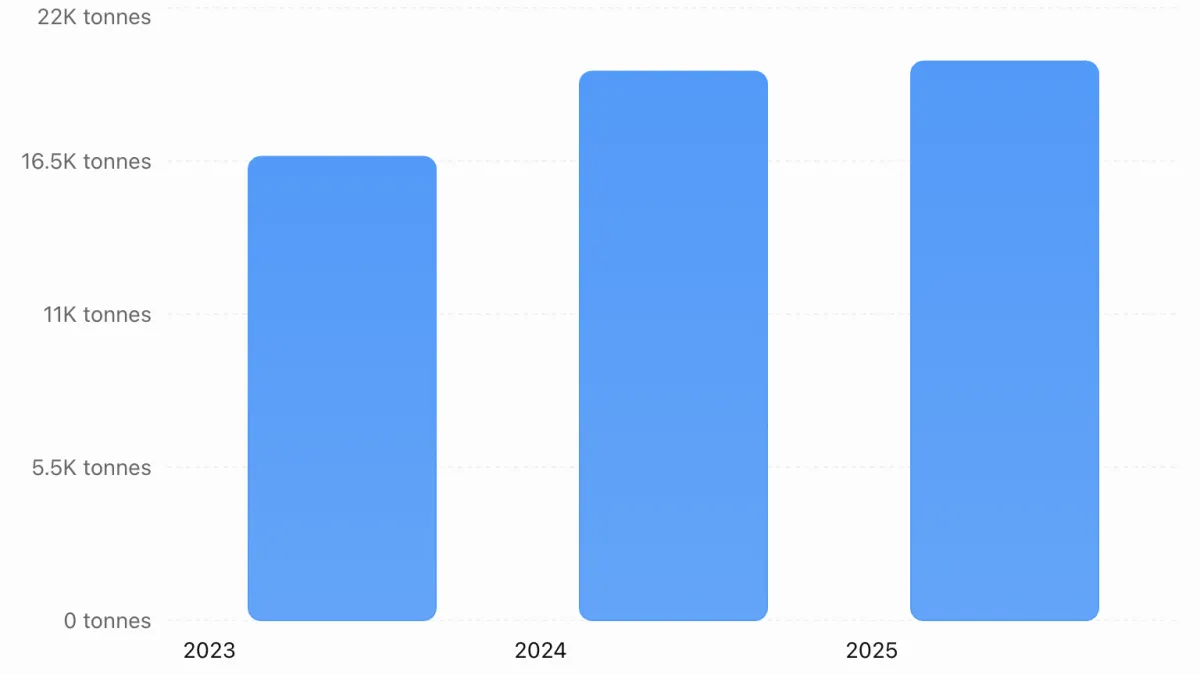 Production estimates from Zanzibar's official statistical series.
Figure 2 | Estimated Production Value Declines: 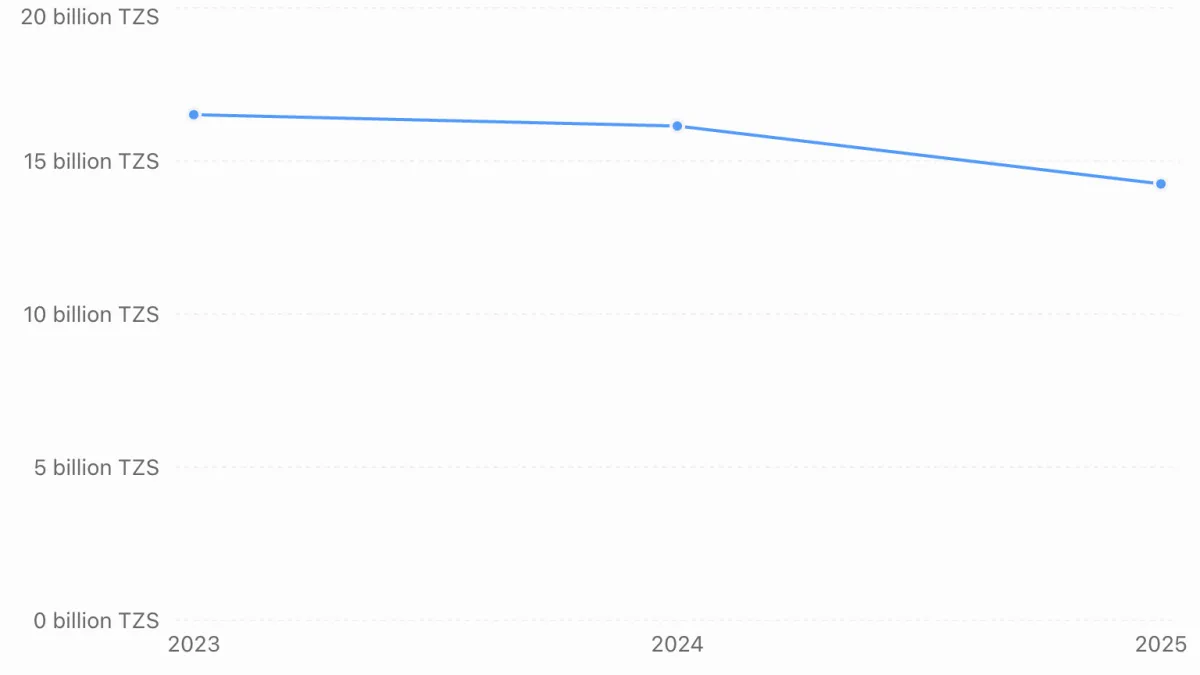 Estimated value of production at current prices, not export receipts. Source: OCGS Statistical Abstract 2025.
The ratio of production value to volume declined from approximately TZS 819,000 per tonne in 2024 to TZS 710,000 in 2025, a reduction of around 13.3%. Relative to 2023, the implied average value per tonne declined by approximately 28%.
These calculations provide an indication of the weakening monetary value associated with each tonne of production. However, they do not establish the exact price farmers received. The aggregate ratio can be influenced by differences in seaweed varieties, product quality, valuation methods and the timing of transactions. Establishing whether farmers experienced an equivalent reduction in earnings would require producer level price and income records.
The statistics nevertheless demonstrate the limits of expanding production without addressing the terms under which the crop is sold. Farmers can increase harvest volumes while generating less monetary value if the average value realised per unit declines sufficiently.
For Zanzibar, where seaweed farming is an important source of income for women and coastal communities, such changes can reduce the financial incentive to invest in equipment, improved cultivation and higher quality production.
Zanzibar's Export Figures Reveal an Additional Commercial Challenge
The decline in estimated production value is only one part of the industry's economic performance. Zanzibar's 2025 Statistical Abstract also reports seaweed exports of approximately 3,902 tonnes in 2025, compared with 7,090 tonnes in 2024. The recorded export value declined from TZS 10.74 billion to TZS 5.23 billion.
Figure 3 | Seaweed Exports Contract 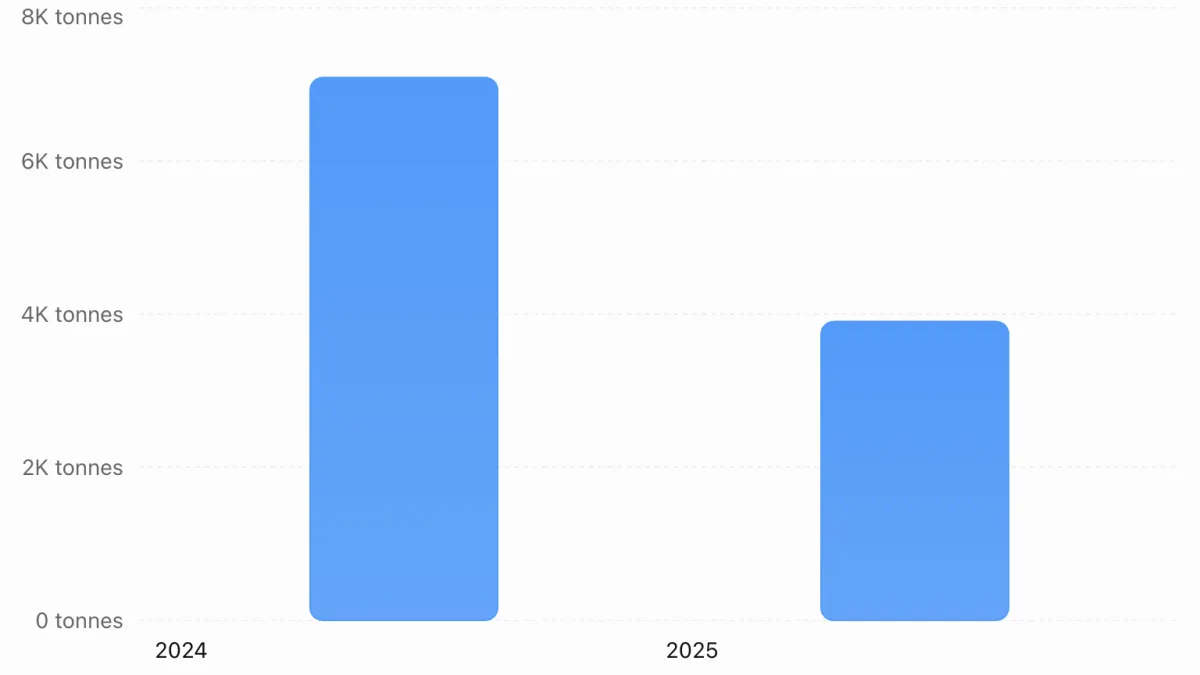 Source: OCGS, Zanzibar Statistical Abstract 2025, Table E.3.3. Recorded exports are different from total seaweed production.
The export statistics imply a reduction of approximately 45% in shipment volumes and 51% in recorded export value. This is a different measurement from the estimated value of seaweed produced, since not every tonne harvested necessarily leaves Zanzibar as an export in the same year. Stocks, domestic purchases, processing and differences in recording periods can affect the relationship between production and exports.
These figures warrant further investigation because they indicate that the increase in harvested seaweed was not accompanied by an increase in recorded foreign sales in the calendar year. They also reinforce the importance of distinguishing production, purchases from farmers, domestic processing and exports when evaluating the industry's contribution to Zanzibar's economy.
The available data do not establish exactly why exports contracted. Changes in overseas demand, buyer orders, market prices, product quality and inventory movements are possible explanations, but they require confirmation from exporters, producer organisations and trade statistics.
Mwinyi Wants Zanzibar to Capture More Value Through Processing
Speaking at the opening of the Zanzibar Seaweed Investment Forum at the Golden Tulip Hotel in Unguja on November 18, President Hussein Ali Mwinyi called for greater domestic processing and manufacturing rather than continued dependence on selling raw seaweed.
The Zanzibar President's Office confirmed that the government intends to promote improved planting material, cultivation technology, processing facilities and products that can generate higher commercial returns. The investment forum brings together government institutions, prospective investors, commercial buyers, financial organisations and development partners, including the United Nations Development Programme.
The economic case for local processing rests on the difference between selling seaweed as an agricultural commodity and manufacturing ingredients or finished goods from it. Certain seaweed varieties can be processed into carrageenan, an ingredient used in food manufacturing, while other products may serve cosmetics, agricultural inputs and specialised industrial markets.
Processing can create additional value through extraction, formulation, packaging, quality assurance and marketing. It can also generate demand for technical skills and equipment that are not required to the same extent in basic cultivation and drying.
However, local processing does not automatically produce higher returns for farmers. A manufacturer may capture additional value while purchasing raw material at prevailing market prices. The distribution of benefits depends on contracts, producer bargaining power, factory costs and the prices obtained from final buyers.
This is particularly relevant in a sector with many small producers. Farmers may be unable to influence prices individually where only a limited number of buyers purchase their harvests. Cooperatives, transparent grading systems, competing buyers and reliable purchase agreements can improve their commercial position, but their effectiveness must be assessed through actual transaction data.
The government has already identified weak markets and declining prices as problems. In July 2026, President Mwinyi said Zanzibar was pursuing processing investments because farmers continued to face challenges obtaining dependable buyers and remunerative prices. The new production figures reinforce those concerns.
The $127 Million Investment Target Is Substantial Relative to the Existing Industry
The Zanzibar Seaweed Investment Forum, scheduled for November 18 to 20, is seeking between $46 million and $127 million in potential investment commitments. At the upper end, the amount is equivalent to approximately TZS 336.4 billion using the conversion presented by organisers ahead of the event.
The proposed financing covers a range of opportunities, including cultivation technologies, drying and storage infrastructure, processing plants, manufacturing facilities and products intended for international markets.
The amount is considerable when compared with the industry's existing commercial scale. Zanzibar's estimated seaweed production value of TZS 14.25 billion in 2025 represents only about 4.2% of the TZS 336.4 billion upper investment target.
This comparison does not establish that the investment is excessive. Factories and supporting infrastructure are capital investments expected to operate over several years, while production value is an annual measure. Nevertheless, the difference demonstrates the extent of commercial expansion that investors would need to anticipate to justify such expenditure.
The proposed investment may be commercially viable where processing allows producers to sell considerably higher value goods, expand into new markets or increase production volumes. Its viability would depend on the type of project, production costs, market demand and expected returns.
Investment announcements must also be evaluated according to their financial status. A project presented to investors does not represent committed capital, and a memorandum of understanding may still depend on financing approvals, permits, land arrangements and commercial contracts. As of the November 18 opening, the $127 million remained an investment ambition rather than a verified amount already financed.
Processing Investment Will Have to Address the Conditions Facing Farmers
The composition of Zanzibar's seaweed production places additional demands on any processing strategy. The 2025 Statistical Abstract shows that approximately 19,941 tonnes of the 20,075 tonnes produced were Eucheuma spinosum, while about 133 tonnes were Eucheuma cottonii. These varieties have different characteristics and commercial applications, meaning the type of seaweed available must inform the technology and product markets targeted by investors.
A factory designed for one processing method cannot necessarily use all available seaweed varieties interchangeably. Investors must consider the composition, quality and consistency of the raw material, alongside the specifications required by industrial buyers.
Production conditions are also changing. Seaweed cultivation in shallow coastal waters is exposed to high temperatures, disease, weather conditions and changing marine environments. Research and investment in suitable varieties, improved seedlings and deeper water cultivation could support productivity, but adoption may require equipment, financing and training that individual producers cannot easily afford.
Research reported by United Nations Africa Renewal in November 2026 describes work examining naturally occurring seaweed varieties for potentially greater tolerance to heat and disease. Such research could eventually help farmers maintain more reliable production, although preliminary findings should not be presented as proven commercial improvements.
Zanzibar also has existing processing initiatives that should form part of assessing the next stage of investment. The Chamanangwe seaweed processing facility on Pemba, for example, has featured in government plans to increase value addition. Its operational capacity, utilisation and actual sales would provide useful evidence about the commercial conditions faced by new industrial investors.
The need for reliable electricity, water, storage, skilled personnel and international market access will be central to those assessments. A processing factory can increase domestic manufacturing value added only if it operates at economically sustainable capacity and sells products at prices sufficient to cover production and financing costs.
For farmers, the more relevant indicators will be prices received, quantities sold, production costs and annual income. Increasing the value of seaweed exports or manufactured products would be economically useful, but the distribution of those gains will determine how much the investment improves coastal livelihoods.
Zanzibar's Seaweed Strategy Faces a Test Beyond Production Growth
Zanzibar's seaweed industry has expanded physical production substantially over the past several years, from approximately 8,785 tonnes in 2020 to 20,075 tonnes in 2025. The government's ambition to reach 40,000 tonnes of dried seaweed by 2030 would require nearly doubling the latest annual output.
The decline in estimated production value during 2024 and 2025 shows why increasing harvest volumes cannot be the only measure of progress. The capacity to produce more seaweed must be accompanied by commercially dependable demand, competitive prices, improved product quality and investment that allows more processing to take place within Zanzibar.
The November investment forum is intended to connect those requirements with potential capital and industrial partners. Its immediate outcome should be assessed through the projects and financial commitments that emerge, rather than the aggregate value of opportunities presented to participants.
Longer term results will require more detailed measurement. Production volume, estimated production value, actual farmgate prices, export receipts, factory utilisation and household income should be reported as separate indicators. Combining them into a single measure of industry performance risks obscuring the conditions experienced by farmers and manufacturers.
Zanzibar has demonstrated that it can expand seaweed production. The latest official figures show that the additional volume has not protected the estimated value of the crop. The economic test for the government's processing strategy will be whether new investment increases value created within Zanzibar and improves the earnings of the people producing its raw material.
 Uchumi360
Business Intelligence
Uchumi360 covers business, investment, and economic policy across East, Central, and Southern Africa.
For the serious reader
You read to the end. That places you in a small group.
Uchumi360 is built for readers who demand precision over speed, structure over sentiment, and analysis that holds uncomfortable conclusions rather than softening them. If this work sharpens how you think about Africa's economy, help us keep building the infrastructure behind it.
Institutional Partners
Commission intelligence. Shape the conversation.
Uchumi360 works with development finance institutions, investment firms, sovereign bodies, and strategic organisations across the coverage region. Institutional partnership unlocks:
- Commissioned sector and country intelligence reports
- Branded research series under your institution's authority
- Exclusive data briefings for internal strategy teams
- Speaking and editorial presence at Uchumi360 events
- Co-published investment outlooks for your markets
Support Our Work
Independent analysis has a cost. Help us bear it.
Uchumi360 does not carry advertising. It does not take editorial direction from sponsors. Every article is produced without commercial compromise. Your contribution funds the reporting, research, and editorial infrastructure that keeps this analysis free from influence.
Secure checkout: One-time and monthly support are processed securely. Add payment credentials to enable checkout here.
Stay Connected
Keep up with every new insight.
Follow our latest analysis, policy coverage, and market intelligence as soon as it is published. If you need something specific, reach out directly and we will point you to the right research.
