
Can CNG Use Help Tanzania De-Risk External Energy Dependency Pressure and Propel Energy Security in the Near Future?
Ready
Tanzania consumed 5.12 billion litres of petroleum products in 2024/25, up 10.3 percent from 4.64 billion litres in 2023/24. Diesel accounted for 2.82 billion litres, while petrol reached 2.01 billion litres. The retail network, which is heavily linked to road transport, consumed 3.16 billion litres, equal to 61.8 percent of total petroleum consumption. Direct consumers, including agriculture and industries, accounted for 28.9 percent, while mining, aviation and power generation took smaller shares. This is why CNG matters most in transport. Tanzania’s fuel-import exposure is not abstract. It is tied to vehicles moving people, food, cement, manufactured goods, port cargo, farm inputs, mining supplies and regional freight. Fuel prices enter the cost structure of almost every productive sector.
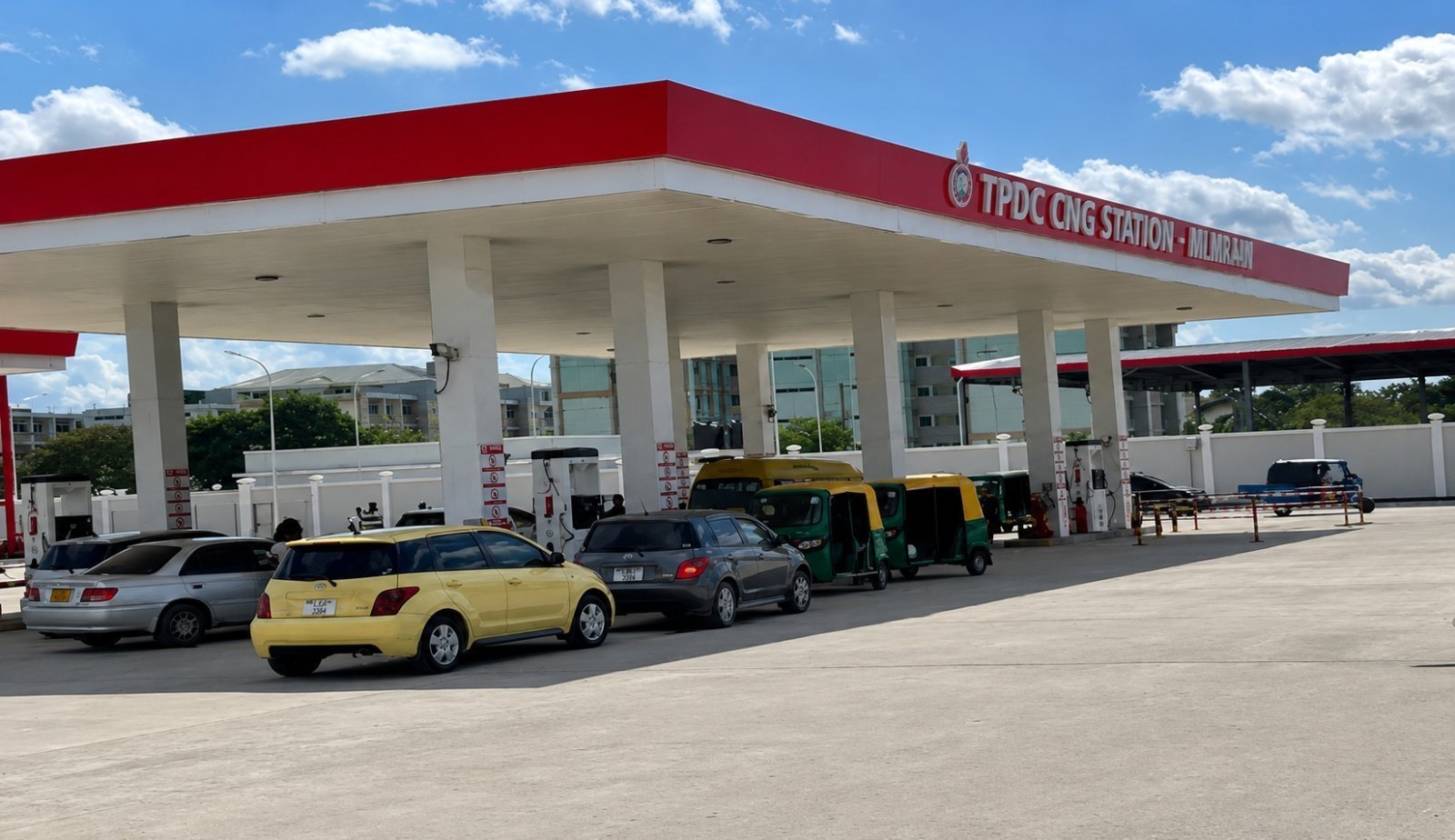
Tanzania’s compressed natural gas market is beginning to move from policy ambition into measurable transport demand, giving the country a potential domestic buffer against rising dependence on imported petrol and diesel.
The case is built around a sharp imbalance. Tanzania imported 10.66 billion litres of petroleum products in the 2024/25 financial year, a 15.6 percent increase from 9.22 billion litres a year earlier. Of that volume, 40.28 percent was for the domestic market, while 59.72 percent was transit fuel for neighbouring countries moving through Tanzanian ports. Local petroleum imports were almost flat, down 0.46 percent, but transit imports surged, with transit diesel alone rising 36.21 percent to 4.56 billion litres.
At the same time, Tanzania holds discovered natural gas reserves of about 57.54 trillion standard cubic feet, according to the Energy and Water Utilities Regulatory Authority. That creates a policy question with real economic weight: can Tanzania use more of its own gas in transport to reduce external fuel dependency, lower logistics exposure and improve energy security?
The answer is increasingly data-driven. Compressed natural gas, or CNG, is not yet large enough to materially replace imported petroleum. But the growth curve is difficult to ignore.
In the 2023/24 financial year, CNG use in vehicles rose by 292 percent, with average daily refuelling increasing from 490 vehicles to 1,919 vehicles. The following year, CNG production reached 12.80 million kilogrammes, up from 7.27 million kilogrammes in 2023/24. Vehicles consumed 11.19 million kilogrammes, or 87 percent of total CNG output, while industrial users consumed 1.40 million kilogrammes and commercial users took 207,902 kilogrammes.
That is strong growth from a low base. It does not yet change the structure of Tanzania’s petroleum market, but it shows that where supply exists, users are responding.
Transport is the centre of petroleum demand
Tanzania consumed 5.12 billion litres of petroleum products in 2024/25, up 10.3 percent from 4.64 billion litres in 2023/24. Diesel accounted for 2.82 billion litres, while petrol reached 2.01 billion litres. The retail network, which is heavily linked to road transport, consumed 3.16 billion litres, equal to 61.8 percent of total petroleum consumption. Direct consumers, including agriculture and industries, accounted for 28.9 percent, while mining, aviation and power generation took smaller shares.
This is why CNG matters most in transport. Tanzania’s fuel-import exposure is not abstract. It is tied to vehicles moving people, food, cement, manufactured goods, port cargo, farm inputs, mining supplies and regional freight. Fuel prices enter the cost structure of almost every productive sector.
A CNG car saves money for one user. A CNG bus can affect commuting costs for hundreds of passengers. A CNG truck can influence the delivered price of goods across retail, agriculture, construction and manufacturing.
That makes heavy transport the strategic market. Tanzania had 15,954 CNG vehicles and three-wheel motorcycles by June 2025, up from 7,000 a year earlier. But the composition shows that adoption is still concentrated in smaller mobility. The CNG fleet included 1,001 sedans, 2,093 hatchbacks, 603 trucks, 451 vans and mini-vans, 312 sport utility vehicles and wagons, 34 buses and 11,460 three-wheel motorcycles.
The truck and bus numbers are still small. That is the central limitation of the CNG story. Tanzania’s CNG market is growing, but it has not yet penetrated the highest fuel-consuming vehicle classes at scale.
The import-pressure case
The energy-security argument is not only about the number of litres imported. It is also about how those imports are financed and moved.
EWURA said foreign-currency constraints strained import financing in 2024/25, while higher throughput created an urgent need to modernise receiving infrastructure to reduce demurrage costs and protect Tanzania’s competitiveness as a regional energy gateway. The regulator also pointed to the need to enhance petroleum supply security through a Strategic Petroleum Reserve.
Those details matter because they show that fuel dependency is not just a pump-price issue. Imported petroleum exposes the economy to dollar availability, shipping costs, port congestion, demurrage, global oil markets and geopolitical shocks. Tanzania can manage those risks through procurement, storage and infrastructure, but it cannot remove them while transport remains overwhelmingly dependent on imported liquid fuels.
CNG offers a partial hedge. It does not remove the country from the global oil market. It does not replace petroleum imports in the near term. But it can reduce the growth of imported fuel demand if deployed where consumption is highest.
That means the policy focus should not be broad and symbolic. It should be targeted: trucks, buses, port fleets, municipal vehicles, industrial transport, cement distribution, mining-service fleets and logistics operators on high-traffic corridors.
Gas reserves are large, but usable supply is the real constraint
Tanzania’s gas-resource base is strong, but reserves are not the same as immediately available supply. The country’s current production comes mainly from Songo Songo in Lindi and Mnazi Bay in Mtwara. In 2024/25, Songo Songo produced 28.43 billion standard cubic feet, while Mnazi Bay produced 34.22 billion standard cubic feet, bringing total natural gas production to 62.65 billion standard cubic feet.
Natural gas consumption stood at 63.30 billion standard cubic feet in 2024/25. Power generation remained the dominant user, consuming 47.11 billion standard cubic feet, or 74.43 percent of total gas consumption. Industries consumed 15.61 billion standard cubic feet, or 24.65 percent. CNG vehicles consumed 565.06 million standard cubic feet, equal to only 0.89 percent of total natural gas consumption.
That number is important. Even after rapid growth, CNG remains marginal in the national gas balance. Its current share is too small to transform Tanzania’s energy-security position today.
The opportunity lies in what that small base can become. If vehicle CNG consumption can grow from less than one percent of gas use into a meaningful transport segment, Tanzania would create a direct link between domestic gas and reduced liquid-fuel import exposure.
The gas system also has room for more non-power use. EWURA reported that combined installed capacity across four natural gas processing facilities is 470 million standard cubic feet per day, with the Madimba plant at 210 million standard cubic feet per day, Songo Songo at 140 million, Songas at 110 million and Maurel & Prom at 10 million. Capacity utilisation in 2024/25 remained below full potential across all plants, partly because gas use for power generation declined.
That shift could support more gas use in industry, transport and commercial markets, provided supply, pricing and distribution infrastructure are expanded in parallel.
Infrastructure is beginning to follow demand
CNG adoption depends on refuelling confidence. Fleet owners will not convert trucks or buses if station access is limited, queues are long, or supply is unreliable.
The early network is expanding. In 2024/25, EWURA issued 28 construction approvals and seven operation licencesfor natural gas supply facilities and CNG filling stations, mainly in Dar es Salaam and Pwani. As of June 2025, Tanzania had 186.177 kilometres of natural gas distribution pipelines and four CNG receiving terminals supplying gas through virtual pipeline systems.
CNG filling stations increased from five in 2023/24 to nine in 2024/25, with operators located mainly in Dar es Salaam, alongside own-use facilities such as Dangote Cement’s stations in Mtwara and Mkuranga.
For a national transport economy, that remains a small base. Heavy transport needs corridor coverage, not only urban visibility. Stations have to be placed near port gates, truck yards, inland container depots, bus terminals, industrial parks, cement routes, mining corridors and major highways.
Dar es Salaam and Pwani are the logical first markets because they combine port activity, industry, fleet concentration and consumer demand. The next stage would need to follow freight and passenger corridors toward Morogoro, Dodoma, Tanga, Mtwara, Mbeya, Mwanza and regional routes serving Zambia, Rwanda, Burundi, Malawi, Uganda and the Democratic Republic of Congo.
Future gas supply could strengthen the case
Tanzania’s future CNG capacity will also depend on new gas development.
The Ntorya Gas Field in the Ruvuma Block has estimated resources of about 1.6 trillion cubic feet. The Tanzania Petroleum Development Corporation says Phase I of the project targets 40 million to 60 million standard cubic feet per day, while Phase II is planned to lift production to 140 million standard cubic feet per day. A 35-kilometre, 14-inch pipeline is planned to connect Ntorya to the Madimba Natural Gas Processing Plant.
That supply outlook matters because a serious CNG programme cannot rely only on existing stations in Dar es Salaam. It needs gas availability closer to industrial and logistics demand. If Ntorya and related pipeline investments expand supply flexibility, CNG can move from an urban refuelling niche toward a corridor-based fuel system.
The same applies to mini-LNG and virtual pipeline systems. For regions outside the main pipeline network, mobile and modular gas delivery systems could help serve industrial users, remote commercial customers and future CNG corridors before full pipeline expansion becomes economical.
Petroleum demand projections sharpen the urgency
EWURA says Tanzania’s petroleum demand has followed a long-term upward trajectory, with historical data indicating average annual growth of about 6 percent.
If domestic petroleum consumption grows at that historical average, demand would rise from 5.12 billion litres in 2024/25 to about 6.85 billion litres by 2029/30. The transport-heavy retail segment would rise from 3.16 billion litres to roughly 4.24 billion litres over the same period.
These are indicative calculations based on EWURA’s historical growth reference, not official forecasts. But they show the scale of the challenge. Tanzania does not need CNG to replace all petroleum products for the fuel to matter. It needs CNG to slow the growth of imported petrol and diesel in the parts of the economy where fuel consumption is highest.
Even after rapid growth, CNG remains marginal relative to Tanzania’s petroleum market. Vehicle CNG consumption of 11.19 million kilogrammes in 2024/25 is still small when measured against domestic petroleum consumption of 5.12 billion litres. Its energy-security value therefore depends less on current volumes and more on whether adoption can move into high-consumption fleets such as trucks, buses, port logistics vehicles, municipal fleets and industrial transport. Without that shift, CNG will remain a cost-saving niche rather than a national fuel-import hedge.
Heavy transport is the decisive test
The economics of CNG are strongest when vehicles operate frequently, consume large volumes of fuel and return to predictable refuelling points. That makes the first scalable markets easier to identify.
Port trucks are one category. They operate around concentrated logistics zones, consume significant diesel volumes and serve trade flows that affect wider business costs. City buses are another. They follow regular routes and return to depots, making fleet refuelling easier to plan. Cement, beverage, manufacturing and mining-support fleets also offer anchor demand because they are high-consumption users with predictable routes.
This matters for investors. A station built for scattered private cars carries demand risk. A station anchored by bus operators, logistics companies or industrial fleets has a clearer utilisation case. Once anchor demand is secured, smaller users can follow.
The same principle applies to vehicle dealers and fleet financiers. CNG trucks and buses will not scale without asset financing, maintenance capacity, cylinder certification, spare-parts availability and trained technicians. A lower fuel bill is not enough if operators face high conversion costs, safety uncertainty or weak after-sales support.
The industrial value case
The strongest version of Tanzania’s CNG story is not only about fuel substitution. It is about domestic value creation.
A larger CNG ecosystem can create demand for gas processing, compression, transport, station construction, equipment maintenance, certified conversion workshops, safety inspection, fleet management systems, technical training, engineering services and local finance. EWURA reported that companies registered in the Local Suppliers and Service Providers database rose to 2,450 by June 2025, up from 2,132 a year earlier.
That base can be used to widen Tanzanian participation in the gas value chain. The risk is that the country replaces imported petroleum with imported CNG equipment, imported kits, imported cylinders and foreign technical services. The stronger model would localise more of the support economy over time.
For Tanzania, this is where CNG crosses from energy policy into industrial policy. Domestic gas should not only power electricity plants or be reserved for future liquefied natural gas exports. Part of it can serve domestic mobility, industrial competitiveness and logistics resilience.
The limits are clear
CNG is not a complete energy-security solution. It remains a fossil fuel. It still requires imported equipment in parts of the value chain. It needs strict safety management. It requires upfront investment from vehicle owners and station operators. It also competes with other uses of gas, including power generation, industrial heat, households, commercial users and potential export projects.
There are also technical and behavioural constraints. Long-distance truckers need reliable refuelling across corridors. Bus operators need depot-linked supply. Banks need confidence in resale values and conversion standards. Insurers need clarity on risk. Regulators need inspection capacity. Consumers need assurance that CNG vehicles are safe and convenient.
Those constraints explain why CNG adoption can grow quickly in numbers but still remain limited in strategic impact. Three-wheelers and private cars can build public visibility. Heavy transport determines national relevance.
A practical hedge, not a silver bullet
The numbers now allow a measured conclusion. Tanzania imported 10.66 billion litres of petroleum products in 2024/25. Domestic petroleum consumption reached 5.12 billion litres. Transport-linked retail demand accounted for 61.8 percent of total consumption. CNG vehicle use is rising fast, with 15,954 vehicles and three-wheelers by June 2025, but vehicle CNG consumption still represents less than 1 percent of total natural gas consumption.
That means CNG is not yet a national replacement for petrol and diesel. It is a practical hedge against future import pressure.
Its importance will depend on targeted scale. If Tanzania moves CNG into trucks, buses, port fleets, industrial logistics and regional freight corridors, the country can convert part of its natural gas base into lower transport-fuel exposure. If adoption remains concentrated in small vehicles and three-wheelers, CNG will continue to grow, but its energy-security effect will remain limited.
The opportunity is now measurable. Petroleum imports are rising. Domestic petroleum demand is on a long-term upward path. CNG consumption is expanding. Gas reserves are large. New supply projects such as Ntorya are being prepared. Infrastructure approvals are increasing.
The policy test is execution. Tanzania has a domestic fuel that can move part of its own economy with less exposure to external oil markets. CNG will not replace every imported litre. But in heavy transport, it can become one of the country’s most practical tools for de-risking fuel dependency, supporting logistics competitiveness and turning natural gas reserves into domestic economic value.
 Uchumi360
Business Intelligence
Uchumi360
Business Intelligence
Uchumi360 covers business, investment, and economic policy across East, Central, and Southern Africa.
For the serious reader
You read to the end. That places you in a small group.
Uchumi360 is built for readers who demand precision over speed, structure over sentiment, and analysis that holds uncomfortable conclusions rather than softening them. If this work sharpens how you think about Africa's economy, help us keep building the infrastructure behind it.
Institutional Partners
Commission intelligence. Shape the conversation.
Uchumi360 works with development finance institutions, investment firms, sovereign bodies, and strategic organisations across the coverage region. Institutional partnership unlocks:
- Commissioned sector and country intelligence reports
- Branded research series under your institution's authority
- Exclusive data briefings for internal strategy teams
- Speaking and editorial presence at Uchumi360 events
- Co-published investment outlooks for your markets
Support Our Work
Independent analysis has a cost. Help us bear it.
Uchumi360 does not carry advertising. It does not take editorial direction from sponsors. Every article is produced without commercial compromise. Your contribution funds the reporting, research, and editorial infrastructure that keeps this analysis free from influence.
Secure checkout: One-time and monthly support are processed securely. Add payment credentials to enable checkout here.
Stay Connected
Keep up with every new insight.
Follow our latest analysis, policy coverage, and market intelligence as soon as it is published. If you need something specific, reach out directly and we will point you to the right research.
