
Kenya’s $16 Billion Refinery Bid Puts Tanzania’s Energy Gateway Under Pressure
Ready
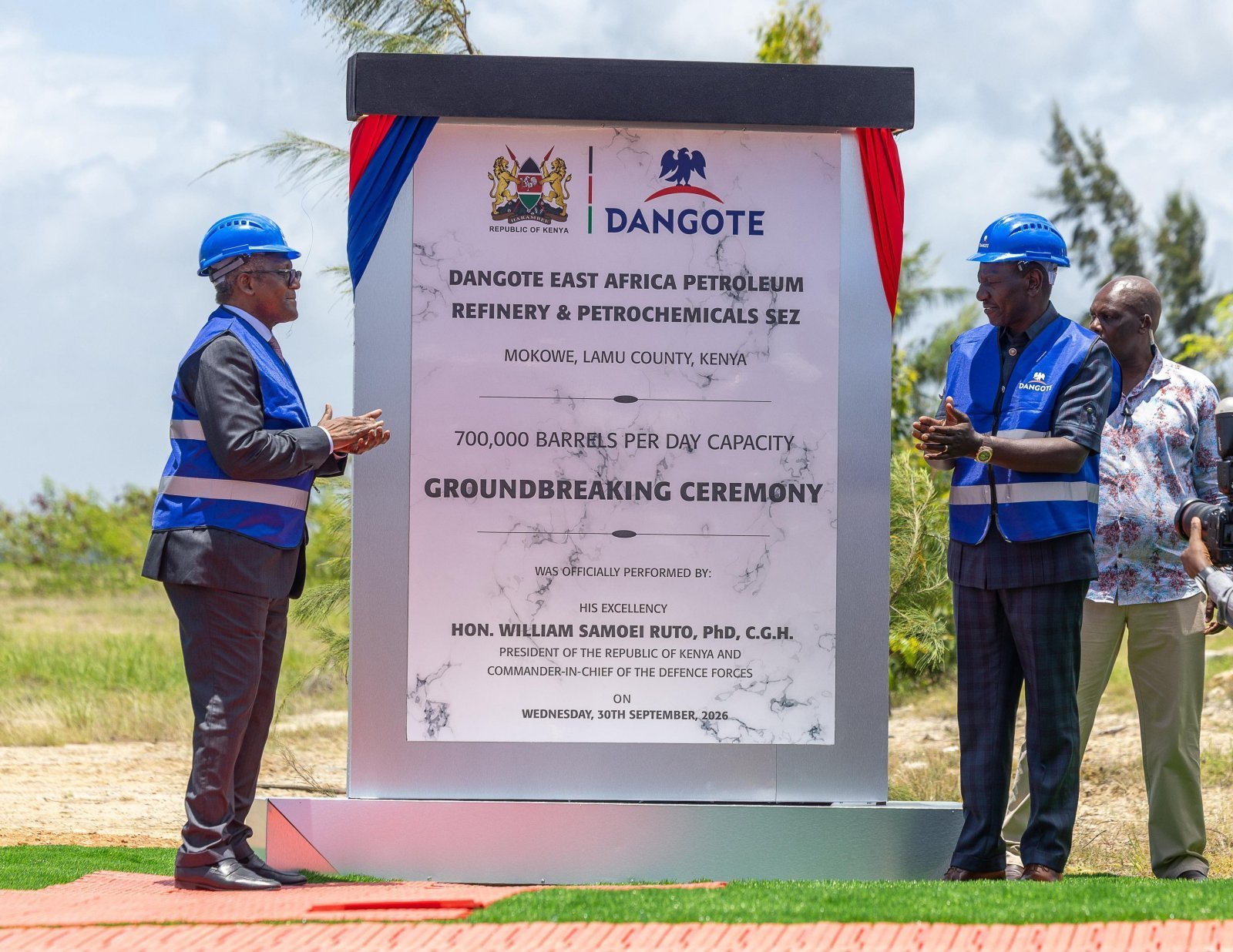
Kenya broke ground on the $16 billion Dangote East Africa Petroleum Refinery in Lamu on September 30, 2026. The refinery is designed to process up to 700,000 barrels of crude per day and is expected to include a 1,000 MW power plant, positioning Lamu as a potential petroleum and industrial hub for East and Central Africa. President William Ruto described the project as an investment in energy security, industrialisation and regional integration, while Aliko Dangote said the facility should be completed within 40 months and argued that Africa must process more of what it produces. The project carries a direct Tanzanian dimension because Dangote says Tanga was considered before Lamu was selected. Uganda, meanwhile, says it still intends to develop its own refinery and has previously discussed Tanga. The result is a new regional infrastructure contest involving Lamu, Tanga and Uganda’s refining plans. The project also faces unresolved land claims in Lamu, where a court has ordered the status quo maintained on disputed land until October 14.
DAR ES SALAAM — Kenya has begun construction of a $16 billion refinery in Lamu that could reshape the economics of petroleum supply across East Africa and put new pressure on Tanzania’s established role as a gateway for fuel moving into the region. The Dangote East Africa Petroleum Refinery is designed to process up to 700,000 barrels of crude oil per day and is expected to include power generation capacity of up to 1,000 MW. President William Ruto presented the investment as part of a much wider industrial strategy, describing it as “an investment in energy security, industrialisation, and regional integration.” The distinction is significant because Kenya is attempting to combine refining, power generation, port infrastructure and regional distribution in one location, potentially giving Lamu a role in the regional energy system that extends well beyond Kenya’s domestic market.
Ruto used the launch to place the refinery within a broader argument about Africa's industrial capacity. “We must produce more of what we consume. We must add value to more of what we produce. And we must progressively replace what we import with what we manufacture,” he said, while also stating that Kenya spent KSh530 billion importing petroleum products last year. The economic proposition behind the project is therefore straightforward. Kenya wants to retain more value from petroleum consumption inside its economy while using Lamu’s location to serve markets beyond its borders. If the refinery achieves commercial scale and can distribute products competitively into neighbouring countries, the investment could change the economics of fuel supply along several East African corridors.
The Lamu project puts Tanzania directly into Kenya’s energy calculation
The Tanzanian dimension is unusually direct because Lamu was not the only coastal location considered for the refinery. Dangote said Tanga had previously been considered before the project moved to Lamu, explaining that the Kenyan location offered deeper waters, suitable ground for heavy equipment, and deep-sea access. That history gives the project a particular relevance for Tanzania because Tanga sits within the same northern East African petroleum geography and has previously featured in discussions around Uganda’s crude and refining plans. The choice between the two locations was therefore not simply a decision about where to construct a refinery. It was also a decision about which coastal corridor would have the opportunity to anchor a much larger industrial and energy system.
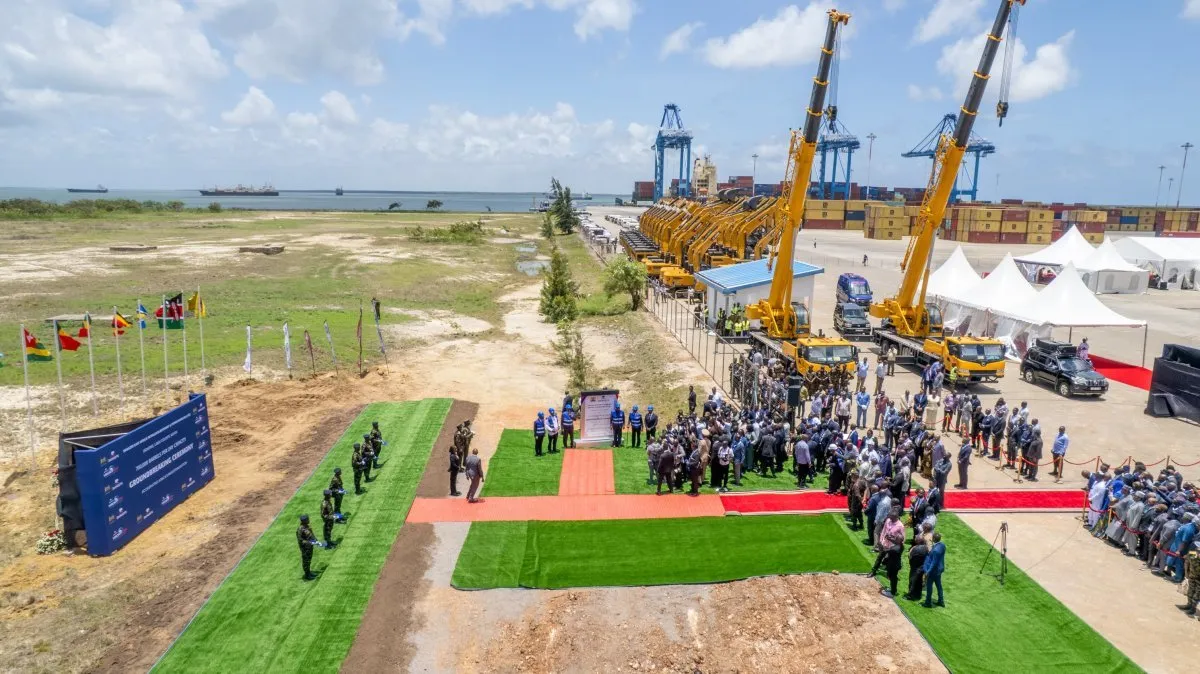 Dangote described the decision in personal terms at the groundbreaking, saying that before discussions around the project he had “never really heard of any name called Lamu” and that he had been introduced to the location through discussions with Ruto. He subsequently argued that Lamu offered the physical characteristics required for the project. The consequence for Tanzania is that a major private investor who considered Tanga has now committed to building a refinery at the Kenyan coast, creating a new industrial centre that will eventually compete for crude, capital, logistics activity and regional fuel markets.
Dangote is building a refinery, but he is selling a much larger industrial proposition
The project is being presented as considerably broader than a facility that converts crude into petrol and diesel. Dangote said the investment would include “tanks, pipelines, processing units and jetties” and described the objective as building “an industrial ecosystem.” The refinery is expected to be accompanied by large scale power generation and supporting infrastructure, giving Lamu the potential to attract businesses that depend on petroleum products, electricity, logistics and industrial services. That model could increase the economic importance of the project because the refinery becomes an anchor for other activity rather than an isolated processing plant.
Dangote has also attached a skills development component to the investment. He told Lamu leaders that the company would establish a training school capable of training 1,000 local people and linked that commitment to a wider argument about African technical capacity. “Going forward in the future, we don’t have to go and bring Chinese, Indians, or so to come and build our infrastructure,” he said. “We are going to build capacity here.” The economic question is whether those skills eventually translate into local engineering, maintenance, contracting and industrial businesses capable of participating beyond the construction phase. For Lamu, that could determine how much of the refinery's economic value remains within the local economy.
The Pan African argument is central to the project
Dangote has framed Lamu as part of a continental industrialisation story rather than simply a Kenyan investment. “This is Africa coming together to build Africa,” he said at the ceremony, adding that the project represents “a new chapter in Africa’s industrial journey.” He compared Lamu with his Lekki refinery in Nigeria and said, “Lekki proved that it can be done, Lamu must prove that it can be repeated.” The comparison is important because Dangote is effectively presenting the two projects as evidence that large scale African private capital can finance and operate industrial infrastructure previously associated with multinational oil companies and state owned enterprises.
He went further by defining the underlying economic problem in terms of the continent's commodity structure. “Africa cannot build lasting prosperity by exporting what it has and importing what it needs,” Dangote said. “We must produce more of what we consume. We must process more of what we produce.” Ruto made a similar argument in his speech, saying that Africa's resources should become the beginning of African industry rather than the end of its contribution to global prosperity. In petroleum, that means retaining more processing activity, engineering work, logistics, tax revenue and industrial demand within African economies instead of sending crude abroad and importing finished products.
Uganda's position shows why East Africa may develop several refinery strategies
The regional picture becomes more complicated when Uganda's position is considered. President Yoweri Museveni attended the groundbreaking but made clear that Uganda's own refining ambitions remain alive. “We’re going to build a small refinery in Uganda,” he said, adding, “We had planned this long ago. We can’t change that.” Museveni also referred directly to Tanzania, saying, “We had also discussed a refinery in Tanga. I don’t know what happened,” before saying he wanted to discuss the issue with Ruto and President Samia Suluhu Hassan.
Those remarks expose a central tension in East Africa's energy planning. Kenya is building Lamu as a large regional refinery. Uganda intends to retain domestic refining capacity close to its own crude production. Tanzania has an established petroleum import and distribution network and remains strategically positioned between the Indian Ocean and multiple landlocked markets. The region therefore has several national energy strategies developing simultaneously, even as political leaders increasingly describe energy infrastructure as a foundation for regional integration.
Ethiopia sees Lamu as another route into the regional energy market
Ethiopia's participation adds another dimension because the country's enormous consumer market could become an important destination for refined products from the Kenyan coast. Prime Minister Abiy Ahmed said the refinery would give Ethiopia another regional source of petroleum products, stating that “an additional regional source will broaden our supply options and create new opportunities for trade and investment.” That is the commercial proposition behind Lamu's regional ambition. A refinery of 700,000 barrels per day cannot depend solely on Kenyan demand if it is to operate at the scale envisaged by its developers.
Abiy also framed the project through the question of African ownership and skills. “Young Africans should not remain observers of projects such as this,” he said. “They should become their engineers, technicians, entrepreneurs, and leaders.” His comments align with the broader argument made by Ruto and Dangote that industrialisation should create productive capacity inside African economies. Whether that happens will depend less on the symbolism of the groundbreaking than on the extent to which African workers, suppliers, investors and businesses participate in the refinery's construction and eventual operation.
For Tanzania, the competition is shifting from ports to value chains
Ruto captured the infrastructure logic of the investment with one of the strongest lines from the ceremony: “A corridor without commerce is just a road. A port without industry is just a harbour.” His argument is particularly relevant to Tanzania because Dar es Salaam has already established itself as a major gateway for petroleum and general cargo moving into the interior. The Central Corridor connects the port with several landlocked markets, while Tanga has strategic relevance to northern Tanzania and Uganda. Lamu is now attempting to build a competing model in which the port itself becomes the starting point for a much larger industrial chain.
This changes the nature of the corridor competition in East Africa and the wider region. Tanzania does not necessarily lose its position simply because Kenya builds a refinery, because petroleum logistics depend on distance, infrastructure, storage, taxes, pipeline capacity, financing and the reliability of supply. But Lamu gives Kenya an industrial asset that Tanzania does not currently have at comparable scale. If refining is combined with storage, power generation, port facilities and efficient inland transport, Kenya could capture economic activity that previously passed through Tanzanian infrastructure without being processed there.
The biggest test will be whether Lamu can secure a regional crude and product market
The headline capacity of 700,000 barrels per day is enormous, but the commercial test will be feedstock and market access. Kenya does not produce enough crude to supply a refinery of that scale from domestic production alone, meaning Lamu will depend on imported or regionally sourced crude. Dangote has said the facility's deep sea access was one reason the site was selected, allowing crude to arrive by sea and potentially enabling the refinery to serve markets beyond Kenya.
Uganda's position is therefore commercially significant. The country is developing its own oil production and has long debated the most efficient relationship between crude exports, domestic refining and regional infrastructure. If Uganda retains substantial crude for domestic refining, Lamu would need to compete for feedstock from other producers. If regional governments instead develop agreements linking crude production to multiple refineries and distribution corridors, the same infrastructure could become complementary rather than competitive.
The project also carries a local economic question that Kenya cannot avoid
The scale of the investment has generated expectations in Lamu, but it has also created disputes over land and local livelihoods. A court order concerning disputed land associated with the project did not stop the September 30 groundbreaking, but the underlying legal issues remain unresolved. Ruto addressed the concerns directly, asking who would receive jobs, whether local businesses would win contracts, what would happen to land and whether fishermen would retain their livelihoods.
“These questions are not obstacles to development,” Ruto said. “They are questions responsible development must answer.” That formulation is economically relevant because the value of a $16 billion project cannot be measured only by its capital expenditure. Its longer term contribution will depend on employment, local procurement, skills transfer, taxation, ownership, infrastructure access and whether businesses around the refinery become productive participants in the new industrial corridor.
Lamu puts a new question before Tanzania
The immediate Tanzanian question is not whether Dar es Salaam will stop being a regional energy gateway. Its established infrastructure and connections to landlocked markets will continue to matter. The more consequential question is whether Tanzania can capture a larger share of the value created around the energy flows that already pass through its territory.
Lamu demonstrates the advantage of attaching industrial production to a logistics corridor. Kenya is attempting to connect port infrastructure, refining, power generation, storage and regional distribution in one investment strategy. Tanzania has its own opportunity to develop a deeper industrial proposition around Dar es Salaam and Tanga, particularly as regional demand for energy, transport and manufacturing expands.
Ruto described the wider ambition as a generational project. “Our forebears secured the flag,” he said. “Our generation must build the industries that make independence real in the lives of every citizen.” Dangote expressed the same objective in a shorter formulation: “Africa must industrialise Africa.”
For East Africa, the significance of Lamu will ultimately be determined by what happens after the speeches. If the refinery connects African crude to African consumers, creates local industrial capacity and integrates with neighbouring economies, it could become a major regional manufacturing and energy asset. If Tanzania, Uganda and Kenya respond by building isolated national systems, the region may end up with competing infrastructure serving the same markets.
The more consequential competition is therefore no longer over which port handles East Africa's fuel. It is over which corridor captures the processing, manufacturing, finance, skills and trade that come after the cargo arrives. East Africa is entering a contest over who captures the value between the oilfield and the consumer.
FAQ
Why is Kenya building the Lamu refinery? The project is being presented as an effort to expand refining capacity, reduce dependence on imported petroleum products and create a larger industrial base around the Lamu port corridor. President William Ruto said Kenya spent KSh 530 billion on petroleum imports last year and framed the refinery as part of a broader push to process more of what Africa produces within the continent.
How large is the Lamu refinery project? The project is valued at about US$16 billion and is designed to process up to 700,000 barrels of crude oil per day. The wider complex is also planned to include up to 1,000 MW of power generation, with the stated intention of supplying petroleum products and supporting industrial activity across East and Central Africa.
Could the Lamu refinery affect Tanzania's position in regional petroleum trade Potentially. Lamu is being developed alongside Kenya's broader LAPSSET corridor and is intended to serve regional markets, including landlocked economies. Tanzania already serves several of these markets through the Dar es Salaam corridor, so a large refinery linked to a deepwater port could introduce a new source of competition for petroleum storage, distribution and transit business.
Why did Dangote choose Lamu instead of Tanga? Aliko Dangote said the project had previously considered Tanga in Tanzania but that Lamu offered advantages including deeper waters, suitable ground conditions for heavy industrial equipment and direct deep sea access. He also described the location decision as part of the commercial considerations behind developing the refinery.
Will the refinery serve countries beyond Kenya? The project is explicitly being presented as a regional facility. Ethiopian Prime Minister Abiy Ahmed said the refinery could provide Ethiopia with an additional regional source of petroleum products, while the Kenyan government has framed the project as serving East and Central Africa. The actual scale of regional supply will depend on the refinery's eventual production, pricing and transport economics.
When is the refinery expected to be completed? Dangote committed to returning to Lamu to commission the refinery within 40 months of the September 30, 2026 groundbreaking. That places the stated target around early 2030, although the completion date remains a project commitment rather than an independently verified delivery date.
What happens to Lamu residents and local businesses? The project has generated questions over land, livelihoods, fishing, environmental protection and local participation. Ruto explicitly acknowledged these concerns at the groundbreaking and said local residents should receive jobs, business opportunities and protection of their rights. Dangote also announced plans for a training school intended to train 1,000 people from Lamu.
 Uchumi360
Business Intelligence
Uchumi360
Business Intelligence
Uchumi360 covers business, investment, and economic policy across East, Central, and Southern Africa.
For the serious reader
You read to the end. That places you in a small group.
Uchumi360 is built for readers who demand precision over speed, structure over sentiment, and analysis that holds uncomfortable conclusions rather than softening them. If this work sharpens how you think about Africa's economy, help us keep building the infrastructure behind it.
Institutional Partners
Commission intelligence. Shape the conversation.
Uchumi360 works with development finance institutions, investment firms, sovereign bodies, and strategic organisations across the coverage region. Institutional partnership unlocks:
- Commissioned sector and country intelligence reports
- Branded research series under your institution's authority
- Exclusive data briefings for internal strategy teams
- Speaking and editorial presence at Uchumi360 events
- Co-published investment outlooks for your markets
Support Our Work
Independent analysis has a cost. Help us bear it.
Uchumi360 does not carry advertising. It does not take editorial direction from sponsors. Every article is produced without commercial compromise. Your contribution funds the reporting, research, and editorial infrastructure that keeps this analysis free from influence.
Secure checkout: One-time and monthly support are processed securely. Add payment credentials to enable checkout here.
Stay Connected
Keep up with every new insight.
Follow our latest analysis, policy coverage, and market intelligence as soon as it is published. If you need something specific, reach out directly and we will point you to the right research.
