
Mozambique’s Gas Giant Awakens. Now Comes the Hard Part
Ready
Mozambique’s ambition to become a major liquefied natural gas exporter moved another step forward on September 10, when ExxonMobil announced preliminary offshore engineering agreements for Rovuma LNG. The development envisages 18 wells and associated subsea infrastructure. Yet the company’s announcement contained an important qualification: the partners were still working toward a final investment decision in 2026. Momentum is building, but the biggest commitments are not all settled.
Mozambique’s ambition to become a major liquefied natural gas exporter moved another step forward on September 10, when ExxonMobil announced preliminary offshore engineering agreements for Rovuma LNG. The development envisages 18 wells and associated subsea infrastructure. Yet the company’s announcement contained an important qualification: the partners were still working toward a final investment decision in 2026. Momentum is building, but the biggest commitments are not all settled.
That distinction captures Mozambique’s position. It has substantial discovered gas, an operating offshore export facility and several much larger developments advancing at different speeds. What it does not yet have is an economy transformed by the industry. The question is no longer simply whether the country can export gas. It is whether export growth can finance and help build a broader domestic economy.
The geological foundation is substantial. The TotalEnergies-led Mozambique LNG venture puts recoverable gas resources in Offshore Area 1 at approximately 65 trillion cubic feet, following discoveries that began in 2010. The commercial challenge is to connect that offshore resource to processing plants, shipping infrastructure and paying customers and to keep the entire system operating for decades.
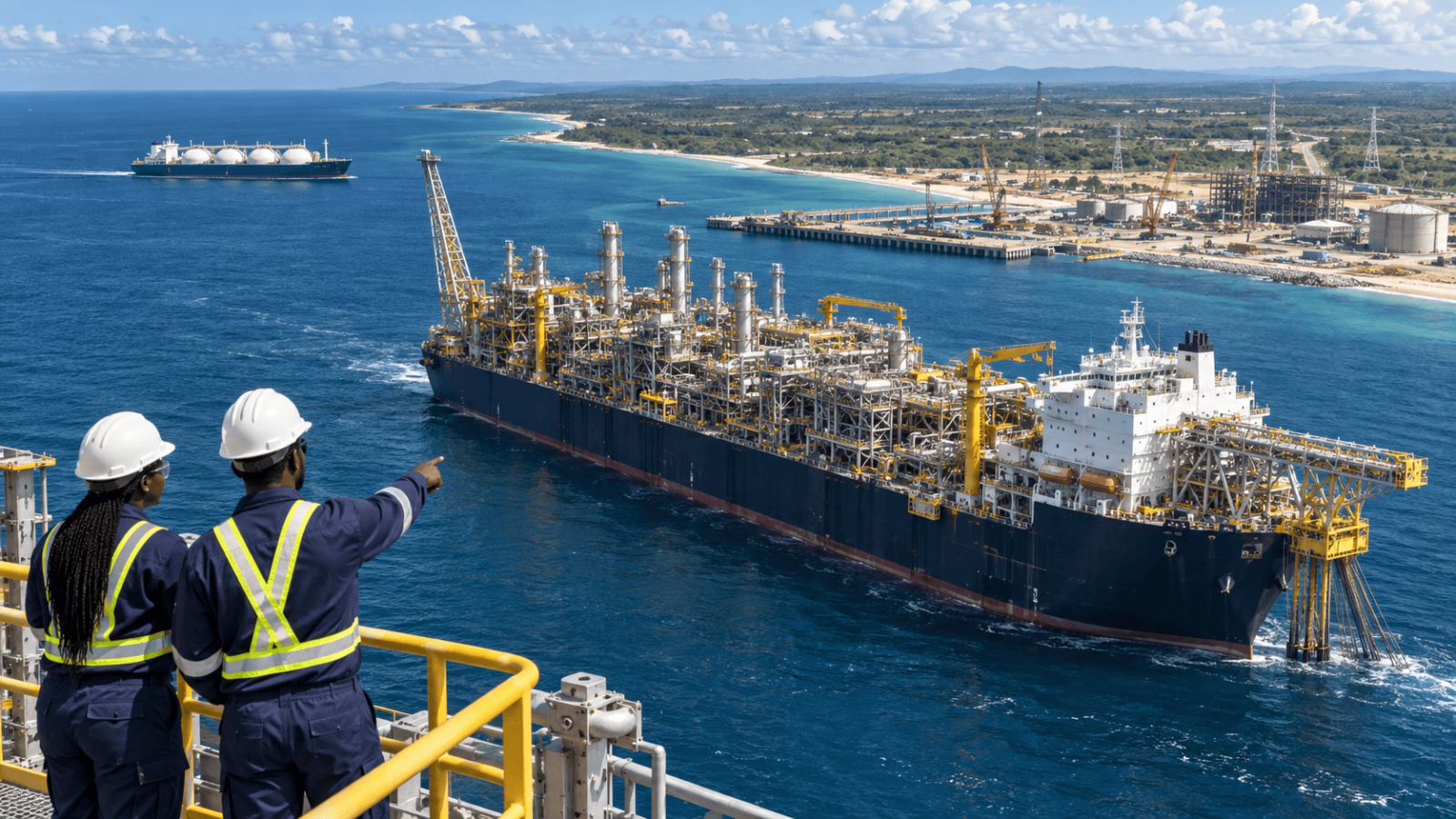
The first evidence that the northern discoveries could become a functioning export business came from Coral South. The Eni-led floating LNG project shipped its first cargo in November 2022 and has annual liquefaction capacity of 3.4 million tonnes. Mozambique therefore already participates in the international LNG market; the prospective boom is an expansion of an operating industry, not its creation from scratch.
Coral North is intended to extend that offshore model. Following a final investment decision in October 2025, the project’s floating production facility reached its hull-launch milestone in South Korea on January 16, 2026. Eni puts its capacity at 3.6 million tonnes a year and targets completion in 2028. Together, the two Coral developments would provide 7 million tonnes of annual capacity. Those figures describe the intended operating configuration, not current output. Coral North’s development status and Eni’s construction update.
The offshore sequence offers a useful lesson. Floating facilities allow some resources to be developed without waiting for the completion of a large coastal industrial complex. They do not eliminate construction, marine or commercial risks. Nor do they automatically create the extensive domestic infrastructure needed to supply factories and households. Delivering an export cargo and developing a national gas economy are different achievements.
The larger onshore developments face a more demanding test. Mozambique LNG was suspended in 2021 following an insurgent attack on Palma in Cabo Delgado. The disruption demonstrated that a resource discovery, financing package and construction contract could all be overtaken by a deterioration in security.
TotalEnergies and President Daniel Chapo announced a full restart of onshore and offshore activities on January 29, 2026, following the lifting of force majeure on November 7, 2025. The company reported project progress of 40% at the January restart and said first LNG was expected in 2029. Engineering and equipment procurement had advanced during the suspension, so the return to construction did not mean starting over.
The initial Mozambique LNG development comprises two liquefaction trains with combined capacity of 13.12 million tonnes a year. Its investment decision in 2019 covered a project valued at approximately $20 billion. That historical figure is not necessarily its final cost: Reuters reported in October 2025 that TotalEnergies had notified Mozambique of approximately $4.5 billion in additional costs associated with the suspension. The reported increase should not be treated as a fully settled revised budget.
Rovuma LNG would be larger still. ExxonMobil’s August 10, 2026 update specified 12 modular liquefaction units with combined capacity of 18.6 million tonnes a year and anticipated start-up in 2031. The company described the initial onshore engineering award as work supporting project definition ahead of a final investment decision. Contractor selection was therefore an advance toward construction approval, not evidence that the entire development had already been sanctioned.
The financial commitment is nevertheless becoming more tangible. On August 17, the Area 4 partners announced approximately $1.1 billion in pre-investment contracts for long-lead equipment, including subsea production systems, valves and offshore pipe. Such purchases can shorten the eventual construction schedule, while exposing investors to expenditure before the final go-ahead. They remain distinct from approval of the full project.
Adding the operators’ stated capacities for Coral South, Coral North, Mozambique LNG and Rovuma LNG produces a prospective total of about 38.7 million tonnes a year. That calculation combines an operating facility, developments under construction and a project still awaiting its final investment decision. It is not a production forecast, an export figure or a guarantee that all four facilities will operate simultaneously at full capacity. The scale of the opportunity is real; so is the distance between that opportunity and delivery.
Nigeria provides a useful benchmark. Nigeria LNG’s existing six-train plant has capacity of 22 million tonnes a year, while its Train 7 expansion is intended to increase that to 30 million. Nigeria is expanding an established export complex that began operating in 1999. Mozambique, by contrast, must build much of its proposed capacity through separate developments. Its prospective total may be larger, but comparing that total with Nigeria’s operating plant would confuse ambition with accomplishment.
Algeria illustrates a different gas model. Its industry serves domestic electricity demand and exports through both LNG facilities and pipelines to Europe. Gas supplied about 98% of Algerian electricity generation in 2023, according to the US Energy Information Administration. Mozambique’s northern developments are oriented toward seaborne LNG, while its national electricity strategy combines gas with substantial renewable generation. Algeria’s experience shows the importance of a domestic market—but also the need to balance that market with export commitments.
That balancing act can become difficult even for an experienced producer. The International Energy Agency estimates that Algeria’s LNG exports fell 18% in 2025, with reduced feedgas availability, domestic market priorities and infrastructure downtime contributing. For Mozambique, the lesson is that liquefaction capacity alone does not determine export performance. Reliable upstream production and competing domestic requirements matter as well.
Egypt offers a sharper warning. The IEA reports that Egyptian gas production fell almost 15% in the first 11 months of 2025, while LNG imports rose to more than 12 billion cubic metres for the year, from roughly 3 billion in 2024. LNG exports became marginal as domestic supply took priority. Mozambique’s immediate challenge is largely the reverse: building facilities to commercialise discovered gas. Egypt demonstrates what can happen later if production fails to keep pace with domestic needs.
Senegal and Mauritania are closer peers as emerging offshore exporters. Their shared Greater Tortue Ahmeyim development exported its first LNG cargo in April 2025. Project partner Kosmos describes a system combining deepwater production, offshore processing and a floating liquefaction facility near the maritime border, with domestic gas supply also planned. Like Mozambique’s Coral projects, it shows how an initial offshore development can establish an export business before a much wider industrial transformation takes place.
Tanzania is the most immediate regional comparison. Equinor reports nine discoveries containing more than 20 trillion cubic feet of gas in place in its offshore Block 2. Its public project description says the company and its partners are discussing LNG agreements with the government alongside the Shell-led partners in Blocks 1 and 4. The proposed Lindi plant remains described as dependent on a final investment decision. Mozambique has moved further in turning its northern discoveries into LNG exports. Tanzania’s position underscores that substantial resources alone do not settle commercial terms or unlock investment.
Mozambique’s own policy documents recognise the limits of an export-only strategy. The National Development Strategy 2025–2044, known as ENDE, sets a long-term ambition of reaching middle-income status through structural economic change. Its energy priorities include improving domestic supply and affordability, supporting competitive industry and expanding regional energy trade. Gas is part of that programme, not a substitute for the rest of it.
The industrial proposals are specific. ENDE identifies petrochemical development at Afungi and Vilankulo, including fertilisers and gas-to-liquids fuels. These are government development priorities, not evidence of financed factories or operating production lines. Their significance is the intended connection between gas resources and domestic manufacturing: Mozambique wants to earn income from industrial production as well as fuel exports.
The Government’s Five-Year Programme 2025–2029, or PQG, provides the nearer-term policy framework. The government’s announcement links the programme to ENDE and emphasises economic diversification, employment, infrastructure and sustainable management of natural resources. Those priorities offer a more useful test of the gas strategy than the value of announced investment alone: whether the industry helps other productive sectors expand.
Electricity access supplies another measurable test. Mozambique’s National Energy Compact targets universal electricity access by 2030, against the 60.1% baseline stated in the document. It estimates that achieving the goal requires 4.9 million additional connections through grid and off-grid systems. Its generation strategy includes gas alongside hydro, solar and wind, supported by transmission investment. The plan therefore does not assume that an LNG export boom will, by itself, electrify the country.
The practical implication is that domestic development requires its own investment case. Gas allocated to a power station or fertiliser plant still needs processing, transport infrastructure, a viable price and customers able to pay. Transmission lines and household connections need financing even when fuel is available. Announcing a domestic-use ambition is therefore the beginning of an industrial policy, not its completion.
Public finances make the timing particularly important. In its February 2026 assessment, the International Monetary Fund estimated Mozambique’s public-sector debt at 91.4% of GDP in 2025 and highlighted difficult government financing conditions. Its medium-term outlook placed the start of the next major LNG production wave from 2030 onward—a more cautious planning horizon than TotalEnergies’ stated 2029 target. The difference reinforces the case for fiscal plans that can withstand delays.
Nor are export receipts equivalent to government revenue. The public return depends on prices, operating costs, financing obligations, contractual arrangements and tax payments. The IMF welcomed completion of the sovereign wealth fund’s legal framework, while stressing governance, transparency and debt management. The economic implication is straightforward: future gas income cannot safely be treated as money already available for spending.
Employment claims require similar care. TotalEnergies says Mozambique LNG could provide up to 7,000 direct jobs for Mozambicans during construction and more than $4 billion in contracts for Mozambican companies. These are projected construction-phase benefits, not a count of permanent operating jobs or proof that the full contract value will remain in the domestic economy. Sustained gains will depend on the skills and businesses that remain competitive after construction ends.
Security and community relations remain part of that economic calculation. Restarting work is an important milestone, but it does not remove the need to protect communities, maintain access to livelihoods and ensure that local people share in the benefits. A durable gas industry needs more than a functioning construction site. It needs conditions in which businesses and households around that site can invest in their own futures.
Mozambique now has several concrete milestones against which progress can be judged: investment approval for Rovuma LNG, delivery of the facilities already under development, and implementation of its electricity and industrial plans. Each answers a different question. A signed contract demonstrates commitment. An operating plant demonstrates execution. Reliable electricity, competitive local suppliers and sustainable public finances demonstrate something more consequential.
The gas giant is awakening. Whether Mozambique becomes a more prosperous economy will be decided by what it builds beyond the export terminals.
 Uchumi360
Business Intelligence
Uchumi360
Business Intelligence
Uchumi360 covers business, investment, and economic policy across East, Central, and Southern Africa.
For the serious reader
You read to the end. That places you in a small group.
Uchumi360 is built for readers who demand precision over speed, structure over sentiment, and analysis that holds uncomfortable conclusions rather than softening them. If this work sharpens how you think about Africa's economy, help us keep building the infrastructure behind it.
Institutional Partners
Commission intelligence. Shape the conversation.
Uchumi360 works with development finance institutions, investment firms, sovereign bodies, and strategic organisations across the coverage region. Institutional partnership unlocks:
- Commissioned sector and country intelligence reports
- Branded research series under your institution's authority
- Exclusive data briefings for internal strategy teams
- Speaking and editorial presence at Uchumi360 events
- Co-published investment outlooks for your markets
Support Our Work
Independent analysis has a cost. Help us bear it.
Uchumi360 does not carry advertising. It does not take editorial direction from sponsors. Every article is produced without commercial compromise. Your contribution funds the reporting, research, and editorial infrastructure that keeps this analysis free from influence.
Secure checkout: One-time and monthly support are processed securely. Add payment credentials to enable checkout here.
Stay Connected
Keep up with every new insight.
Follow our latest analysis, policy coverage, and market intelligence as soon as it is published. If you need something specific, reach out directly and we will point you to the right research.
