
59.7 Percent of Rural Tanzanians With Electricity Are Powered by Solar, Not the Grid. Tanzania's Energy Transition Is Happening on Rooftops, Not Transmission Lines.
Ready
The NBS Household Energy Consumption Survey 2023 reveals that 59.7 percent of rural Tanzanian households with electricity use off-grid solar systems rather than the national grid. Solar has evolved from a temporary stopgap into a permanent component of Tanzania's energy architecture, driven by falling equipment costs, improved battery storage, and innovative pay-as-you-go financing models that allow households to acquire systems without upfront capital. The finding creates significant market implications: Tanzania's rural energy market is one of Africa's largest distributed electricity markets, generating commercial opportunities in battery manufacturing, smart metering, energy financing, productive use appliances, cold storage, and electric irrigation. Policy must adapt to support interoperability between grid and off-grid systems, establish solar equipment quality standards, and ensure financing remains accessible as the market scales.
DAR ES SALAAM — Tanzania's rural electrification is happening differently from how energy policy has traditionally imagined it.
The NBS Household Energy Consumption Survey 2023 reveals that 59.7 percent of rural households with electricity now rely on off-grid solar systems rather than connections to the national grid. More than half of electrified rural Tanzania is powered not by TANESCO transmission lines but by solar panels on rooftops, in fields, and on community installations whose generation occurs where electricity is consumed rather than hundreds of kilometres away at a centralised plant.
This is not a marginal phenomenon. It is the dominant mode of rural electrification in Tanzania today, and it reflects a structural shift in energy economics that conventional grid-extension planning did not anticipate at this scale.
How solar economics changed
For most of the past two decades, off-grid solar was positioned as a temporary measure for communities too remote or too expensive to connect to the national grid. The assumption was that grid extension would eventually reach every community and solar would be superseded.
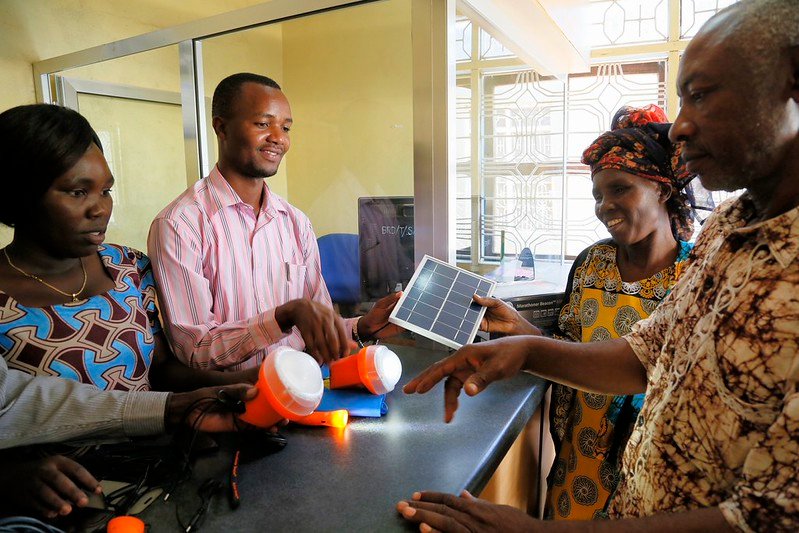
Rapid improvements in solar technology, falling photovoltaic panel costs, better battery storage capacity, and the emergence of pay-as-you-go financing models have changed the economics fundamentally. A rural household that would have waited years for grid extension can now acquire a solar home system on a mobile-money payment plan, receiving light, phone charging, and basic appliance power within days of signing up. The wait for the grid to arrive has been replaced by an immediate commercial transaction.
Companies including ZOLA Electric, Engie Energy Access, and M-KOPA have scaled pay-as-you-go solar models across Tanzania's rural market, converting what was a capital-intensive infrastructure barrier into a recurring revenue model that mirrors mobile money in its accessibility. The household pays a small amount weekly or monthly, building toward full ownership of a system that increases in capability as the payment record matures.
The result is the 59.7 percent figure the NBS survey documents: more than half of electrified rural Tanzania chose solar over waiting for the grid, not because the grid was unavailable in all cases, but because solar was accessible, affordable, and immediate.
What decentralised electricity does to rural economies
The 59.7 percent solar penetration rate is an energy statistic with economic implications that extend well beyond the energy sector.
A rural shop whose owner can operate under electric lighting until 9pm rather than closing at sunset serves more customers and generates more revenue than it did before solar. A health clinic whose refrigeration is solar-powered can maintain vaccine cold chains reliably, reducing preventable disease and improving healthcare quality. A school with solar lighting can host evening adult education programmes. A farmer with a solar-charged irrigation controller can manage water schedules more precisely. A mobile money agent operating through solar can serve customers continuously rather than dependent on TANESCO supply reliability.
Each of these micro-level changes contributes incrementally to rural productivity. The aggregate effect of 59.7 percent of rural Tanzania having reliable electricity, even at the modest capacity of most solar home systems, on rural economic activity is larger than any single intervention can capture.
The investment market this creates
The NBS finding has direct implications for investors evaluating Tanzania's energy market.
Tanzania's rural solar sector is one of sub-Saharan Africa's most scaled distributed electricity markets. The commercial opportunities it generates extend beyond solar panel sales to battery storage, whose economics improve with each generation of technology; smart metering systems that enable pay-as-you-go models at decreasing cost; agricultural productive use equipment including solar irrigation pumps and solar cold storage; rural digital services whose viability depends on reliable electricity; and consumer finance products for solar-powered appliances whose market is created by the energy access the solar installation provides.
The companies that built Tanzania's pay-as-you-go solar market understand this. ZOLA Electric and Engie Energy Access have progressively expanded from basic lighting kits toward solar home systems capable of powering televisions, fans, and small productive equipment. The market logic is clear: a customer who adopted solar for lighting will upgrade to solar for productivity if the financing terms and equipment reliability support it.
Grid and solar are complements, not competitors
The 59.7 percent rural solar penetration should not be read as a threat to grid expansion. The two systems serve different use cases that the NBS data implicitly describes.
Urban centres, industrial zones, manufacturing parks, and high-density residential areas require the grid's capacity and reliability for the commercial and industrial loads that solar systems cannot economically serve at relevant scales. The Julius Nyerere Hydropower Project's 2,115MW and the 8,000MW target by 2030 are correctly calibrated for the industrial electricity demand whose growth TISEZA's manufacturing pipeline will generate.
Rural dispersed settlements, smallholder agricultural communities, and remote areas whose grid extension cost per household is high relative to the demand density they represent are precisely the use case where distributed solar economics are strongest. A national energy strategy that treats grid extension and solar deployment as complementary tools rather than competing priorities will reach universal access faster and at lower total cost than one that treats the grid as the only legitimate electrification pathway.
Tanzania's NBS data suggests this complementary model is already emerging organically from household-level decisions. Energy policy now needs to formalise and support what the market is already doing.
 Uchumi360
Business Intelligence
Uchumi360
Business Intelligence
- - National Bureau of Statistics Tanzania, Household Energy Consumption Survey 2023
- 59.7 percent of rural households with electricity using off-grid solar
- Available at nbs.go.tz
- - Tanzania National Development Plan 2026/27
- JNHPP 2,115MW, 8,000MW target 2030, installed capacity 4,522.54MW March 2026
- Available at planning.go.tz
- - Tanzania Ministry of Finance, FY2026/27 Budget Speech
- Village electrification 100 percent FY2024/25
- Available at mof.go.tz
Uchumi360 covers business, investment, and economic policy across East, Central, and Southern Africa.
For the serious reader
You read to the end. That places you in a small group.
Uchumi360 is built for readers who demand precision over speed, structure over sentiment, and analysis that holds uncomfortable conclusions rather than softening them. If this work sharpens how you think about Africa's economy, help us keep building the infrastructure behind it.
Institutional Partners
Commission intelligence. Shape the conversation.
Uchumi360 works with development finance institutions, investment firms, sovereign bodies, and strategic organisations across the coverage region. Institutional partnership unlocks:
- Commissioned sector and country intelligence reports
- Branded research series under your institution's authority
- Exclusive data briefings for internal strategy teams
- Speaking and editorial presence at Uchumi360 events
- Co-published investment outlooks for your markets
Support Our Work
Independent analysis has a cost. Help us bear it.
Uchumi360 does not carry advertising. It does not take editorial direction from sponsors. Every article is produced without commercial compromise. Your contribution funds the reporting, research, and editorial infrastructure that keeps this analysis free from influence.
Secure checkout: One-time and monthly support are processed securely. Add payment credentials to enable checkout here.
Stay Connected
Keep up with every new insight.
Follow our latest analysis, policy coverage, and market intelligence as soon as it is published. If you need something specific, reach out directly and we will point you to the right research.
