
Tanzania Adds $274 Million Fuel Storage Capacity as Dar Port Targets Regional Energy Trade
Ready
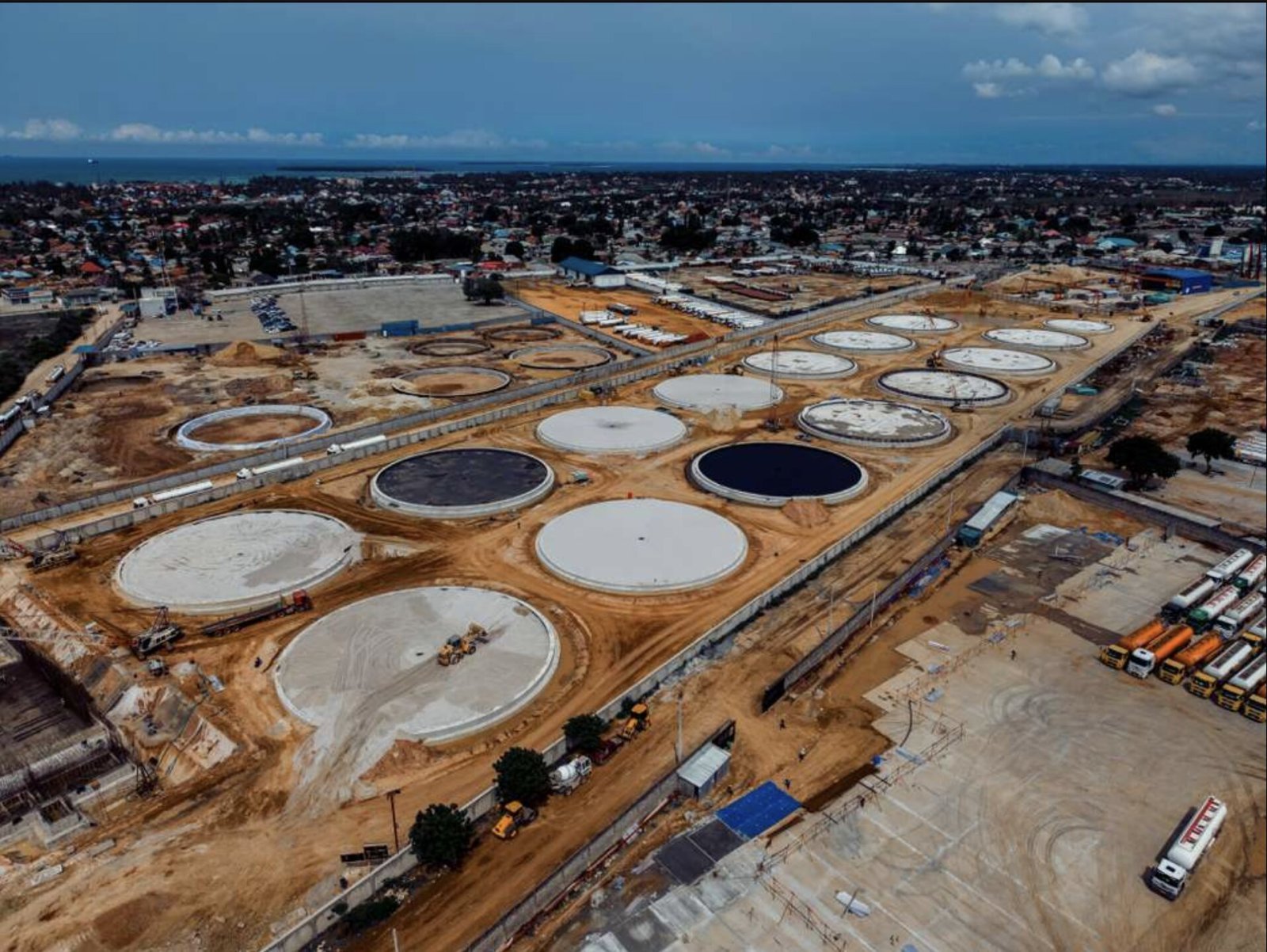
Tanzania is adding 378,000 cubic metres of petroleum storage at Dar es Salaam Port through a TZS 701.8 billion project that is now 52 percent complete. The facility, being built at Tungi in Kigamboni, consists of 15 tanks for diesel, petrol and Jet A1 aviation fuel and is designed to reduce delays in receiving imported petroleum products. Tanzania's existing receiving terminals had a combined capacity of 1.637 million cubic metres as of June 2024, with Dar es Salaam accounting for 1.045 million cubic metres. The new facility would therefore expand Dar es Salaam's receiving storage by about 36 percent. The investment also comes as Tanzania handles substantial fuel volumes for neighbouring landlocked markets, making storage capacity a regional trade issue rather than only a domestic energy concern.
DAR ES SALAAM — Tanzania is adding 378,000 cubic metres of petroleum storage at Dar es Salaam Port through a TZS 701.8 billion project that is now 52 percent complete, giving the country's main fuel gateway substantially more room to receive imported petroleum products and serve regional markets.
The project at Tungi in Kigamboni consists of 15 tanks covering diesel, petrol and aviation fuel. Tanzania Ports Authority says construction began in 2024 and that the project is intended to reduce vessel waiting time, lower demurrage costs and improve the efficiency of petroleum handling at the port. The latest progress update, issued after a TPA inspection on September 3, 2026, puts implementation at 52 percent. That makes the project one of the most consequential pieces of midstream petroleum infrastructure currently being added to Tanzania's trade system.
Why is Tanzania spending TZS 701.8 billion on fuel storage?
The economics of the project begin with a simple constraint. Tanzania imports large quantities of refined petroleum products, but the ability to receive a ship is only useful if sufficient storage space exists after the cargo reaches the port. EWURA's FY2023/24 data recorded 23 operational petroleum receiving terminals at Dar es Salaam, Tanga and Mtwara with a combined capacity of 1,637,222 cubic metres. Of that total, the receiving terminals listed at Dar es Salaam accounted for 1,045,499 cubic metres, while Tanga had 180,933 cubic metres and Mtwara had 54,493 cubic metres. The remaining capacity in the national total includes the TAZAMA terminal at Kigamboni, which has 231,000 cubic metres of diesel storage.
The figures also expose an error in some descriptions of Tanzania's existing infrastructure. Mtwara does not have approximately 935 million litres of petroleum storage, as stated in the supplied draft. EWURA's official FY2023/24 depot table records only 54,493 cubic metres at Mtwara, equivalent to about 54.5 million litres, while Tanga has 180,933 cubic metres, or about 181 million litres. Dar es Salaam's 1,045,499 cubic metres is approximately 1.045 billion litres. The national figure of 1,637,222 cubic metres is therefore the appropriate number for describing total receiving storage, rather than adding the individual port figures in the original draft as though all three were billion litre facilities.
The new 378,000 cubic metres represents an increase of about 36 percent over Dar es Salaam's 1.045 million cubic metres of receiving terminal storage recorded by EWURA. Once operational, the new tanks would bring the Dar es Salaam receiving terminal network to roughly 1.423 million cubic metres, assuming the existing capacity remains unchanged. The project is therefore better understood as an expansion of the country's principal petroleum receiving system rather than a replacement for Tanzania's existing storage network. The TPA project is also separate from the 231,000 cubic metre TAZAMA storage terminal, which serves the diesel pipeline connection to Zambia.
What exactly is being built at Kigamboni?
The facility comprises 15 tanks. Six are designed for diesel, five for petrol, three for Jet A1 aviation fuel and one is an interface tank. The three main product categories have capacities of 162,000 cubic metres for diesel, 135,000 cubic metres for petrol and 81,000 cubic metres for Jet A1, giving the project its total 378,000 cubic metre capacity. The configuration reflects the products that dominate Tanzania's petroleum import system and gives the port dedicated space for aviation fuel as well as road transport fuels.
The construction contract is valued at TZS 678.6 billion including VAT and was awarded to a joint venture between China Railway Major Bridge Engineering Group and WUHUAN Engineering. TPA separately contracted Khatib and Alami Consulting Engineering Offshore, working with Projmors and Anova Consult, for project supervision at TZS 23.2 billion over 24 months. The two components bring the reported project value to TZS 701.8 billion. TPA's September 2026 update says the project had reached 52 percent completion.
The construction history also shows why the project's timeline needs to be reported carefully. TPA records the formal start of construction as August 16, 2024, and in February 2025 the Transport Ministry reported progress of 14.77 percent. By March 2026, TPA reported 41 percent completion, while the government's 2026 budget documentation referred to an earlier target of completion in August 2026. By September 3, however, the project stood at 52 percent. The most recent public completion date identified in the project's March 2026 reporting was February 3, 2027, meaning the August 2026 target cited earlier should no longer be treated as the operative completion date.
How much petroleum does Tanzania move through its ports?
The storage expansion becomes more consequential when placed against Tanzania's role in regional petroleum supply. EWURA's petroleum data shows that imported products entering Tanzania serve several markets. These include mainland Tanzania, Zanzibar through transshipment, and transit markets in Zambia, Malawi, the Democratic Republic of Congo, Rwanda, Burundi and Uganda. EWURA's fact sheet records a 40:60 ratio between imports for the local market and transit markets, illustrating that a large share of the petroleum infrastructure around Tanzania's ports serves trade beyond the domestic economy.
The latest EWURA fact sheet available in 2025 reported average daily mainland consumption of 6.18 million litres of petrol and 8.27 million litres of diesel, alongside 592,651 litres of Jet A1 and 10,326 litres of kerosene. Those figures alone put petrol and diesel consumption at roughly 14.45 million litres a day. The same publication reported 4.01 billion litres of liquid fuel imports for the domestic market and 4.72 billion litres for transit markets, although those import figures cover a broader period than a single day's consumption and should not be directly divided into the daily demand numbers without accounting for stock movements and transit flows.
This regional dimension changes the economics of storage. A tanker carrying fuel for Zambia, Malawi, Rwanda, Burundi or the DRC does not represent only Tanzanian consumption. Tanzania is functioning as the maritime entry point for an inland market whose demand is partly determined by economic activity beyond its borders. Storage capacity at Dar es Salaam therefore becomes part of the infrastructure through which several landlocked economies access global petroleum markets. The same logic explains why delays at the port can propagate through trucking, fuel distribution and industrial supply chains well beyond Dar es Salaam.
Can another 378,000 cubic metres materially change tanker delays?
TPA says it can. The authority's September 2026 assessment says the project is intended to reduce petroleum vessel waiting times from more than 30 days to an average of two days. It also cites estimated demurrage costs of about US$25,000 per day. At that rate, a 30 day wait would imply approximately US$750,000 in demurrage for a vessel, although that calculation is an illustration based on the stated daily rate and maximum waiting period rather than a measured average cost across all vessels.
The underlying problem has been documented independently of the latest construction update. A performance audit by Tanzania's Controller and Auditor General found that the absence of a common petroleum receiving facility had contributed to delays and additional charges associated with discharging imported fuel. The audit also recorded the government's decision to use TIPER infrastructure temporarily as a single receiving terminal before the new facility was developed. It noted that the existing arrangement did not provide sufficient capacity for diesel requirements.
That makes the new facility an investment in throughput as much as storage. If vessels can discharge faster because product can move directly into dedicated tanks, the port can process imported cargo without waiting for existing tanks to empty before another shipment is received. The economic benefit would therefore come from higher asset utilisation, shorter vessel turnaround times and lower costs associated with waiting, rather than simply from the number of litres physically sitting inside the new tanks.
Does the project make Tanzania a regional fuel hub?
Tanzania already has many of the physical characteristics of a regional petroleum gateway. Dar es Salaam receives large ocean going fuel shipments, the country has receiving terminals at three ports, road tankers distribute petroleum inland and across borders, and TAZAMA connects Dar es Salaam with Zambia through a 1,710 kilometre pipeline. EWURA describes road transport as the dominant mode for moving petroleum products within Tanzania and to neighbouring landlocked countries, while TAZAMA provides a separate strategic route for diesel into Zambia.
The new tanks add another layer to that network. Dar es Salaam's existing receiving storage is already much larger than the individual capacities recorded at Tanga and Mtwara, and the new facility will widen that gap. This concentration gives Dar es Salaam greater ability to receive large petroleum cargoes and distribute them into Tanzania's domestic market and the regional transit system. It also creates a stronger economic case for complementary investments in pipelines, rail freight, inland depots and cross border logistics because the value of additional coastal storage depends partly on how efficiently fuel can move away from the port.
There is also a strategic distinction between being a fuel importer and being a fuel logistics hub. Tanzania does not need to produce all the petroleum it handles to earn economic value from the trade. Revenue can arise from port services, storage, transport, handling, taxes and associated logistics even when the product itself is imported. The investment at Kigamboni therefore supports a wider trade model in which Tanzania's geographic position on the Indian Ocean becomes an economic asset for supplying a large inland market.
What does the expansion mean for Tanzania's energy security?
Storage does not eliminate exposure to global oil prices. Tanzania remains dependent on imported refined petroleum products, meaning international crude prices, refinery margins, freight costs, exchange rates and geopolitical disruptions can still affect domestic prices. EWURA's pricing system explicitly incorporates international petroleum market costs into the regulated cap prices for petrol, diesel and kerosene. The new storage infrastructure can improve physical supply security and reduce port related costs, but it cannot insulate consumers from the international price of petroleum.
Its value is therefore strongest during short term supply disruptions and periods of logistical stress. A larger receiving and storage system allows Tanzania to hold more product at the point where international cargoes enter the country and can reduce the probability that a delay involving one vessel immediately constrains downstream availability. That function becomes more important as regional demand grows and Tanzania handles a larger share of petroleum moving towards landlocked markets.
The investment also sits alongside a broader debate over strategic petroleum reserves. An EWURA presentation on strategic petroleum reserves reported that the country's 1.637 million cubic metres of operational receiving storage is equivalent to a limited buffer relative to petroleum demand, while the Petroleum Act 2025 gives TPDC a mandate connected to establishing strategic petroleum reserves. The new TPA tanks should therefore not automatically be described as a strategic petroleum reserve. Their immediate function is petroleum receiving and storage infrastructure, although additional storage can contribute to the country's broader supply security.
The bigger economic story is what happens after the tanks are filled
The TZS 701.8 billion investment solves one constraint in Tanzania's petroleum supply chain, but its full economic return will depend on what connects the tanks to the rest of the region. If storage capacity expands faster than inland evacuation capacity, the bottleneck can simply move from the port to roads, railways, pipelines or inland depots. EWURA's infrastructure data already shows the importance of this question because Tanzania's coastal terminals hold 1.637 million cubic metres while inland terminals have a nominal combined capacity of 75,625 cubic metres, most of which EWURA says is not operational.
The strongest interpretation of the Kigamboni project is therefore not that Tanzania has solved its fuel security problem. It is that the country is expanding the first major link in a regional petroleum logistics chain. The next economic test will be whether storage, ports, pipelines, railways, trucks and inland depots are developed as one system capable of moving fuel reliably into Tanzania and the neighbouring economies that increasingly depend on Dar es Salaam as an import corridor. A larger tank farm can increase the capacity of the gateway, but the value of a gateway is ultimately determined by how much trade it can move through it.
FAQ
How much will Tanzania's new petroleum storage project cost? The project has a reported total value of TZS 701.8 billion. TPA says the construction contract with China Railway Major Bridge Engineering Group and WUHUAN Engineering is worth TZS 678.6 billion including VAT, while project supervision costs a further TZS 23.2 billion.
How much additional fuel can the new facility store? The 15 tanks will have a combined capacity of 378,000 cubic metres, equivalent to about 378 million litres. Six tanks will hold diesel, five petrol, three Jet A1 aviation fuel and one will serve as an interface tank.
How much petroleum storage does Tanzania currently have? EWURA recorded 1,637,222 cubic metres of operational petroleum storage at receiving terminals in Dar es Salaam, Tanga and Mtwara in FY2023/24. Dar es Salaam accounted for 1,045,499 cubic metres, Tanga 180,933 cubic metres and Mtwara 54,493 cubic metres, with the national total also incorporating other receiving infrastructure including the TAZAMA terminal.
Which countries depend on Tanzania's fuel import corridor? Tanzania's petroleum import infrastructure serves domestic consumers as well as transit markets in Zambia, Malawi, the Democratic Republic of Congo, Rwanda, Burundi and Uganda. EWURA's 2025 fact sheet reported a 40:60 ratio between petroleum imports for the local and transit markets.
When will the new tanks be completed? TPA reported 52 percent completion as of September 3, 2026. A March 2026 project update reported by The Citizen gave February 3, 2027 as the scheduled completion date, while an earlier government document had cited August 2026, making the February 2027 date the later published schedule identified in the available reporting.
Will the project eliminate fuel price increases in Tanzania? No. The storage expansion can reduce costs associated with port delays, vessel waiting and fuel handling, but Tanzania remains dependent on imported petroleum products and therefore remains exposed to international fuel prices, freight costs, exchange rates and other external factors. EWURA's regulated pricing system incorporates international petroleum market costs into domestic fuel price calculations.
 Uchumi360
Business Intelligence
Uchumi360
Business Intelligence
Uchumi360 covers business, investment, and economic policy across East, Central, and Southern Africa.
For the serious reader
You read to the end. That places you in a small group.
Uchumi360 is built for readers who demand precision over speed, structure over sentiment, and analysis that holds uncomfortable conclusions rather than softening them. If this work sharpens how you think about Africa's economy, help us keep building the infrastructure behind it.
Institutional Partners
Commission intelligence. Shape the conversation.
Uchumi360 works with development finance institutions, investment firms, sovereign bodies, and strategic organisations across the coverage region. Institutional partnership unlocks:
- Commissioned sector and country intelligence reports
- Branded research series under your institution's authority
- Exclusive data briefings for internal strategy teams
- Speaking and editorial presence at Uchumi360 events
- Co-published investment outlooks for your markets
Support Our Work
Independent analysis has a cost. Help us bear it.
Uchumi360 does not carry advertising. It does not take editorial direction from sponsors. Every article is produced without commercial compromise. Your contribution funds the reporting, research, and editorial infrastructure that keeps this analysis free from influence.
Secure checkout: One-time and monthly support are processed securely. Add payment credentials to enable checkout here.
Stay Connected
Keep up with every new insight.
Follow our latest analysis, policy coverage, and market intelligence as soon as it is published. If you need something specific, reach out directly and we will point you to the right research.
