
Africa Once Tried to Build What It Needed. What Happened to That Economic Ambition?
Ready
Africa’s first generation of governments treated factories, refineries, electricity, agriculture and technical capability as extensions of political independence. Many early industrial projects later failed, but the continent’s subsequent dependence on imported manufactured goods has created another problem: African consumption increasingly supports production, jobs and industrial knowledge outside Africa.
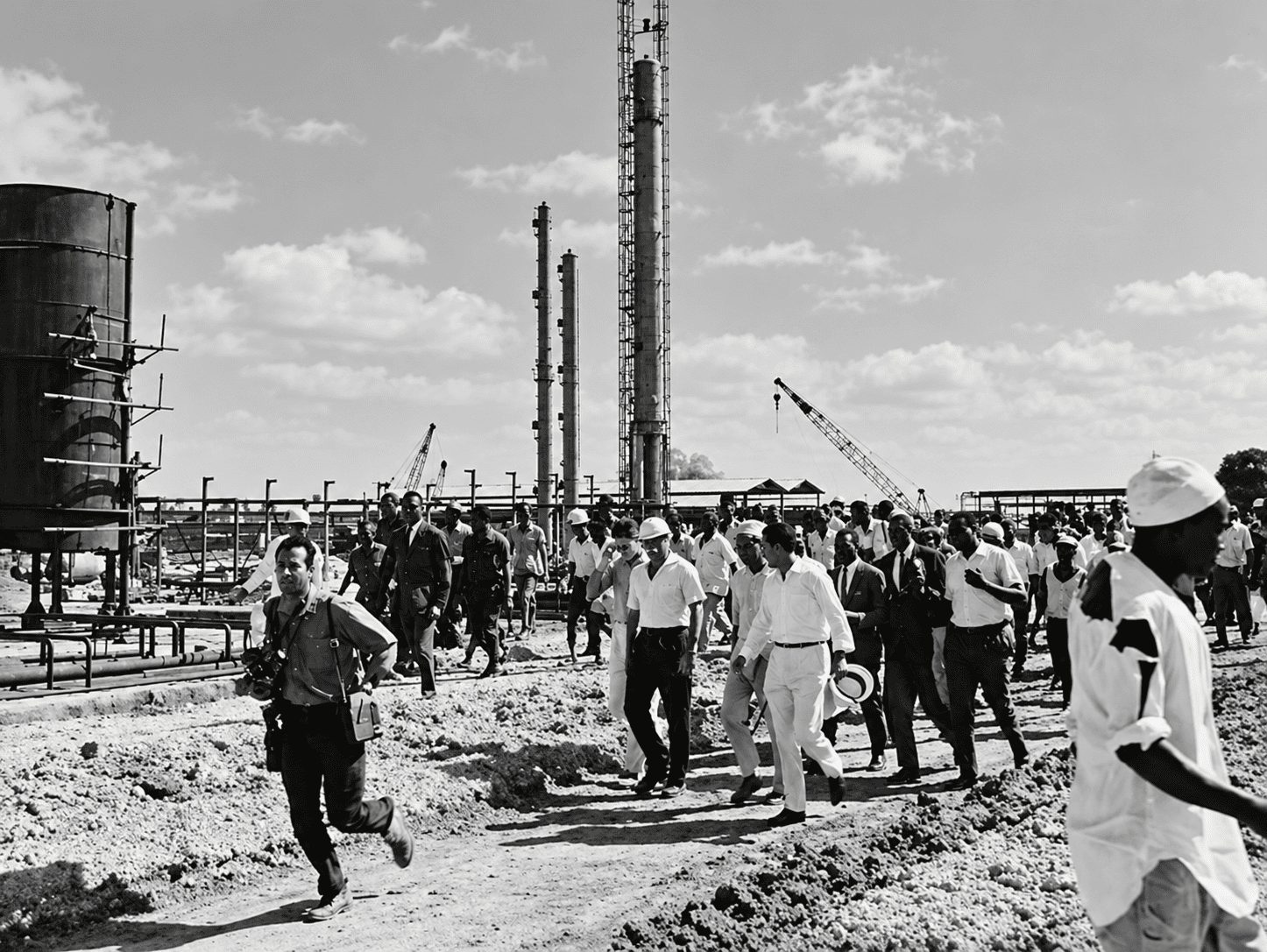
In the first decades after independence, many African governments approached economic sovereignty as something that had to be built physically. Political independence had removed colonial administrations, but the new states still imported machinery, petroleum products, manufactured consumer goods, medicines, industrial equipment, and technical expertise from economies that had spent decades or centuries accumulating productive capacity. The first generation of African leaders therefore confronted an uncomfortable reality: a country could control its flag, parliament, and foreign policy while remaining dependent on external producers for much of what kept its economy functioning. Their response varied from country to country, but industrialization, agricultural transformation, electricity generation, domestic refining, infrastructure, and, in several cases, defense manufacturing became central parts of national development strategy.
The economic results were mixed and should not be romanticized. Some factories were built without sufficient market demand, state enterprises accumulated losses, agricultural policies disrupted production, foreign exchange controls distorted incentives, and protected manufacturers often had little reason to become internationally competitive. By the 1980s, many of these systems were under severe pressure from debt, oil shocks, drought, weak management, and declining access to foreign exchange. Structural adjustment subsequently dismantled or liberalized large parts of the post-independence economic model. Much of that correction was necessary. What followed, however, was not simply the closure of inefficient public enterprises. In many countries, the broader political commitment to building domestic productive capability also weakened, while importing finished products became progressively easier than developing industries capable of producing them competitively at home.
The consequences are visible in Africa’s current trade structure. UNIDO estimates that manufactured goods now account for between 88 percent and 94 percent of imports across African regional economic communities. Africa represented just 2 percent of global manufacturing value added in 2024 despite accounting for a much larger share of the world’s population and natural resources. The continent still exports a large proportion of its commodities at relatively low levels of processing while importing machinery, fuels, chemicals, pharmaceuticals, vehicles, electronics, textiles, and processed consumer goods carrying considerably more value.
This is where the economic history becomes relevant again. Several newly independent African countries were attempting to build refineries, hydroelectric dams, fertilizer factories, steel plants, textile mills, and defense industries when their populations, government revenues, engineering workforces, and domestic markets were only a fraction of what they are today. The question is not whether Africa should reproduce the economic policies of the 1960s. It is why the determination to build productive capacity was stronger when the continent possessed far fewer resources with which to do it.
Independence Was Initially Understood as an Economic Project
Ghana under Kwame Nkrumah offers one of the clearest examples. Independence in 1957 was followed by an ambitious attempt to transform a cocoa exporting economy into a more industrial one. The Akosombo project was central to that vision because electricity was expected to support aluminium production and a wider manufacturing base. Ghana also commissioned the Tema Oil Refinery in September 1963, only six years after independence. Tema Oil Refinery itself describes the facility as Ghana’s first major value adding investment after the Akosombo Dam.
Nkrumah’s wider ambition for aluminium was even more revealing. Ghana possessed bauxite and was building abundant hydroelectric power, so the strategic objective was to capture more of the aluminium chain domestically rather than remain an exporter of minerals and an importer of finished industrial products. The complete chain was never achieved, and Ghana would spend subsequent decades returning to essentially the same question of how to integrate bauxite mining, refining and aluminium production. The importance of the original plan lies less in whether every component succeeded than in the economic reasoning behind it: natural resources were expected to become inputs into domestic industry rather than merely commodities shipped abroad.
Tanzania followed a different ideological route after the Arusha Declaration of 1967, but self reliance was similarly understood in productive terms. The strategy called for reducing dependence on imported basic consumer and capital goods, developing local technical capability and transforming agriculture while the state assumed control over major sections of production and finance. A later Basic Industry Strategy introduced in 1975 explicitly sought to deepen industrialisation into heavier industries.
The initial industrial expansion was substantial. World Bank historical assessments show Tanzania’s manufacturing sector growing at an average annual rate of 9.4 percent between 1964 and 1973. Manufacturing increased from roughly 7 percent of GDP to 11.5 percent, and by 1973 nearly half of the country’s manufactured goods supply was being produced locally. That expansion later stalled under the combined pressure of the oil shock, drought, electricity shortages, foreign exchange constraints and wider weaknesses in the state enterprise system, but the scale of the earlier shift shows that industrial expansion was not merely political rhetoric. Productive capacity was actually being created.
Tanzania’s petroleum strategy reflected the same thinking. A refinery was established in Dar es Salaam in the early years after independence, while the country simultaneously invested in manufacturing, fertiliser, textiles and other industries. What is striking from the perspective of the 2020s is that Tanzania was trying to establish domestic refining capacity when its economy was dramatically smaller, the road network was limited, electricity access was low and the domestic vehicle fleet was tiny compared with today.
The strategic question facing policymakers at the time was not whether importing refined fuel might sometimes be cheaper. It was whether a country expected to industrialise could afford to remain permanently dependent on external producers for critical inputs.
Nigeria Built Refineries While Its Oil Industry Was Still Young
Nigeria’s petroleum history provides perhaps the clearest illustration of how Africa’s productive ambitions changed over time. The first Port Harcourt refinery began operating in 1965, only five years after independence. Warri followed in 1978, Kaduna in 1980 and a second Port Harcourt refinery in 1989. Nigeria eventually accumulated around 445,000 barrels per day of installed public refining capacity.
The economic logic was straightforward. Crude petroleum is only the beginning of the oil value chain. Refining adds engineering, processing, maintenance, storage, petrochemicals, logistics and skilled industrial employment before the final products reach consumers. A country that extracts crude oil and exports it while importing petrol, diesel and aviation fuel earns revenue from the resource but allows much of the industrial activity associated with that resource to take place somewhere else.
For periods in Nigeria’s early refining history, domestic capacity was sufficient to meet a large share of national petroleum product requirements. The deterioration came later as maintenance failures, weak management, underinvestment and political interference reduced utilisation. Eventually one of the world’s major crude producers became heavily dependent on imported refined products while its own state refineries operated far below capacity.
The absurdity of that arrangement is easier to see when the value chain is followed physically. Nigerian crude can be loaded onto a vessel, transported to a refinery abroad, processed by engineers and technicians employed in another economy, sold through international trading networks and transported back to West Africa as petrol or diesel. Nigeria earns from extracting the crude and spends foreign exchange buying back the more processed version.
The recent development of large private refining capacity, particularly the Dangote refinery, can therefore be understood not only as a commercial investment but as an attempt to reverse a structural problem that Nigeria had already identified six decades earlier.
Zambia Treated Fuel Supply as a Question of National Security
Zambia’s experience shows how closely early economic planning connected production infrastructure with sovereignty. At independence in 1964, much of Zambia’s petroleum supply depended on Rhodesia. When Rhodesia declared unilateral independence in 1965, Zambia suddenly faced the strategic risk of relying on a politically hostile route for an input essential to copper mining, transport and the wider economy.
The response was physical infrastructure. Tanzania and Zambia negotiated a pipeline agreement in 1967, TAZAMA was incorporated in 1968 and the system was subsequently expanded to move petroleum from Dar es Salaam into landlocked Zambia. The INDENI refinery was established in Ndola in 1973, creating a supply chain in which imported crude could enter through Tanzania, move inland and be refined in Zambia.
That investment was made by countries considerably poorer than they are today because dependence on external fuel supply was treated as a structural vulnerability. Zambia had just experienced how quickly geopolitics could interrupt energy access, and the solution was not simply to search for another foreign supplier. It was to build an alternative corridor and domestic processing capacity.
INDENI continued refining for decades but has since shifted away from its traditional refining role and now imports and distributes finished petroleum products. Its own corporate history describes the company today as an importer and seller of petrol, diesel, aviation fuel, kerosene and other finished products.
There can be valid commercial reasons for such a transition. Old refineries can become inefficient, upgrading them can require enormous capital and very large modern refineries can produce fuel more cheaply than smaller national facilities. But the calculation looks different when examined at the level of the national economy. Importing the final product removes part of the industrial process from the domestic economy and increases dependence on foreign refineries, international shipping, regional transport routes, foreign exchange availability and external price movements.
The events of recent years have repeatedly demonstrated the cost of that exposure. A war or disruption thousands of kilometres away can raise crude prices, refinery margins and freight costs almost simultaneously. African economies that import most of their petroleum requirements then experience higher transport costs, increased foreign exchange demand and inflation even when nothing has changed in domestic production. Energy dependence becomes a transmission channel through which geopolitical crises elsewhere enter household budgets and company balance sheets in Africa.
Egypt Connected Electricity, Agriculture and Heavy Industry
Egypt under Gamal Abdel Nasser pursued one of the continent’s most ambitious state led industrialisation programmes. The Aswan High Dam, whose construction began in 1960, was designed not simply as an electricity project but as infrastructure capable of reshaping agriculture, controlling the Nile and providing large amounts of power for a growing industrial economy. The first electricity from the High Dam was generated in 1967 as Egypt expanded steel, chemicals, engineering and other industries.
The significance of the dam was that electricity generation was embedded in a wider economic strategy. Industrialisation required dependable power, while agricultural modernisation required irrigation and water management. Infrastructure was therefore built around expected future production rather than simply around current consumption.
Egypt also invested in defence manufacturing because military dependence was viewed as an extension of economic dependence. Nigeria reached a similar conclusion remarkably early. The Defence Industries Corporation of Nigeria was established by an Act of Parliament in 1964, only four years after independence. With technical assistance from the West German firm Fritz Werner, its Kaduna facility was designed to manufacture thousands of rifles and submachine guns and millions of rounds of ammunition annually. During the Nigerian Civil War, production was expanded significantly, and after the conflict some of its machinery was used to manufacture civilian products including industrial spare parts and water equipment.
Nigeria was not technologically self sufficient, nor was the early defence industry independent of foreign expertise. That would be an unrealistic interpretation. What matters is that technology transfer and domestic manufacturing were built into procurement strategy. The government was attempting to move progressively from purchasing finished military equipment toward creating the engineering base required to produce at least some of it domestically.
DICON itself now acknowledges that its capabilities deteriorated over subsequent decades because of inadequate funding, changing defence requirements and institutional weaknesses, even as Nigeria’s dependence on imported military equipment remained substantial. Recent governments have again attempted to revive the organisation and expand local defence production.
The wider economic lesson is not that every African country should manufacture tanks, aircraft or missiles. Many countries lack the scale to do so efficiently. The relevant question is whether billions of dollars in public procurement should leave no industrial capability behind. Even where major systems are imported, contracts can create domestic maintenance, assembly, component manufacturing, software development, research, technical training and engineering capability if governments deliberately negotiate for them.
Where procurement is treated solely as buying finished equipment, the entire learning process is imported together with the product.
Agriculture Was Supposed to Be the Foundation of Industrialisation
The early emphasis on self reliance was not confined to factories. Agricultural transformation was understood as a prerequisite for broader industrial development because most Africans lived and worked in rural economies. Tanzania attempted large scale reorganisation of agriculture under Ujamaa, while Egypt linked irrigation infrastructure with agricultural intensification and Ghana sought to connect agricultural production with domestic processing.
Not all of these programmes succeeded. Tanzania’s compulsory villagisation, in particular, created serious disruptions and remains one of the clearest examples of how ambitious economic planning can produce damaging results when policy overwhelms incentives and local realities. But the underlying economic relationship between agriculture and industrialisation remains valid.
A productive agricultural economy does more than produce food. It supplies raw materials to milling, beverages, edible oils, textiles, leather, food processing, animal feed, chemicals and packaging industries. Rising farm productivity raises rural income, expands consumer demand and can release labour into more productive sectors without creating food shortages. The processing industries surrounding agriculture then generate jobs that extend well beyond farming itself.
Africa has made incomplete progress through that transition. The continent produces enormous quantities of agricultural commodities while much of their higher value processing still occurs elsewhere. The African Development Bank has repeatedly highlighted this imbalance. Africa has historically supplied the majority of the world’s raw cocoa beans while capturing a much smaller share of processed cocoa products, even though processing multiplies the value retained within the producing economy.
The same economic structure is repeated across multiple commodities. Cotton can leave an African country before becoming fabric and return as clothing. Oilseeds can be exported while supermarkets sell imported edible oils. Hides can leave livestock producing economies while shoes are imported. Cashew nuts, coffee, fruit and minerals frequently travel through international value chains in which the highest value stages are located outside the countries that produced the original raw material.
This does not mean every commodity must be processed entirely within the producing country. International specialisation can lower costs and improve efficiency. The problem arises when limited domestic processing becomes the permanent structure across most sectors, because the country then captures only the earliest and often least labour intensive stage of the value chain.
Africa Did Not Simply Liberalise Trade. It Lost Part of Its Production Strategy
By the late 1970s and 1980s, weaknesses in the post independence model had become increasingly difficult to finance. Tanzania’s own industrial experience illustrates the pressures. After manufacturing expanded rapidly through 1973, growth stalled as imported oil became dramatically more expensive, drought reduced output, electricity and water shortages constrained factories and the balance of payments deteriorated. The industrial system had achieved substantial import substitution but still relied heavily on imported machinery, spare parts and intermediate inputs, which meant foreign exchange shortages could quickly restrict domestic production.
Similar problems appeared elsewhere. Many state enterprises were overstaffed, poorly managed or protected from competition. Governments used scarce foreign exchange to sustain industries that were sometimes unable to produce goods competitively. External borrowing increased and fiscal pressures became unsustainable. By the 1980s and 1990s, structural adjustment programmes promoted trade liberalisation, privatisation, currency reform, fiscal consolidation and a reduced role for the state in commercial production.
Those reforms corrected real distortions. Consumers gained access to products that domestic monopolies had often supplied poorly or expensively, while private investment expanded into sectors that had previously been reserved for state companies. The difficulty was that the policy correction often weakened the wider ambition to create domestic productive capability as well. Over time, many governments became more effective at facilitating imports and distribution than at addressing the difficult combination of electricity, finance, technology, logistics, skills, standards and market scale required for local firms to compete with imported products.
The economic impact accumulated gradually rather than appearing as a single policy failure. Refining capacity declined in some countries while fuel import infrastructure expanded. Domestic textile industries struggled against imported garments and second hand clothing. Fertiliser, machinery, pharmaceuticals, electrical equipment and vehicles increasingly arrived through ports rather than emerging from domestic industrial chains. Large urban markets continued to expand, but a growing share of the manufactured goods consumed in those markets originated outside the continent.
UNIDO’s latest regional value chain analysis captures the resulting structure clearly: manufactured goods represent between 88 percent and 94 percent of African regional blocs’ total imports, while exports remain disproportionately concentrated in primary commodities. Africa’s manufacturing value added per person is also substantially below the developing country average.
The concern is therefore not that Africa imports. Every successful economy imports extensively. The United States, Germany, China, Japan and South Korea are all major importers. The difference is that they simultaneously possess deep productive systems capable of exporting sophisticated goods and services, supplying domestic demand and continually upgrading technology. Import dependence becomes structurally dangerous when it is not balanced by comparable productive capability.
Every Finished Product Carries an Employment Chain With It
The employment consequences are particularly important because Africa’s demographic structure is now fundamentally different from that of the early independence period. The continent has hundreds of millions more people, much larger cities and an expanding working age population that requires productive employment at a scale public administration and subsistence agriculture cannot provide.
Manufacturing matters in this environment because a factory creates economic activity beyond the people standing on the production line. A food processor purchases crops, packaging, electricity, transport, maintenance, insurance, cleaning services, finance and machinery. A refinery employs engineers and technicians while supporting contractors involved in welding, instrumentation, logistics, storage and maintenance. A textile mill connects farmers producing cotton with spinning, weaving, dyeing, garment manufacturing, transport and retail. An electrical equipment plant creates demand for metals, plastics, components, engineers and distribution.
When a finished product is imported, the African economy still receives value. Ports handle the cargo, transporters move it, banks finance it and retailers sell it. Consumers may also benefit from lower prices and better quality than an inefficient domestic producer could provide. What the economy does not capture is most of the production activity that occurred before the product reached the port.
This distinction is critical because retail and distribution cannot fully substitute for production in economies attempting to create millions of productive jobs. A shop selling imported shoes creates employment, but the leather processing, design, manufacturing, machinery maintenance and component supply jobs connected to producing those shoes remain in the exporting country. The same applies to pharmaceuticals, household appliances, construction materials, vehicles, food products and industrial equipment.
Africa’s growing consumer market consequently creates enormous industrial demand. The question is where the employment generated by that demand appears.
UNIDO estimates that Africa accounted for only 2 percent of global manufacturing value added in 2024. That figure is particularly striking when set against the continent’s population and expected demographic growth.
The African Development Bank continues to identify industrialisation as essential for shifting workers from low productivity agriculture and informal activity into more productive formal employment. Its current strategy places particular emphasis on agro processing, critical mineral beneficiation, pharmaceuticals, textiles and regional value chains under the African Continental Free Trade Area.
The development debate has therefore come back, through a different route, to a problem that early African governments were already trying to solve.
Energy Security Has Become More Important, Not Less
The early emphasis on domestic energy infrastructure also deserves reconsideration because the African economy is now considerably more energy intensive than it was at independence. Larger cities, vehicle fleets, telecommunications networks, mines, factories, data centres and modern transport systems all require reliable energy.
An economy that depends heavily on imported petroleum transmits global energy shocks rapidly into domestic prices. Higher crude prices raise the dollar requirement for imports. Higher refining margins can increase finished fuel costs further. Freight disruptions increase shipping expenses. Currency depreciation then amplifies the local currency cost before the fuel has even reached the pump. Once prices rise domestically, transport operators, farms, mines and manufacturers pass those costs through the economy.
Domestic refining cannot eliminate exposure to international crude prices, and an inefficient local refinery can sometimes make fuel more expensive rather than cheaper. Energy security should therefore not be confused with producing everything domestically regardless of cost. The more useful objective is diversification: competitive refining where it makes economic sense, regional fuel infrastructure, natural gas, hydroelectricity, geothermal, solar, wind, storage and transmission systems capable of reducing the economy’s dependence on a narrow set of imported fuels.
The same principle applies to electricity. Ghana’s Akosombo project and Egypt’s Aswan Dam reflected an early recognition that industrialisation required energy infrastructure built ahead of demand. Modern African industrial policy faces an even greater requirement. Factories cannot compete internationally if electricity is unreliable, expensive or dependent on emergency diesel generation.
Energy infrastructure therefore determines not only whether households have electricity but whether an economy can manufacture competitively.
The Early Leaders Were Often Wrong About the Method, but Not About the Economic Problem
There is a temptation to interpret the post independence industrialisation period through two equally misleading extremes. One presents it as a lost golden age in which visionary leaders built productive economies that later politicians abandoned. The other dismisses the period as failed socialism, inefficient state ownership and economically irrational import substitution.
The historical record supports neither simplification. Early governments correctly identified structural weaknesses inherited from colonial economies. Production was concentrated in primary commodities, industrial capability was thin, domestic technical skills were scarce and most higher value manufactured products were imported. Their response created real industrial capacity in several countries, but it also created inefficient enterprises, fiscal burdens and protected industries that frequently failed to become competitive.
Later governments were correct to liberalise many markets, encourage private investment and expose domestic producers to competition. The mistake was allowing competitiveness to become synonymous with accepting almost permanent dependence on imported manufacturing.
A more useful conclusion is that African economies needed to change the instruments without abandoning the objective. The original objective was to increase the amount of value created domestically. That objective remains valid.
The Rest of the World Has Rediscovered Industrial Policy
The global economic environment makes Africa’s earlier retreat from industrial strategy especially interesting because many advanced economies are now moving in the opposite direction. The United States has spent heavily to encourage domestic semiconductor, battery and clean technology manufacturing. European governments increasingly discuss strategic autonomy in energy, defence and critical technologies. India has built production incentives around domestic manufacturing, while China’s economic rise was constructed through decades of deliberate industrial policy, infrastructure investment, technology acquisition and export expansion.
The language has changed. Governments now speak of supply chain resilience, strategic industries, national security, reshoring and technological sovereignty rather than self reliance or import substitution. The underlying concern is familiar: excessive dependence on external production creates economic and geopolitical vulnerability.
Recent crises have strengthened that argument. COVID exposed dependence on foreign medical equipment and pharmaceutical supply chains. The Russia Ukraine conflict transformed European thinking about energy security. Red Sea shipping disruptions raised freight costs and forced companies to reconsider supply routes. The geopolitical instability affecting energy markets in 2026 has again shown how quickly production decisions made elsewhere can affect inflation and industrial costs across importing countries.
Africa therefore does not need to rediscover an obsolete economic doctrine. It needs to recognise that the question its early governments asked has become central to economic policy globally: which productive capabilities are too important to leave almost entirely outside the domestic or regional economy?
Africa’s Second Industrialisation Must Be Regional and Commercially Disciplined
The strongest argument against the old industrial model was scale. Many newly independent African countries attempted to support factories serving markets of only a few million relatively poor consumers. Production runs were small, capital costs were high and companies protected behind national borders had limited incentive to become internationally competitive.
The African Continental Free Trade Area changes that calculation. A manufacturer capable of serving a continental or large regional market can operate at a scale unavailable to the industries created in the 1960s. The policy objective should therefore shift from every country attempting to manufacture everything toward countries specialising within regional production systems.
East Africa does not require every member state to manufacture pharmaceuticals, fertiliser, vehicles and electrical equipment independently. It requires enough regional productive depth that a much larger share of the goods consumed across the region can be supplied competitively from within it.
The same applies to critical minerals. Zambia and the Democratic Republic of Congo together possess extraordinary copper and cobalt resources. Exporting those minerals generates foreign exchange, but considerably more value could be retained if regional industries expand into refined metals, cables, electrical components and parts of the battery chain. Ghana’s bauxite resources raise a similar question around aluminium. Tanzania’s agricultural and mineral base provides opportunities across food processing, textiles, fertiliser, construction materials and mineral beneficiation.
The objective should not be to manufacture domestically at any price. Industries that require permanent protection, absorb large subsidies and remain internationally uncompetitive can ultimately make countries poorer.
A modern industrial strategy instead requires choosing sectors where resources, market size, location or existing capabilities create plausible advantages, then dealing methodically with the constraints preventing investment. That means reliable electricity, efficient ports, predictable taxation, affordable long term finance, industrial land, technical skills, standards, transport infrastructure and procurement policies that reward domestic value addition without insulating producers permanently from competition.
The private sector must carry much more of that production than it did under the original state led model. Government’s role is less about owning every factory and more about creating conditions in which productive investment becomes commercially rational.
The Economic Cost of Import Dependence Is Becoming Harder to Ignore
Africa’s present economic structure is increasingly defined by a mismatch between the continent’s role as a supplier of raw materials and its much weaker position in the higher value stages of production. Copper, crude petroleum, agricultural commodities, bauxite, cobalt, lithium and other inputs leave African economies in large volumes, but many of the finished products made from those resources return through African ports as electrical equipment, refined fuels, processed foods, aluminium products, batteries, machinery and consumer goods. Each individual transaction may be commercially rational, particularly where foreign producers benefit from larger scale, better technology or lower production costs, but the cumulative effect over decades is that a substantial share of the employment, engineering capability, supplier development, taxation and industrial knowledge associated with African consumption is created outside the continent. The result is an economic structure in which domestic demand can grow rapidly without producing a comparable expansion in domestic productive capacity.
The employment implications are particularly important because Africa’s demographic pressures are now much greater than they were during the first decades after independence. Governments are trying to create work for rapidly expanding urban populations while much of the spending generated by those same populations supports production systems elsewhere. The importation of a finished electrical product, pharmaceutical, vehicle, garment or processed food still generates domestic activity through transport, warehousing, finance, retail and distribution, but most of the higher value production activity has already taken place before the product enters the country. The engineering work, machinery maintenance, component production, product development and much of the formal industrial employment remain concentrated in the exporting economy. This helps explain why African economies can record respectable GDP growth while still struggling to create enough productive employment for their expanding labour forces.
The contrast with the early post independence period is therefore less about ideology than about the economic questions governments chose to prioritise. Ghana commissioned an oil refinery within six years of independence, Nigeria established a defence manufacturing corporation four years after independence, Tanzania spent its first decades attempting to expand the domestic share of manufactured goods, Zambia and Tanzania built a cross border petroleum system after Zambia’s dependence on Rhodesian supply routes became a strategic vulnerability, and Egypt invested heavily in electricity generation because industrial expansion required an energy system capable of supporting it. These countries were operating with smaller tax bases, fewer engineers, shallower financial markets and considerably weaker infrastructure than they possess today, yet they treated productive capacity as a central measure of economic independence.
Many of those early projects eventually became inefficient, financially unsustainable or technologically outdated, and the subsequent liberalisation of African economies corrected important distortions. The deeper problem emerged when the rejection of inefficient state ownership gradually became associated with a much broader retreat from industrial ambition. Instead of asking how domestic production could become more competitive, many economies became progressively organised around earning foreign exchange through commodities, services, remittances and external finance and then using that foreign exchange to purchase an expanding range of manufactured goods from abroad. That model can sustain growth for long periods, particularly when commodity prices are favourable and imports are inexpensive, but it leaves employment creation, industrial capability and parts of national energy security exposed to production decisions made outside the continent.
The scale of Africa’s present market makes that dependence more consequential than it was several decades ago. The continent now has far larger cities, deeper financial systems, more technically trained workers, more sophisticated private companies and access to a continental trade framework that can support production at a scale that individual post independence states could rarely achieve. This means the contemporary industrial challenge should not be framed as a return to protected state factories or an attempt to eliminate imports. The more useful question is how African economies can retain a larger share of the value generated by their own resources and consumption while remaining commercially competitive. That requires deeper processing of agricultural and mineral commodities, stronger regional manufacturing chains, more reliable energy systems, better technical training, patient industrial finance and procurement policies that create local capability without shielding inefficient producers indefinitely from competition.
The historical comparison is significant because it shows that Africa’s earlier governments were attempting to solve a problem that has not disappeared. They frequently used the wrong instruments, underestimated market constraints and built institutions that later became difficult to sustain, but they understood that an economy dependent on exporting raw materials and importing most of its manufactured needs would struggle to accumulate technological capability and create enough productive employment. The continent is now richer, more urbanised and more technologically capable than it was at independence, yet its manufacturing share remains small relative to its population and consumption. The unfinished task is therefore not to reproduce the industrial policies of the 1960s, but to recover the seriousness with which those governments treated the question of what African economies should actually be capable of producing.
FAQ
Why did African governments emphasise manufacturing after independence?
Many newly independent states inherited economies designed primarily to export commodities and import manufactured goods. Early governments therefore saw industrialisation as a way to create employment, reduce external dependence, acquire technical capabilities and retain more value from domestic resources.
Did Tanzania successfully expand manufacturing after independence?
For a period, yes. World Bank historical assessments show manufacturing growing at an average annual rate of 9.4 percent between 1964 and 1973, while its share of GDP increased from about 7 percent to 11.5 percent. By 1973, nearly half of Tanzania’s manufactured goods supply was produced domestically. The sector subsequently faced severe constraints from oil shocks, drought, foreign exchange shortages and weaknesses in state enterprise management.
Why did Nigeria build domestic refineries and a defence industry?
Nigeria sought to retain more value from its petroleum resources and reduce strategic dependence on imported military equipment. Its Defence Industries Corporation was established in 1964 and developed domestic production of rifles, ammunition and other equipment with German technical support.
Why did Zambia and Tanzania build the TAZAMA pipeline?
Zambia’s dependence on petroleum supplies through Rhodesia became a major strategic vulnerability after Rhodesia’s unilateral declaration of independence in 1965. Tanzania and Zambia subsequently developed an alternative petroleum corridor from Dar es Salaam, with TAZAMA incorporated in 1968.
How dependent is Africa on manufactured imports today?
UNIDO estimates that manufactured goods account for roughly 88 percent to 94 percent of imports across African regional economic communities, while Africa accounted for only about 2 percent of global manufacturing value added in 2024.
Should Africa return to the old import substitution model?
Not in its original form. A modern industrial strategy would need stronger private sector participation, regional scale, export competitiveness, technology transfer and disciplined support for industries with realistic commercial potential. The objective is not complete self sufficiency, but a much greater share of value addition and production within African economies.
 Uchumi360
Business Intelligence
Uchumi360
Business Intelligence
Uchumi360 covers business, investment, and economic policy across East, Central, and Southern Africa.
For the serious reader
You read to the end. That places you in a small group.
Uchumi360 is built for readers who demand precision over speed, structure over sentiment, and analysis that holds uncomfortable conclusions rather than softening them. If this work sharpens how you think about Africa's economy, help us keep building the infrastructure behind it.
Institutional Partners
Commission intelligence. Shape the conversation.
Uchumi360 works with development finance institutions, investment firms, sovereign bodies, and strategic organisations across the coverage region. Institutional partnership unlocks:
- Commissioned sector and country intelligence reports
- Branded research series under your institution's authority
- Exclusive data briefings for internal strategy teams
- Speaking and editorial presence at Uchumi360 events
- Co-published investment outlooks for your markets
Support Our Work
Independent analysis has a cost. Help us bear it.
Uchumi360 does not carry advertising. It does not take editorial direction from sponsors. Every article is produced without commercial compromise. Your contribution funds the reporting, research, and editorial infrastructure that keeps this analysis free from influence.
Secure checkout: One-time and monthly support are processed securely. Add payment credentials to enable checkout here.
Stay Connected
Keep up with every new insight.
Follow our latest analysis, policy coverage, and market intelligence as soon as it is published. If you need something specific, reach out directly and we will point you to the right research.
