
Africa Wants Silicon Valley Before Building Shenzhen. Artificial Intelligence Cannot Industrialise the Continent. The Sequence Still Matters.
Ready
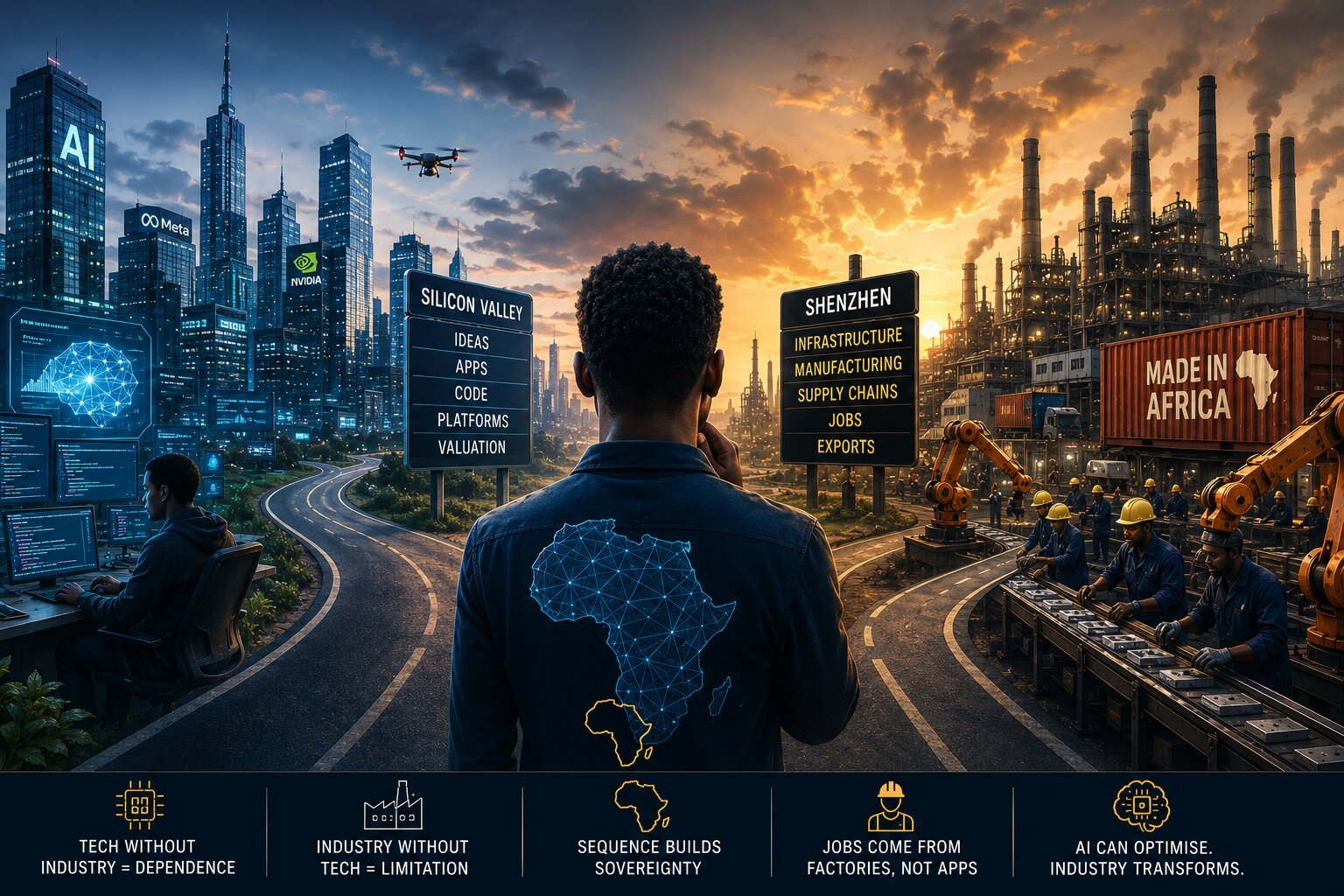
Africa wants Silicon Valley before building Shenzhen, and the distinction captures the most consequential economic sequencing error in the continent's current development discourse. Silicon Valley became globally dominant because America already possessed enormous industrial depth underneath its technology sector, built across a century of manufacturing, aerospace, semiconductor research, and advanced industrial production before software companies emerged as major global powers. Shenzhen became a technology and hardware powerhouse because China spent decades building factories, export manufacturing zones, industrial logistics, ports, highways, railways, energy infrastructure, and technical workforce capacity before the country emerged as a global leader in electric vehicles, telecommunications equipment, batteries, and AI systems. Africa increasingly hosts some of the world's most energetic conversations around fintech, digital transformation, startup ecosystems, and AI innovation while simultaneously importing most industrial machinery, electronics, semiconductors, advanced manufacturing systems, pharmaceuticals, and technological hardware from abroad, consuming advanced technology extensively while producing relatively little of the physical infrastructure making that technology possible. The article identifies why the industrial sequencing that every successful development case maintained cannot be bypassed through AI adoption, what Africa risks by treating software as an alternative to industrialisation rather than as a layer built on top of it, and why Tanzania's physical infrastructure developments are more economically consequential than any AI strategy the country is simultaneously designing. The continent learned how to pitch decks before learning how to finance factories. The sequence must reverse, not because factories are fashionable but because every economy whose development trajectory Africa aspires to replicate was industrial before it was digital, and the historical record has not yet produced an exception to that sequence.
Africa increasingly speaks about artificial intelligence as though it is a development strategy. Governments are launching national AI frameworks. Universities are creating machine learning programmes. Startup ecosystems are repositioning around automation and digital transformation. International conferences discuss the Fourth Industrial Revolution as if the continent is approaching a technological leap capable of bypassing the slower stages of economic development entirely. That assumption deserves much more scrutiny than it is currently receiving.
Because artificial intelligence cannot industrialise Africa. Historically, industrial capacity always came first. The countries now dominating artificial intelligence, advanced technology, semiconductors, cloud computing, robotics, and digital infrastructure all followed the same broad developmental sequence: they first became industrial powers, and only afterward became technological powers. America built steel mills, automobile factories, oil systems, industrial machinery, aviation infrastructure, and manufacturing capacity long before Silicon Valley dominated global software. South Korea industrialised through shipbuilding, textiles, steel, and electronics manufacturing before Samsung became a technological giant. Taiwan built precision manufacturing ecosystems before becoming central to global semiconductor production. China became the factory of the world before becoming an artificial intelligence superpower. Factories came first. Africa increasingly wants the reverse sequence, and that choice may become the most consequential economic sequencing error of the current generation of African leadership.
Why Silicon Valley required Shenzhen to exist first
The conceptual distinction between Silicon Valley and Shenzhen captures the sequencing argument more precisely than any abstract formulation because it identifies in geographically concrete terms the two things that Africa's development discourse is attempting to achieve in the wrong order. Silicon Valley became globally dominant in software because America already possessed enormous industrial depth underneath its technology sector, built across a century of manufacturing investment, aerospace systems development, semiconductor research infrastructure, and advanced industrial production whose technical workforce, engineering culture, supply chain sophistication, and institutional quality gave Silicon Valley's companies the human and institutional capital that software development at commercial scale requires. The semiconductor fabrication, the precision manufacturing, the defence and aerospace engineering, and the advanced materials science that preceded Silicon Valley's software dominance were not incidental to it. They were the productive foundation on which it compounded.
Shenzhen's transformation from a fishing village into the world's hardware production capital is the manufacturing foundation story that Silicon Valley's software success obscures when the Valley is invoked as the development model without the Shenzhen context that made it possible. According to National Bureau of Statistics of China industrial development data, China spent decades building factories, export manufacturing zones, industrial logistics systems, ports, highways, railways, energy infrastructure, and technical workforce capacity across Shenzhen and the broader Pearl River Delta before the country emerged as a global leader in electric vehicles, telecommunications equipment, batteries, and AI systems. Huawei emerged from Shenzhen's manufacturing ecosystem. BYD's electric vehicle leadership emerged from battery manufacturing capability built through years of industrial production. CATL's battery dominance emerged from the materials science and manufacturing process engineering that industrial production at scale generates. The factories trained the engineers. The manufacturing ecosystems built the supply chains. The supply chains created the technical capability. The technical capability later supported AI leadership. Africa wants to start at the end of that sequence.
What the contrast between Africa's digital adoption and industrial underdevelopment reveals
Africa currently hosts some of the world's most energetic conversations around fintech, digital transformation, startup ecosystems, and AI innovation while simultaneously importing most industrial machinery, electronics, semiconductors, advanced manufacturing systems, pharmaceuticals, and technological hardware from abroad. The continent consumes advanced technology extensively. It produces relatively little of the physical infrastructure making that technology possible. According to UNIDO World Manufacturing Production data, Africa accounts for less than 3% of global manufacturing output despite representing approximately 18% of the global population, confirming that the digital activity whose pace and dynamism Africa's startup community demonstrates is occurring on top of a productive structure whose depth is insufficient to generate the returns the digital discourse projects.
This is not technological sovereignty. It is technologically mediated dependence, and the distinction matters for the same reason that the Silicon Valley and Shenzhen distinction matters: the productive foundation determines what the technological layer can compound into. Africa whose digital economy is built entirely on imported hardware, operating systems, cloud infrastructure, and manufacturing systems is not building technological capability. It is building technological consumption whose sophistication reflects the productive capability of the economies that manufactured the systems being consumed rather than the productive capability of the African economies consuming them. According to UNCTAD's Economic Development in Africa Report 2023, Africa exports raw materials and imports finished goods at terms that reflect the productive complexity gap between African economies and the manufacturing economies that supply them, and the digital economy's addition to that structure is to import digital systems alongside the physical ones rather than to resolve the productive structure that generates the import dependence in both categories.
What the AI infrastructure requirements reveal about the physical economy underneath
Artificial intelligence itself exposes the productive foundation requirement most precisely because the physical infrastructure that AI systems require is among the most capital and energy-intensive in the modern economy, making AI the specific technology that most directly demonstrates the dependence of the digital economy on physical industrial systems. According to International Energy Agency analysis, data centres supporting global AI inference at scale consume electricity at rates that make them significant industrial energy consumers, with AI training and inference workloads projected to drive substantial increases in data centre energy demand across the next decade. According to Semiconductor Industry Association manufacturing data, the advanced chips enabling the AI systems whose commercial and strategic significance is driving the technology competition between the United States and China require fabrication facilities whose capital cost exceeds USD 20 billion per site and whose manufacturing process precision demands accumulated engineering knowledge that decades of semiconductor manufacturing experience generates. The batteries enabling the mobile devices, electric vehicles, and backup power systems that the digital economy's commercial operation depends on require lithium, cobalt, nickel, and graphite whose processing and manufacturing involve industrial chemical engineering at the frontier of materials science. AI is not weightless. It is profoundly heavy, materially intensive, and industrially dependent in ways that the software abstraction layer's clean user interface consistently obscures.
The countries currently leading AI are also the countries dominating semiconductor production, advanced manufacturing, industrial robotics, logistics systems, and energy infrastructure. That relationship is not accidental and it is not changing in the direction Africa's AI discourse assumes. America leads AI because it leads advanced manufacturing, aerospace, semiconductor research, and industrial innovation whose compounding returns the software layer amplifies. China leads AI because it leads manufacturing, battery systems, electric vehicles, and industrial robotics whose productive foundation gave the technology sector the engineering workforce, supply chain depth, and institutional quality that AI leadership requires. The physical economy still determines power, and artificial intelligence increases the value of the countries controlling the physical manufacturing systems that AI infrastructure depends on rather than creating a pathway to prosperity that bypasses those systems.
What Tanzania must build before AI can amplify it productively
Tanzania's most consequential economic developments in 2026 are physical rather than digital, and their significance for the country's long-run productive trajectory substantially exceeds the significance of any AI strategy, digital economy initiative, or startup ecosystem development that is simultaneously occurring. According to Standard Chartered Bank's official announcement of 28 April 2026, the USD 2.33 billion SGR financing for Lots 3, 4, and 5 restructures Central Corridor logistics in ways that reduce the transport cost component of manufacturing investment for corridor-adjacent facilities. According to Tanzania Electric Supply Company operational records, installed electricity generation capacity has crossed approximately 4,000 megawatts, creating the energy foundation whose industrial investment significance Uchumi360 documented in its May 2026 energy analysis. Tanzania's natural gas reserves confirmed at approximately 57 trillion cubic feet by TPDC data, critical minerals pipeline across graphite, nickel, and helium, and port modernisation programme are all physical systems whose development determines Tanzania's productive trajectory more consequentially than any technological strategy whose compounding returns depend on the productive foundation that the physical investments are creating.
A logistics company operating on Tanzania's SGR corridor with reliable electricity from the energy surplus and efficient port access through the Dar es Salaam expansion can use AI-powered route optimisation to generate meaningful efficiency gains whose commercial value compounds across the scale of the operation. Those AI tools applied to the same logistics operation without the SGR, without reliable electricity, and without efficient port access improve the analytics of a constrained operation without removing the operational constraints that limit output. The physical systems are the signal. The AI is the amplifier. Tanzania must build the signal before designing the amplification, and the physical investment programme whose pace is more impressive than the industrial strategy and financial system alignment whose development must match it is the most important economic priority that the country's AI and digital economy discourse is helping to displace from the urgency it deserves.
Africa learned how to pitch decks before learning how to finance factories. The continent learned to discuss AI before building the productive systems that AI could amplify productively. The sequence must reverse, not because factories are fashionable or because AI is unimportant, but because every economy whose development trajectory Africa aspires to replicate was industrial before it was digital, and the historical record has not yet produced the exception to that sequence that Africa's development discourse is betting the continent's economic future on finding.
FAQ
Why is the Silicon Valley versus Shenzhen distinction analytically important for Africa? Because Silicon Valley became globally dominant in software because America already possessed enormous industrial depth built across a century of manufacturing, aerospace, and semiconductor development, while Shenzhen became a hardware powerhouse because China spent decades building factories, export zones, and industrial infrastructure before emerging as an AI leader. Africa wants Silicon Valley's software output without building Shenzhen's manufacturing foundation, which is the sequencing error whose correction is most consequential for the continent's development trajectory.
Can AI contribute to African development without industrial foundations? AI can generate marginal efficiency improvements in specific contexts where the primary constraints are informational rather than physical. Mobile money is genuinely valuable. Digital logistics platforms improve fragmented markets. But AI cannot generate the industrial learning, supply chain depth, engineering workforce development, and productive complexity accumulation that manufacturing investment creates as an operational byproduct, and Africa's development trajectory requires both the industrial foundation and the AI amplification in the sequence that makes the amplification economically meaningful rather than analytically sophisticated window dressing on structural constraint.
What does Tanzania's 2026 experience reveal about the correct sequencing? Tanzania's most economically consequential 2026 developments are physical: USD 2.33 billion SGR financing per Standard Chartered's April 2026 announcement, 4,000 megawatts of installed generation per TANESCO records, port expansion, natural gas infrastructure, and critical minerals development. These are more consequential than any AI strategy because they are building the productive signal that AI amplification eventually generates its returns on. A logistics company on the SGR corridor with reliable electricity can use AI route optimisation to generate meaningful gains. The same AI tools applied to a logistics operation constrained by road economics and unreliable power improve analytics without removing the operational constraints that limit output.
Why does AI infrastructure reveal the dependence on physical industrial systems? According to IEA analysis, data centres supporting AI inference at scale consume electricity at industrial energy consumer rates. According to SIA manufacturing data, advanced chip fabrication requires facilities costing over USD 20 billion per site whose manufacturing process precision demands decades of accumulated semiconductor engineering experience. AI is not weightless. It is materially intensive and industrially dependent in ways the software abstraction layer obscures. The countries leading AI are also the countries dominating semiconductor production, advanced manufacturing, and industrial robotics, confirming that physical industrial capability determines what the AI layer can compound into.
What is the specific sequencing Africa must reverse? Industrial foundation building must advance in parallel with and ultimately ahead of AI adoption if AI adoption is to generate the economic returns whose projection is driving policy enthusiasm. The Development Bank of Tanzania's industrial lending expansion, pension fund capital deployment toward manufacturing, procurement preferences for locally manufactured goods, export processing zone governance improvement, and industrial energy pricing in manufacturing zones are the foundation-building investments that determine whether Tanzania's AI strategy amplifies a deep productive system or produces analytical sophistication on a shallow productive structure. The sequence runs factories first, amplification second, and the urgency of building the factories is proportionate to the pace at which the automation window is narrowing.
 Uchumi360
Business Intelligence
Uchumi360
Business Intelligence
- UNIDO, World Manufacturing Production statistics
- Africa below 3% of global manufacturing
- Available at unido.org
- National Bureau of Statistics of China, industrial development sequence and AI sector emergence data
- Available at stats.gov.cn
- Korean Development Institute, South Korea industrial sequence research
- Available at kdi.re.kr
- International Energy Agency, data centre energy consumption and AI infrastructure analysis
- Available at iea.org
- Semiconductor Industry Association, advanced fabrication facility capital cost data
- Available at semiconductors.org
- UNCTAD, Economic Development in Africa Report 2023
- Available at unctad.org
- Harvard Growth Lab, Economic Complexity Index
- Technology sector emergence from productive foundations
- Available at growthlab.hks.harvard.edu
- Tanzania Electric Supply Company, operational records
- Available at tanesco.co.tz
- Standard Chartered Bank, SGR financing announcement, 28 April 2026
- Available at sc.com
- Tanzania Petroleum Development Corporation, natural gas reserve data
- Available at tpdc.go.tz
Uchumi360 covers business, investment, and economic policy across East, Central, and Southern Africa.
For the serious reader
You read to the end. That places you in a small group.
Uchumi360 is built for readers who demand precision over speed, structure over sentiment, and analysis that holds uncomfortable conclusions rather than softening them. If this work sharpens how you think about Africa's economy, help us keep building the infrastructure behind it.
Institutional Partners
Commission intelligence. Shape the conversation.
Uchumi360 works with development finance institutions, investment firms, sovereign bodies, and strategic organisations across the coverage region. Institutional partnership unlocks:
- Commissioned sector and country intelligence reports
- Branded research series under your institution's authority
- Exclusive data briefings for internal strategy teams
- Speaking and editorial presence at Uchumi360 events
- Co-published investment outlooks for your markets
Support Our Work
Independent analysis has a cost. Help us bear it.
Uchumi360 does not carry advertising. It does not take editorial direction from sponsors. Every article is produced without commercial compromise. Your contribution funds the reporting, research, and editorial infrastructure that keeps this analysis free from influence.
Secure checkout: One-time and monthly support are processed securely. Add payment credentials to enable checkout here.
Stay Connected
Keep up with every new insight.
Follow our latest analysis, policy coverage, and market intelligence as soon as it is published. If you need something specific, reach out directly and we will point you to the right research.
