
TISEZA Records $3.14 Billion in Chinese Investment as Tanzania Expands Industrial Pipeline
Ready
China accounted for US$3.1438 billion of the foreign investment recorded through Tanzania's EPZ and SEZ schemes between April and June 2026. Seven projects registered under those schemes represented US$3.3785 billion in capital and 30,235 projected jobs. The numbers mark a sharp increase from the same period a year earlier, but the more consequential question is what happens after investment registration. Tanzania is attracting projects large enough to alter the geography of industrial production, from a planned US$3 billion industrial park in Bagamoyo to another roughly US$3 billion industrial cluster in Ruvuma. Their economic value will ultimately depend on implementation, exports, local procurement, skills, technology transfer and the emergence of Tanzanian firms around them. The investment boom therefore presents Tanzania with a different challenge from the one it faced a decade ago: turning foreign capital into industrial depth.
DAR ES SALAAM — Tanzania's latest investment figures show a sharp rise in the scale of projects entering its EPZ and SEZ pipeline, with China accounting for almost all foreign capital registered through the schemes between April and June 2026. TISEZA recorded seven projects worth US$3.3785 billion during the quarter, compared with US$135.66 million from eight projects in the corresponding quarter of 2025. The projects carry 30,235 projected jobs and US$517.8 million in expected export turnover, compared with 1,415 jobs and US$92.9 million a year earlier.
China accounted for US$3.1438 billion of the latest investment, with 19,027 projected jobs and US$290.6 million in expected export turnover. Kenya contributed US$3.1 million and the United Arab Emirates US$0.9 million. The figures are significant, but they describe registered projects and projected outcomes rather than capital already converted into operating factories. That distinction matters because several of the largest projects remain under development, making implementation rather than registration the next measure of performance.
The scale also needs to be placed beside Tanzania's wider investment pipeline. Under the general investment scheme, TISEZA registered 243 projects worth US$1.88005 billion during the same quarter, with manufacturing accounting for 139 projects, US$764.07 million in capital and 17,875 projected jobs. The latest quarter therefore contains two different stories: a broad pipeline of mostly smaller investments and a much smaller number of EPZ and SEZ projects whose capital values are large enough to dominate the headline numbers.
The concentration of capital is now as important as the amount
The regional distribution illustrates why the investment figures need to be read carefully. Ruvuma accounted for US$2.6 billion of the EPZ and SEZ capital through one project, with 18,050 projected jobs and US$265.5 million in expected export turnover. Lindi followed with US$180 million and 10,000 projected jobs, while two Iringa projects accounted for US$543.1 million and 375 projected jobs. Dar es Salaam recorded US$50 million and 1,000 projected jobs, while two projects in Njombe accounted for US$5.4 million and 810 projected jobs.
This distribution is important because Tanzania's industrial economy has historically been heavily concentrated around Dar es Salaam and the main coastal corridor. The latest pipeline points toward a wider geography in which Ruvuma, Lindi and Iringa could receive large industrial investments linked to agriculture, forestry, energy and manufacturing. That can broaden the country's productive base, but only if supporting infrastructure, electricity, logistics and labour capabilities develop alongside the projects. An industrial project in a region without competitive connections to suppliers and markets can carry a large investment value without producing the wider industrial network policymakers expect.
The Ruvuma project is particularly ambitious. TISEZA describes an HWTZ industrial cluster in Songea with an estimated value of about US$3 billion, including a one million tonne per year aluminium plant and a 2,100 MW coal fired power plant, with 10,000 direct jobs projected. The authority also reported that equipment for the first phase was expected through the Port of Mtwara in July 2026. These are project targets rather than realised production, so their significance will ultimately depend on whether construction, financing and commissioning proceed as planned.
Bagamoyo offers a different model of industrial concentration
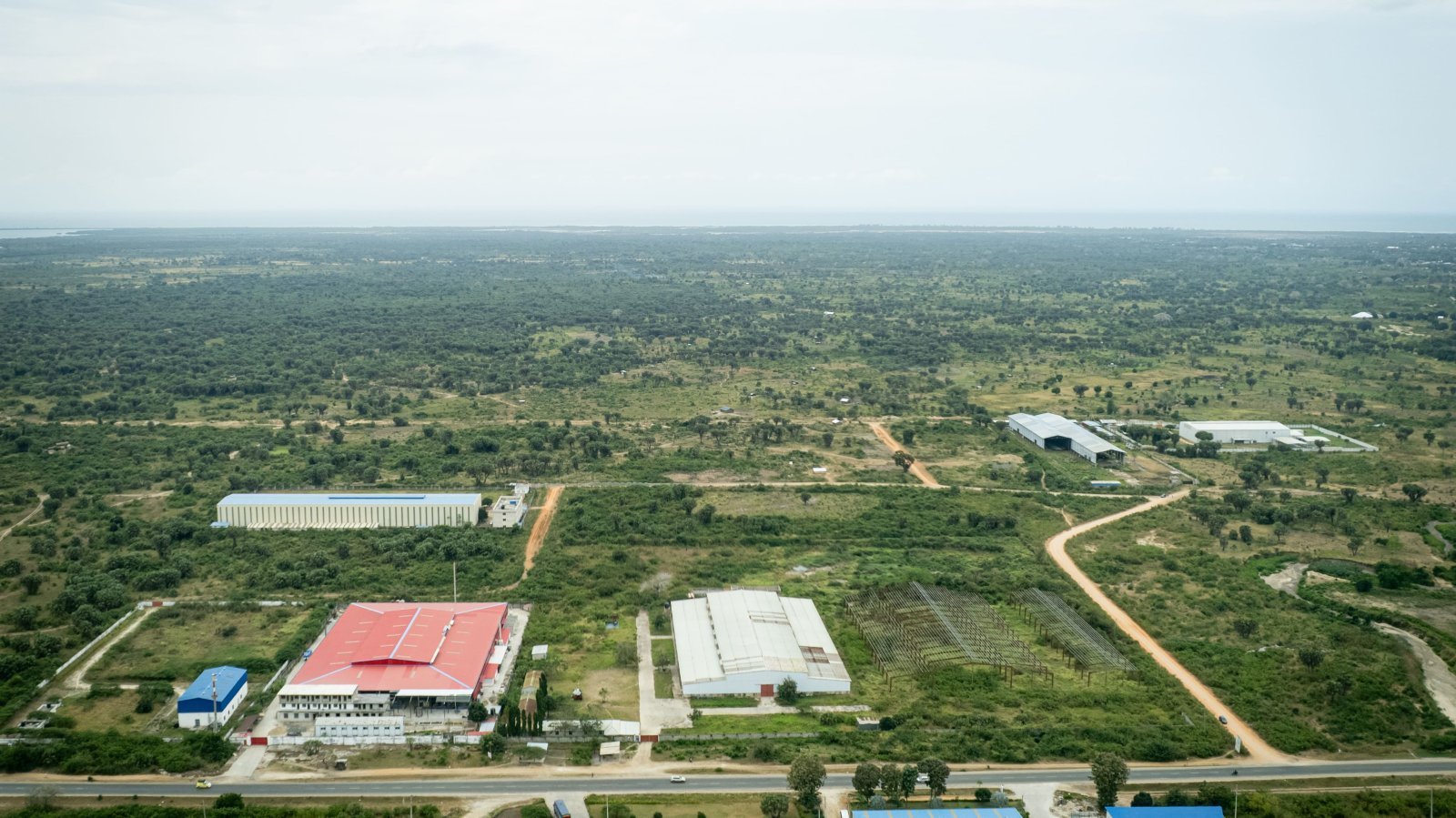
On the coast, HWTZ SEZ Limited is developing a 500 hectare industrial park in Bagamoyo under a 33 year lease. TISEZA says the investment is expected to exceed US$3 billion and is intended to attract more than 150 industrial investments, while the project itself is expected to create more than 5,000 direct jobs. The park is being developed as part of the wider Bagamoyo Eco Maritime City and is designed around industries including vehicle, boat and motorcycle assembly and construction materials.
The project moved from investment announcement toward physical implementation during 2026. In April, The Citizen reported that TISEZA and HWTZ had signed the agreement and that the first compressed natural gas powered heavy duty lorry was targeted for production by the end of the year. The project was also expected to produce motorcycles, fishing boats and spare parts, while TISEZA required at least 10 percent of spare parts to be sourced locally within three months of operations.
That local sourcing requirement is more significant for Tanzania's industrial strategy than the headline investment value alone. A factory becomes economically more consequential when Tanzanian companies begin supplying components, engineering, logistics, maintenance, packaging and other inputs. The same principle applies to skills. HWTZ has said it will establish a training institution for Tanzanian workers, creating the possibility that the investment could contribute to a deeper pool of industrial skills rather than simply providing employment within one foreign owned company.
The real industrial test starts after the investment certificate
Foreign investment can affect an economy through several channels, but the largest long term gains usually come from connections between the investor and the domestic economy. A factory that imports most of its inputs, employs a limited number of specialised workers and exports finished products can still contribute through employment, taxes and foreign exchange. A factory that develops domestic suppliers, trains workers, transfers technical knowledge and stimulates new companies creates a wider production network. The second outcome is harder to achieve and requires deliberate monitoring.
Tanzania's current investment policy gives it an opportunity to make those connections measurable. The HWTZ requirement for local spare parts provides one example, while economic zones provide the physical setting for several companies to operate around common infrastructure. The policy question is whether such requirements can gradually produce suppliers that meet international standards without making Tanzanian production uncompetitive. Local content works economically when domestic firms become capable suppliers rather than when firms are forced to purchase inputs at substantially higher cost.
The same logic applies to exports. TISEZA recorded US$517.8 million in projected export turnover from the seven EPZ and SEZ projects in the quarter. That figure is useful as an indicator of intended export capacity, but the more informative measure over time will be actual exports, the share of inputs sourced locally and whether firms increase their production and reinvest in Tanzania. The distinction between projected turnover and realised exports should remain central to how the investment boom is assessed.
China’s role is part of a longer investment relationship
The latest quarterly figure is not the beginning of Tanzania's Chinese investment relationship. In March 2024, the Tanzania Investment Centre said 256 Chinese projects registered between January 2021 and December 2023 represented US$2.4 billion and approximately 29,122 expected jobs. The Investment Centre also reported that, by February 2024, 1,274 Chinese projects worth approximately US$11.4 billion had been registered, with expected employment of about 149,759 people. Those figures cover different periods and should not be added together, but they show that the latest capital inflow sits within an established investment relationship.
What is changing is the scale and physical form of some projects. Earlier Chinese investment in Tanzania included a wide range of businesses, while the latest pipeline contains industrial parks and large production projects that can influence entire local economies. That creates the possibility of industrial clustering, where factories share infrastructure and generate demand for suppliers, logistics operators, maintenance companies and skilled labour. If those connections develop, the economic impact can extend well beyond the balance sheet of the original investor.
TISEZA's own investment data already show that manufacturing is the dominant sector in the wider investment pipeline. Of the 243 general investment projects registered in the quarter, 139 were manufacturing projects worth US$764.07 million and carrying 17,875 projected jobs. Foreign investors provided US$479.70 million of manufacturing capital, while joint ventures provided US$190.18 million. The manufacturing story is therefore broader than the Chinese projects, even though China dominates the latest EPZ and SEZ numbers.
Tanzania now needs to measure industrial depth, not just investment volume
The policy challenge has consequently moved from attracting investors toward measuring what those investors leave behind. TISEZA's latest figures provide useful measures of registered capital, projected employment and expected turnover, but they do not yet show how much of the committed capital has been deployed, how many projected jobs have materialised or how much domestic procurement has occurred. Those measures become particularly important when a small number of projects account for several billion dollars in registered investment.
A stronger monitoring framework would follow projects from registration through construction and production, then measure actual capital deployed, operating capacity, jobs created, Tanzanian workers trained, domestic procurement, exports, taxes paid after incentives and subsequent reinvestment. It would also track the number and quality of domestic firms entering investor supply chains. That would allow policymakers to distinguish between an investment boom on paper and a sustained increase in productive capacity.
The economic opportunity is substantial. Tanzania has a large domestic market, access to regional markets and an Indian Ocean position that can support export oriented production. The government is also expanding economic zones and investor facilitation, with TISEZA reporting more than 40 land parcels allocated to investors across Bagamoyo, Ruvuma, Kwala and Nala since the official launch of Tanzania's SEZ framework in August 2025.
The latest Chinese investment should therefore be judged neither simply by its size nor by the nationality of the investors. Its real significance will be determined by whether factories become anchors for Tanzanian suppliers, whether workers acquire industrial capabilities, whether exports expand and whether new domestic firms emerge around the projects. Tanzania has reached the stage where attracting capital is no longer the entire industrial policy problem.
FAQ
How much Chinese investment was recorded in Tanzania's latest EPZ and SEZ figures? TISEZA recorded US$3.1438 billion in Chinese FDI between April and June 2026. China therefore accounted for almost all of the US$3.1478 billion in foreign capital recorded through the EPZ and SEZ schemes during the quarter.
Does the US$3.14 billion represent money already spent on operating factories? No. The figure represents investment registered during the reporting period. Several projects remain under development, so registered capital should not be treated as equivalent to realised production, completed construction or actual employment.
What is the largest concentration of this investment? Ruvuma recorded one EPZ or SEZ project worth US$2.6 billion, with 18,050 projected jobs and US$265.5 million in expected export turnover. The project is associated with HWTZ's planned industrial cluster in Songea.
What is planned for the HWTZ project in Bagamoyo? HWTZ SEZ Limited is developing a 500 hectare industrial park under a 33 year lease, with expected investment exceeding US$3 billion. The park is intended to attract more than 150 industrial investments, while HWTZ's own project is expected to create more than 5,000 direct jobs.
Why does local sourcing matter? Local sourcing determines how strongly foreign factories connect with Tanzanian businesses. The HWTZ Bagamoyo project includes a requirement that at least 10 percent of spare parts be sourced locally within three months of operations, providing one mechanism for developing domestic suppliers.
Is China's role in Tanzania's investment market new? No. Tanzania's Investment Centre reported 1,274 Chinese projects worth approximately US$11.4 billion by February 2024. It also recorded 256 Chinese projects worth US$2.4 billion between January 2021 and December 2023. The periods overlap, so the figures should not be added together.
What should Tanzania measure next? The key measures should move beyond registered capital to actual capital deployed, factories completed, jobs created, domestic procurement, exports, worker training, technology transfer and reinvestment. These indicators would show whether the investment pipeline is producing sustained industrial capacity rather than only large project announcements.
 Uchumi360
Business Intelligence
Uchumi360
Business Intelligence
Uchumi360 covers business, investment, and economic policy across East, Central, and Southern Africa.
For the serious reader
You read to the end. That places you in a small group.
Uchumi360 is built for readers who demand precision over speed, structure over sentiment, and analysis that holds uncomfortable conclusions rather than softening them. If this work sharpens how you think about Africa's economy, help us keep building the infrastructure behind it.
Institutional Partners
Commission intelligence. Shape the conversation.
Uchumi360 works with development finance institutions, investment firms, sovereign bodies, and strategic organisations across the coverage region. Institutional partnership unlocks:
- Commissioned sector and country intelligence reports
- Branded research series under your institution's authority
- Exclusive data briefings for internal strategy teams
- Speaking and editorial presence at Uchumi360 events
- Co-published investment outlooks for your markets
Support Our Work
Independent analysis has a cost. Help us bear it.
Uchumi360 does not carry advertising. It does not take editorial direction from sponsors. Every article is produced without commercial compromise. Your contribution funds the reporting, research, and editorial infrastructure that keeps this analysis free from influence.
Secure checkout: One-time and monthly support are processed securely. Add payment credentials to enable checkout here.
Stay Connected
Keep up with every new insight.
Follow our latest analysis, policy coverage, and market intelligence as soon as it is published. If you need something specific, reach out directly and we will point you to the right research.
