
Africa’s Critical Minerals: The Top 10 Resources Powering the Continent’s Industrial Future
Ready
Africa’s critical minerals should not be defined only by the anxiety of Beijing, Washington and Brussels. They should be defined by Africa’s own industrial shortages: electricity, food security, steel, cement, transport, storage, manufacturing and value addition.
Africa’s critical-minerals debate has been captured too easily by external demand. Washington wants secure supply chains. Brussels wants clean-energy inputs. Beijing wants industrial feedstock and market influence. Global automakers want batteries. Technology firms want electronics inputs. Commodity traders want margin. The language is green, strategic and diplomatic, but the balance sheet is clear: most outside powers define Africa’s minerals by what those minerals can do for their own industrial systems.
Africa needs a different definition.
The continent’s true critical minerals are not only the minerals that appear on United States, European Union or Chinese priority lists. They are the minerals that can power Africa’s own industrial future: electricity grids, railways, affordable housing, fertiliser, steel, cement, transport systems, agro-processing, battery storage, digital infrastructure, electric mobility, manufacturing zones and regional value chains.
That distinction matters. A mineral can be critical to Brussels because it feeds European electric vehicles. It can be critical to Beijing because it feeds Chinese battery and manufacturing dominance. It can be critical to Washington because it reduces strategic dependency. But for Africa, a mineral is truly critical only if it helps the continent move from extraction to production.
The African Development Bank has already framed this shift. Its paper on critical minerals argues that Africa can convert its mineral endowment into diversified, higher-value growth only by focusing on beneficiation, industrialisation, infrastructure, governance and regional integration. The Africa Mining Vision makes the same structural point: mineral resources should support local beneficiation, value addition, manufacturing feedstock, industrial linkages and small and medium-sized enterprise participation, not remain enclave extraction projects.
The global context is undeniable. The International Energy Agency reported in its 2025 Global Critical Minerals Outlook that demand for key energy minerals continued to grow strongly in 2024, with lithium demand rising by nearly 30%, while nickel, cobalt, graphite and rare earths demand grew by 6% to 8%, largely driven by electric vehicles, battery storage, renewables and electricity networks. The World Bank has also warned that production of minerals such as graphite, lithium and cobalt could increase by nearly 500% by 2050 to meet clean-energy demand.
But Africa should not read that demand only as an export opportunity. It should read it as an industrial warning. If the continent exports ores and imports batteries, exports bauxite and imports aluminium products, exports copper and imports cables, exports phosphate and imports fertiliser, exports iron ore and imports machinery, then the critical-minerals boom will repeat the old commodity pattern in a new green language.
The correct African question is therefore not: “Which minerals does the world want from us?” It is: “Which minerals can help Africa build power, food security, factories, mobility, digital systems and bargaining power?”
By that test, Africa’s top critical minerals are not just battery minerals. They are industrialisation minerals.
Copper: The Metal of Electrification
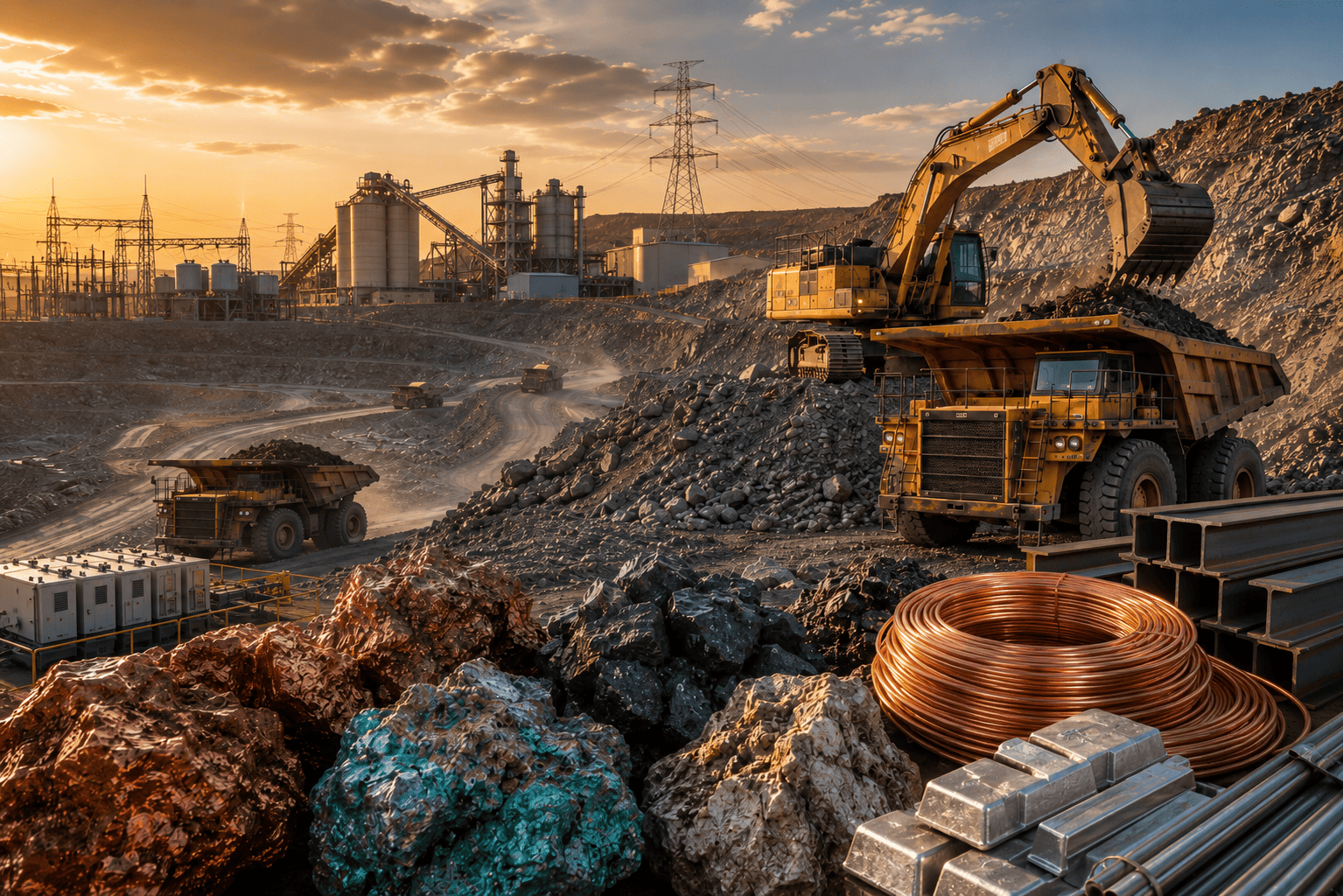
Copper is Africa’s most important industrial mineral because electricity is the foundation of industrialisation. No serious manufacturing strategy survives without power generation, transmission, distribution, motors, transformers, substations, wiring and grid expansion. Copper sits inside all of them.
The Democratic Republic of Congo and Zambia are already central to global copper supply. According to the United States Geological Survey’s 2025 Mineral Commodity Summaries, the Democratic Republic of Congo holds about 80 million tonnes of copper reserves and produced about 3.3 million tonnes in 2024. Zambia holds about 21 million tonnes of reserves and produced about 680,000 tonnes. Together, the two countries hold roughly 101 million tonnes of copper reserves, about 10% of global reserves, and produced about 17% of global mined copper in 2024.
For Africa, copper is not only an export metal for global clean-energy supply chains. It is the material backbone of domestic electrification. The African opportunity is to build copper-based value chains: cables, transformers, electrical components, renewable-energy infrastructure, industrial wiring, rail electrification and grid equipment.
This is why the Lobito Corridor has attracted global attention. The corridor links mineral-rich regions in Zambia and the Democratic Republic of Congo to Angola’s Atlantic port of Lobito, with international financing seeking to improve access to copper and cobalt supply chains. Reuters reported in 2025 that Africa Finance Corporation was signing a USD 320 million deal with Italy, partly to support the Lobito Corridor.
Africa’s copper future should therefore be judged not only by export tonnage, but by how much copper is converted into African electrical infrastructure. A continent with hundreds of millions of people still needing reliable electricity cannot treat copper only as a foreign-exchange earner.
Iron Ore: The Foundation of Steel and Infrastructure
If copper is the metal of electrification, iron ore is the mineral of physical industrialisation. Steel is the skeleton of railways, bridges, factories, ports, pipelines, power plants, machinery, vehicles, housing and industrial equipment. No continent industrialises without steel.
Iron ore does not always appear in Western critical minerals lists because it is not scarce in the same way as lithium, cobalt or rare earths. But for Africa’s industrial future, it is more critical than many fashionable minerals. Without steel, there is no serious infrastructure state.
Africa has major iron ore potential, including in Guinea, South Africa, Liberia, Mauritania and Sierra Leone. South Africa produced about 66 million tonnes of usable iron ore in 2024 and holds about 930 million tonnes of crude ore reserves, according to the United States Geological Survey. Mauritania produced about 15 million tonnes in 2024. Guinea’s Simandou project adds a different scale: Rio Tinto reports about 1.5 billion tonnes of ore reserves in its Simandou blocks at roughly 65% iron, while Reuters has reported that the wider Simandou project could produce 120 million tonnes annually and potentially raise Guinea’s gross domestic product by 26% by 2030.
The Africa Mining Vision explicitly calls for minerals to provide manufacturing feedstock and for mineral development to support backward and forward linkages. Iron ore is the clearest test of that vision. If Africa cannot convert iron ore into steel, and steel into machinery, rail components, construction products and manufacturing inputs, industrialisation will remain dependent on external suppliers.
The African steel question is not technical alone. It is strategic. Exporting ore while importing fabricated steel is one of the clearest signs of a continent still losing value between the mine and the factory.
Bauxite: The Route to Aluminium and Lightweight Manufacturing
Bauxite is critical because aluminium is critical. Aluminium is used in power lines, transport systems, construction, packaging, appliances, renewable-energy equipment and industrial components. It is lightweight, recyclable and central to modern manufacturing.
Guinea is one of the world’s most important bauxite economies. The United States Geological Survey estimates that Guinea produced about 130 million tonnes of bauxite in 2024 and holds about 7.4 billion tonnes of reserves. That is roughly 29% of world mine production and about 26% of global reserves. The same source estimates that 32% of global bauxite resources are in Africa.
Africa’s recurring problem is the gap between mining and refining. Exporting bauxite while importing aluminium products is a classic example of lost value. The industrial prize is not the rock; it is alumina refining, aluminium smelting, rolling, extrusion, packaging, transport components, construction profiles and cable production.
Bauxite also exposes one of Africa’s biggest industrial constraints: power. Aluminium smelting requires large amounts of reliable electricity. That means Africa’s bauxite strategy cannot be separated from energy strategy. Mineral policy, power policy and industrial policy must be designed together.
The United Nations Conference on Trade and Development has repeatedly emphasised that African value addition requires moving from minerals to manufacturing, with sustained policy action, economic diversification and product-level industrial opportunities. Bauxite is exactly the kind of mineral where that logic matters.
Manganese: The Quiet Mineral Behind Steel and Batteries
Manganese rarely gets the attention of cobalt or lithium, but Africa cannot build an industrial future without it. Its first importance is steel. Manganese is used in steelmaking to improve strength, hardness and durability. That makes it essential for construction, railways, machinery, infrastructure and industrial equipment.
Its second importance is batteries. Certain battery chemistries use manganese, and demand linked to clean-energy technologies gives the mineral another industrial pathway. But Africa should begin with the first point: steel.
South Africa and Gabon are already important manganese producers. The United States Geological Survey estimates that South Africa holds about 560 million tonnes of manganese reserves, Gabon 61 million tonnes, and Ghana 13 million tonnes. Africa holds roughly 37% of global manganese reserves, while South Africa, Gabon, Ghana and Côte d’Ivoire together produced about 13.18 million tonnes of manganese content in 2024, roughly 66% of world output.
The African opportunity is to move beyond ore exports toward manganese alloys, steel inputs and battery-related chemical products where feasible. This is where mineral value addition becomes practical: not every country needs to make electric vehicles, but mineral-rich countries can produce intermediate products that feed African and global industries.
Phosphate Rock: The Mineral of Food Security
Phosphate may be Africa’s most under-discussed critical mineral because it powers agriculture rather than electric vehicles. But food security is industrial policy. A continent that cannot raise agricultural productivity will struggle to industrialise, urbanise or reduce import dependency.
Phosphate is a key input in fertiliser. Africa has major phosphate resources, especially in North Africa and parts of West Africa, yet much of the continent still suffers from low fertiliser use, weak soil productivity and high exposure to imported fertiliser prices.
Morocco alone holds about 50 billion tonnes of phosphate-rock reserves out of a global total of 74 billion tonnes, according to the United States Geological Survey. Algeria, Egypt, Tunisia, South Africa, Senegal and Togo add further reserves, taking Africa’s listed reserves to roughly 59 billion tonnes, or about 80% of the world total. African countries listed by the United States Geological Survey produced about 46.5 million tonnes of phosphate rock in 2024.
The industrial logic is straightforward: phosphate should feed fertiliser production, fertiliser should raise agricultural yields, higher yields should support agro-processing, and agro-processing should build food-manufacturing industries.
This is why phosphate belongs on an Africa-first critical-minerals list. It may not dominate the external geopolitics of electric mobility, but it is essential for African productivity. A continent with large food-import bills cannot ignore the mineral base of fertiliser.
Limestone: The Overlooked Mineral of Cities, Cement and Construction
Limestone is not glamorous. It does not excite global critical-minerals diplomacy. But for Africa’s industrialisation, it is indispensable.
Africa is urbanising. It needs housing, roads, ports, factories, warehouses, bridges, schools, hospitals, power stations and water infrastructure. Cement is central to that build-out, and limestone is the essential raw material for cement. A country that cannot produce affordable cement cannot build affordably.
Limestone belongs in an Africa-first critical minerals framework because industrialisation is physical before it is digital. Factories need floors. Ports need terminals. Railways need stations. Cities need drainage. Energy systems need foundations. Housing needs cement. Industrial parks need roads and warehouses.
The United States Geological Survey describes global limestone and dolomite resources suitable for lime manufacture as “very large” and adequate for the listed producing countries. South Africa produced about 1.1 million tonnes of lime in 2024, while many African countries have large limestone and cement-feedstock potential, even where reserve reporting is not standardised.
The Africa Mining Vision recognises the importance of industrial minerals for the local production of consumer and industrial goods. Limestone is precisely that type of mineral: not globally strategic in the same way as cobalt, but domestically critical for construction-led transformation.
Natural Graphite: The Battery Mineral Africa Should Not Export Raw
Graphite is central to battery anodes and therefore to energy storage, electric mobility and renewable-power systems. Mozambique, Madagascar, Tanzania and other African countries have graphite potential, making the continent highly relevant to global battery supply chains.
Madagascar produced about 89,000 tonnes of natural graphite in 2024 and holds about 27 million tonnes of reserves, according to the United States Geological Survey. Mozambique produced about 75,000 tonnes and holds about 25 million tonnes. Tanzania produced about 25,000 tonnes and holds about 18 million tonnes. Together, these three countries hold about 70 million tonnes, roughly 24% of world graphite reserves.
But from an African perspective, graphite is critical for more than exports. Africa needs battery storage for unreliable grids, mini-grids, solar systems, telecom towers, industrial parks, electric two-wheelers, electric buses and household power resilience. The continent’s power challenge means storage is not a luxury technology; it is an industrial necessity.
The danger is familiar. If Africa exports graphite concentrate and imports finished battery cells, the continent will lose most of the value. The strategic opportunity is to move into spherical graphite, anode materials, battery components and regional storage systems where market scale and power conditions allow.
Cobalt: The Battery Metal That Must Become an African Industrial Lever
Cobalt is already the mineral most associated with Africa’s critical-minerals debate, mainly because the Democratic Republic of Congo dominates global mined supply.
The United States Geological Survey estimates that the Democratic Republic of Congo produced about 220,000 tonnes of cobalt in 2024, equal to roughly 76% of world mine production. It holds about 6 million tonnes of cobalt reserves, roughly 55% of global reserves.
But cobalt’s African importance should not be reduced to its role in foreign electric vehicles. For Africa, cobalt matters because it can anchor battery value chains, industrial chemicals, refining capacity, mineral governance reforms, transport corridors and regional processing.
Cobalt is both an opportunity and a warning. It can generate revenue, jobs and industrial positioning. But without governance, traceability, responsible mining, local processing and regional infrastructure, cobalt can also reproduce conflict, dependency and external control.
The African cobalt question should therefore be framed differently. It is not only how much cobalt the Democratic Republic of Congo exports. It is how much industrial capacity, refining, transport infrastructure, supplier development and regional bargaining power cobalt leaves behind.
Lithium: The Storage Mineral for African Power Resilience
Lithium is the headline mineral of the battery age. Zimbabwe, Namibia, Mali, Ghana, the Democratic Republic of Congo and other African countries have attracted attention as lithium exploration and production expands.
Zimbabwe produced about 22,000 tonnes of lithium content in 2024 and holds about 480,000 tonnes of reserves, according to the United States Geological Survey. The same source identifies measured and indicated lithium resources of about 3 million tonnes in the Democratic Republic of Congo, 1.2 million tonnes in Mali, 860,000 tonnes in Zimbabwe, 230,000 tonnes in Namibia and 200,000 tonnes in Ghana.
Africa should not define lithium only through electric cars in Europe, China or the United States. Lithium is critical because Africa needs storage. Power unreliability is one of the continent’s greatest industrial taxes. Factories cannot compete when electricity is expensive or unstable. Hospitals, data centres, schools, telecom networks, agro-processors and small manufacturers all need dependable power. Battery storage can help stabilise grids, support solar deployment and expand industrial reliability.
The International Energy Agency reported that lithium demand rose by nearly 30% in 2024, far above the annual growth rate seen in the previous decade, driven largely by batteries and clean-energy applications.
Lithium processing is technically demanding and capital intensive, so not every African lithium producer will build full battery supply chains immediately. But countries can still negotiate better terms around processing, skills, infrastructure, power supply, local procurement and regional battery ecosystems.
Rare Earth Elements: The Minerals of Motors, Magnets and Modern Industry
Rare earth elements are essential in permanent magnets, electronics, renewable-energy systems, motors and advanced manufacturing. They are strategically important because global processing is highly concentrated, and supply disruptions can affect major industrial sectors.
Africa has rare earth potential in several countries, including South Africa, Tanzania, Madagascar, Nigeria, Malawi, Burundi and Namibia. The United States Geological Survey estimates that South Africa holds about 860,000 tonnes of rare-earth reserves and Tanzania about 890,000 tonnes. Madagascar produced about 2,000 tonnes in 2024, while Nigeria produced about 13,000 tonnes, though reserve data for both is not available in the United States Geological Survey table.
The African case for rare earths should not be written only in the language of external supply security. The continent will need motors, turbines, electronics, medical devices, digital infrastructure, industrial automation and renewable-energy systems. Rare earths sit inside that future.
Rare earths are difficult to process and environmentally sensitive. That means Africa must be careful. The goal should not be reckless extraction. It should be targeted investment, environmental governance, regional processing where feasible, skills development and strategic partnerships that leave more value on the continent.
Bonus Minerals Africa Cannot Afford to Ignore
The top 10 minerals above define the core of an Africa-first critical-minerals strategy. But several other minerals deserve serious attention because they are also strategic to the continent’s industrial future.
Platinum group metals should be treated as a first-tier bonus mineral group. South Africa holds about 63 million kilograms of platinum group metal reserves, while Zimbabwe holds about 1.2 million kilograms. South Africa produced about 120,000 kilograms of platinum and 72,000 kilograms of palladium in 2024, while Zimbabwe produced 19,000 kilograms of platinum and 15,000 kilograms of palladium. Their Africa-first use is not only catalytic converters; it includes hydrogen technologies, fuel cells, industrial catalysts, jewellery, medical devices and high-value refining.
Chromium is essential because stainless steel is impossible without it. South Africa produced about 21 million tonnes of marketable chromite ore in 2024 and holds about 200 million tonnes of shipping-grade chromite reserves. Zimbabwe produced about 1.1 million tonnes and holds about 540 million tonnes of reserves. For Africa, chromium matters for stainless steel, rail, machinery, industrial equipment, food-processing equipment and infrastructure durability.
Titanium mineral sands also deserve a bonus position. Mozambique produced about 1.9 million tonnes of ilmenite in 2024, South Africa 1.3 million tonnes, Madagascar 240,000 tonnes, Senegal 300,000 tonnes, and Kenya 40,000 tonnes of rutile. Titanium feeds pigments, welding rods, aerospace materials, corrosion-resistant equipment and high-value mineral-sands industries.
Nickel should also be included because it links stainless steel, batteries and industrial alloys. Africa’s reported reserve position is less transparent than Indonesia or Australia, but Zambia began commercial production at a new nickel sulphide mine in Kalumbila in 2024, and African nickel laterite and sulphide potential matters for future battery and stainless-steel value chains.
Potash belongs in the conversation because food security is an industrial policy. The United States Geological Survey notes that new potash mines in Ethiopia and Morocco are planned to begin after 2028, while world potash consumption is expected to keep rising. For Africa, potash is critical because fertiliser supply is directly linked to crop yields, agro-processing, food imports and rural productivity.
The Real Critical Mineral Is Value Addition
The most important conclusion is that no mineral is truly critical if Africa exports it raw and imports it finished. Criticality is not geological. It is industrial.
Copper becomes critical when it powers African grids. Iron ore becomes critical when it feeds African steel. Bauxite becomes critical when it becomes aluminium products. Manganese and chromium become critical when they support African steel and battery inputs. Phosphate and potash become critical when they raise African farm productivity. Limestone becomes critical when it builds African cities. Graphite, cobalt and lithium become critical when they support African storage, transport and manufacturing. Rare earths become critical when they feed African industrial technology, not only foreign supply security.
Africa’s critical minerals should not be defined only by the anxiety of Beijing, Washington and Brussels. They should be defined by Africa’s own industrial shortages: electricity, food security, steel, cement, transport, storage, manufacturing and value addition.
This requires a different kind of state capacity. African governments need geological data, power planning, transport corridors, processing zones, water management, environmental enforcement, skilled engineers, trade finance, regional standards and smarter contracts. They also need to avoid the temptation of symbolic export bans that are not backed by processing capacity. Value addition cannot be declared into existence. It must be built.
The old model was simple: license a mine, collect taxes, export ore, import finished goods. The new model must be harder and more deliberate: license a mine, build power, connect rail, develop processing, train workers, finance suppliers, anchor manufacturing, coordinate regionally and negotiate offtake agreements that leave industrial capability behind.
That is the only way the critical-minerals boom becomes an African industrial revolution rather than another extractive cycle.
External powers will continue to define Africa’s minerals by their own needs. Beijing, Washington and Brussels are not wrong to do so. Every industrial power thinks first about its own factories, vehicles, grids, technologies and strategic vulnerabilities.
Africa must now do the same.
The continent’s true critical minerals are the ones that can help it build electricity systems, feed its people, construct its cities, manufacture its inputs, power its transport, store its energy and own a larger share of the value chain.
By that standard, Africa’s critical-minerals future is not beneath the ground. It is in what the continent chooses to build above it.
 Uchumi360
Business Intelligence
Uchumi360
Business Intelligence
Uchumi360 covers business, investment, and economic policy across East, Central, and Southern Africa.
For the serious reader
You read to the end. That places you in a small group.
Uchumi360 is built for readers who demand precision over speed, structure over sentiment, and analysis that holds uncomfortable conclusions rather than softening them. If this work sharpens how you think about Africa's economy, help us keep building the infrastructure behind it.
Institutional Partners
Commission intelligence. Shape the conversation.
Uchumi360 works with development finance institutions, investment firms, sovereign bodies, and strategic organisations across the coverage region. Institutional partnership unlocks:
- Commissioned sector and country intelligence reports
- Branded research series under your institution's authority
- Exclusive data briefings for internal strategy teams
- Speaking and editorial presence at Uchumi360 events
- Co-published investment outlooks for your markets
Support Our Work
Independent analysis has a cost. Help us bear it.
Uchumi360 does not carry advertising. It does not take editorial direction from sponsors. Every article is produced without commercial compromise. Your contribution funds the reporting, research, and editorial infrastructure that keeps this analysis free from influence.
Secure checkout: One-time and monthly support are processed securely.
Stay Connected
Keep up with every new insight.
Follow our latest analysis, policy coverage, and market intelligence as soon as it is published. If you need something specific, reach out directly and we will point you to the right research.
