
Africa Funds Apps Faster Than Factories. That Imbalance Explains Why the Startup Boom Has Not Produced Industrial Transformation.
Ready
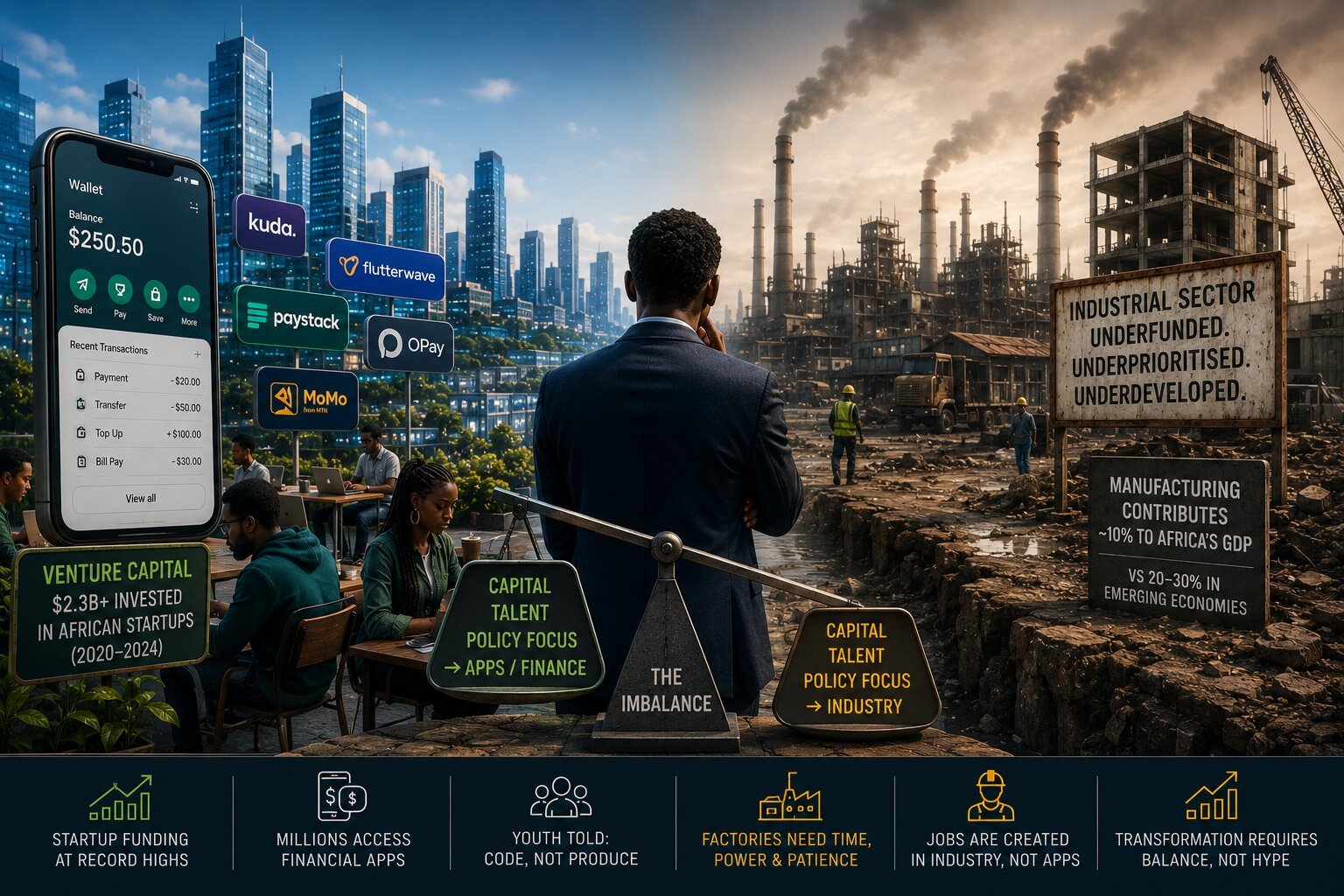
Venture capital and industrialisation operate according to fundamentally different economic logics, and Africa has built a startup culture optimised for venture capital rather than for the productive industrial capacity whose development determines long-run economic power. Venture capital prefers businesses that scale quickly without heavy physical infrastructure, and software fits this model precisely because digital products can scale across markets without requiring factories, industrial machinery, or large production systems. Factories behave differently: manufacturing absorbs capital slowly, industrial projects require land, energy, machinery, logistics coordination, technical labour, and supply chains, returns emerge gradually, and industrial ecosystems compound slowly before becoming globally competitive, making them unattractive to most venture capital structures. The result is predictable: African startup ecosystems produce fintech platforms, payment systems, digital marketplaces, and logistics applications because those are the businesses venture economics reward, while industrial startups struggle for financing. Silicon Valley created some of the world's most valuable software companies, but America already possessed enormous industrial depth before the modern startup era emerged. China built factories before building unicorns, with state banks financing manufacturing clusters, industrial zones, ports, railways, and export systems at massive scale over decades before BYD, CATL, and Huawei emerged as global technology companies. Tanzania's most economically important 2026 developments, the SGR financing, the energy surplus, the port expansion, are physical rather than digital, and the article argues that the financial system must evolve to fund factories with the same institutional enthusiasm currently directed toward software platforms. The question Africa has not yet answered is not whether apps matter. They do. The question is whether the continent can build financial systems capable of funding factories with the same institutional enthusiasm currently reserved for software, because countries become powerful through production complexity, not platform valuations.
Africa's startup economy has a visibility problem disguised as a success story, and the distinction between those two things requires examining not the headlines the startup boom generated but the economic structure those headlines were actually describing. Over the past decade, Africa experienced an explosion of venture capital interest, startup incubators, innovation hubs, fintech platforms, accelerator programmes, pitch competitions, and technology conferences whose combined visibility created the impression of a continental economic transformation. Nairobi became Silicon Savannah. Lagos emerged as a fintech capital. Cape Town strengthened its startup ecosystem. Kigali positioned itself as an innovation hub. The headlines multiplied quickly. But beneath the excitement sits a harder economic reality: Africa is funding apps faster than factories, and that imbalance explains why the continent's startup boom has not translated into the industrial transformation that the employment challenge, productive complexity development, and export competitiveness that Africa's demographic scale requires demand.
The issue is not that African startups lack talent. Some of the continent's most impressive founders built important businesses under extremely difficult conditions. Mobile payments genuinely transformed financial access across East Africa. Logistics platforms improved fragmented distribution systems. Digital commerce reduced coordination inefficiencies in markets whose fragmentation created genuine commercial problems that software was well-positioned to solve. According to GSMA Mobile Economy Sub-Saharan Africa 2023 data, mobile money transaction values across the region reached levels that demonstrate both the commercial significance of the innovation and the genuine market need it addressed. The problem is structural rather than individual, and it begins with the fundamentally different economic logics that venture capital and industrialisation operate according to. Venture capital prefers businesses that scale quickly without heavy physical infrastructure, seeking fast growth, high margins, asset-light expansion, rapid user acquisition, and eventual exits through acquisitions or public listings. Software fits this model precisely because digital products can scale across markets without requiring factories, industrial machinery, or large production systems. Factories behave differently in every dimension that venture capital's risk-return framework assesses: manufacturing absorbs capital slowly before generating returns, industrial projects require land, energy systems, machinery, logistics coordination, technical labour, supply chains, regulatory approvals, and infrastructure reliability whose combined provision demands the kind of patient, multi-year commitment that most venture fund lifecycle economics cannot accommodate.
Why the divergence between app funding and factory funding matters for economic outcomes
The economic consequence of funding apps faster than factories is not simply that Africa's startup ecosystem is weighted toward software rather than hardware, a sectoral composition that might be commercially rational given the relative barriers to entry in each category. The consequence is that the type of innovation being financed most aggressively is the type that generates the least productive complexity accumulation, the least employment multiplier effect, and the least export competitiveness improvement in the categories where Africa's structural economic challenge is most acute. According to Harvard Growth Lab Economic Complexity Index research, economies become wealthy not by producing more things but by producing more sophisticated things whose manufacture generates the engineering learning, supply chain depth, and technical workforce development that compound into the productive sophistication that sustains high income levels across economic cycles. Fintech platforms, payment systems, and digital marketplaces generate genuine commercial value and solve real market problems, but they do not produce the industrial learning, supply chain depth, or engineering workforce development that manufacturing ecosystems generate as a byproduct of their operational requirements.
The employment multiplier dimension is equally consequential. According to International Labour Organisation research on manufacturing employment in developing economies, manufacturing employment multipliers across supplier networks, logistics, maintenance, and secondary commercial activity substantially exceed the employment multipliers of equivalent revenue service sector or digital platform businesses, because manufacturing value chains create backward linkages into local supply chains and forward linkages into export markets whose combined employment effect exceeds what any individual business model could generate directly. A fintech platform whose valuation reaches a billion dollars while employing a few hundred people directly is commercially impressive and industrially irrelevant to the employment absorption challenge that Africa's demographic expansion creates, because the economic logic that produced the valuation is the same economic logic that made the employment count small: efficiency through digital scale rather than productivity through industrial depth.
What Silicon Valley and Shenzhen reveal about the sequencing
The difference between Silicon Valley and China's industrial development trajectory illustrates the structural argument most precisely because it shows what the two models produce at maturity rather than what they require to start. Silicon Valley created some of the world's most commercially valuable software companies, and the innovation ecosystem it represents is genuinely impressive by any measure of technological creativity and commercial ambition. But America already possessed enormous industrial depth before the modern startup era emerged: the United States built steel industries, automotive manufacturing, aerospace systems, industrial machinery, railways, oil infrastructure, semiconductor production, and advanced manufacturing capacity across the century preceding Silicon Valley's dominance, and the technical workforce, engineering culture, research institutions, and supply chain sophistication that Silicon Valley's companies drew on as their human and institutional capital foundation were products of that industrial accumulation rather than prerequisites that appeared from nowhere.
China followed a fundamentally different path that Africa's startup culture is not replicating. According to National Bureau of Statistics of China industrial output data, Beijing did not rely primarily on venture capital to industrialise. China built factories before building unicorns, with state banks financing infrastructure, manufacturing clusters, industrial zones, ports, railways, and export systems at massive scale over decades before companies like BYD, CATL, Huawei, and CRRC emerged as global technology and industrial leaders. According to Korean Development Institute research, South Korea followed the same sequence, building shipbuilding, steel, and electronics manufacturing capacity through state-directed industrial finance before Samsung became a global technology brand. The technology companies that have most consequentially shaped the global economy emerged from industrial economies rather than preceding them, and the African startup ecosystem's ambition to produce equivalent companies while skipping the industrial foundation reflects a sequencing error whose economic consequences will be measured in productive complexity stagnation rather than in startup valuation cycles.
What Tanzania's most consequential 2026 developments reveal
Tanzania increasingly reflects this broader continental tension in ways that make the specific contrast between digital narrative and physical development analytically precise rather than abstractly structural. The country speaks more aggressively about digital transformation, startup ecosystems, innovation, and technological modernization, and the ambition to participate in the global technology economy is genuine and commercially grounded in Tanzania's growing private sector sophistication. At the same time, Tanzania's most economically important 2026 developments are overwhelmingly physical rather than digital. According to Standard Chartered Bank's official announcement of 28 April 2026, the USD 2.33 billion SGR financing for Lots 3, 4, and 5 represents the most consequential single infrastructure investment in Tanzania's recent economic history, restructuring Central Corridor logistics in ways that no digital platform investment could replicate or substitute. According to Tanzania Electric Supply Company operational records, installed electricity generation capacity crossing approximately 4,000 megawatts creates the industrial energy foundation whose significance for manufacturing investment viability Uchumi360 documented in its May 2026 energy analysis. Port expansion, natural gas infrastructure, critical minerals development, and industrial zone development at Bagamoyo and Mkuranga are all physical systems whose development determines Tanzania's productive trajectory more consequentially than any startup ecosystem metric.
The regional comparison across East Africa confirms the pattern. According to Kenya National Bureau of Statistics data, Kenya's fintech ecosystem is the most developed in the region by any conventional measure, with Nairobi generating the largest venture capital deployment, the most sophisticated mobile money infrastructure, and the broadest startup ecosystem across East Africa. Kenya's manufacturing sector contributes approximately 7 to 8% of GDP despite that digital ecosystem leadership, confirming that digital economy sophistication does not automatically generate manufacturing depth without the industrial policy, financial system alignment, and patient capital deployment that Uchumi360's industrial series has consistently identified as the binding complement to physical infrastructure. Rwanda's startup ecosystem is smaller than Kenya's but its institutional quality, documented in the Rwanda Development Board's Annual Report 2025, has produced stronger manufacturing employment multipliers from the investment it attracts because the RDB's financing instruments are better calibrated to industrial payback horizons than the venture capital structures that dominate Kenya's digital investment landscape.
What Africa's financial system must build to fund factories alongside apps
The financial system evolution that would allow Africa to fund factories with the same institutional enthusiasm currently directed toward software platforms requires instruments whose structure is incompatible with conventional venture capital logic and requires the deliberate construction of the patient capital infrastructure that industrialisation has always demanded. According to Korean Development Institute research, South Korea used directed credit through the Korea Development Bank and associated policy finance institutions to fund manufacturing sectors whose payback horizons commercial venture capital would not have accommodated, with the critical design feature being performance requirements that converted state support from a subsidy into an industrial development instrument. According to the African Development Bank's industrial financing research, the primary financing gap for manufacturing investment across Sub-Saharan Africa is not in the availability of capital at the continental level but in the availability of capital structured at the terms that manufacturing requires: long tenor, patient returns, and risk-sharing arrangements that allow early-phase manufacturing operations to absorb the learning curve losses that precede stable profitability.
Tanzania's Development Bank of Tanzania, whose mandate covers industrial financing according to its founding legislation, represents the institutional vehicle whose expansion toward manufacturing-scale industrial lending would begin redirecting capital from circulation toward production. The pension sector, whose liability duration naturally aligns with manufacturing investment payback periods in ways that venture capital fund lifecycles do not, represents an underutilised patient capital base whose strategic deployment toward industrial bond instruments and manufacturing project finance would extend the financial system's industrial capacity without requiring the concessional terms that development bank lending provides. Blended finance structures combining concessional first-loss capital from multilateral development institutions with commercial bank lending would reduce the effective risk to commercial lenders in manufacturing transactions to levels that make industrial lending commercially viable without requiring the full subsidy that direct development bank lending provides. These instruments are the factory-funding equivalents of the startup accelerator, seed fund, and venture capital structures that the digital economy has built over the past decade, and their development with equivalent institutional enthusiasm would begin producing the industrial transformation whose absence the startup boom's visibility has obscured.
Africa can produce both apps and factories. The constraint is not engineering talent, commercial ambition, or entrepreneurial energy. It is the financial architecture whose evolution from venture-optimised to industrially-aligned is the most consequential financial system development the continent can undertake. Countries become powerful through production complexity, not platform valuations, and no amount of startup ecosystem development has yet demonstrated the ability to substitute for the manufacturing depth that every economy which achieved productive sophistication built as its foundation before the digital layer that celebrated it came into existence.
FAQ
Why has Africa's startup boom not translated into industrial transformation? Because venture capital and industrialisation operate according to fundamentally different economic logics. Venture capital prefers asset-light businesses that scale quickly, which software satisfies and manufacturing does not. The result is that African startup ecosystems produce fintech platforms and digital marketplaces because those are the businesses venture economics reward, while industrial startups struggle for financing whose structure is incompatible with manufacturing's slower compounding logic. According to Harvard Growth Lab ECI research, the productive complexity that generates long-run wealth accumulates through manufacturing rather than through digital platforms, and the funding imbalance is directing Africa's entrepreneurial energy toward the commercially rewarded sector rather than the developmentally consequential one.
Is the argument that fintech and digital platforms are economically worthless? No. Mobile money transformed financial access. Logistics platforms improved fragmented distribution. Digital commerce reduced coordination inefficiencies. According to GSMA data, mobile money transaction values across Sub-Saharan Africa demonstrate genuine commercial significance. The argument is about sequencing and balance: digital platforms generate commercial value but do not produce the industrial learning, supply chain depth, or engineering workforce development that manufacturing ecosystems generate as operational byproducts, and Africa's funding imbalance is producing digital vitality without industrial depth in ways whose consequences compound as the productive complexity gap between Africa and manufacturing economies widens.
What financial instruments would redirect capital toward industrial investment? Development Bank of Tanzania expansion toward machinery financing and long-tenor industrial lending. Pension fund regulatory framework evolution allowing manufacturing investment. Blended finance structures combining concessional first-loss capital from multilateral institutions with commercial bank lending. Procurement preferences for locally manufactured goods under Tanzania's Public Procurement Act. Industrial energy pricing in manufacturing zones. These are the factory-funding equivalents of the startup accelerator, seed fund, and venture capital structures that the digital economy built over the past decade.
How does the Silicon Valley versus Shenzhen comparison apply to Africa? Silicon Valley created globally valuable software companies from an economy that already possessed enormous industrial depth. China built factories before building unicorns, directing state bank financing toward manufacturing clusters, industrial zones, and export systems before BYD, CATL, and Huawei emerged as global technology leaders. Africa's startup culture is attempting to replicate Silicon Valley's output without the industrial foundation whose prior existence made that output possible, which is the sequencing error whose correction requires building Shenzhen-equivalent manufacturing capacity alongside the Silicon Savannah narrative rather than treating them as alternative development models.
What does Tanzania's 2026 economic trajectory reveal about the apps-factories balance? Tanzania's most consequential 2026 developments are physical rather than digital: the USD 2.33 billion SGR financing, electricity generation crossing 4,000 megawatts, port expansion, natural gas infrastructure, and critical minerals development. These are the systems that determine Tanzania's productive trajectory more consequentially than any startup ecosystem metric, confirming that the physical foundation whose construction the infrastructure programme represents must be complemented by industrial financing rather than by startup ecosystem development if the infrastructure's productive potential is to be realised.
 Uchumi360
Business Intelligence
Uchumi360
Business Intelligence
- GSMA, Mobile Economy Sub-Saharan Africa 2023
- Mobile money transaction value data
- Available at gsma.com
- Harvard Growth Lab, Economic Complexity Index
- Productive complexity and manufacturing accumulation research
- Available at growthlab.hks.harvard.edu
- International Labour Organisation, manufacturing employment multipliers in developing economies
- Available at ilo.org
- National Bureau of Statistics of China, industrial output and manufacturing development data
- Available at stats.gov.cn
- Korean Development Institute, South Korea industrial finance and directed credit research
- Available at kdi.re.kr
- African Development Bank, industrial financing gap across Sub-Saharan Africa
- Available at afdb.org
- Kenya National Bureau of Statistics, fintech ecosystem and manufacturing GDP data
- Available at knbs.or.ke
- Rwanda Development Board, Annual Report 2025
- Manufacturing employment multipliers and financing instrument data
- Available at rdb.rw
- Tanzania Electric Supply Company, operational records
- Available at tanesco.co.tz
- Standard Chartered Bank, SGR financing announcement, 28 April 2026
- Available at sc.com
- Development Bank of Tanzania, mandate and lending portfolio documentation
- Available at dbt.go.tz
Uchumi360 covers business, investment, and economic policy across East, Central, and Southern Africa.
For the serious reader
You read to the end. That places you in a small group.
Uchumi360 is built for readers who demand precision over speed, structure over sentiment, and analysis that holds uncomfortable conclusions rather than softening them. If this work sharpens how you think about Africa's economy, help us keep building the infrastructure behind it.
Institutional Partners
Commission intelligence. Shape the conversation.
Uchumi360 works with development finance institutions, investment firms, sovereign bodies, and strategic organisations across the coverage region. Institutional partnership unlocks:
- Commissioned sector and country intelligence reports
- Branded research series under your institution's authority
- Exclusive data briefings for internal strategy teams
- Speaking and editorial presence at Uchumi360 events
- Co-published investment outlooks for your markets
Support Our Work
Independent analysis has a cost. Help us bear it.
Uchumi360 does not carry advertising. It does not take editorial direction from sponsors. Every article is produced without commercial compromise. Your contribution funds the reporting, research, and editorial infrastructure that keeps this analysis free from influence.
Secure checkout: One-time and monthly support are processed securely. Add payment credentials to enable checkout here.
Stay Connected
Keep up with every new insight.
Follow our latest analysis, policy coverage, and market intelligence as soon as it is published. If you need something specific, reach out directly and we will point you to the right research.
