
Critical PHP Flaws Put Businesses And Millions Of Websites At Risk
Ready
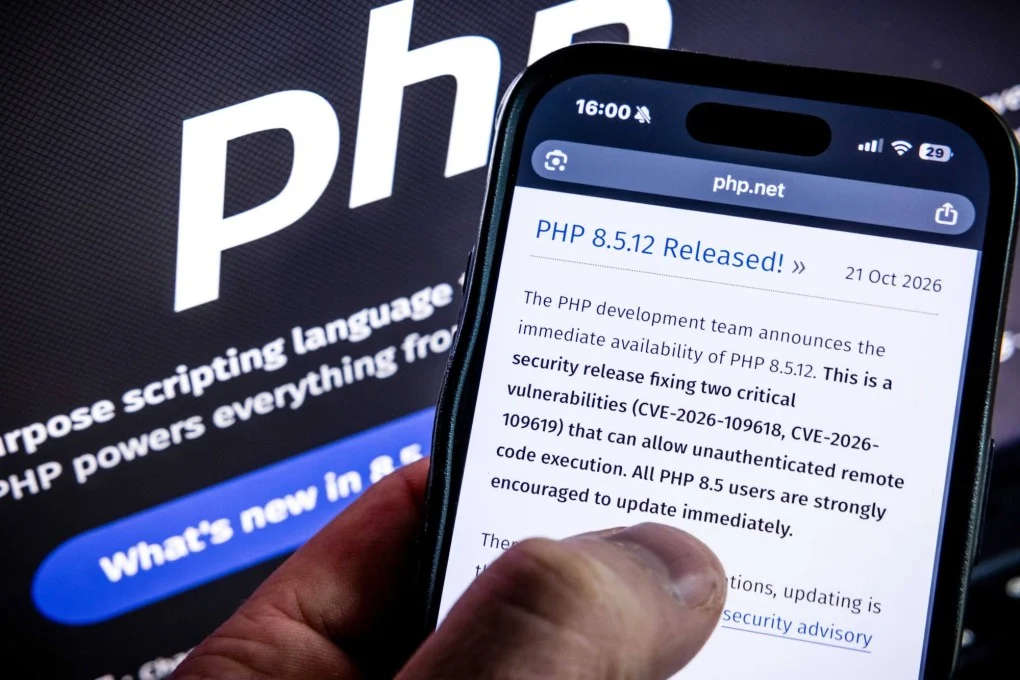
PHP has released emergency fixes for two critical vulnerabilities capable of allowing unauthenticated remote code execution. For businesses, the disclosure exposes a larger risk created by dependence on web infrastructure that is often inexpensive to build but poorly understood and inconsistently maintained.
Two critical security vulnerabilities discovered in PHP have forced an emergency update of one of the technologies underlying a large part of the commercial internet, leaving companies, hosting providers and public institutions with an immediate task of determining whether the servers behind their websites and online applications have been patched.
The PHP development team released PHP 8.5.12, 8.4.27, 8.3.36 and 8.2.35 on 21 October after identifying two vulnerabilities, CVE 2026 109618 and CVE 2026 109619, that can allow an attacker without an authenticated account to execute code remotely on an affected server. PHP has assigned both vulnerabilities a severity score of 9.2 out of 10 under CVSS v4.0 and says there is no complete mitigation short of updating the affected software. The warning applies to PHP installations serving web requests through configurations including PHP FPM, Apache mod_php, php cgi, FrankenPHP and LiteSpeed, with PHP describing the risk as highest for mod_php because researchers demonstrated an attack that can be triggered before application code begins running.
For companies that depend on PHP without necessarily knowing that they do, the disclosure creates an unusual problem. PHP normally sits below the visible layer of a website or application. Customers interact with an online shop, booking platform, news website, corporate portal or government service without seeing the programming language processing requests on the server. Management may know which website or content management system the organisation uses while having little reason, until an incident such as this, to know which version of PHP is installed underneath it.
That separation between the technology a company sees and the technology on which it actually depends has become one of the less visible risks of the digital economy. Businesses increasingly derive revenue, collect customer information and deliver services through combinations of programming languages, frameworks, databases, plugins, cloud infrastructure and open source software assembled over many years. A vulnerability in one component can affect systems whose owners may not even know that component is present.
A Security Update With Commercial Consequences
The two vulnerabilities are serious because successful exploitation can move the attacker beyond the public face of a website and into the server executing the application. CVE 2026 109618 involves corruption of internal request data during out of memory handling, while CVE 2026 109619 involves internal state remaining accessible after the memory supporting it has been freed. Under vulnerable conditions, both can lead to remote code execution with the privileges available to the affected web process.
What an attacker could subsequently reach depends on the architecture of the individual system. A web server may be relatively isolated, or it may have access to databases, application credentials, customer records, file storage and other internal services. The commercial exposure therefore varies considerably between a basic informational website and an online platform connected to transactions, accounts or sensitive information.
The urgency is increased by the absence of a complete workaround. PHP's instruction is to move supported installations to 8.5.12, 8.4.27, 8.3.36 or 8.2.35. Linux distributions and long term support vendors received patches in advance and may distribute corrected packages through their own systems. PHP 8.1 and older releases are no longer maintained by the PHP project, although some operating system distributors and commercial support providers may continue to backport security fixes.
PHP 8.2 presents another immediate maintenance issue because its security support ends on 31 December 2026. A company updating an 8.2 installation today may therefore solve the immediate vulnerability while still facing another upgrade decision within little more than two months.
For large technology companies with inventories of their infrastructure, automated deployment systems and dedicated security teams, identifying affected servers can be relatively straightforward. The more difficult exposure is likely to exist among organisations whose websites and applications have accumulated over time through external developers, agencies, inexpensive hosting providers and legacy systems for which maintenance responsibility is no longer clear.
A website commissioned several years ago may still be generating sales or collecting customer information even though the developer who built it is no longer involved. Another may sit on a shared hosting account renewed annually by an administrative employee. A company may have several websites developed by different agencies, while an older internal portal continues operating because replacing it has never appeared urgent enough to justify the cost.
The vulnerability does not make all of those systems compromised. It makes knowing what they are running considerably more important.
Africa's Low Cost Web Infrastructure Creates A Particular Maintenance Problem
The issue has particular relevance across African markets because PHP based technologies helped reduce the cost of bringing businesses and institutions online. Shared hosting, inexpensive development and content management systems built around PHP allowed companies that could not justify large technology budgets to establish websites, ecommerce stores, news platforms, booking systems and organisational portals at relatively low cost.
That model has delivered substantial economic value. A small hotel in Arusha, a tour operator in Kigali, a retailer in Nairobi or a professional firm in Lusaka can maintain a global web presence without owning servers or employing a large software engineering team. Media organisations can publish continuously without building publishing systems from the beginning, while schools, NGOs and public institutions can operate online services using technology available to organisations with far larger budgets.
The weakness appears later, when the cost of creating the system and the cost of maintaining it are treated as the same problem.
A company may pay a developer once to build a website and a hosting provider annually to keep it online, without having a separate arrangement covering application maintenance, dependency upgrades, security monitoring and replacement of software that has reached the end of support. The website continues functioning, so the absence of maintenance remains largely invisible until a vulnerability, compatibility failure or security incident exposes it.
This is one reason technical debt can accumulate rapidly in smaller organisations. Replacing an old PHP version may require more than installing a new package if the application above it depends on old frameworks, plugins or custom code. A routine security update can become a migration project because several years of deferred maintenance have been compressed into one urgent decision.
The economics of that decision are often misunderstood because businesses tend to value a digital system according to what it originally cost to build. A website developed for $3,000 may later process tens or hundreds of thousands of dollars in annual transactions. A booking system may have become the main source of reservations for a hotel. A publisher may depend on its website for most of its audience and advertising inventory. A school or government institution may have gradually moved services onto an application that began as a relatively small technology project.
Once that happens, the original development cost says very little about the economic value of the asset. A system that cost little to build can become expensive to lose.
PHP Shows How Much Of The Digital Economy Depends On Shared Code
There is a broader economic significance to the incident because PHP is open source software. Companies can build commercial applications with it without paying the kind of licence fees historically associated with proprietary enterprise software. That lowers the cost of software development, hosting and experimentation, particularly for smaller companies and emerging markets.
The resulting economic value is distributed far beyond the institutions responsible for maintaining the underlying code. Developers maintain the language, security researchers examine it for weaknesses, operating system companies package it, cloud and hosting providers deploy it, and millions of organisations build commercial activity above it. The revenue generated through those applications can be vastly larger than the financial resources available to the open source projects on which they depend.
This pattern extends well beyond PHP. Modern companies routinely depend on open source components embedded several layers below the software visible to management. The arrangement has made software cheaper and faster to develop, but it has also concentrated considerable economic dependence in pieces of infrastructure that rarely appear in corporate risk registers.
The latest PHP disclosure provides an unusually clear demonstration of that dependence because the vulnerability is located in the language runtime itself rather than in one particular website application. PHP says all installations serving web requests should be considered within the affected population until they are updated or confirmed to have received an appropriate vendor supplied patch.
The operational response is already showing how responsibility differs between hosting models. Some managed platforms can patch applications centrally, meaning customers may have little or nothing to do. Other services provide the infrastructure but leave runtime updates to customers, requiring individual businesses or developers to install or redeploy the corrected versions. Organisations operating their own servers carry the responsibility directly.
For companies outsourcing their technology, the most immediate uncertainty may therefore be contractual rather than technical. Paying a company to host a website does not necessarily mean that company is responsible for maintaining every component of the application. Paying a developer to build an application does not necessarily mean that developer continues monitoring its dependencies years after delivery. Managed hosting, server administration, application maintenance and cybersecurity can be separate services even when the customer experiences them as one website.
The PHP disclosure has turned those distinctions into questions companies need answered quickly. They need to establish which PHP versions their systems use, whether the corrected packages have been installed, whether unsupported PHP versions remain in production and which supplier or internal team is responsible for completing the work.
The Cost Of Failure Is Determined By What Sits Behind The Server
The financial exposure from a vulnerable server cannot be estimated simply from the cost of repairing the website. If exploitation results in a compromise, expenditure can include forensic investigation, emergency engineering work, restoration of systems, credential replacement and security reviews. A company that has exposed personal or financial information may face additional legal, regulatory and notification obligations depending on the jurisdiction and nature of the data involved.
Interruption can be more expensive than repair. An ecommerce company loses transactions when checkout becomes unavailable. A hotel can lose reservations. A media company can lose advertising impressions and subscriptions. A logistics business can lose the systems through which customers place or follow orders. An institution that has digitised a public service may suddenly have to return to slower manual processes.
The economic value at risk is consequently determined by the activity dependent on the system rather than the price of the software itself.
That is particularly relevant for smaller African businesses, where relatively inexpensive digital systems increasingly support operations much larger than the technology budgets that created them. A company may have digitised faster than its technology governance has developed. Customer acquisition moved online, payments became digital, databases grew and websites became commercial infrastructure, while responsibility for maintenance remained with the same informal arrangement established when the business first created an online presence.
The PHP vulnerabilities do not establish that those companies have been attacked, and vulnerability should not be confused with compromise. They do expose the consequences of allowing uncertainty to persist around the infrastructure supporting commercial activity.
The immediate response is technical and relatively clear. Supported installations need the corrected releases, older installations need confirmation that a distributor or long term support vendor has supplied an equivalent patch or they need to be upgraded, and organisations need to verify the versions actually running in production rather than assuming an update has taken place.
The longer term issue is economic. Digital systems have moved from being supplementary tools to becoming productive assets through which companies sell, communicate, collect information and operate. Their maintenance costs belong with the cost of operating the business rather than the cost of occasionally redesigning its website.
PHP's emergency release makes that distinction difficult to ignore. The software itself can be downloaded without a licence fee, and many of the websites built on it were inexpensive to create. The businesses that now depend on those systems can be worth millions.
The vulnerability may be in the code, but the value exposed by it sits on corporate balance sheets, in customer relationships and in the daily transactions that increasingly pass through software most executives never see.
FAQ
What happened to PHP on 21 October 2026? PHP released emergency security updates after two critical vulnerabilities were identified in the PHP runtime. The vulnerabilities can allow unauthenticated remote code execution under affected configurations.
Which PHP vulnerabilities were discovered? The vulnerabilities are CVE 2026 109618 and CVE 2026 109619. PHP has assigned both a CVSS v4.0 severity score of 9.2.
Which PHP versions contain the fixes? The corrected releases are PHP 8.5.12, PHP 8.4.27, PHP 8.3.36 and PHP 8.2.35.
Are all PHP websites compromised? No. The existence of a vulnerability does not mean a server has been successfully attacked. PHP is urging installations serving web requests to update because affected systems may be vulnerable to unauthenticated remote code execution.
Why is the PHP vulnerability important for businesses? PHP is used underneath websites and applications that can support sales, customer accounts, databases and other business operations. A vulnerability at the server level can therefore create financial and operational exposure even when the affected company does not develop software itself.
What should businesses do? Businesses should establish which PHP versions their websites and applications are running, confirm that the relevant security updates have been installed, identify unsupported versions and clarify whether their internal technology team, hosting company or external developer is responsible for maintaining the underlying infrastructure.
 Uchumi360
Business Intelligence
Uchumi360 covers business, investment, and economic policy across East, Central, and Southern Africa.
For the serious reader
You read to the end. That places you in a small group.
Uchumi360 is built for readers who demand precision over speed, structure over sentiment, and analysis that holds uncomfortable conclusions rather than softening them. If this work sharpens how you think about Africa's economy, help us keep building the infrastructure behind it.
Institutional Partners
Commission intelligence. Shape the conversation.
Uchumi360 works with development finance institutions, investment firms, sovereign bodies, and strategic organisations across the coverage region. Institutional partnership unlocks:
- Commissioned sector and country intelligence reports
- Branded research series under your institution's authority
- Exclusive data briefings for internal strategy teams
- Speaking and editorial presence at Uchumi360 events
- Co-published investment outlooks for your markets
Support Our Work
Independent analysis has a cost. Help us bear it.
Uchumi360 does not carry advertising. It does not take editorial direction from sponsors. Every article is produced without commercial compromise. Your contribution funds the reporting, research, and editorial infrastructure that keeps this analysis free from influence.
Secure checkout: One-time and monthly support are processed securely. Add payment credentials to enable checkout here.
Stay Connected
Keep up with every new insight.
Follow our latest analysis, policy coverage, and market intelligence as soon as it is published. If you need something specific, reach out directly and we will point you to the right research.
