
OPINION: African Governments Are Choosing AI Conferences Over Factories Because Factories Are Hard. That Choice Has a Cost That Citizens Will Pay.
Ready
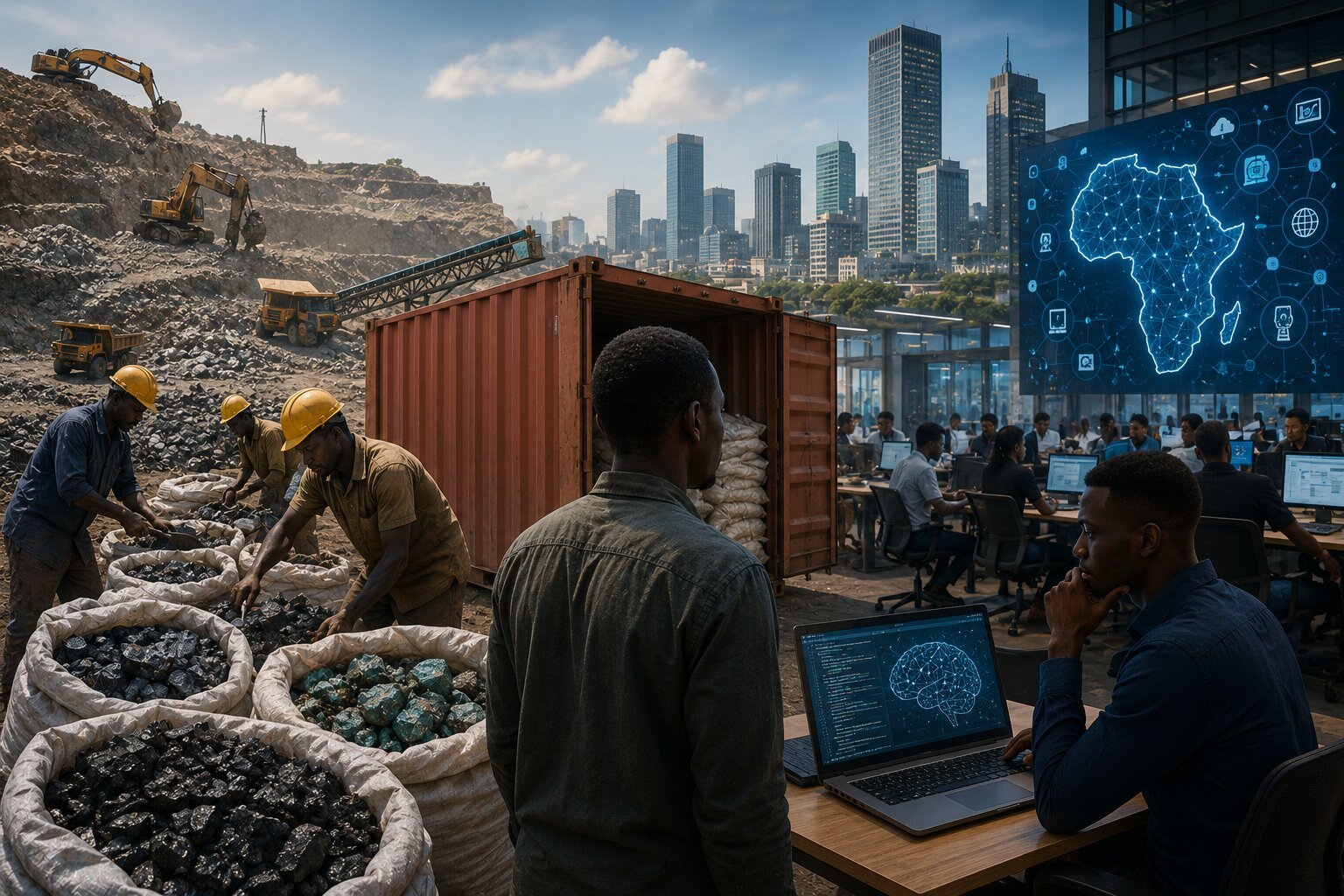
Africa's governments, investors, and policy institutions are conducting an increasingly sophisticated conversation about artificial intelligence, digital economies, and the Fourth Industrial Revolution while the continent accounts for less than 3% of global manufacturing output, exports the majority of the critical minerals feeding the global technology supply chain in raw form, and faces an electricity reliability deficit that constrains the industrial activity that digital economies sit on top of. Every economy that has achieved technological sophistication at scale, the United States, South Korea, Taiwan, China, and even India, was an industrial economy first, and the technology sectors those countries now dominate emerged from productive systems rather than preceding them. This article identifies why the sequencing matters, what Africa risks by treating technology as an alternative to industrialisation rather than a layer built on top of it, and why the continent's demographic moment makes getting the sequence right more urgent than at any previous point in its economic history. African governments are choosing AI conferences over factories because factories are hard. That choice has a cost that citizens will pay.
Africa accounts for less than 3% of global manufacturing output despite holding approximately 18% of the global population, according to United Nations Industrial Development Organisation data, exports the cobalt, lithium, graphite, and rare earth minerals that build the semiconductors, batteries, and electronic systems powering the global technology economy in predominantly raw and unprocessed form, and is simultaneously conducting one of the most energetic continental conversations about artificial intelligence, digital transformation, and the Fourth Industrial Revolution that any developing region has produced in the past decade. Those three facts sit in a relationship with each other that African development discourse is not confronting with the analytical honesty the stakes require. The continent wants the software economy before building the physical economy that software economies sit on. It wants the outcome of industrialisation without the sequence that produces it. And the historical record of every economy that has achieved technological sophistication at scale is unambiguous about whether that sequence can be reversed: it cannot.
No country in modern economic history has become wealthy by digitising poverty. According to research published by the Harvard Growth Lab's Economic Complexity Index, economic transformation has followed the same structural sequence across every documented case of successful development: energy infrastructure, basic manufacturing, logistics systems, productivity growth driven by industrial learning, and then technological sophistication layered on top of productive capacity whose depth and complexity made digital amplification economically meaningful. The United States built steel, railways, oil systems, aviation infrastructure, and manufacturing capacity across eight decades before Silicon Valley dominated global software. According to the World Bank's World Development Indicators, South Korea's manufacturing sector contributed above 28% of GDP during its industrial acceleration phase in the 1970s and 1980s, with export manufacturing in textiles, steel, and shipbuilding preceding semiconductor dominance and consumer electronics by two decades. China, according to the National Bureau of Statistics of China, became the world's largest manufacturing economy before becoming a global artificial intelligence power, spending thirty years building the factory ecosystem whose technical workforce, supply chain depth, and engineering capability gave its technology sector the productive foundation it needed to compound into global dominance. Even India's technology sector, which African development discourse consistently invokes as the preferred comparison point for digital economy ambitions, emerged from a country with significant industrial depth in pharmaceuticals, engineering services, chemicals, and manufacturing, sectors whose technical workforce provided the engineering talent that India's software industry subsequently absorbed and redirected.
The amplifier problem that AI discourse is not confronting
Artificial intelligence is not a development model. It is an amplifier of productive systems that already exist, and the economic logic of amplification is straightforward: if the underlying productive system is weak, AI amplifies weakness. If the underlying productive system is strong, AI amplifies productivity. According to McKinsey Global Institute's research on AI's economic impact, the largest productivity gains from AI adoption are concentrated in economies with high existing levels of industrial complexity, digital infrastructure, and technical workforce depth, precisely because AI tools are most valuable when they are applied to systems that are already operating at a level of sophistication where marginal efficiency gains translate into significant output improvements. An agricultural economy where the binding constraint is market access, post-harvest handling infrastructure, and cold-chain logistics does not become more productive because its farmers download an AI-powered crop advisory application. It becomes more productive when the cold-chain infrastructure is built, the market access is secured, and the application then helps optimise operations within a system that is already functioning. The application is the last mile, not the first.
Africa's current technology discourse systematically inverts this logic by treating digital tools as the solution to problems whose roots are physical, institutional, and industrial rather than informational. According to the African Development Bank's African Economic Outlook 2023, Sub-Saharan Africa's manufacturing sector contributes below 11% of GDP on average, compared to more than 24% in East Asia during its industrial acceleration phase. The gap between those two figures is not a technology gap. It is a capital, infrastructure, energy, skills, and policy coherence gap whose closure requires the same patient, politically difficult, long-horizon institutional investment that every economy which closed it had to make, and which cannot be substituted by a fintech ecosystem, a startup accelerator, or a national AI strategy whose implementation depends on electricity reliability that the country's industrial zones do not yet consistently provide.
The employment contradiction that nobody at the AI conference is addressing
Africa's demographic moment makes the sequencing question more urgent than academic, because the continent is entering the period of its largest youth population expansion in history at precisely the moment when it is orienting its development conversation toward the technology with the most labour-reducing economic logic of any that has been deployed at scale in the modern era. According to the United Nations Population Fund's State of World Population report, Africa's working-age population is projected to reach 1.1 billion by 2030 and nearly double again by 2050, making the continent's labour absorption challenge the largest of any region in the world across the next three decades. Historically, according to research published by the International Labour Organisation, the economic mechanism through which developing economies have absorbed equivalent demographic surges into productive employment has been manufacturing, with the factory-led development models of East Asia absorbing hundreds of millions of workers into formal employment during the industrial acceleration phases that preceded technological sophistication.
AI's economic logic runs in the opposite direction. According to the World Economic Forum's Future of Jobs Report 2023, AI and automation are projected to displace a net 14 million jobs globally by 2027, with the displacement concentrated in the routine cognitive and manual tasks that entry-level manufacturing and service employment provides, precisely the employment categories that represent the most realistic near-term economic option for the majority of Africa's expanding working-age population. China employed hundreds of millions through factories before beginning to automate them, building the industrial workforce, the technical capability, and the social stability that the automation transition required over several decades of manufacturing-led growth. Africa is conducting a serious continental conversation about automation before building the factories themselves, which is not a technological sophistication but a developmental category error whose consequences will be measured in the employment gap between the jobs the demographic surge requires and the jobs the technology-first development model can create.
The mineral paradox at the centre of Africa's technology ambition
The most precise illustration of the contradiction between Africa's technological aspirations and its industrial positioning is not the manufacturing GDP gap or the electricity reliability deficit, significant as both are. It is the relationship between the minerals Africa holds and the technology systems those minerals feed. According to the United States Geological Survey's Mineral Commodity Summaries 2024, the Democratic Republic of Congo accounts for approximately 74% of global cobalt production, a mineral whose primary commercial application is lithium-ion battery manufacturing for electric vehicles, smartphones, and the data centre infrastructure that AI systems run on. According to the same USGS data, African countries hold dominant positions in graphite, manganese, tantalum, and platinum group metals whose industrial applications span the full spectrum of the technology economy, from semiconductor fabrication to fuel cell development to aerospace systems. Zimbabwe and Mali hold lithium deposits whose development is accelerating as global battery demand grows, according to Benchmark Mineral Intelligence's lithium supply chain analysis. Mozambique and Tanzania hold graphite reserves whose scale makes them consequential for the anode materials that battery manufacturing requires, as Uchumi360 documented in its May 2026 coverage of Tanzania's critical minerals pipeline.
The continent that holds these resources exports the overwhelming majority of them in raw or minimally processed form, according to UNCTAD's Economic Development in Africa Report 2023, capturing the extraction margin while the processing, manufacturing, and technology application margins accumulate in China, South Korea, Japan, and the European Union. Africa wants to participate in the Fourth Industrial Revolution while remaining structurally positioned at the bottom of the industrial value chain feeding it, mining the cobalt that goes into the batteries that power the AI servers that process the data that generates the economic value that African governments are hoping digital economy strategies will eventually deliver. The circularity of that position is the clearest available expression of what happens when technological ambition is not grounded in industrial strategy.
What Tanzania, Kenya, Rwanda, and the region reveal about the practical gap
The regional picture across East Africa provides the ground-level evidence for the abstract structural argument, because each country in the Uchumi360 coverage geography is simultaneously conducting an ambitious technology and digital economy conversation and managing the industrial and infrastructure deficits that make that conversation aspirational rather than operational. In Tanzania, as documented in Uchumi360's analysis of TARURA's road network condition, 69.31% of the district road network remains earthen road according to Parliamentary Infrastructure Committee data presented by Dennis Londo in 2024, with the agency receiving only 12% of its annual budget allocation in the 2023/2024 financial year. Tanzania's manufacturing sector contributes approximately 8 to 9% of GDP, well below the 20 to 30% that Vision 2050's USD 1 trillion target requires, according to the Bank of Tanzania's economic data. The country has a national AI and digital economy strategy. It does not yet have the electricity reliability, the road network quality, or the manufacturing base that would make an AI-enabled economy more than a communications framework for an import-dependent consumption economy.
Kenya's position is more advanced across most industrial and digital indicators, and the contrast is instructive rather than flattering. According to the Kenya National Bureau of Statistics, Kenya's manufacturing sector contributes approximately 7 to 8% of GDP, below Tanzania's and well below the East Asian benchmarks, despite Kenya's more developed financial system, more sophisticated services economy, and more active startup and technology investment ecosystem. The Nairobi International Financial Centre, which Uchumi360 documented in its April 2026 analysis of East Africa's financial hub competition, is a genuine institutional development whose ambition is commercially grounded, but it is being built on an economy whose manufacturing base is insufficient to generate the industrial complexity that deep financial markets require as their productive foundation. Rwanda's governance quality and institutional discipline, consistently cited as the regional benchmark for policy execution, has not yet translated into manufacturing depth, with the sector contributing below 7% of GDP according to the National Institute of Statistics of Rwanda, reflecting the fundamental challenge that a small landlocked economy faces in building industrial scale without the market size and logistics economics that favour larger coastal economies.
The infrastructure contradiction that technology discourse treats as background
Advanced digital economies depend on electricity reliability, high-capacity data infrastructure, transport network quality, semiconductor access, logistics systems, and industrial energy supply at standards that a significant share of African industrial zones still cannot consistently provide. According to the International Energy Agency's Africa Energy Outlook 2022, Sub-Saharan Africa outside South Africa has an average electricity access rate whose reliability for industrial and commercial users constrains manufacturing competitiveness in ways that no amount of mobile money penetration or startup ecosystem development can compensate for. Data centres, which are the physical infrastructure of the AI economy, require power reliability specifications that most African cities cannot guarantee without dedicated generation and backup systems whose capital cost adds to the already challenging economics of digital infrastructure investment. According to Uchumi360's April 2026 analysis of Tanzania's energy position, Tanzania has achieved an installed generation capacity that now exceeds domestic peak demand for the first time, a genuine milestone, but the transmission and distribution infrastructure required to deliver that generation reliably to industrial users across the country's 26 regions remains a work in progress whose completion timeline extends well into the next decade.
The countries currently dominating artificial intelligence development are also the countries dominating semiconductor manufacturing, advanced industrial robotics, rare earth processing, battery system production, and the cloud infrastructure whose physical instantiation requires extraordinary material and energy intensity. According to research published by the International Energy Agency, training a single large language model of the scale currently used in commercial AI applications requires energy consumption equivalent to the lifetime driving of approximately five conventional vehicles, and the data centres supporting global AI inference at scale consume electricity at rates that make them significant industrial energy consumers in their own right. The digital economy sits on top of a physical economy that is extraordinarily material-intensive, and Africa's position as a supplier of the materials feeding that physical economy without yet being a significant participant in the manufacturing and energy systems it requires is the structural contradiction that no technology strategy document has yet resolved.
What the East Asian sequence actually required and why it cannot be skipped
The East Asian development model that produced the world's most successful cases of economic transformation from low-income agricultural economies to technologically sophisticated industrial powers required a specific sequence of institutional investments, policy commitments, and capital deployments that took decades to compound into the outcomes that African governments are hoping to achieve through digital economy strategies on much shorter timelines. According to research published by the World Bank's Commission on Growth and Development, the common elements across the East Asian success cases, South Korea, Taiwan, Singapore, and China, included sustained infrastructure investment that preceded industrial expansion, export discipline that forced domestic manufacturers to meet international quality standards, technical education systems co-designed with the industrial sector's specific skill requirements, long-tenor patient capital that financed industrial investment across payback horizons that commercial banks would not have supported, and state coordination capacity that could implement industrial policy consistently across political cycles.
South Korea did not become a technology power by beginning with advanced technology. According to the Korean Development Institute's economic history research, South Korea's industrial strategy began with textiles and light manufacturing in the 1960s, moved into steel, shipbuilding, and petrochemicals in the 1970s, and entered electronics and semiconductor manufacturing in the 1980s, with each phase building on the technical workforce, supply chain infrastructure, and industrial capital that the previous phase had generated. Samsung, now a global technology giant, began as a trading company and moved through food processing and textiles before entering electronics manufacturing. The technology capability that Samsung now represents is the output of six decades of industrial compounding, not the starting point of a development strategy. Taiwan's semiconductor dominance, which according to TSMC's corporate history began with deliberate state investment in the Industrial Technology Research Institute in the 1970s, emerged from a manufacturing economy whose depth in precision engineering, quality management, and technical education gave the semiconductor industry the human and institutional capital it required. Africa's technology ambitions are real and the capabilities of African engineers, entrepreneurs, and innovators are genuine. What is missing is not ambition. It is the industrial foundation that gives ambition the productive system to compound through.
The psychological dimension of this problem is worth naming precisely because it operates through incentives that are rational at the individual and institutional level while being destructive at the developmental level. Industrialisation feels old. AI feels futuristic. According to survey research published by the African Union Development Agency on policy priorities across African governments, digital economy and technology transformation consistently rank among the top priorities that governments want to be associated with, while industrial policy, manufacturing investment, and infrastructure development rank as important but less prestigious agenda items whose political communication value is lower. Investors prefer software margins to industrial margins because asset-light businesses scale faster and exit more cleanly than factories. Young people enter technology because the entry barriers are lower, the status signals are higher, and the timeline from idea to income is shorter than manufacturing requires. None of these incentives are irrational individually. Their collective effect is a continent whose development conversation is oriented toward the fastest and most visible forms of economic activity rather than toward the slowest and most foundational ones, which is precisely the inverse of the orientation that produced the transformations Africa is hoping to replicate.
Africa does not need less technology. It needs to stop treating technology as an alternative to industrialisation rather than as a layer built on top of it. The physical economy is not disappearing. It is becoming more technologically integrated, which is precisely why the countries that control the physical economy are also the ones dominating the technology economy, and why the countries that supply the physical economy's raw material inputs without controlling its manufacturing and processing stages are watching the Fourth Industrial Revolution from the same structural position they watched the first three: as suppliers of the inputs, consumers of the outputs, and bystanders to the value creation that happened in between.
FAQ
Is the argument that Africa should ignore AI and digital technology? No. The argument is that digital technology is an amplifier of productive systems that already exist, not a substitute for building them. According to McKinsey Global Institute research, the largest AI productivity gains accrue to economies with existing industrial complexity and technical workforce depth. Africa needs both the industrial foundation and the digital layer, in that sequence, rather than treating the digital layer as a shortcut around the industrial foundation.
Why does the manufacturing GDP gap matter so much? According to UNIDO data, Africa accounts for less than 3% of global manufacturing output despite holding 18% of the world's population. According to the African Development Bank's African Economic Outlook 2023, manufacturing contributes below 11% of Sub-Saharan Africa's GDP on average, compared to more than 24% in East Asia during its industrial acceleration phase. Manufacturing matters because it creates employment at scale, transfers technical capability, deepens supply chains, increases exports, and generates the tax base that finances the public services and infrastructure that digital economies require as their foundation.
What is the relationship between Africa's minerals and the technology economy? According to the USGS Mineral Commodity Summaries 2024, the DRC accounts for approximately 74% of global cobalt production, a critical input for battery manufacturing that powers electric vehicles, smartphones, and the data centres running AI systems. African countries hold dominant positions in graphite, lithium, manganese, and rare earths whose applications span the full technology economy. Africa exports the majority of these minerals raw, capturing the extraction margin while processing, manufacturing, and technology application margins accumulate elsewhere. The continent is structurally positioned as a supplier of inputs to the Fourth Industrial Revolution rather than a participant in it.
Why is Africa's demographic moment relevant to the sequencing argument? According to UNFPA projections, Africa's working-age population will reach 1.1 billion by 2030 and nearly double again by 2050, making Africa's labour absorption challenge the largest of any region globally across the next three decades. The World Economic Forum's Future of Jobs Report 2023 projects AI and automation will displace a net 14 million jobs globally by 2027. Historically, developing economies absorbed demographic surges through manufacturing employment. Africa is conducting a serious conversation about AI-driven automation before building the manufacturing base that would give its expanding workforce the productive employment that demographic transitions require to generate development rather than instability.
What did the East Asian economies actually do that Africa is not doing? According to Korean Development Institute research, South Korea began with textiles in the 1960s, moved through steel and shipbuilding in the 1970s, and entered electronics in the 1980s, with each phase building on the technical workforce and industrial capital the previous phase generated. Taiwan's semiconductor dominance emerged from a manufacturing economy with deep precision engineering capability. China spent three decades building factory ecosystems before becoming an AI power. The common element is industrial compounding across decades, with technological sophistication as the output of industrial depth rather than its substitute. African governments are attempting to claim the output without building the input, which the historical record does not support as a viable development pathway.
 Uchumi360
Business Intelligence
Uchumi360
Business Intelligence
- United Nations Industrial Development Organisation, World Manufacturing Production statistics
- Available at unido.org
- Harvard Growth Lab, Economic Complexity Index
- Development sequencing research cited from Harvard Growth Lab publications
- Available at growthlab.hks.harvard.edu
- World Bank, World Development Indicators
- Available at data.worldbank.org
- McKinsey Global Institute, AI economic impact research
- Productivity gain concentration in high-complexity economies cited from MGI reports
- African Development Bank, African Economic Outlook 2023
- Sub-Saharan Africa manufacturing GDP below 11% figure
- Available at afdb.org
- United Nations Population Fund, State of World Population report
- Africa working-age population projections
- Available at unfpa.org
- International Labour Organisation, manufacturing and employment research
- East Asian labour absorption through manufacturing cited from ILO publications
- World Economic Forum, Future of Jobs Report 2023
- AI displacement projections
- Available at weforum.org
- United States Geological Survey, Mineral Commodity Summaries 2024
- DRC cobalt production share and African mineral position data
- Available at usgs.gov
- UNCTAD, Economic Development in Africa Report 2023
- Raw mineral export share figure
- Available at unctad.org
- Benchmark Mineral Intelligence, lithium and graphite supply chain analysis
- Zimbabwe lithium and Tanzania graphite data
- International Energy Agency, Africa Energy Outlook 2022
- Sub-Saharan Africa electricity reliability data
- Available at iea.org
- International Energy Agency, AI energy consumption data
- Large language model training energy equivalence cited from IEA publications
- World Bank Commission on Growth and Development, report on East Asian development model
- Available at worldbank.org
- Korean Development Institute, South Korea industrial strategy history research
- Samsung and South Korean industrial sequencing data
- Available at kdi.re.kr
- TSMC corporate history and Industrial Technology Research Institute documentation
- Taiwan semiconductor development history cited
- Available at tsmc.com
- National Institute of Statistics of Rwanda, manufacturing GDP data
- Available at statistics.gov.rw
- Bank of Tanzania, economic data on manufacturing sector GDP share
- Available at bot.go.tz
- Tanzania Parliamentary Infrastructure Committee, 2024 report
- TARURA road network data cited from Uchumi360's prior analysis
- African Union Development Agency, policy priority survey research
- Digital economy versus industrial policy prestige gap cited
Uchumi360 covers business, investment, and economic policy across East, Central, and Southern Africa.
For the serious reader
You read to the end. That places you in a small group.
Uchumi360 is built for readers who demand precision over speed, structure over sentiment, and analysis that holds uncomfortable conclusions rather than softening them. If this work sharpens how you think about Africa's economy, help us keep building the infrastructure behind it.
Institutional Partners
Commission intelligence. Shape the conversation.
Uchumi360 works with development finance institutions, investment firms, sovereign bodies, and strategic organisations across the coverage region. Institutional partnership unlocks:
- Commissioned sector and country intelligence reports
- Branded research series under your institution's authority
- Exclusive data briefings for internal strategy teams
- Speaking and editorial presence at Uchumi360 events
- Co-published investment outlooks for your markets
Support Our Work
Independent analysis has a cost. Help us bear it.
Uchumi360 does not carry advertising. It does not take editorial direction from sponsors. Every article is produced without commercial compromise. Your contribution funds the reporting, research, and editorial infrastructure that keeps this analysis free from influence.
Secure checkout: One-time and monthly support are processed securely. Add payment credentials to enable checkout here.
Stay Connected
Keep up with every new insight.
Follow our latest analysis, policy coverage, and market intelligence as soon as it is published. If you need something specific, reach out directly and we will point you to the right research.
