
70 Million People Today, 129 Million by 2050: Tanzania’s Housing Pressure Is Building
Ready
The 2022 Population and Housing Census placed Tanzania’s population at 61.74 million people, living in about 14.30 million households. That produced a national average household size of 4.3 people. The mainland pattern shows the direction of change more clearly: urban households averaged 3.8 people, while rural households averaged 4.7 people. In Dar es Salaam, the average household size was 3.5.
Tanzania’s residential real estate market is often discussed through land prices, apartment rents, mortgage rates, and the expansion of cities such as Dar es Salaam, Dodoma, Arusha and Mwanza. But the deeper demand story begins with a simpler number: how many people live in one household.
That ratio matters because housing demand is not created by population alone. It is created by households. A country of 70 million people living in large extended households requires fewer housing units than the same population living in smaller nuclear households, single-person homes, young-worker rentals and urban starter units. As Tanzania urbanizes, the number of households is rising faster than many conventional housing discussions capture.
According to the Tanzania Bureau of Statistics, the population of Tanzania has reached around 70 million in 2026. 2022 Housing Census posits that the population lives in about 14.30 million households, with a national average household size of 4.3 people. That is the baseline number for understanding Tanzania’s housing economy. Every movement in that ratio changes how many homes, rooms, rental units, surveyed plots and apartments the country needs.
The change is already visible. Tanzania’s average household size declined from 4.8 people in 2012 to 4.3 people in 2022. In real estate terms, this is not just a demographic detail. It means the same population now requires more housing units than it would have needed under the older household structure.
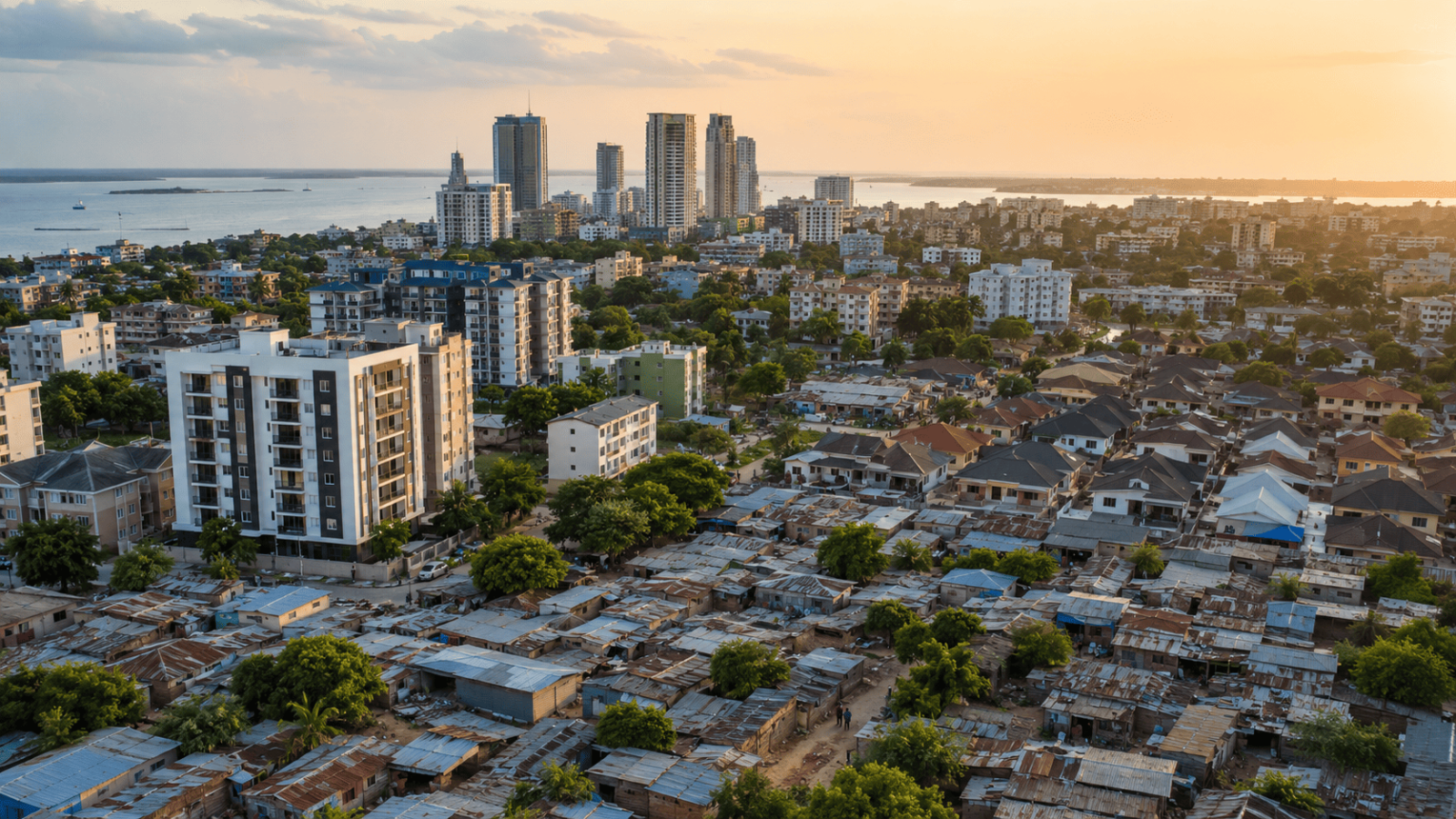
The urban-rural split makes the demand story clearer. On Tanzania Mainland, the average household size in 2022 was 4.3, but urban households averaged 3.8 people, compared with 4.7 people in rural areas. Dar es Salaam was even lower, with an average household size of 3.5 people. That figure matters because Dar es Salaam is Tanzania’s largest residential market and the place where changing household patterns show up fastest in demand for rooms, apartments, rentals and peri-urban homes.
This is the first major signal for developers and investors: Tanzania’s future housing demand will not be driven only by large family houses. It will increasingly come from smaller urban households, including students, young workers, newly employed graduates, small families, migrants, single professionals and newly married couples. These groups create demand for rental rooms, studio units, one-bedroom apartments, compact two-bedroom units, serviced plots, peri-urban self-build homes and incremental housing.
The population outlook makes the equation larger. UN-linked medium-variant projections place Tanzania’s population at about 129.6 million people by 2050, with 59.1% of the population living in urban areas. That would mean an urban population of about 76.5 million people by mid-century. Even under lower projections, Tanzania’s population is expected to more than double from its 2022 census level.
At the 2022 national average household size of 4.3 people, a population of 129.6 million would imply roughly 30.1 million households by 2050. Compared with 14.3 million households in 2022, that points to about 15.8 million additional households over the period. This is not an official housing target, but it is a useful demographic estimate because it converts population growth into potential household formation.
The annual implication is large. Between 2022 and 2050, Tanzania may need to accommodate roughly 560,000 additional households per year under a constant-household-size calculation. This figure does not include replacement of old housing, upgrading of informal settlements, disaster-related losses, changes in household size, or the need to improve housing quality. It simply shows the pressure created by population growth and household formation.
This is where the housing gap becomes more urgent. Tanzania is already estimated to face an annual housing shortfall of about 200,000 units, a challenge linked to rapid urbanization, informality and rising living costs. If household formation continues to accelerate, the gap between formal supply and actual demand could widen unless land, infrastructure, finance and planning systems adjust.
Urbanization will concentrate the pressure. If Tanzania reaches an urban share of about 59.1% by 2050, then the country’s urban housing market will need to absorb tens of millions of additional residents. Using the 2022 urban household size of 3.8 people, an urban population of 76.5 million would imply about 20.1 million urban households by 2050. That is the real estate demand hidden inside Tanzania’s urban future.
The mortgage market shows how much of this demand remains outside formal finance. As of September 2025, Tanzania’s outstanding residential mortgage debt stood at TZS 720.81 billion, up 10.92% year-on-year. The average mortgage debt size was TZS 124.17 million, while outstanding mortgage debt was equal to only 0.46% of GDP. Twenty-nine banks and financial institutions were reporting mortgage portfolios.
Those numbers show a structural mismatch. The demographic demand for housing is broad, but the formal mortgage market remains narrow. A mortgage market with an average debt size above TZS 124 million cannot by itself serve the majority of young urban workers, informal earners, low-income households or self-build families. This is one reason Tanzania’s housing supply continues to depend heavily on informal construction, incremental building and rental rooms.
The scale of informality confirms the point. More than 70% of urban housing is informal, and over 90% of housing nationwide has been built by individuals. This means Tanzania’s largest housing developer is not the state, banks or formal real estate companies. It is the household itself.
That fact changes how residential real estate demand should be understood. Tanzania does not only need finished apartments and gated estates. It needs an ecosystem that supports serviced land, incremental housing, housing microfinance, affordable rentals, safe densification, basic infrastructure, tenure security, and lower-cost construction materials.
The formal economy is already recording the demand. In 2024, real estate activities grew by 4.3%, driven by increased demand for residential, commercial and office buildings linked to population growth and the expansion of economic activities. Real estate accounted for 2.7% of GDP, while construction remained much larger, contributing 12.8% of GDPin 2024.
This matters because housing is not only a social issue. It is an economic value chain. Every new household generates demand for land, cement, steel, timber, roofing, tiles, paint, plumbing, electrical fittings, furniture, transport, labour, surveying, architecture, insurance and finance. Residential demand therefore spreads across the economy even when the final house is built informally.
Dar es Salaam shows the concentration effect most clearly. The World Bank has described the city as having an estimated six million inhabitants, accounting for about 40% of Tanzania’s urban population and 17% of national GDP. It also reported that Dar es Salaam was growing at about 5.6% annually and projected to exceed 10 million people by 2030. This is why housing pressure in Dar es Salaam is not only about high rents in premium areas. It is about the speed at which people arrive compared with the speed at which serviced land, drainage, water, roads, sanitation and formal housing are provided.
For developers, the largest opportunity is likely to sit below the luxury segment. High-end housing will continue to exist in areas such as Masaki, Oysterbay, Upanga, Mikocheni, Arusha suburbs, Dodoma’s planned zones and Zanzibar’s coastal property market. But the broader volume demand will come from people who need affordable rental housing, compact urban units, serviced plots, starter homes and middle-income apartments.
Five product categories are likely to define the next cycle.
The first is affordable rental housing, especially single rooms, studios, one-bedroom and compact two-bedroom units near transport routes, universities, markets, hospitals, industrial zones and employment centres.
The second is serviced plots, because many Tanzanians still prefer to build gradually. The difference between orderly self-building and informal sprawl is whether land is surveyed, planned and connected to basic infrastructure.
The third is incremental starter housing, where households begin with a structurally sound core unit and expand as income improves. This model aligns more closely with how many Tanzanians already build.
The fourth is middle-income apartments and townhouses, particularly in Dar es Salaam, Dodoma, Arusha and Mwanza. This segment depends heavily on price discipline, location, mortgage affordability and rental yields.
The fifth is high-end and lifestyle real estate, which will remain visible and attractive to investors, but will not solve the broad housing demand created by population growth and household formation.
The household ratio is the most important number because it changes the size of the market. At 4.3 people per household, every additional 1 million people creates demand for about 232,000 households. At the current urban ratio of 3.8 people per household, every additional 1 million urban residents creates demand for about 263,000 households. If household sizes continue to decline, Tanzania will need more housing units for the same population base.
This is the central housing equation: population growth increases total demand, urbanization concentrates demand, and smaller household sizes multiply the number of units required.
For policy, the implication is direct. Tanzania’s housing challenge is not only a construction problem. It is a planning, finance, land and infrastructure problem. The country needs more accurate housing data, stronger coordination between institutions, better serviced-land delivery, more flexible housing finance, rental-market regulation, support for self-built housing and a stronger affordable-housing pipeline.
For investors, the message is equally clear. Tanzania’s next real estate opportunity is not defined only by luxury apartments or speculative land appreciation. It is defined by household mathematics. The strongest demand sits where population growth, smaller urban households and affordability pressure meet.
Tanzania had 61.7 million people and 14.3 million households in 2022. By 2050, it could have about 129.6 million people and more than 30 million households if current household-size assumptions hold. That is the long-term residential real estate story.
Every fall in household size increases the number of homes required. Every million new urban residents creates hundreds of thousands of household formations. Every gap in mortgage access pushes more people toward self-building and informal rentals. Every delay in serviced land delivery expands unplanned settlements.
The future of Tanzania’s real estate market will therefore be shaped less by land speculation alone and more by whether the market can provide the right housing products for the households Tanzania is actually creating.
 Uchumi360
Business Intelligence
Uchumi360
Business Intelligence
Uchumi360 covers business, investment, and economic policy across East, Central, and Southern Africa.
For the serious reader
You read to the end. That places you in a small group.
Uchumi360 is built for readers who demand precision over speed, structure over sentiment, and analysis that holds uncomfortable conclusions rather than softening them. If this work sharpens how you think about Africa's economy, help us keep building the infrastructure behind it.
Institutional Partners
Commission intelligence. Shape the conversation.
Uchumi360 works with development finance institutions, investment firms, sovereign bodies, and strategic organisations across the coverage region. Institutional partnership unlocks:
- Commissioned sector and country intelligence reports
- Branded research series under your institution's authority
- Exclusive data briefings for internal strategy teams
- Speaking and editorial presence at Uchumi360 events
- Co-published investment outlooks for your markets
Support Our Work
Independent analysis has a cost. Help us bear it.
Uchumi360 does not carry advertising. It does not take editorial direction from sponsors. Every article is produced without commercial compromise. Your contribution funds the reporting, research, and editorial infrastructure that keeps this analysis free from influence.
Secure checkout: One-time and monthly support are processed securely. Add payment credentials to enable checkout here.
Stay Connected
Keep up with every new insight.
Follow our latest analysis, policy coverage, and market intelligence as soon as it is published. If you need something specific, reach out directly and we will point you to the right research.
