
From Sovereignty Scrutiny to Port Efficiency: The DP World Investment Story in Tanzania
Ready
Ports do not lie. Ships either wait less or they do not. Containers either move faster or they do not. Importers either save money or they do not. Exporters either become more competitive or they do not. Landlocked countries either choose Dar es Salaam more often or they do not.
The DP World debate in Tanzania was never only about a port. It was about sovereignty, public trust, commercial urgency and the anxiety that follows when strategic infrastructure meets foreign capital. Ports are not ordinary assets. They are the front doors of national economies, the customs gates of industrial policy, and the physical infrastructure through which food, fuel, machinery, minerals, consumer goods and exports move.
That is why the controversy was predictable.
When Tanzania moved to deepen port cooperation with DP World, critics framed the arrangement as a sovereignty risk. Supporters framed it as an efficiency reform. Both sides had a point. A port is too strategic to be handed over carelessly, but too important to be left underperforming. The real question was never whether foreign capital should touch Dar es Salaam port. The real question was whether Tanzania could structure the investment in a way that preserved public leverage while upgrading commercial performance.
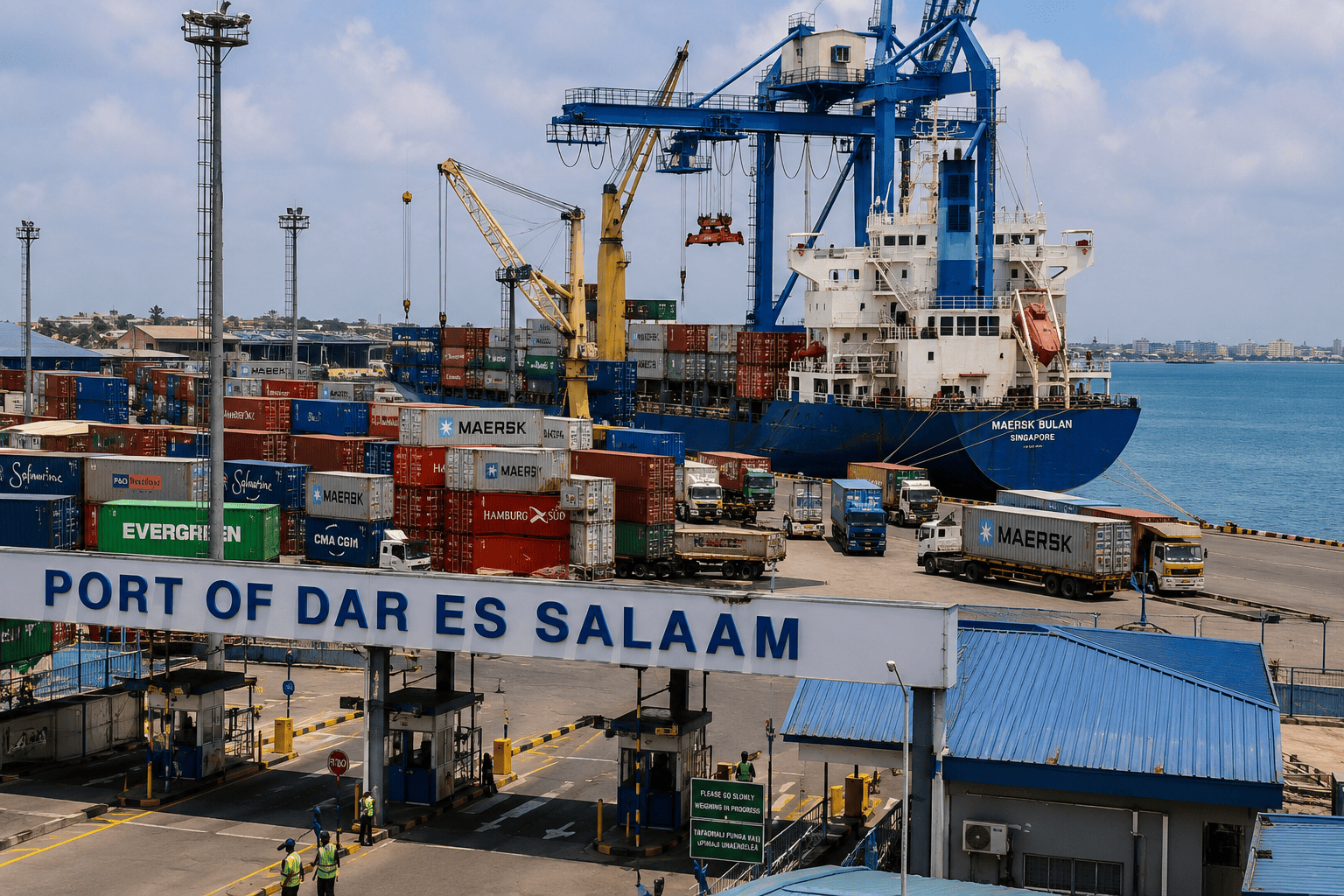
DP World announced in October 2023 that it had signed a 30-year concession agreement with the Tanzania Ports Authority to operate and modernise the multi-purpose terminal at Dar es Salaam port, positioning the terminal as a gateway linking Tanzania and neighbouring landlocked markets to global trade. DP World’s own Dar es Salaam terminal profile describes the arrangement as a Build, Operate and Transfer concession for Terminal 1 over 30 years.
The backlash was immediate because ports sit at the intersection of economics and sovereignty. Associated Press reported in October 2023 that the deal had triggered protests and arrests, while the Tanzania Ports Authority said DP World would operate only four berths at Dar es Salaam port, not the entire port, with performance reviews every five years over the 30-year period.
That detail matters. Much of the public debate treated the transaction as if Tanzania had surrendered its whole port system. The more accurate reading is narrower but still significant: Tanzania entered a long-term private-operation arrangement over a strategic section of its most important maritime gateway. The controversy was not imaginary. But neither was the economic logic behind the reform.
Dar es Salaam port matters far beyond Tanzania. It serves Tanzania’s domestic economy and links landlocked markets including Zambia, Malawi, Rwanda, Burundi, Uganda and eastern Democratic Republic of Congo to the Indian Ocean. In a region where transport costs can decide whether a manufacturer survives, port efficiency is not a technical issue. It is an industrial competitiveness issue.
The Tanzania Ports Authority’s own statistical bulletin shows why the stakes are high. Total port throughput rose from 23.061 million tonnes in 2022 to 26.478 million tonnes in 2023, showing that the country’s maritime system was already under rising pressure before DP World’s operational involvement began.
That pressure is structural. Tanzania wants to become a logistics platform for East and Central Africa, not merely a coastal country with ports. Dar es Salaam, Tanga and Mtwara are strategic assets. But Dar es Salaam remains the anchor because of its location, hinterland connections and role in Tanzania’s import-export economy. A 2023 policy paper by REPOA notes that more than 70% of Tanzania’s trade is processed through Dar es Salaam port, underlining its centrality to national competitiveness.
This is why inefficiency is also a sovereignty problem. A congested port raises import costs, delays exporters, increases storage expenses, weakens manufacturers, frustrates transporters and makes landlocked neighbours look for alternative corridors. National ownership is not enough if national infrastructure cannot perform.
The World Bank-backed Dar es Salaam Maritime Gateway Project was built around exactly this problem: improving the effectiveness and efficiency of Dar es Salaam port for Tanzania and its hinterland. The project’s later restructuring documents show that port modernisation was not a cosmetic agenda but part of a long-running effort to improve maritime capacity, operational performance and regional trade connectivity.
The investment case becomes sharper when placed inside Tanzania’s wider corridor strategy. Standard Chartered arranged USD 2.33 billion in financing in 2026 for two segments of Tanzania’s Standard Gauge Railway, part of a 1,219-kilometre line linking Dar es Salaam to Mwanza and improving connections to Rwanda, Burundi, Uganda and Democratic Republic of Congo. Reuters also reported that Tanzania’s broader railway ambition covers a 2,561-kilometre network, designed to improve freight and passenger connectivity across domestic and regional corridors.
That is the larger economic story. Tanzania is trying to monetise geography. Ports, railways, dry ports, roads, special economic zones and border systems are no longer separate infrastructure projects. They are pieces of one national logistics thesis: make Tanzania the preferred gateway for Central and East African trade.
In that context, the DP World agreement should be read less as a standalone port transaction and more as part of a corridor economy strategy. If the port improves but the railway is unreliable, the impact is limited. If the railway improves but customs procedures remain slow, the impact is reduced. If customs improves but local logistics companies cannot scale, the gains leak. The prize is not only faster containers. The prize is a lower-cost trade system.
The early performance claims are encouraging, though they require careful tracking over time. The Citizen reported in April 2026 that cargo throughput at Dar es Salaam port reached 27.7 million tonnes in the 2024/25 financial year, up from 24 million tonnes a year earlier, and that the port was expected to surpass its 30 million-tonne goal after strong first-quarter performance.
If sustained and independently verified across multiple years, that would support the reform argument. But throughput alone is not enough. A port can handle more cargo while still imposing delays and costs on users. The real performance scorecard must include ship waiting time, berth productivity, container dwell time, customs clearance, truck turnaround time, digital-system reliability, cargo damage, tariff transparency, labour conditions and the cost paid by importers and exporters.
That is where the sovereignty debate should have matured. Instead of asking only whether foreign capital should operate part of the port, Tanzania should ask: what measurable national productivity gains must this partnership deliver, by when, and under what public oversight?
A well-structured concession can reduce cargo dwell time, improve terminal technology, expand handling capacity, professionalise operations and make a port more attractive to shipping lines. A poorly structured concession can transfer monopoly power from an inefficient public operator to a powerful private one. The difference is governance.
That governance has several layers. The first is contract design. A strategic terminal concession should define investment obligations, service standards, tariff rules, performance benchmarks, dispute mechanisms, labour protections, local-content obligations, technology-transfer expectations and termination safeguards. A government that signs a long concession without strong performance clauses risks losing leverage.
The second layer is regulatory capacity. The Tanzania Ports Authority and other relevant public institutions must remain strong enough to supervise the operator, publish performance data and defend national interest. Public ownership of the landlord function becomes meaningful only if the state can monitor, enforce and renegotiate from a position of competence.
The third layer is transparency. The public does not need every commercial clause in a concession agreement, but it needs enough information to understand the structure, risks, obligations and expected benefits. The original controversy was intensified by public suspicion. In strategic infrastructure, opacity creates political risk even when the commercial logic is valid.
The fourth layer is competition. Dar es Salaam does not operate in isolation. It competes with Mombasa, Djibouti, Berbera and other Indian Ocean logistics nodes. Landlocked markets will choose corridors based on price, reliability and speed, not sentiment. If Tanzania wants cargo from Rwanda, Burundi, Zambia, Uganda and eastern Democratic Republic of Congo, Dar es Salaam must become consistently easier, faster and more predictable than rival routes.
The fifth layer is domestic spillover. Port reform should not only benefit the terminal operator and shipping lines. It should support Tanzanian clearing and forwarding agents, transporters, warehouse operators, inland container depots, manufacturers, exporters, farmers, mining companies and small businesses. If efficiency gains are trapped at the port gate, the wider economy will not feel the reform.
This is where DP World’s global model becomes relevant. The company presents itself not merely as a port operator but as an integrated logistics group, connecting ports, terminals, logistics parks, inland transport and supply-chain services. Its Dar es Salaam profile frames Terminal 1 as part of a wider network serving East and Central Africa.
That integrated model can be useful if it lowers trade costs and improves corridor reliability. It can also raise concerns if one company gains too much influence across a strategic supply chain. Tanzania’s task is to take the operational benefits without allowing private control to become public dependency.
There is also a broader African lesson here. Many African countries face the same dilemma: strategic infrastructure needs capital, technology and operational discipline, but citizens fear that long-term concessions can weaken sovereignty. That fear is not irrational. Africa has seen infrastructure deals where governments borrowed poorly, negotiated weakly or failed to enforce public-interest terms. But refusing private capital entirely is not a strategy either. Underperforming infrastructure is itself a national cost.
The better framing is strategic partnership under public discipline.
Tanzania should retain clear regulatory control, publish credible performance indicators, protect labour interests, insist on local supplier participation, monitor tariffs, and make sure the port’s improvement is connected to rail, road and industrial-policy outcomes. The government should also communicate better. When citizens do not understand what has been concessioned, what has not, who owns what, and how performance will be judged, legitimate reform becomes vulnerable to political suspicion.
The Adani container-terminal issue adds another layer to Tanzania’s port story. Reuters reported in November 2024 that Tanzania intended to maintain agreements with an Adani Group unit to operate Container Terminal 2 at Dar es Salaam port, even after Kenya cancelled separate Adani deals following allegations against the group’s chairman in the United States. Tanzania’s port authority said its agreements were in accordance with Tanzanian law.
This shows that Tanzania’s port liberalisation is not only about DP World. It is a broader shift toward private-sector involvement in strategic port operations. That makes governance even more important. Multiple private operators can bring investment and expertise, but they also require stronger coordination, clearer regulation and careful protection of national logistics interests.
For investors, the signal is powerful. Tanzania is opening strategic logistics assets to global operators while simultaneously building rail and corridor infrastructure. If executed well, this strengthens the investment case across warehousing, trucking, clearing and forwarding, manufacturing, agribusiness, mining logistics, fuel distribution, cold-chain services, inland dry ports and industrial zones.
For citizens, the test is different. They will judge the reform by prices, jobs, service quality, government revenue, transparency and national dignity. If the port becomes faster but the benefits are not felt in trade costs, public revenue or local participation, the political legitimacy of the reform will remain fragile.
Ports do not lie. Ships either wait less or they do not. Containers either move faster or they do not. Importers either save money or they do not. Exporters either become more competitive or they do not. Landlocked countries either choose Dar es Salaam more often or they do not.
The DP World story is therefore not a simple victory for liberalisation, nor is it a simple warning against foreign capital. It is a case study in the next phase of African infrastructure politics. Governments need private balance sheets, global expertise and operational technology. But they also need sharper contracts, stronger regulators, better public communication and citizens who understand that sovereignty is not only about ownership. It is also about performance.
Tanzania’s opportunity is clear. If Dar es Salaam port improves meaningfully, the country’s investment case strengthens across logistics, manufacturing, agribusiness, mining, fuel distribution, warehousing and regional trade. If the reforms disappoint, sovereignty critics will claim vindication.
The final test of the DP World investment will not be political noise. It will be measurable national productivity.
Tanzania does not need a port that is merely publicly defended. It needs a port that is commercially feared, regionally preferred and nationally accountable.
 Uchumi360
Business Intelligence
Uchumi360
Business Intelligence
Uchumi360 covers business, investment, and economic policy across East, Central, and Southern Africa.
For the serious reader
You read to the end. That places you in a small group.
Uchumi360 is built for readers who demand precision over speed, structure over sentiment, and analysis that holds uncomfortable conclusions rather than softening them. If this work sharpens how you think about Africa's economy, help us keep building the infrastructure behind it.
Institutional Partners
Commission intelligence. Shape the conversation.
Uchumi360 works with development finance institutions, investment firms, sovereign bodies, and strategic organisations across the coverage region. Institutional partnership unlocks:
- Commissioned sector and country intelligence reports
- Branded research series under your institution's authority
- Exclusive data briefings for internal strategy teams
- Speaking and editorial presence at Uchumi360 events
- Co-published investment outlooks for your markets
Support Our Work
Independent analysis has a cost. Help us bear it.
Uchumi360 does not carry advertising. It does not take editorial direction from sponsors. Every article is produced without commercial compromise. Your contribution funds the reporting, research, and editorial infrastructure that keeps this analysis free from influence.
Secure checkout: One-time and monthly support are processed securely. Add payment credentials to enable checkout here.
Stay Connected
Keep up with every new insight.
Follow our latest analysis, policy coverage, and market intelligence as soon as it is published. If you need something specific, reach out directly and we will point you to the right research.
