
Tanzania's Infrastructure Push Is Not a Collection of Projects. It Is a Systematic Attempt to Become East Africa's Economic Artery.
Ready
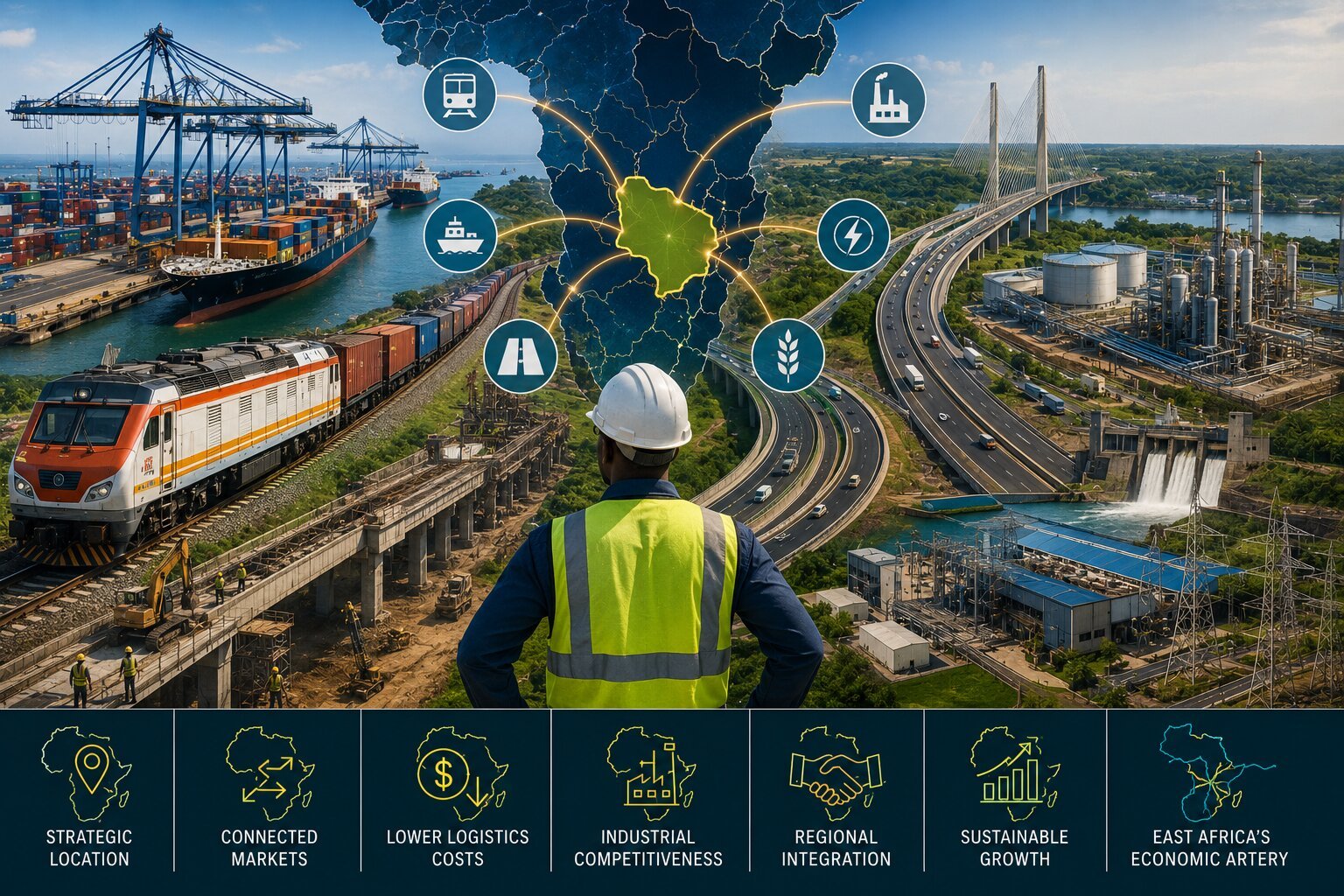
Infrastructure projects are often discussed in Africa as though they are isolated construction stories, measured individually by their completion timelines, their capital costs, and their physical specifications rather than by what they collectively do to the cost structure of the economy they serve and the industrial investment decisions they make commercially rational or commercially unviable. Tanzania is entering a phase where multiple infrastructure systems are beginning to connect into something much larger than their individual components, with railways, ports, roads, bridges, hydropower, airports, logistics corridors, and industrial energy systems increasingly interacting in ways that could gradually reposition the country from a peripheral regional market into one of East and Central Africa's core economic arteries. The significance is not in the concrete. It is in what cheaper movement of goods, energy, people, and capital eventually allows economies to produce, and the answer to that question depends on whether Tanzania's infrastructure integration produces the industrial investment that converts logistics cost reduction into manufacturing output, or whether it produces a more efficient trading economy whose competitive advantage over regional peers is measured in import distribution speed rather than export manufacturing depth.
Infrastructure projects are often discussed in Africa as though they are isolated construction stories, and the framing consistently understates what infrastructure actually does when executed at scale across multiple interconnected systems simultaneously. A bridge here. A railway there. A port expansion somewhere else. Measured individually by their completion timelines, their capital costs, and their physical specifications, each project generates its own construction narrative, its own ribbon-cutting ceremony, and its own fiscal accounting entry in the public investment budget. What that individual measurement misses is the mechanism through which infrastructure creates economic value: not through the existence of individual assets but through the change in cost structures that connected assets produce when goods, energy, people, and capital can move more cheaply, more reliably, and more predictably through an economy whose physical systems have been upgraded from fragmented to integrated.
Tanzania is entering a phase where multiple infrastructure systems are beginning to connect into something much larger than their individual components, and the economic significance of that connection is beginning to become visible in ways that the project-by-project framing of most infrastructure coverage obscures. According to Standard Chartered Bank's official announcement of 28 April 2026, the USD 2.33 billion financing for SGR Lots 3, 4, and 5 extends the Standard Gauge Railway toward Mwanza in an infrastructure investment whose regional logistics significance extends well beyond Tanzania's domestic transport economics. According to Tanzania Electric Supply Company operational records, installed electricity generation capacity has crossed approximately 4,000 megawatts following the Julius Nyerere Hydropower Project commissioning, creating the energy foundation whose industrial production significance Uchumi360 documented in its May 2026 energy analysis. Dar es Salaam port expansion, road and bridge construction including the Jangwani Bridge whose urban productivity significance extends beyond its physical flood mitigation function, and industrial zone development at Bagamoyo and along the Mkuranga corridor are together creating an integrated enabling infrastructure whose combined effect on manufacturing investment economics substantially exceeds what any individual project's contribution to logistics cost reduction or energy reliability would generate independently. The significance is not in the concrete. It is in what cheaper movement of goods, energy, people, and capital eventually allows economies to produce.
Why infrastructure systems matter differently from infrastructure projects
The economic mechanism through which infrastructure creates value at the systems level rather than the project level is specific enough to deserve analytical precision rather than general assertion about connectivity and economic linkage. Individual infrastructure projects reduce costs for the specific activity they serve: a port expansion reduces maritime handling costs for the goods it processes, a railway reduces transport costs for the corridor it connects, an electricity generation investment reduces energy costs for the consumers it supplies. Those individual cost reductions are economically valuable, but their value compounds when the systems connect, because connected systems create competitive positions that individual cost reductions in isolated sectors do not.
A manufacturing investor evaluating Tanzania as a potential production location is not evaluating the port in isolation from the railway, or the railway in isolation from the electricity supply, or the electricity supply in isolation from the logistics corridor connecting the industrial zone to the export point. The investor is evaluating the total cost of production at the Tanzanian facility relative to the total cost of production at the competing location, and that total cost incorporates energy cost, logistics cost, port handling cost, transit time, and supply chain reliability simultaneously. According to World Bank research on manufacturing location decisions in developing economies, the combination of logistics efficiency and energy reliability consistently produces larger manufacturing investment attraction effects than either variable alone, because the manufacturing operations whose location decisions determine industrial development trajectories require both variables to function at competitive standards rather than tolerating deficiency in either as a characteristic of the investment environment.
China's infrastructure strategy understood this systems logic earlier and applied it more consistently than any comparable development programme in recent economic history. According to National Bureau of Statistics of China data on infrastructure investment sequencing, Beijing did not build railways, ports, highways, and industrial zones as isolated transport infrastructure investments. It built them as components of an integrated movement system whose combined effect was to reduce the total logistics cost of manufacturing in China below the threshold that made it commercially superior to alternative production locations for successive generations of global manufacturing investment. Ports connected to railways. Railways connected to factories. Factories connected to export zones. Export zones connected to global shipping routes. The ecosystem compounded, and the compounding effect is what produced one of the most competitive manufacturing environments in modern economic history rather than a series of impressive individual infrastructure achievements whose economic multiplication never materialised because the systems connection was never completed.
What the SGR achieves within the integrated system
The Standard Gauge Railway's significance within Tanzania's integrated infrastructure development is not primarily as a transport project whose value is measured in the reduction of passenger journey times between Dar es Salaam and Mwanza. Its strategic economic significance is as a logistics cost restructuring instrument for the Central Corridor trade system connecting Tanzania's Indian Ocean port access to the landlocked markets of Rwanda, Burundi, Uganda, and the eastern Democratic Republic of Congo whose external trade flows through Tanzanian infrastructure at volumes that make Tanzania the gateway economy for a combined population of tens of millions of people whose import and export costs determine the competitiveness of their productive sectors.
According to the Central Corridor Transit Transport Facilitation Agency's corridor performance assessments, logistics costs along the Central Corridor from Dar es Salaam to Kigali have historically been among the highest in East Africa for equivalent distances, reflecting the road-dominated transport economics whose combination of fuel costs, vehicle depreciation, driver costs, and transit time imposes a logistics cost burden that manufacturing investment consistently prices into its location decision analysis as a competitive disadvantage relative to coastal manufacturing locations. The SGR's freight economics reduce the per-tonne-kilometre cost of moving goods along the Central Corridor below road freight economics at volume, which changes the commercial calculation for two categories of industrial investment whose attraction Tanzania has been pursuing: manufacturing investment that serves the regional market through the Central Corridor, whose cost structure improves when logistics costs decline, and processing investment that uses the corridor to move mineral inputs from inland mining operations to coastal processing facilities, whose economics improve when the transport cost component of mineral processing is reduced.
The SGR Lot 5 extension to Mwanza, connecting to Lake Victoria's northern shore and the waterborne transport network linking Tanzania to Uganda, Rwanda, and Burundi, creates a multimodal logistics system whose integration of railway, lake transport, and port infrastructure produces the corridor connectivity that reduces landlocked market access costs in ways that road transport alone cannot replicate at equivalent commercial viability. According to World Bank corridor performance data for the Northern and Central Corridors, the competitiveness of the Central Corridor relative to the Northern Corridor through Mombasa depends on the total logistics cost from origin to destination for specific product categories and specific origin-destination pairs, and the SGR's impact on the Central Corridor's competitive position against the Northern Corridor determines whose port and whose logistics infrastructure landlocked market shippers choose, with direct implications for the freight volumes that determine whether the SGR generates the economic returns that its financing requires.
What the Jangwani Bridge reveals about infrastructure's quiet economic function
The Jangwani Bridge in Dar es Salaam represents the category of infrastructure investment whose economic significance is most systematically underestimated in the African development commentary that concentrates on megaproject scale and ignores the urban productivity losses that inadequate urban infrastructure imposes on the commercial and manufacturing activity of cities whose economic weight is the foundation on which national industrial development depends. Dar es Salaam is projected to become one of the world's largest cities over the coming decades, according to United Nations Population Division urban growth projections, and its status as Tanzania's primary commercial and industrial centre means that the productivity losses from urban infrastructure deficiency compound across the entire economy rather than being confined to the transport sector whose immediate users experience them most directly.
Flood disruptions in the Msimbazi corridor have repeatedly shut down movement inside East Africa's fastest-growing major city, imposing transport delays that increase fuel costs for commercial vehicles, reduce labour productivity for workers whose journey times extend significantly during flood events, disrupt the supply chain operations of manufacturers and distributors whose production and distribution schedules depend on predictable transport times, and reduce the economic output of commercial and service sector businesses whose customers, employees, and suppliers cannot reach them reliably during the disruption periods. According to World Bank urban economics research on productivity losses from inadequate urban infrastructure in rapidly growing African cities, the cumulative economic cost of recurring infrastructure failures in major urban centres substantially exceeds the capital cost of the infrastructure improvements that would prevent them, making urban infrastructure investment among the highest-return public investment categories available to governments whose economic development depends on commercial and industrial activity concentrated in major urban centres.
The Jangwani Bridge, understood not as a flood mitigation project but as an urban productivity investment whose primary economic function is removing a recurring disruption from the movement system of a city whose commercial and industrial activity generates a significant share of Tanzania's GDP and tax revenue, illustrates how infrastructure investment whose headline purpose is physical construction creates economic value through the cost structure changes whose compounding effects accumulate invisibly in productivity, commercial activity, and investment attractiveness rather than appearing as a single measurable return on the construction budget. Infrastructure quietly improves productivity. That is its real power, and the quietness of the improvement is what causes it to be systematically undervalued in the infrastructure investment prioritisation frameworks that concentrate on megaproject scale rather than on the cumulative productivity effects that urban infrastructure improvements generate across the commercial and industrial ecosystems they serve.
The regional competitive implications of Tanzania's integrated system
East Africa's regional competitive landscape for industrial investment attraction is being reshaped by Tanzania's infrastructure integration in ways that the regional development commentary has not yet fully priced, because the conventional framework for evaluating East African competitive positioning concentrates on individual country attributes, financial depth, governance quality, logistics efficiency, and investment climate ratings, rather than on the integrated enabling infrastructure whose systems connection determines manufacturing investment attractiveness more reliably than any individual attribute.
Kenya's infrastructure depth and financial services sophistication create genuine advantages for service sector investment and for manufacturing categories whose production economics depend primarily on access to skilled labour, financial services, and regional consumer markets rather than on energy cost and logistics corridor integration. According to Kenya National Bureau of Statistics data, Kenya's manufacturing sector contributing approximately 7 to 8% of GDP despite its infrastructure advantages confirms that infrastructure alone does not automatically generate manufacturing depth without the industrial policy, financial system alignment, and manufacturing strategy that convert enabling conditions into productive investment. Rwanda's governance quality and institutional discipline documented in the Rwanda Development Board's Annual Report 2025 create strong investment attraction for services, fintech, and light manufacturing, but Rwanda's energy constraints and small domestic market limit its industrial anchor potential in the energy-intensive and logistics-dependent manufacturing categories where Tanzania's integrated system creates distinctive competitive advantages.
Uganda's oil infrastructure development, whose commercial production advancement alongside the East African Crude Oil Pipeline creates an energy wealth positioning opportunity whose industrial utilisation parallels Tanzania's natural gas industrial strategy, shares the same fundamental question that Tanzania's LNG analysis raises: whether the energy resource becomes an industrial catalyst or an export enclave. The DRC's mineral wealth, whose cobalt, coltan, lithium, and copper reserves make it the most mineral-significant economy in the coverage region for global technology supply chain purposes, remains the most consequential gap between potential and productive capacity in the regional landscape, with the institutional constraints on industrial investment creating the opening for Tanzania's integrated infrastructure to serve as the processing and export gateway for DRC mineral production that the SGR's Mwanza extension and Lake Victoria connectivity make geographically accessible.
What the infrastructure system requires to become transformational
The critical question that Tanzania's infrastructure integration poses, and that the construction achievement narrative consistently defers, is whether the physical systems whose connection is creating the enabling infrastructure for industrial development will attract the manufacturing investment, processing activity, and export-oriented production that convert logistics cost reductions and energy surplus into industrial transformation rather than into a more competitive trading economy whose efficiency improvements benefit import distribution rather than domestic production. According to UNCTAD's Economic Development in Africa Report 2023, the pattern of infrastructure investment expanding without proportionate manufacturing development is one of the continent's most consistent structural failures, reflecting the gap between the enabling conditions that infrastructure creates and the industrial policy, financial system alignment, and manufacturing strategy whose simultaneous development determines whether the enabling conditions produce productive investment or remain underutilised as prerequisites for industrial development that never materialises.
The Development Bank of Tanzania's industrial lending expansion, the pension sector's long-horizon capital deployment toward manufacturing investment, and the blended finance structures that bridge concessional and commercial capital toward industrial transactions are the financial system complements whose development must advance at a pace proportionate to the infrastructure investment whose productive utilisation they are designed to enable. The procurement preferences for locally manufactured goods, the industrial energy pricing in manufacturing zones, and the export processing zone governance efficiency whose benchmarks must be measured against Vietnam and Indonesia rather than regional peers are the industrial policy complements whose implementation determines whether the SGR carries manufactured goods or imported goods more efficiently. The technical and vocational education curriculum alignment with manufacturing workforce requirements is the human capital complement whose development is the longest-lead-time constraint on industrial production at quality standards that global manufacturing supply chain participants require.
Tanzania's infrastructure push is quietly rewiring the economics of East Africa, not because individual projects are large but because the systems are beginning to connect in ways that change the cost structure of moving goods, energy, people, and capital across the region's most important trade corridors. Whether that rewiring produces industrial transformation or simply improves the logistics of the trading economy whose import dependence and productive shallowness the infrastructure was supposed to address depends on the industrial strategy, financial alignment, and institutional quality decisions that are as consequential for Tanzania's development trajectory as the infrastructure investment itself. The direction is right. The pace of the complementary development is the variable that determines the outcome.
FAQ
Why is Tanzania's infrastructure described as a system rather than a collection of projects? Because infrastructure creates economic value through the cost structure changes that connected systems produce rather than through the existence of individual assets. A port expansion reduces maritime handling costs for the goods it processes, but its economic significance compounds when connected to a railway that reduces inland transport costs simultaneously, creating a total logistics cost reduction that changes manufacturing investment economics more powerfully than either investment alone. According to World Bank research on manufacturing location decisions, the combination of logistics efficiency and energy reliability produces larger manufacturing investment attraction effects than either variable independently, because manufacturing operations require both to function at competitive standards.
What is the SGR's significance for East and Central African trade beyond Tanzania? The SGR's Lot 5 extension to Mwanza connects to Lake Victoria's northern shore and the waterborne transport network linking Tanzania to Uganda, Rwanda, and Burundi, creating a multimodal logistics system that reduces landlocked market access costs for economies whose external trade has historically flowed through road-dominated transport whose economics imposed logistics cost burdens that manufacturing investment consistently priced as competitive disadvantages. According to CCTTFA corridor performance assessments, the Central Corridor's competitiveness against the Northern Corridor through Mombasa determines whose infrastructure landlocked market shippers choose, and the SGR's impact on that competition determines the freight volumes whose generation makes the railway economically productive.
What does the Jangwani Bridge contribute to Tanzania's economic development? The Jangwani Bridge removes a recurring urban productivity disruption from Dar es Salaam's movement system rather than simply mitigating flood risk. According to World Bank urban economics research, recurring infrastructure failures in major urban centres impose cumulative economic costs that substantially exceed the capital cost of preventing them through infrastructure investment. Dar es Salaam is projected by United Nations Population Division data to become one of the world's largest cities over coming decades, making urban productivity investment whose benefits compound across the commercial and industrial activity concentrated in the city a higher economic return investment than its project-level analysis typically captures.
What must happen for Tanzania's infrastructure integration to produce industrial transformation? Infrastructure creates enabling conditions without guaranteeing their productive utilisation. The Development Bank of Tanzania's industrial lending capacity must expand to provide long-tenor manufacturing financing. Procurement preferences for locally manufactured goods under Tanzania's Public Procurement Act must be systematically applied. Export processing zone governance efficiency must be benchmarked against Vietnam and Indonesia. Industrial energy pricing in manufacturing zones must be calibrated to competitive cost structures. The industrial policy, financial system alignment, and manufacturing strategy whose simultaneous development with physical infrastructure determines whether logistics cost reductions attract manufacturing investment or simply improve import distribution efficiency are the complements whose absence would leave Tanzania's infrastructure investment as an impressive enabling foundation on which industrial transformation did not materialise.
How does Tanzania's infrastructure integration compare to Kenya and Rwanda? Kenya's infrastructure depth creates advantages for service sector and financial economy investment, but Kenya's manufacturing contributing approximately 7 to 8% of GDP per Kenya National Bureau of Statistics data despite its infrastructure advantages confirms that infrastructure alone does not automatically generate manufacturing depth. Rwanda's governance quality documented in the RDB Annual Report 2025 creates strong investment attraction for services and light manufacturing, but Rwanda's energy constraints and small domestic market limit its industrial anchor potential. Tanzania's combination of energy surplus, SGR logistics corridor, Indian Ocean port access, critical minerals, and natural gas creates a convergence of enabling conditions that neither Kenya nor Rwanda holds simultaneously, potentially shifting manufacturing investment attraction as the systems integration matures.
 Uchumi360
Business Intelligence
Uchumi360
Business Intelligence
- Standard Chartered Bank, SGR financing announcement, 28 April 2026
- Available at sc.com
- Tanzania Electric Supply Company, operational records
- 4,000 MW capacity figure
- Available at tanesco.co.tz
- Central Corridor Transit Transport Facilitation Agency, corridor performance assessments
- Available at ttfa.org
- Specific data edition requires identification before publication
- National Bureau of Statistics of China, infrastructure investment sequencing data
- Available at stats.gov.cn
- World Bank, research on manufacturing location decisions and infrastructure integration in developing economies
- Specific reports require identification before publication
- Available at worldbank.org
- World Bank, corridor performance data for Northern and Central Corridors
- Available at worldbank.org
- World Bank, urban economics research on productivity losses from inadequate urban infrastructure
- Available at worldbank.org
- United Nations Population Division, Dar es Salaam urban growth projections
- Available at population.un.org
- UNCTAD, Economic Development in Africa Report 2023
- Infrastructure investment without manufacturing development pattern data
- Available at unctad.org
- Kenya National Bureau of Statistics, manufacturing GDP share data
- Available at knbs.or.ke
- Rwanda Development Board, Annual Report 2025
- Available at rdb.rw
- Tanzania Petroleum Development Corporation, natural gas reserve data
- Available at tpdc.go.tz
- Tanzania Investment Centre, Bagamoyo and Mkuranga industrial zone project data
- Available at tic.go.tz
Uchumi360 covers business, investment, and economic policy across East, Central, and Southern Africa.
For the serious reader
You read to the end. That places you in a small group.
Uchumi360 is built for readers who demand precision over speed, structure over sentiment, and analysis that holds uncomfortable conclusions rather than softening them. If this work sharpens how you think about Africa's economy, help us keep building the infrastructure behind it.
Institutional Partners
Commission intelligence. Shape the conversation.
Uchumi360 works with development finance institutions, investment firms, sovereign bodies, and strategic organisations across the coverage region. Institutional partnership unlocks:
- Commissioned sector and country intelligence reports
- Branded research series under your institution's authority
- Exclusive data briefings for internal strategy teams
- Speaking and editorial presence at Uchumi360 events
- Co-published investment outlooks for your markets
Support Our Work
Independent analysis has a cost. Help us bear it.
Uchumi360 does not carry advertising. It does not take editorial direction from sponsors. Every article is produced without commercial compromise. Your contribution funds the reporting, research, and editorial infrastructure that keeps this analysis free from influence.
Secure checkout: One-time and monthly support are processed securely. Add payment credentials to enable checkout here.
Stay Connected
Keep up with every new insight.
Follow our latest analysis, policy coverage, and market intelligence as soon as it is published. If you need something specific, reach out directly and we will point you to the right research.
