
East Africa's Cities Are Spending Billions on Roads That Will Congest Again Within a Decade. The Solution Is Already on Their Streets. They Just Need More of It.
Ready
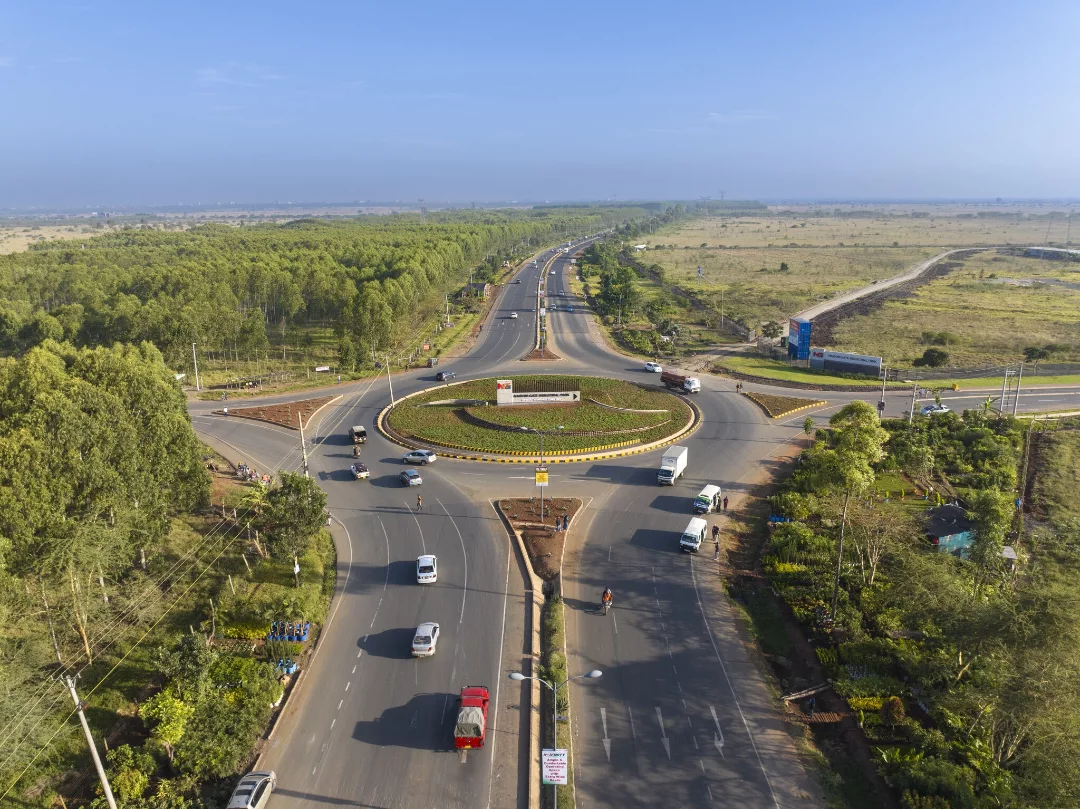
East Africa's fastest-growing cities, Nairobi, Kampala, Dar es Salaam, and Kigali, are responding to urban congestion through road expansion and flyover construction whose induced demand economics ensure the new capacity fills with new vehicle trips within years, recreating the congestion at larger scale and higher infrastructure maintenance cost. Carmel, Indiana replaced over 150 traffic lights with roundabouts over thirty years, reduced lane counts through road diets, quadrupled its population, and produced more efficient commutes without the congestion that the conventional more-lanes approach generates. Roundabouts produce measurable economic and environmental benefits whose evidence base is robust: they reduce fatal accidents by up to 90% according to US Federal Highway Administration research, reduce fuel consumption by eliminating idle time at red lights, cut carbon emissions at intersections by 20 to 40% according to transportation research, cost 30 to 50% less to maintain than signalised intersections over their operational lifetime, improve traffic throughput by keeping vehicles moving rather than stopping them, and create the road space whose reallocation to pedestrian infrastructure, cycling lanes, and street trees improves the urban environment whose quality determines whether shorter trips are made by foot or by car. For East African cities whose fiscal constraints make infrastructure maintenance cost a binding budget concern, whose vehicle fleets are growing faster than road capacity can accommodate, whose pedestrian and cyclist safety records are among the world's most dangerous, and whose carbon emission reduction commitments require the transport sector solutions that roundabouts provide at lower cost than the electric vehicle transition, the case for systematic roundabout deployment is economically, environmentally, and fiscally compelling. This article makes that case with the research evidence, the East African city-specific analysis, and the Carmel, Indiana demonstration whose thirty-year outcome is the most directly applicable urban traffic engineering precedent available. East Africa is not running out of road. It is running out of the right kind of road design. The roundabout is not a novelty. It is the proven intersection management system whose systematic deployment across Nairobi, Kampala, Dar es Salaam, and Kigali would produce measurable improvements in traffic flow, safety, fuel consumption, emissions, and fiscal efficiency simultaneously. The question is whether the cities building the next generation of infrastructure will learn from Carmel before they repeat the mistakes that Carmel spent thirty years correcting.
Every morning in Nairobi, Kampala, Dar es Salaam, and Kigali, the same scene plays out across hundreds of intersections simultaneously.
Vehicles queue behind red lights whose cycle times were calibrated for traffic volumes that existed years ago. Engines idle. Fuel burns. Time passes. The productivity whose loss compounds across the millions of people experiencing the same delay at the same moment is the economic cost that traffic engineering decisions made decades ago, and reinforced by each subsequent road expansion that added capacity without changing the intersection logic, are imposing on East Africa's most economically productive cities every single day.
The conventional response is more lanes. More flyovers. More road expansion. More infrastructure spending that generates the induced demand whose economic logic fills the new capacity with new vehicle trips within years of the construction whose purpose was to reduce the congestion the new trips recreate at larger scale.
Carmel, Indiana proved there is a better way. Over thirty years, this suburb north of Indianapolis in the United States replaced over 150 traffic lights with roundabouts, reduced lane counts rather than increasing them, watched its population nearly quadruple, and produced more efficient commutes without the congestion that the standard more-lanes response generates. It is now the roundabout capital of the United States with 151 roundabouts and counting.
The lesson is not American. It is universal. And East Africa's cities need to learn it before the next billion dollars of road expansion recreates at larger scale the problem it was built to solve.
The economic cost of East African urban congestion
Before making the case for roundabouts, it is necessary to establish the scale of the problem that the current intersection management approach is producing and sustaining across East Africa's four largest and fastest-growing urban economies.
Nairobi's traffic congestion costs Kenya's economy an estimated KES 50 billion annually according to the Kenya National Bureau of Statistics transport sector analysis, a figure whose components include the productive time whose loss the commute delays impose on the workforce, the fuel whose combustion at idle represents pure economic waste without productive output, the vehicle wear and maintenance costs whose acceleration stop-and-start urban driving produces, the emergency service response times whose lengthening the congestion imposes with the healthcare outcomes that delayed ambulance arrival produces, and the business location decisions made against Nairobi because the congestion whose daily experience makes the city's productivity premium over alternatives smaller than the rental and labour cost differential that urban location is supposed to compensate for.
Kampala's congestion pattern is worsened by the bowl topography whose geography concentrates all traffic movement through a limited number of corridor routes whose intersection management determines the city's entire commute experience. According to Uganda Bureau of Statistics economic data, the Kampala Metropolitan Area generates approximately 65% of Uganda's GDP while housing a population whose growth rate is among East Africa's fastest, creating the demand pressure on the road network whose capacity the current intersection management approach was not designed to handle at the volumes that urbanisation is generating.
Dar es Salaam's traffic cost is documented in World Bank urban transport research showing that the city's average commute time exceeds 90 minutes each way for significant portions of the working population, a commute duration whose productivity loss across the formal sector workforce represents a material drag on Tanzania's manufacturing competitiveness at the precise moment when the industrial investment whose attraction TISEZA's one-factory-per-day approval pace documents is making Dar es Salaam's urban productivity the determining factor in whether the manufacturing employment whose generation Vision 2050 requires can be sustained at the efficiency level that competitive export manufacturing demands.
Kigali's traffic challenge is qualitatively different from the other three cities because Rwanda's governance discipline has produced a city whose planning quality is among East Africa's strongest, but whose growth rate, driven by the conference economy, the technology sector investment, and the middle-class residential expansion that Uchumi360's Rwanda coverage has documented, is creating intersection management demands at the pace that even well-planned cities struggle to accommodate without the systematic approach to intersection design that roundabouts provide at the traffic volumes Kigali is approaching.
What roundabouts actually do and why the engineering works
A roundabout is a circular intersection whose geometry enforces the yield-on-entry rule that keeps traffic flowing continuously rather than stopping it periodically as the red-amber-green signal cycle does. Vehicles entering the roundabout yield to traffic already circulating, merge when a gap appears, and exit at their desired road without the stopping and acceleration cycle that signalised intersections impose at every light change.
The traffic flow advantage is the most immediately visible benefit and the one that makes the commute efficiency difference that Carmel's thirty-year outcome most directly demonstrates. At a signalised intersection, every vehicle stopped at a red light must accelerate from zero when the light turns green, consuming the kinetic energy whose loss the stopping caused and producing the fuel burn and time delay whose accumulation across hundreds of light cycles per day per vehicle is the congestion cost that urban traffic engineering should be minimising. At a roundabout, vehicles yield for seconds rather than minutes and re-enter traffic flow without the full stop-and-start cycle, maintaining the momentum whose conservation is the fundamental efficiency advantage that continuous flow intersection design provides.
According to research by Carroll Engineering, roundabouts reduce intersection delay by 65 to 75% compared with signalised intersections, a delay reduction whose aggregate effect across a city with hundreds of intersections is the commute time improvement whose magnitude the Carmel, Indiana experience makes concrete. A city that replaces its signalised intersections with roundabouts systematically is not making a marginal improvement to a single intersection's performance. It is restructuring the fundamental flow physics of the entire urban road network at every point where the vehicle-stopping and vehicle-starting cycle whose repetition produces congestion currently occurs.
The safety case whose evidence is unambiguous
The safety improvement that roundabouts produce relative to signalised intersections is the most robustly documented benefit in the transportation engineering literature and the one whose relevance for East African cities is most directly measurable in the human cost that the current intersection design is imposing.
According to United States Federal Highway Administration research, roundabouts reduce fatal accidents by 82 to 90% compared with signalised intersections. The geometric explanation for this dramatic safety improvement is the conflict point reduction that roundabout design produces relative to the four-way signalised intersection it replaces. A standard four-way signalised intersection has 32 conflict points, locations where vehicle paths cross, merge, or diverge in ways that create collision risk. A roundabout replacing the same four-way intersection has 8 conflict points, a 75% reduction in the geometric collision risk whose elimination the roundabout's geometry enforces regardless of driver behaviour.
The specific collision types whose elimination or reduction roundabout geometry produces are the fatal collision categories whose prevalence in East African urban traffic is most consequential for the public health and economic cost of road accidents. Head-on collisions are geometrically impossible in a properly designed roundabout because all vehicles travel in the same direction around the central island. Right-angle collisions, the T-bone crashes that traffic light failures and red-light running produce and that are among the most fatal collision types in urban traffic, are eliminated by the yield-on-entry geometry that prevents perpendicular vehicle paths from intersecting at speed. The collision types that remain, primarily low-speed sideswipe collisions during lane changes within the roundabout, are the collision categories whose severity is substantially lower than the eliminated types because the speed reduction that the roundabout geometry enforces through its curvature limits the kinetic energy whose release in a collision determines the injury severity.
East African road safety statistics document the human cost whose reduction the roundabout's safety profile would produce at meaningful scale. According to World Health Organisation road safety data, Kenya, Uganda, Tanzania, and Rwanda all record road traffic fatality rates substantially above the global average, with intersection-related collisions representing a significant share of the total fatalities whose prevention the geometric safety improvement that roundabouts provide would contribute to at every intersection conversion.
The environmental case whose urgency East African cities cannot defer
The environmental benefits of roundabouts are the dimension of the argument whose relevance for East African city governments making long-term infrastructure investment decisions has the longest time horizon and the most directly measurable contribution to the carbon emission reduction commitments that all four governments have made in their nationally determined contributions under the Paris Agreement.
Vehicle idling at red lights is one of the largest sources of avoidable urban transport emissions in every city whose signalised intersection network requires vehicles to stop and restart multiple times per commute. According to transportation research published in peer-reviewed journals including Transportation Research Part D, roundabouts reduce carbon dioxide emissions at intersections by 20 to 40% compared with signalised intersections by eliminating the idle emissions that red light waiting produces and reducing the fuel consumption that acceleration from zero requires at every light change. At the scale of a city with hundreds of signalised intersections and millions of daily vehicle passages, the aggregate emission reduction that systematic roundabout deployment produces is a measurable contribution to the urban air quality improvement whose health benefits extend beyond the climate commitment into the respiratory health of the urban population whose exposure to vehicle exhaust at concentrated intersection points is the most direct public health consequence of the current intersection design.
Nairobi's air quality monitoring data, available through the Kenya Meteorological Department, documents the pollution concentration at major signalised intersections whose vehicle idling produces the emission concentrations that pedestrian and commuter exposure measurements confirm are significantly elevated above background levels. The intersection air quality improvement that roundabout conversion produces is the environmental benefit whose health value is most immediately visible and most directly translatable into the healthcare cost reduction and workforce productivity improvement whose economic valuation strengthens the fiscal case for roundabout investment beyond the traffic engineering argument alone.
Kigali's commitment to becoming Africa's greenest city, whose expression in the Kigali Green City master plan and the Rwanda Green Fund's investment priorities Uchumi360's Rwanda coverage has documented, is the most directly relevant policy framework for the roundabout's environmental benefit in the East African context. A systematic roundabout deployment programme whose intersection conversion reduces Kigali's transport sector emissions by 20 to 40% at every converted intersection is contributing to the green city ambition through transport infrastructure investment rather than the tree planting and building energy efficiency measures that green city programmes typically emphasise, at the intersection density that Kigali's compact urban geography makes most feasible and most impactful.
The fiscal case whose relevance for East African budget constraints is most immediate
East African city governments face the infrastructure maintenance budget constraints that rapidly growing urban populations impose when the tax base whose expansion lags the service delivery requirement produces the fiscal gap that development partner financing and central government transfers cannot fully close. In that fiscal environment, the lifecycle cost advantage that roundabouts provide relative to signalised intersections is the budget argument whose relevance for infrastructure investment decisions is most immediately compelling.
According to GFT Incorporated transportation engineering research, roundabouts cost 30 to 50% less to maintain over their operational lifetime than signalised intersections whose electrical infrastructure, signal timing systems, controller maintenance, lamp replacement, and electrical power consumption represent the ongoing operating cost that a roundabout's passive geometric design eliminates entirely. A signalised intersection requires the electrical connection, the signal controller, the signal heads, the detection systems, and the maintenance programme whose annual cost accumulates across the intersection's operational life into the budget commitment that multiplied across hundreds of intersections represents a significant recurring expenditure. A roundabout requires the initial construction, the pavement maintenance whose frequency is comparable to the surrounding road network, and the central island landscaping whose maintenance is the most significant recurring cost but whose magnitude is a fraction of the electrical infrastructure maintenance that the signalised intersection requires.
For Dar es Salaam, where the Tanzania National Roads Agency's maintenance budget is already stretched across a national road network whose expansion the SGR and port development investment has been accelerating, the signalised intersection's electrical maintenance cost reduction that roundabout conversion produces at every conversion is a budget saving whose accumulation across a systematic conversion programme improves the fiscal position of the urban roads authority without reducing the infrastructure service quality that the conversion's traffic flow improvement simultaneously enhances.
For Kampala, where the Kampala Capital City Authority's infrastructure maintenance budget must balance the competing demands of road surface maintenance, drainage system management, public lighting, and the urban service delivery whose quality the capital city's governance mandate requires, the roundabout's maintenance cost advantage provides the budget flexibility whose application to the competing maintenance demands improves the overall infrastructure quality that the same budget can sustain when the electrical infrastructure cost that signalised intersections impose is removed from the expenditure requirement at each converted intersection.
The Carmel, Indiana model and what it demonstrates for East Africa
Carmel, Indiana's thirty-year roundabout programme is the urban traffic engineering precedent whose outcome most directly demonstrates the scale of improvement that a systematic and committed roundabout deployment programme produces in a growing city whose population expansion, rather than creating the congestion whose inevitability the conventional more-lanes narrative assumes, produced the efficiency improvement that better intersection management enabled.
Carmel's road diet, reducing five-lane roads to four or even two lanes as roundabouts replaced signalised intersections, is the component of the programme whose counterintuitive outcome is most instructive for East African city planners whose default response to congestion is wider roads. As Carmel removed lanes, its population nearly quadrupled. Its commutes became more efficient. The road space whose reallocation the lane reduction enabled was redistributed to cycling infrastructure, street trees, and wider footpaths whose improvement made shorter trips feasible by foot or bicycle, reducing the vehicle trips whose reduction improved the remaining vehicle traffic's flow efficiency further.
The virtuous cycle that Carmel's road diet and roundabout programme produced, fewer lanes enabling better flow enabling mode shift enabling further flow improvement, is the urban transport logic whose application in East African cities requires the political commitment to reduce road width rather than expand it, a commitment that runs counter to the infrastructure expansion instinct that road congestion typically produces in the politicians whose constituency includes every driver experiencing the delay.
Kigali's compact urban geography and Rwanda's governance discipline make it the East African city most directly positioned to replicate the Carmel model at the pace and consistency that produces the compounding improvement whose thirty-year outcome in Indiana demonstrates what sustained commitment to the right intersection design produces. Kigali already operates several roundabouts whose traffic management the city's planning has incorporated, and the systematic extension of that approach to every major intersection in the growing metropolitan area is the infrastructure strategy whose fiscal, environmental, and safety benefits the research evidence most directly supports.
Nairobi's Ngong Road, Mombasa Road, and Uhuru Highway corridors whose signalised intersections produce the peak-hour congestion that is the most visible and most economically costly component of the city's traffic dysfunction are the highest-priority conversion targets whose roundabout replacement would produce the traffic flow improvement at the corridors where the commute time loss is greatest and the vehicle count whose idle emission reduction would have the largest aggregate environmental impact.
Dar es Salaam's Morogoro Road, Nyerere Road, and Sam Nujoma Road intersections whose signalised management produces the congestion that the city's industrial investment growth is creating additional vehicle demand on are the conversion priorities whose economic return, measured in manufacturing delivery time improvement, import logistics cost reduction, and workforce commute time saving, is most directly calculable against the intersection conversion investment whose fiscal case the maintenance cost saving strengthens.
Kampala's Nakawa, Jinja Road, and Entebbe Road corridor intersections whose management determines the commute experience of the urban population whose connectivity to the industrial zones that Kiira Motors, the Kampala-Jinja Expressway investment, and the manufacturing sector growth are creating are the conversion priorities whose economic return is most directly connected to the industrial development agenda that Uganda's infrastructure investment is designed to support.
The implementation argument whose simplicity is the roundabout's final advantage
Roundabouts do not require the smart city technology investment, the centralised traffic management infrastructure, the electrical grid reliability, or the specialised maintenance capability that the signalised intersection management systems whose upgrading East African city governments are being advised to pursue as the congestion solution require before they can operate at the performance standard their capital cost is supposed to deliver.
A roundabout works without electricity. It works without signal timing calibration. It works without the controller maintenance whose absence degrades a signalised intersection's performance to the point of creating more congestion than the uncontrolled intersection it replaced. It works across the full range of vehicle types, from the bodaboda motorcycle to the container truck, without the lane specificity and signal timing complexity that mixed-traffic urban environments in East Africa present to signalised intersection designers. It works when the electricity supply fails, when the maintenance budget is constrained, and when the traffic volume pattern changes between the intersection's design phase and its operational reality.
These are not trivial advantages in cities whose infrastructure maintenance systems, grid reliability, and budget predictability are at the developmental stage whose constraints make the simpler technology whose performance is geometry-dependent rather than infrastructure-dependent the more reliable solution for the intersection management challenge that East African urban growth is creating at the pace that the more complex alternative's implementation timeline cannot match.
East Africa does not need to import American traffic engineering philosophy. It needs to apply the intersection design whose geometry the physics of vehicle movement makes universally effective and whose economic, environmental, safety, and fiscal benefits the research evidence has established across thirty years of Carmel's deliberate programme and decades of global transportation research. The roundabout is already on East African streets. The question is whether the cities growing fastest on the planet will deploy it at the scale and consistency that the Carmel model demonstrates is necessary to produce the compounding improvement whose outcome thirty years from now determines whether Nairobi, Kampala, Dar es Salaam, and Kigali are productive, efficient, and liveable cities or larger versions of the congested urban environments that the infrastructure spending of the current decade was supposed to prevent.
FAQ
What is the evidence that roundabouts reduce traffic congestion? According to Carroll Engineering transportation research, roundabouts reduce intersection delay by 65 to 75% compared with signalised intersections by keeping traffic in continuous flow rather than stopping it at signal cycles. Carmel, Indiana replaced over 150 traffic lights with roundabouts over thirty years, nearly quadrupled its population, reduced lane counts through road diets, and produced more efficient commutes without the congestion that the conventional more-lanes approach generates. The geometric mechanism is the yield-on-entry rule that allows vehicles to merge into circulating traffic in seconds rather than waiting through signal cycles that can take several minutes at busy intersections.
Why are roundabouts dramatically safer than traffic lights? According to US Federal Highway Administration research, roundabouts reduce fatal accidents by 82 to 90% compared with signalised intersections. The geometric explanation is the conflict point reduction from 32 in a standard four-way signalised intersection to 8 in a roundabout, a 75% reduction. Head-on collisions are geometrically impossible because all vehicles travel in the same direction. Right-angle collisions are eliminated because perpendicular paths do not intersect at speed. The collisions that remain are low-speed sideswipes whose severity is substantially lower than the eliminated types because the roundabout geometry limits approach speeds through its curvature.
What are the environmental benefits of roundabouts for East African cities? Roundabouts reduce carbon dioxide emissions at intersections by 20 to 40% compared with signalised intersections according to peer-reviewed transportation research, by eliminating the idle emissions that red light waiting produces and reducing the fuel consumption that acceleration from zero requires at every light change. For Nairobi, Kampala, Dar es Salaam, and Kigali, whose vehicle fleets are growing rapidly and whose urban air quality monitoring documents elevated pollution concentrations at major signalised intersections, systematic roundabout deployment contributes to both carbon emission reduction and public health improvement simultaneously.
Why are roundabouts fiscally advantageous for East African city governments? According to GFT Incorporated transportation engineering research, roundabouts cost 30 to 50% less to maintain over their operational lifetime than signalised intersections. A signalised intersection requires electrical infrastructure, signal controllers, signal heads, detection systems, lamp replacement, and ongoing electrical power consumption. A roundabout requires pavement maintenance and central island landscaping whose combined cost is a fraction of the electrical infrastructure maintenance that the signalised intersection imposes. For East African city governments whose maintenance budgets are constrained by the fiscal gap that rapidly growing urban populations create, the lifecycle cost advantage is a budget argument as compelling as the traffic flow and safety arguments.
What would a roundabout programme look like for Kigali, Nairobi, Kampala, and Dar es Salaam? The Carmel, Indiana model provides the template: begin with the highest-traffic signalised intersections whose conversion produces the largest commute time improvement for the most commuters, apply road diets to reduce lane counts while improving flow, reallocate the recovered road space to cycling infrastructure, footpaths, and street trees that make shorter trips feasible without cars, and sustain the programme across the political cycles that produce the compounding improvement whose thirty-year outcome in Indiana demonstrates what consistent commitment to the right intersection design produces. Kigali's governance discipline and compact urban geography make it the most directly positioned East African city to replicate the Carmel model at speed. Nairobi's Ngong Road, Mombasa Road, and Uhuru Highway corridor intersections, Kampala's Nakawa and Jinja Road intersections, and Dar es Salaam's Morogoro Road and Nyerere Road intersections are the highest-priority conversion targets whose traffic flow improvement would be most immediately visible and most economically measurable.
 Uchumi360
Business Intelligence
Uchumi360
Business Intelligence
- City of Carmel Indiana, roundabout programme documentation
- 151 roundabouts, thirty-year implementation history, population growth and commute efficiency outcomes
- Available at carmel.in.gov
- US Federal Highway Administration, roundabout safety research
- Fatal accident reduction 82 to 90% versus signalised intersections, conflict point reduction from 32 to 8
- Available at fhwa.dot.gov
- Carroll Engineering, The Benefits of Roundabouts
- Intersection delay reduction 65 to 75% versus signalised intersections
- Available at carrollengineering.com
- GFT Incorporated, The Benefits of Roundabouts in Modern Traffic Systems
- Maintenance cost reduction 30 to 50% versus signalised intersections
- Available at gftinc.com
- Transportation Research Part D, peer-reviewed research on roundabout carbon dioxide emission reduction 20 to 40% versus signalised intersections
- Available through Elsevier Transportation Research journals
- World Health Organisation, Global Status Report on Road Safety
- Kenya, Uganda, Tanzania, Rwanda road traffic fatality rates
- Available at who.int
- Kenya National Bureau of Statistics, Nairobi traffic congestion economic cost KES 50 billion annually
- Available at knbs.or.ke
- Uganda Bureau of Statistics, Kampala Metropolitan Area GDP contribution approximately 65% of Uganda total
- Available at ubos.org
- World Bank, Dar es Salaam average commute time urban transport research
- Available at worldbank.org
- Kenya Meteorological Department, Nairobi intersection air quality monitoring data
- Available at meteo.go.ke
- Tanzania National Roads Agency, road maintenance budget and network data
- Available at tanroads.go.tz
- Rwanda Green Fund, Kigali Green City master plan and green infrastructure investment documentation
- Available at fonerwa.org
- Rwanda Development Board, Kigali urban planning and infrastructure data
- Available at rdb.rw
- Kampala Capital City Authority, infrastructure maintenance budget data
- Available at kcca.go.ug
- National Bureau of Statistics Tanzania, Dar es Salaam urban transport and industrial corridor data
- Available at nbs.go.tz
- Gilead Teri, Director General TISEZA, Divya Briefing podcast, May 2026
- One factory per day 2024 manufacturing investment context for Dar es Salaam logistics efficiency
- African Development Bank, East Africa urban transport research
- Available at afdb.org
- UNRA, Kampala road network and intersection management data
- Available at unra.go.ug
Uchumi360 covers business, investment, and economic policy across East, Central, and Southern Africa.
For the serious reader
You read to the end. That places you in a small group.
Uchumi360 is built for readers who demand precision over speed, structure over sentiment, and analysis that holds uncomfortable conclusions rather than softening them. If this work sharpens how you think about Africa's economy, help us keep building the infrastructure behind it.
Institutional Partners
Commission intelligence. Shape the conversation.
Uchumi360 works with development finance institutions, investment firms, sovereign bodies, and strategic organisations across the coverage region. Institutional partnership unlocks:
- Commissioned sector and country intelligence reports
- Branded research series under your institution's authority
- Exclusive data briefings for internal strategy teams
- Speaking and editorial presence at Uchumi360 events
- Co-published investment outlooks for your markets
Support Our Work
Independent analysis has a cost. Help us bear it.
Uchumi360 does not carry advertising. It does not take editorial direction from sponsors. Every article is produced without commercial compromise. Your contribution funds the reporting, research, and editorial infrastructure that keeps this analysis free from influence.
Secure checkout: One-time and monthly support are processed securely. Add payment credentials to enable checkout here.
Stay Connected
Keep up with every new insight.
Follow our latest analysis, policy coverage, and market intelligence as soon as it is published. If you need something specific, reach out directly and we will point you to the right research.
