
Fumba’s 3,000-Hectare Bet: How Zanzibar Is Turning a Free Economic Zone Into a Blue Economy City
Ready
The Fumba Free Economic Zone Master Plan 2022–2042 provides the policy backdrop. It says Fumba was declared a Free Economic Zone in 1992 and that the updated plan was needed because the older master plan could no longer respond to current demand, investor interest, infrastructure requirements, and environmental pressures. The report also notes that investors had applied to ZIPA for different projects, but the main challenge was how to locate them, guide spatial growth, and coordinate development inside the Free Economic Zone. Recent developments suggest that the coordination question is now becoming urgent. Fumba is no longer only a planning area. It is becoming a live investment corridor.
Fumba is emerging as one of Zanzibar’s most important development frontiers, with recent project updates showing a coastal investment zone shifting from long-term planning into visible construction, real estate delivery, port operations, sports infrastructure and international education.
The scale is no longer theoretical. The Zanzibar Investment Promotion Authority (ZIPA) describes Fumba Special Economic Zone as a 3,000-hectare site in Unguja with 62 registered projects at different stages of implementation, representing more than $3.3 billion in investment capital. The zone is positioned about 24 kilometres from Malindi Port and 10 kilometres from Abeid Amani Karume International Airport, giving it direct relevance to tourism, logistics, services and urban expansion.
That puts Fumba at the centre of Zanzibar’s attempt to build a new kind of coastal economy: not only beach hotels, not only housing, and not only port activity, but a cluster of investments tied to the Blue Economy (BE), real estate, sports tourism, higher education, logistics and services.
The Fumba Free Economic Zone Master Plan 2022–2042 provides the policy backdrop. It says Fumba was declared a Free Economic Zone in 1992 and that the updated plan was needed because the older master plan could no longer respond to current demand, investor interest, infrastructure requirements, and environmental pressures. The report also notes that investors had applied to ZIPA for different projects, but the main challenge was how to locate them, guide spatial growth, and coordinate development inside the Free Economic Zone.
Recent developments suggest that the coordination question is now becoming urgent. Fumba is no longer only a planning area. It is becoming a live investment corridor.
Real estate is the first visible engine
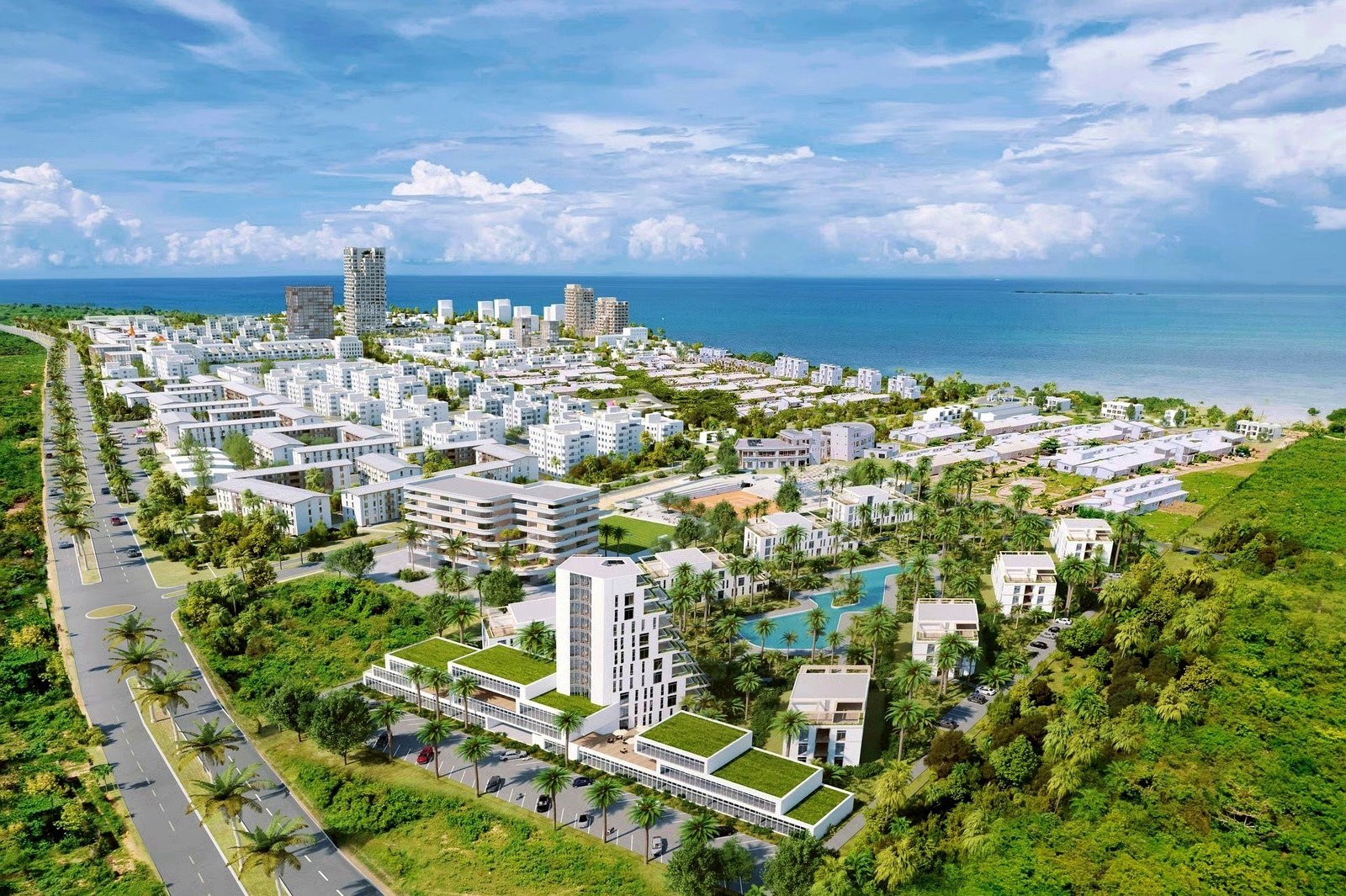
The most visible sign of Fumba’s transformation is residential development. Fumba Town, developed by Customized Property Solutions (CPS), is described as a coastal urban development of about 150 acres, with a 1.5-kilometre seafront and around 1,400 homes sold. CPS also projects Fumba Town to host 20,000 residents by 2035 and 80,000 by 2050, while affiliated composting and recycling systems reportedly handle about 80 percent of household waste.
This real estate momentum is important because it gives Fumba a resident base, not just an investment map. Housing creates demand for shops, schools, medical services, transport, restaurants, maintenance services, digital connectivity, waste systems, security and recreation. It also tests whether Zanzibar can build a planned settlement that avoids the informal infrastructure stress common in fast-growing coastal zones.
Fumba Uptown Living adds another real estate anchor. Bakhresa Group says the project was conceived by the group and is being implemented by Union Property Developers, a subsidiary of Azam Bakhresa Group, on the Fumba peninsula. A separate Bakhresa Group description says the site covers 180 acres on the southern coast of the peninsula and has its own power substation.
Together, Fumba Town and Fumba Uptown Living show that the peninsula is already beyond speculative land banking. It is attracting buyers, tenants, investors and service businesses. The question now is whether the surrounding public infrastructure can keep pace with private development.
Africa Cup of Nations infrastructure is turning Fumba into a sports node
Fumba’s profile has also changed because of the Africa Cup of Nations (AFCON) 2027. The President’s Office and Chairman of the Revolutionary Council of Zanzibar reported in August 2026 that President Hussein Ali Mwinyi inspected the Fumba AFCON stadium and Fumba Port, saying the stadium would become a catalyst for economic opportunities in Zanzibar. The statement said the stadium was expected to accommodate 36,500 spectators, with two external grounds of 5,000 spectators each, and that construction was expected to be completed by the end of December 2026.
This gives Fumba a second growth engine beyond residential property. Stadiums do not automatically create development, but they can accelerate roads, utilities, hospitality investment, retail, public space and destination branding when linked to a broader urban plan. In Fumba’s case, the stadium sits inside an area already attracting real estate, port investment and education infrastructure.
The economic effect will depend on whether the stadium becomes a year-round asset after the tournament. If it is connected to sports academies, events, hotels, conferences, transport services, restaurants and community facilities, it can support a wider sports and entertainment economy. If it functions mainly as an event venue, the long-term impact will be narrower.
Fumba Port changes the geography of the peninsula
The port component gives Fumba a logistics role. The Zanzibar Ports Corporation (ZPC) says it signed Zanzibar’s first official Public-Private Partnership (PPP) with Fumba Inland Container Depot/Terminal on 10 May 2023, with the aim of developing a fully operational port with modern equipment. The project is expected to involve more than $6 million in investment on about 4.96 hectares, with an operational capacity of 3,000 Twenty-Foot Equivalent Units (TEUs).
That changes Fumba’s economic role. It is not just a residential and tourism peninsula. It is becoming part of Zanzibar’s logistics system.
If Fumba Port scales, it can help relieve pressure on Malindi Port, support cargo handling, warehousing, customs-related services, inland distribution and maritime-linked business. It also strengthens the case for roads, storage areas, security systems, truck access, utility corridors and land-use discipline around the port.
The master plan had already anticipated the need for common systems of stormwater management, water supply, liquid-waste disposal, solid-waste management, circulation corridors, pedestrian movement, open spaces and buffer zones. The port makes those systems more important because logistics facilities cannot perform well if surrounding land use becomes disorderly.
Indian Institute of Technology Madras is turning Fumba into a knowledge asset
Fumba’s transformation is also educational. Indian Institute of Technology Madras Zanzibar, the first international campus of the Indian Institute of Technology Madras (IIT Madras), is already operating in Zanzibar and is progressing toward a permanent campus on the Fumba peninsula. In 2026, IIT Madras said the campus had 129 students, with 51 percent from Tanzania and others from countries including Ethiopia, Zambia and Kenya.
A 2026 convocation statement said the permanent IIT Madras Zanzibar campus is being developed on 200 acres allocated in Fumba, with academic, innovation, sports, startup and residential facilities. It also said enrolment was planned to expand to 350–500 students by 2027.
This is one of the most important developments in Fumba because it adds human capital to the area’s investment story. Real estate can create settlement. A port can create logistics. A stadium can create event traffic. But a university can create skills, research, startups, partnerships and a technology ecosystem.
That links directly with the master plan’s wider investment logic, which includes Cyber City, higher learning institutions, Medical City, offshore financial services and Business Process Outsourcing (BPO). The report describes Cyber City as a zone for high-tech office space, data centres, startup incubation and offshore Information Technology (IT) ventures, intended to help Fumba compete in Business Process Outsourcing and digital services.
For Zanzibar, the opportunity is to connect IIT Madras Zanzibar with Fumba’s other sectors: marine science, logistics, tourism technology, Artificial Intelligence (AI), climate adaptation, digital public services, health technology and port systems. That would make Fumba more than a construction zone. It would make it a knowledge-based coastal economy.
The Blue Economy is the strategic anchor
Fumba’s strongest long-term logic is still the Blue Economy. The master plan positions the Free Economic Zone for deep-sea fishing, marine science and technology, fish markets, marinas, seaport infrastructure, beach hotels, beach villas and coastal tourism. It proposes a centre for deep-sea fishing and marine science, supported by ice plants and cold rooms, while also linking marinas and seaport facilities to surrounding small islands.
This is where the phrase “Blue Economy City” becomes meaningful. It is not enough for Fumba to face the ocean. It must use the ocean productively.
That means fisheries infrastructure, marine research, cold-chain facilities, seafood processing, aquaculture support, marina services, island mobility, sports tourism, coastal hospitality and environmental protection need to sit inside one investment ecosystem. The port, the university, the real estate base and tourism-linked facilities can all support that ecosystem if they are planned as connected assets.
The master plan ties the Blue Economy to Zanzibar’s policy direction, noting that implementation should coordinate economic sectors and strengthen linkages between primary, secondary and tertiary sectors. That is the correct logic. A Blue Economy becomes valuable when fish, seaweed, ports, science, hotels, marinas, logistics, finance and skills reinforce one another.
Infrastructure will decide the outcome
The clearest risk is infrastructure. The master plan’s infrastructure diagnosis is blunt. It says Magharibi B District had water-pipe connections in 33 out of 34 Shehias, but only 23 percent of houses were connected to water pipes. It also reported a district water deficit of 37.3 percent, with production of 23.98 million cubic metres against estimated demand of 38.27 million cubic metres.
For Fumba, the report notes that existing storage capacity was insufficient and that water had to be rationed among Shehias. It also says the water distribution map was unavailable, making the network vulnerable to accidental damage during construction and weakening informed infrastructure planning.
Stormwater is another major constraint. The report says formal stormwater infrastructure does not exist in most built areas in Fumba and calls for a comprehensive drainage master plan, including drainage channels, footpaths, retention ponds, wetlands, rain gardens, rooftop gardens, cisterns and pervious pavements.
Solid waste is also unresolved. The report says there is currently no formal solid-waste management service in Fumba Free Economic Zone and recommends integrating collection, disposal, recycling, material recovery and composting into the development plan.
These are not background technicalities. They are the difference between a successful Blue Economy city and a high-value coastal corridor with rising service stress.
A 3,000-hectare zone with housing, a port, a stadium, a university, tourism assets and future commercial projects cannot rely on fragmented infrastructure. Water, sewerage, drainage, roads, power, waste, fibre, lighting, security and public transport must be built as backbone systems.
Power and digital infrastructure must match the ambition
Fumba’s development also depends on energy and connectivity. The master plan notes that Unguja imports electricity from mainland Tanzania through a 39-kilometre, 132-kilovolt submarine cable with a maximum capacity of 100 megawatts (MW), commissioned in 2013 to replace an older 45-megawatt cable. It also says Fumba has two 33-kilovolt lines with provisional capacity to carry additional load in the short term.
But the report identifies power-sector weaknesses, including high connection charges, limited alternative power sources despite abundant sunlight, frequent unplanned outages and lack of Independent Power Producers (IPPs) on the island. It also notes that about 200 hectares have been set aside in Fumba Free Economic Zone for solar-farm investment.
That solar allocation is important. A Blue Economy city with a cyber city, port, stadium, university, hotels and housing cannot be powered on fragile supply assumptions. It needs redundancy, renewable energy, smart grids and protected utility corridors.
Digital infrastructure is equally strategic. The report says Zanzibar is connected to global networks through the SEACOM submarine fibre optic cable from mainland Tanzania, and that the cable passes through Fumba Free Economic Zone. It also notes vulnerabilities, including internet unreliability caused by human activity damaging shallow fibre installations.
For Fumba, fibre is not a convenience. It is a core investment asset. The cyber city, university, port, hotels, property management systems, Closed-Circuit Television (CCTV), traffic management and digital services all depend on reliable connectivity.
The risk is growth without coordination
Fumba’s biggest risk is not lack of investor interest. It is growth outrunning coordination. The master plan warns that investment-driven growth could attract people from downtown and other districts, encourage informal land subdivision and produce squatter settlements, land-use conflicts, land degradation and environmental pollution if surrounding areas are not planned in advance.
That warning is already relevant because actual development is now underway. Private estates can be planned internally. A university campus can be designed properly. A stadium can be built to standards. A port can be engineered. But the surrounding area can still become disorderly if Shehia planning, transport, utilities, housing, land control and public services lag behind.
The Free Economic Zone must therefore avoid becoming a collection of strong projects inside a weak urban system.
What the current development signals
The recent news around Fumba points to a clear pattern. Real estate has created a resident and investor base. Africa Cup of Nations infrastructure is raising the area’s visibility and accelerating roads. Fumba Port is giving the peninsula a logistics role. Indian Institute of Technology Madras Zanzibar is adding a knowledge and innovation layer. The Zanzibar Investment Promotion Authority investment profile shows a large formal pipeline. The master plan gives the spatial logic for the Blue Economy, tourism, education, health, technology, sports and mixed-use development. This is how a Free Economic Zone starts becoming a city.
But the transition is not automatic. Zanzibar must now turn project momentum into urban systems. That means completing backbone infrastructure, securing water supply, building sewerage and drainage, protecting the coastline, formalising waste management, preserving green areas, integrating surrounding communities and aligning private investment with public infrastructure.
Fumba’s 3,000-hectare bet is therefore not simply about attracting capital. The capital is already coming.
The real test is whether Zanzibar can make the investments work together.
If the port supports trade, the university supports innovation, the stadium supports sports tourism, housing supports a resident economy, hotels support the visitor market, and marine infrastructure supports the Blue Economy, Fumba can become one of Zanzibar’s most important new urban-economic platforms.
If those projects grow separately, Fumba risks becoming another coastal development corridor where land values rise faster than infrastructure, community planning and environmental protection.
The direction is now visible. Fumba is moving from a Free Economic Zone on paper into a development frontier on the ground. The next question is execution.
 Uchumi360
Business Intelligence
Uchumi360
Business Intelligence
Uchumi360 covers business, investment, and economic policy across East, Central, and Southern Africa.
For the serious reader
You read to the end. That places you in a small group.
Uchumi360 is built for readers who demand precision over speed, structure over sentiment, and analysis that holds uncomfortable conclusions rather than softening them. If this work sharpens how you think about Africa's economy, help us keep building the infrastructure behind it.
Institutional Partners
Commission intelligence. Shape the conversation.
Uchumi360 works with development finance institutions, investment firms, sovereign bodies, and strategic organisations across the coverage region. Institutional partnership unlocks:
- Commissioned sector and country intelligence reports
- Branded research series under your institution's authority
- Exclusive data briefings for internal strategy teams
- Speaking and editorial presence at Uchumi360 events
- Co-published investment outlooks for your markets
Support Our Work
Independent analysis has a cost. Help us bear it.
Uchumi360 does not carry advertising. It does not take editorial direction from sponsors. Every article is produced without commercial compromise. Your contribution funds the reporting, research, and editorial infrastructure that keeps this analysis free from influence.
Secure checkout: One-time and monthly support are processed securely. Add payment credentials to enable checkout here.
Stay Connected
Keep up with every new insight.
Follow our latest analysis, policy coverage, and market intelligence as soon as it is published. If you need something specific, reach out directly and we will point you to the right research.
