
70% of Tanzania's Urban Population Lives in Slum Households, World Bank Data Shows
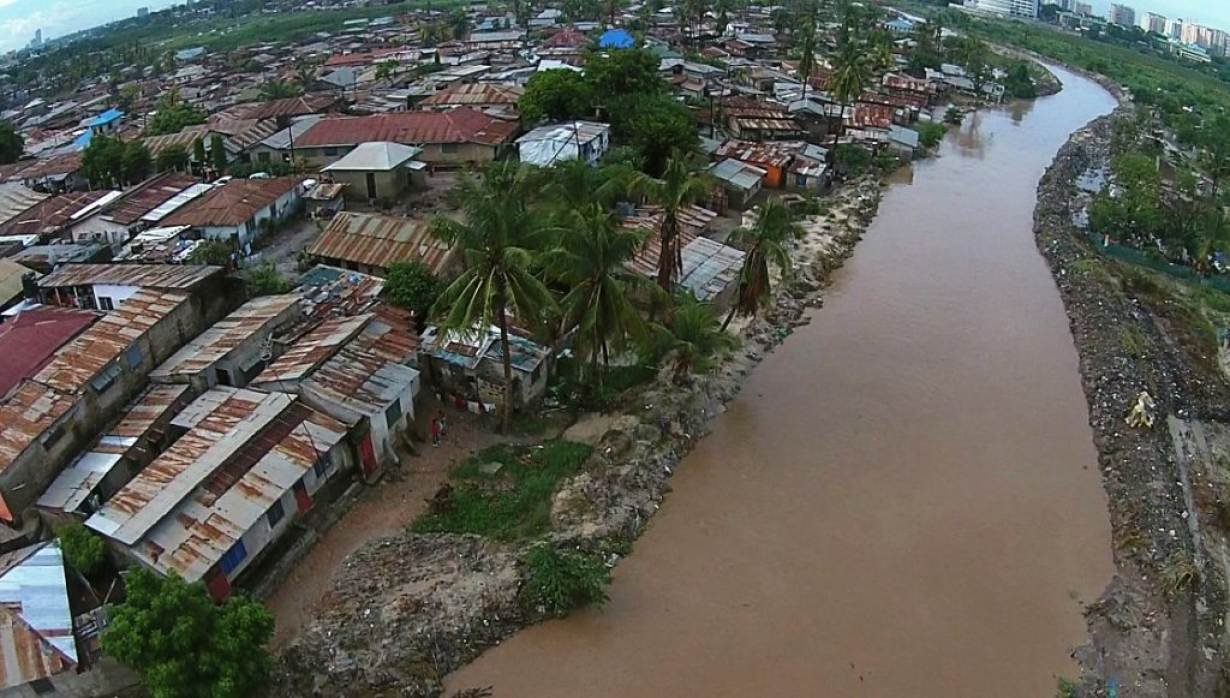
Ready
World Bank data on the share of urban populations living in slum households paints a difficult picture for East and Central Africa in 2022: 78% in the DRC, 70% in Tanzania, 64% in Ethiopia, 53% in Uganda, 40% in Kenya, 38% in Rwanda and 37% in Burundi, against a global average of 23%. These figures shouldn't be read simply as a ranking of whose housing is worst. The indicator measures households lacking at least one of five conditions, improved water, improved sanitation, sufficient living space, durable housing or secure tenure, capturing a broader deficit than the everyday word "slum" suggests. The economic stakes are larger than the housing statistics themselves: East Africa is urbanising precisely as its cities become the primary locations for employment, trade, manufacturing and investment, and a region housing much of that incoming labour force in settlements without adequate infrastructure is building a constraint on its own productivity directly into its fastest-growing economic centres.
DAR ES SALAAM — World Bank data on the share of urban populations living in slum households presents a difficult picture for East Africa. In 2022, the latest year available for the indicator, 70% of Tanzania's urban population was living in slum households, followed by 64% in Ethiopia, 53% in Uganda, 40% in Kenya, 38% in Rwanda and 37% in Burundi. The Democratic Republic of Congo, increasingly central to East Africa's economic and infrastructure geography, recorded an even higher 78%. The global figure was 23%.
What the Data Actually Measures
These numbers shouldn't be read simply as a ranking of which East African country has the worst housing. The World Bank indicator measures the proportion of the urban population living in households lacking at least one of five conditions: improved water, improved sanitation, sufficient living area, durable housing, or security of tenure. It's sourced from UN-Habitat's Urban Indicators Database and covers 2000 to 2022, capturing a broader deficit in the quality and security of urban housing than the everyday use of the word "slum" might suggest.
A note on data recency: separate historical World Bank/UN-Habitat figures reported via Statista show Tanzania's slum share had been declining steadily for over a decade, from 63.5% in 2010 to 41.7% in 2016 to 40% in 2018. A jump to 70% by 2022, as the current dataset shows, would represent a sharp reversal of that decade-long decline within a four-year window. That reversal is not necessarily implausible, rapid, unmanaged urban growth around Dar es Salaam could plausibly drive it, but this analysis could not independently re-confirm the specific 2022 country-level figures against the live World Bank DataBank in this pass. Readers relying on this figure for further work should verify it directly against the current EN.POP.SLUM.UR.ZS dataset before treating it as final.
The economic significance extends well beyond the housing statistics themselves. East Africa is urbanising while its cities simultaneously become the main locations for employment, trade, manufacturing, services, logistics and investment. When a large share of the people moving into these economic centres are housed in settlements without adequate infrastructure, secure tenure, sanitation, drainage or sufficient living space, the housing deficit becomes a constraint on productivity. The region is effectively trying to urbanise its labour force without producing enough formal urban space for that labour force to live, travel and work efficiently.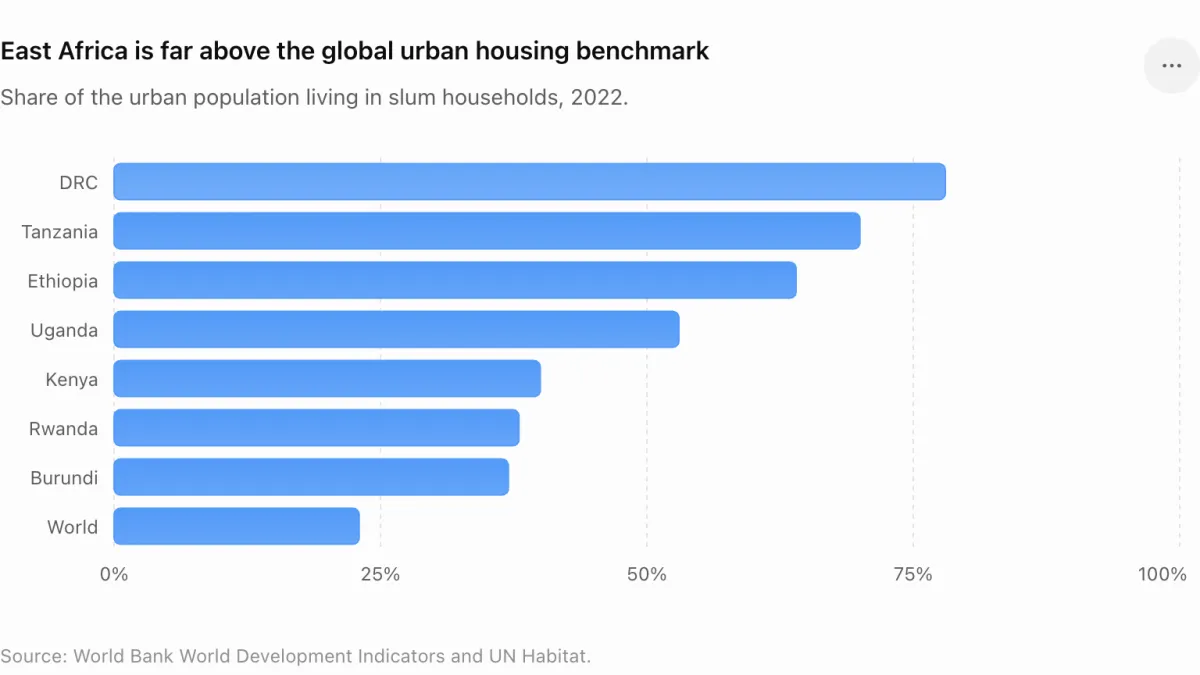 Source: World Bank World Development Indicators, indicator EN.POP.SLUM.UR.ZS, sourced from UN-Habitat.
The Regional Comparison
| Country | Urban population living in slums, 2022 |
| Democratic Republic of Congo | 78% |
| Tanzania | 70% |
| Ethiopia | 64% |
| Uganda | 53% |
| Kenya | 40% |
| Rwanda | 38% |
| Burundi | 37% |
| World | 23% |
Source: World Bank World Development Indicators, indicator EN.POP.SLUM.UR.ZS, sourced from UN-Habitat.
Tanzania Has the Region's Highest Recorded EAC Share
Tanzania's 70% figure places it substantially above Kenya, Uganda, Rwanda and Burundi, and three times the global average. The figure is particularly significant because Tanzania's urban economy concentrates heavily around rapidly expanding cities. Dar es Salaam illustrates the scale: the World Bank has previously estimated roughly 70% of the city's development was informal and not accompanied by corresponding extensions of urban services, while the city grows at approximately 5.6% annually with its population projected to exceed 10 million by 2030. Dar es Salaam also accounts for a substantial share of Tanzania's total urban population and national economic activity.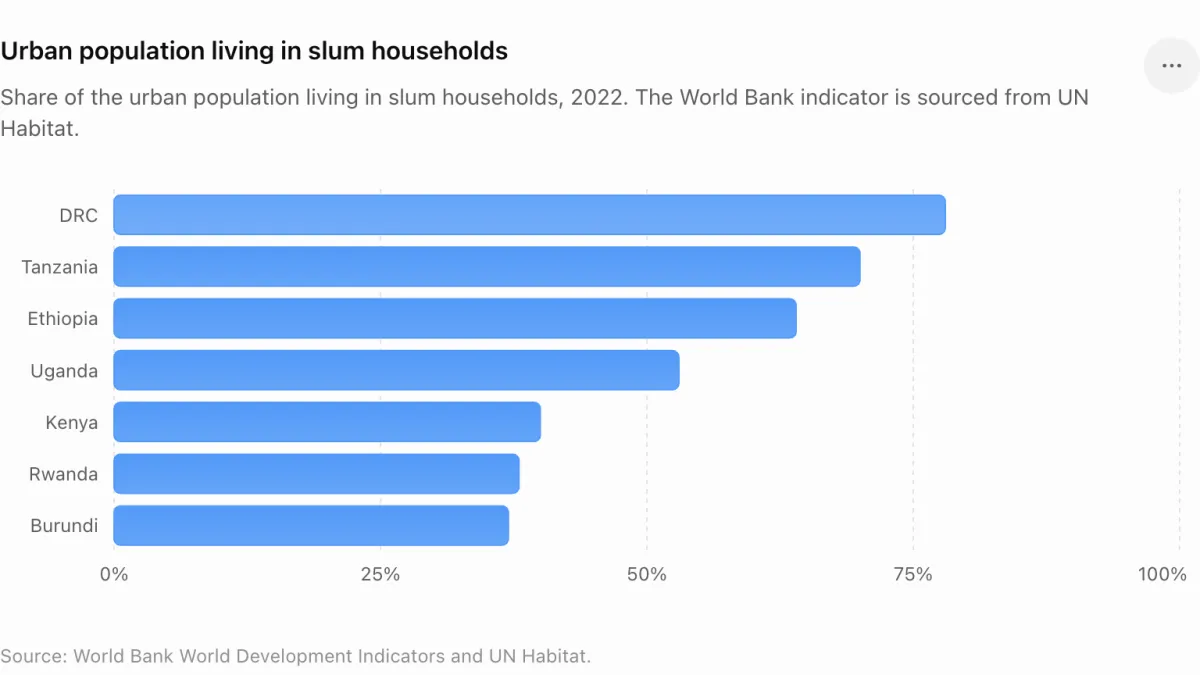 Source: World Bank World Development Indicators, indicator EN.POP.SLUM.UR.ZS, sourced from UN-Habitat.
That makes Tanzania's housing challenge inseparable from its economic geography. When people cannot find affordable formal housing close to employment, they don't disappear from the urban economy, they occupy cheaper land farther from formal infrastructure or build incrementally where planning and services haven't kept pace with population growth. The result is a city where workers can be physically close to an economic centre but economically distant from it because of transport costs, flooding, inadequate roads and unreliable basic services. A worker spending several hours travelling from an informal settlement to a workplace is effectively absorbing part of the cost of the city's failure to provide affordable housing near economic activity, and businesses ultimately bear part of that cost through reduced labour mobility, higher wage requirements and lower operating efficiency.
Tanzania's urbanisation therefore presents a genuine contradiction: the country needs cities to become more productive, since urbanisation is one of the core mechanisms through which economies shift workers from low-productivity agriculture into manufacturing and services, yet the physical form that urbanisation is currently taking can actively prevent that productivity gain from materialising.
Ethiopia's 64% Reveals the Scale of the Problem
Ethiopia's 64% matters because Addis Ababa and the country's other growing urban centres are expected to play an increasingly central role in industrialisation, services and trade, making housing part of the country's broader economic infrastructure rather than a separate social concern. The underlying issue isn't simply the number of housing units built; urban housing has to connect to transport, electricity, water, sanitation, drainage, schools, markets and employment. Building large volumes of housing on cheap land far from economic activity can shift the cost of urbanisation onto transport systems and households instead of solving it. That's why housing policy can't be separated from industrial policy: if Ethiopia wants cities to attract manufacturing and services, workers need to be able to live within reasonable reach of those employment centres, and unaffordable housing near productive areas simply pushes lower-income workers outward into sprawling, increasingly expensive-to-serve cities.
Uganda's 53% Is an Urban Productivity Issue
Kampala illustrates why Uganda's 53% matters economically. World Bank analysis has found Kampala generates a disproportionately large share of Uganda's economic activity and formal employment, while a substantial portion of its population lives in informal settlements, with the city's growth also pushing settlement into environmentally vulnerable, flood-prone areas. This creates what might be called an urban productivity penalty: a city can concentrate businesses, workers and capital while still failing to build the infrastructure that lets those factors of production interact efficiently. Uganda's challenge isn't simply to make Kampala larger, it's to make Kampala more economically productive per square kilometre while developing secondary cities capable of absorbing population and investment, which requires treating housing alongside industrial parks, transport corridors, public transport, drainage, electricity and commercial land as one connected system.
Kenya Has a Lower Ratio but a Large Absolute Crisis
Kenya's 40% is considerably below Tanzania, Ethiopia and Uganda, but that lower percentage shouldn't be read as evidence Kenya has solved its urban housing problem. World Bank analysis of Kenya's affordable housing market estimates a housing deficit exceeding two million units, with demand increasing by roughly 250,000 households annually against new supply averaging fewer than 50,000 units per year, and finds that the growth of informal settlements is driven by this structural shortage and by affordability constraints, particularly in Nairobi.
This exposes a real limitation of the slum percentage as a standalone economic indicator: a country can post a lower percentage while still housing a very large absolute number of people inadequately, simply because its urban population is larger. Kenya also demonstrates why housing finance matters as much as construction: formally produced housing remains beyond the reach of many households, conventional mortgage finance is inaccessible to much of the working population, and the problem sits simultaneously on the supply side and the financial side. Developers need affordable land, infrastructure and construction finance; households need financing products calibrated to actual income levels rather than the economics of higher-income formal workers. Kenya's experience suggests East Africa's housing crisis can't be solved simply by announcing large numbers of new housing units, since the financial structure behind those houses determines who can actually occupy them.
Rwanda's 38% Is Better, But Still a Serious Constraint
Rwanda's 38%, the second-lowest figure among the countries examined here after Burundi, shouldn't obscure the underlying pressure on its cities. World Bank analysis has found more than 60% of urban households living in unplanned settlements in earlier assessments, with the proportion in Kigali substantially higher, and formal housing supply remaining unaffordable for a large share of the population. Rwanda has treated urbanisation as central to its broader economic transformation strategy, which makes the housing question particularly consequential: a government can plan roads, utilities and commercial districts, but if housing supply doesn't expand at the same pace and at prices households can afford, informal development simply returns through another channel. The lesson from Rwanda is that stronger urban planning alone doesn't eliminate the underlying economics of affordability; land prices, construction costs, household incomes and access to finance still determine where people actually end up living.
Burundi's 37% Comes With a Different Economic Context
Burundi's 37% is the lowest figure among the East African countries considered here, but this doesn't necessarily mean Burundi has built a more effective urban housing market. The country is less urbanised than several of its neighbours, meaning the pressure on its housing market isn't directly comparable to Nairobi, Dar es Salaam, Kampala or Kigali. A low share of urban residents living in slums can partly reflect that a smaller share of the population has moved into cities at all, and as urbanisation accelerates, the housing challenge can shift rapidly if formal supply, infrastructure and land administration don't expand ahead of demand. For Burundi, the policy challenge is therefore substantially preventative: an opportunity to establish better urban planning and affordable housing systems before its cities grow significantly larger and become far more expensive to retrofit.
The DRC Shows How Severe the Problem Can Become
The DRC's 78% is the highest among the major East and Central African economies considered here, and substantially above the regional figures. The DRC's urbanisation is happening alongside a large structural transformation driven by mining, trade and population growth; Kinshasa is already one of Africa's largest metropolitan areas, while cities like Lubumbashi, Goma and Kolwezi are increasingly shaped by mining, trade and regional migration. The housing problem intersects directly with economic geography: where population expands rapidly around mining and commercial centres without corresponding investment in housing and urban infrastructure, informal settlements become the mechanism through which the labour market absorbs new workers. This creates a wider development problem, since mining investment can generate substantial export earnings without necessarily building well-serviced cities around that economic activity, leaving capital-intensive industries operating alongside large populations living in inadequate urban environments. The DRC's challenge is therefore not merely to build more houses, but to convert mineral wealth and urban growth into productive urban infrastructure.
East Africa Is Building Cities Faster Than It Is Building Housing Systems
The regional comparison reveals a common pattern with distinct local drivers. Tanzania's challenge is heavily associated with rapid metropolitan growth and expanding informal settlement around Dar es Salaam. Kenya's challenge connects strongly to housing affordability, land costs and formal supply failing to keep pace with household formation. Uganda's problem concentrates around Kampala's rapid growth and infrastructure constraints. Rwanda has pursued stronger planning but still faces a large affordability gap. Burundi remains less urbanised and therefore sits on a different trajectory entirely. Ethiopia is managing rapid urban growth alongside a broader industrial and structural transformation. The DRC combines enormous urban population growth with weak urban infrastructure and a geographically dispersed economic base. The common denominator across all seven cases is that housing supply has not kept pace with the economic and demographic forces pulling people into cities.
The Housing Deficit Is Also a Transport Problem
East Africa cannot solve its housing crisis by treating housing as a construction sector alone. Where affordable housing is unavailable near employment, households compensate through transport: workers travel longer distances, spend more on public transport, lose productive time, and become more vulnerable to fuel price increases, a vulnerability that matters more at a time of elevated global energy prices, since a city forcing low-income workers into long daily journeys effectively exposes its poorest residents to an additional layer of economic volatility. Dar es Salaam's experience illustrates the connection directly: the World Bank has linked the city's unplanned growth with congestion, inadequate urban services and vulnerability to flooding, while investments in the city's transport and drainage systems are specifically intended to improve metropolitan efficiency. Housing therefore needs to be planned around transport corridors and employment centres, not treated as an isolated real estate product disconnected from how people actually move through a city.
Informal Settlements Are Not Simply a Housing Failure
There's also a real danger in describing informal settlements purely as evidence of government failure. Informal settlements are often the market's own response to a formal housing system that cannot accommodate the incomes of the people who need to live in the city; if formal housing costs more than most workers can afford, people find another way to secure shelter. That's why eviction alone rarely solves the underlying problem: removing an informal settlement without creating affordable alternatives simply relocates the same economic problem elsewhere. A more productive approach recognises existing settlements as part of the urban economy and progressively provides roads, drainage, water, sanitation, electricity, waste collection and secure tenure where appropriate. Kenya's informal settlement programme has explicitly linked tenure regularisation and infrastructure investment to higher property values, improved access to credit and stronger municipal revenue, a fundamentally different approach from treating informal settlements as temporary abnormalities that can simply be cleared away.
The Opportunity Is Bigger Than Housing
East Africa's housing deficit is also a potentially large industrial opportunity. The region needs enormous quantities of cement, steel, roofing materials, plumbing equipment, electrical equipment, glass, tiles, doors, windows, prefabricated components and construction machinery, and if governments can expand housing supply while simultaneously developing domestic manufacturing capacity for these inputs, housing investment can become part of industrialisation rather than a pure fiscal cost. That's particularly relevant for Tanzania, Kenya and Ethiopia, which already possess relatively large manufacturing bases and domestic markets: instead of treating affordable housing purely as a budget line, governments can use predictable, sustained housing programmes to create long-term demand for local construction industries. The economics have to be structured carefully, though, since subsidising the final price of housing without addressing land, infrastructure, construction costs and finance can simply produce expensive units that remain inaccessible to the households the policy was meant to serve. The more effective strategy is reducing the cost of producing and financing housing itself, rather than subsidising the final price tag on top of an unreformed cost structure.
East Africa Needs a Different Urbanisation Strategy
The World Bank's own definition of a slum household makes the underlying problem clear: the issue isn't simply whether a building has a roof, it's whether urban residents have water, sanitation, adequate living space, durable housing and security of tenure. That means East African urban policy should increasingly measure the quality of urbanisation rather than simply its speed. A city can grow rapidly and still become poorer in productivity terms if congestion, inadequate housing, unreliable utilities and weak drainage absorb too much of the income generated by urban economic activity. Conversely, a city combining affordable housing, efficient transport, reliable electricity, sanitation, digital connectivity and productive employment can convert population density into a genuine economic advantage rather than a liability.
The region is entering an era in which more people will live in cities, more businesses will depend on metropolitan markets, and more investment will concentrate around urban corridors. If housing supply remains disconnected from that economic transition, the cost will simply appear elsewhere, through congestion, informal employment, public health pressures, flooding, transport expenditure, land disputes and weak labour productivity. The question facing East Africa isn't whether its cities will grow; they will. It's whether the region will build cities in which ordinary workers can actually afford to live close enough to participate productively in the economies those cities are creating.
FAQ
Which East African country had the highest share of urban residents living in slum households in 2022? Among the East African countries examined, Tanzania had the highest share at 70%, followed by Ethiopia (64%), Uganda (53%), Kenya (40%), Rwanda (38%) and Burundi (37%). The Democratic Republic of Congo recorded 78%, the highest figure in the full comparison.
Is the 70% figure for Tanzania definitely accurate? It comes from the World Bank's EN.POP.SLUM.UR.ZS indicator as cited in the source material for this piece, but separate historical data show Tanzania's slum share declining steadily from 63.5% in 2010 to 40% in 2018, making a jump to 70% by 2022 a significant and somewhat unusual reversal that this analysis could not independently re-confirm against the live World Bank dataset. Readers should verify this specific figure directly before relying on it.
What does the World Bank actually mean by "population living in slums"? The indicator measures the share of the urban population living in households lacking at least one of five conditions: improved water, improved sanitation, sufficient living area, housing durability, or security of tenure. It does not require every one of these to be absent, just one.
Does Tanzania's 70% figure mean 70% of the entire country lives in slums? No. The indicator applies specifically to the urban population, not the national population as a whole.
Why does Kenya have a lower percentage but still face a severe housing crisis?Kenya's 40% is a share of its urban population, but Kenya's urban population is large enough that the country still faces an absolute housing deficit exceeding two million units, with annual demand of roughly 250,000 households against supply averaging fewer than 50,000 units per year.
What should East African governments actually do about informal settlements?Evidence supports combining new affordable housing supply with upgrading viable existing settlements through infrastructure, sanitation, drainage, water, roads and secure tenure, rather than treating informal settlements purely as problems to be cleared. Kenya's experience shows tenure regularisation and infrastructure investment can also generate economic benefits through higher property values and stronger municipal revenue.
 Uchumi360
Business Intelligence
Uchumi360
Business Intelligence
Uchumi360 covers business, investment, and economic policy across East, Central, and Southern Africa.
For the serious reader
You read to the end. That places you in a small group.
Uchumi360 is built for readers who demand precision over speed, structure over sentiment, and analysis that holds uncomfortable conclusions rather than softening them. If this work sharpens how you think about Africa's economy, help us keep building the infrastructure behind it.
Institutional Partners
Commission intelligence. Shape the conversation.
Uchumi360 works with development finance institutions, investment firms, sovereign bodies, and strategic organisations across the coverage region. Institutional partnership unlocks:
- Commissioned sector and country intelligence reports
- Branded research series under your institution's authority
- Exclusive data briefings for internal strategy teams
- Speaking and editorial presence at Uchumi360 events
- Co-published investment outlooks for your markets
Support Our Work
Independent analysis has a cost. Help us bear it.
Uchumi360 does not carry advertising. It does not take editorial direction from sponsors. Every article is produced without commercial compromise. Your contribution funds the reporting, research, and editorial infrastructure that keeps this analysis free from influence.
Secure checkout: One-time and monthly support are processed securely. Add payment credentials to enable checkout here.
Stay Connected
Keep up with every new insight.
Follow our latest analysis, policy coverage, and market intelligence as soon as it is published. If you need something specific, reach out directly and we will point you to the right research.
