
Africa's Largest Solar Manufacturing Plant Is Now Operational in Kwala, Kibaha. One Factory Has Already Changed Tanzania's Export Geography.
Ready
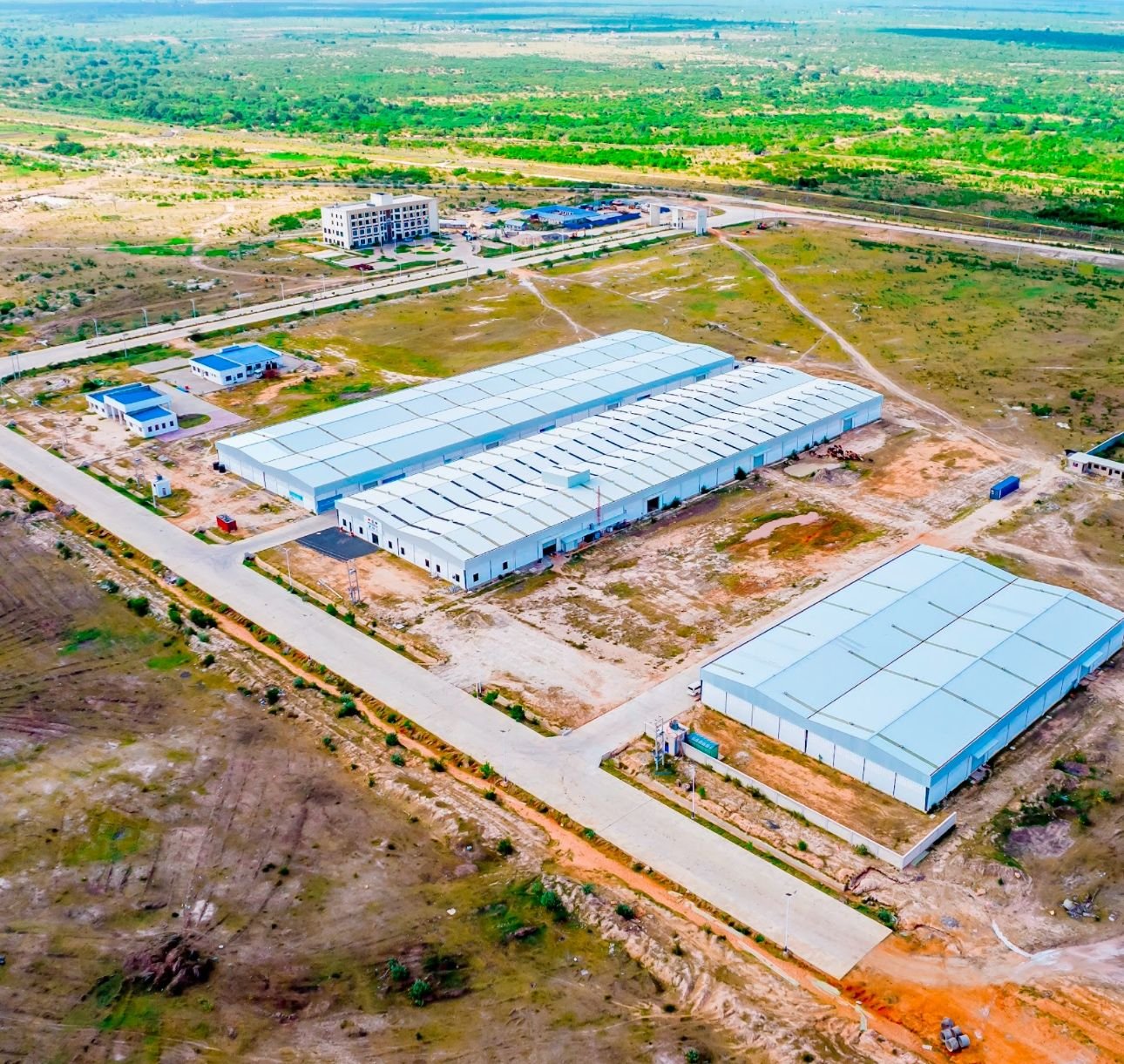
Tanzol's solar manufacturing plant in Kwala, Kibaha is operational, confirmed by TISEZA Director General Gilead Teri in a May 2026 published podcast interview and by industrial zone documentation whose specifics describe a USD 300 million initial investment, a USD 500 million second phase bringing total investment to approximately TZS 2 trillion, first-year export projections of USD 300 million to the American market rising to USD 600 million in year two, against Tanzania's 2024 total US exports of USD 200 to 211 million. The facility is 1,500 metres long, equipped with high-automation machinery and large-volume production lines meeting international certification standards for competitive export markets. It requires at least 50 MW of dedicated electricity and more than 5,000 cubic metres of water daily, demands whose satisfaction is forcing rapid infrastructure upgrades across the Kwala industrial zone. A USD 50 million steel processing plant, Tanzania's first of its kind, is also under establishment in Kwala, complementing the solar complex and reducing dependence on imported steel whose consumption the SGR, port construction, and industrial expansion are generating. The zone projects 100,000 direct jobs and 500,000 indirect positions at full operation. China accounts for over 80% of global solar manufacturing output. Tanzania's entry into large-scale solar production at export certification standards for the American and European markets positions it within the supply chain diversification whose commercial demand the US-China trade friction and clean energy transition are simultaneously creating. Africa's solar manufacturing geography has changed. The evidence is in Kwala. Africa has been described as full of potential for so long that the phrase has lost meaning. In Kwala, Kibaha, Tanzania has moved past potential into production. Africa's largest solar manufacturing plant is not a groundbreaking ceremony. It is a 1,500-metre operational factory shipping solar equipment to the American market. The geography of Africa's clean energy manufacturing story just changed.
KIBAHA, COAST REGION — Africa's largest solar manufacturing plant is operational in Kwala, Kibaha, and the numbers it has already put on the table are among the most commercially significant produced by a single industrial investment in East African economic history.
Tanzol's solar manufacturing facility in Kwala is built, equipped, and producing for the American market. The initial investment is USD 300 million. A second phase of USD 500 million is scheduled for next year, bringing total committed investment in a single Kibaha industrial zone to approximately TZS 2 trillion. First-year export projections stand at USD 300 million, rising to USD 600 million in year two.
Tanzania's total annual exports to the United States in 2024 stood between USD 200 and USD 211 million across all products from all sectors of the entire economy. One operational factory in Kwala is projected to triple that figure in its first full year alone.
Gilead Teri, Director General of Tanzania Investment and Special Economic Zones Authority, confirmed the facility in a published interview on the Divya Briefing podcast in May 2026. "We have a new project and they're moving their operations from Vietnam, from China to develop a solar manufacturing unit, directed to the North American market," he said. "This one enterprise will be exporting USD 300 million worth of solar panels a year. This just doubles Tanzanian trade with the US in just one factory. The size of the factory is a kilometre and a half long, 1,500 metres."
Why this facility matters beyond its own numbers
Solar manufacturing has been dominated by Asia for three decades, with China accounting for more than 80% of global output according to International Energy Agency production data. Africa's participation in the solar economy has been confined almost exclusively to the installation side, consuming panels produced in Chinese factories at prices whose import cost African buyers pay rather than the production margins African manufacturers capture.
Tanzania's entry into large-scale solar production at export certification standards breaks that pattern at the most commercially opportune moment in the global solar supply chain's modern history. The United States and European Union are actively diversifying their solar hardware supply chains as Chinese manufacturing dominance creates the single-source dependency that trade policy, geopolitical friction, and energy security considerations are incentivising major importing economies to reduce. American market solar hardware supply chain diversification is not a future policy aspiration. It is a current commercial reality whose demand the Tanzol facility is positioned to serve from an operational base that is already producing.
The US trade policy environment whose restructuring under the America First framework has created the import tariff architecture that makes production in Tanzania commercially preferable to production in China for manufacturers targeting the North American market is the immediate commercial tailwind whose timing Tanzol's operational status captures at the optimal moment. A factory that is built, certified, and producing when the market access conditions favour its location is in a fundamentally different commercial position from a factory whose feasibility study is responding to the same conditions two years after they became visible.
What is built in Kwala
The Tanzol facility is equipped with high-automation machinery and large-volume production lines designed to meet the international certification standards whose attainment is the non-negotiable market access condition for export into competitive markets including the United States and the European Union. This is the distinction that separates the Kwala facility from the domestic installation sector manufacturing whose lower certification requirements make it a less commercially demanding but also less commercially valuable production base.
The facility's operational infrastructure requirements reveal the scale of what has been built. The solar plant alone requires at least 50 megawatts of dedicated electricity and more than 5,000 cubic metres of water per day. These demands are not the utility consumption of a light assembly operation. They are the operational requirements of a heavy industrial facility whose energy and water intensity is forcing rapid upgrades in the utilities and transport networks serving the Kwala industrial zone, pulling the surrounding infrastructure forward at the pace that a sufficiently large anchor tenant's operational demands create when the host economy's commitment to the zone's development is matched by the investment's commercial scale.
The infrastructure pull effect is the mechanism whose operation at Kwala is producing the agglomeration economics that successful industrial zones generate over time. The Tanzol facility's 50 MW electricity requirement is forcing grid extension and power supply improvements whose benefit extends to every subsequent investor in the zone. The water and logistics infrastructure upgrades whose pace the facility's operation is demanding improve the operating environment for the steel processor, the component suppliers, and the services businesses whose arrival in Kwala's orbit the anchor investment's presence is making commercially rational.
The steel plant and what it completes
Alongside the Tanzol solar complex, a USD 50 million steel processing plant confirmed as Tanzania's first of its kind is being established in Kwala. The combination is not coincidental. Steel is essential in solar panel mounting systems, the transmission line infrastructure that solar generation feeds into, and the industrial construction whose physical infrastructure the solar manufacturing facility itself required to build. A solar manufacturer and a steel processor in the same industrial zone share the logistics, power, and water infrastructure whose co-utilisation improves the economics of both rather than duplicating the cost that separate locations would impose.
The steel plant's domestic supply significance extends beyond the Kwala zone itself. Tanzania's infrastructure decade is consuming steel at accelerating volumes. The Standard Gauge Railway whose USD 2.33 billion financing Standard Chartered arranged in April 2026 requires steel for its continuing construction. The Bagamoyo port development 40 kilometres north of Dar es Salaam requires steel. The tractor head assembly plants, the industrial parks, and the manufacturing units whose approvals TISEZA confirmed at over 900 in 2025 collectively generate the construction steel demand whose domestic supply a Kwala steel processor can serve at the import-substitution economics that proximity to demand creates.
Tanzania's current imported steel bill is a foreign exchange outflow whose reduction domestic processing enables once the facility reaches the production capacity whose attainment the USD 50 million investment is designed to finance.
The employment and economic multiplier
Kwala's industrial zone projects 100,000 direct jobs and 500,000 indirect positions at full operation. The projection's order of magnitude is the analytically significant element rather than the specific figures whose realisation at scale depends on the second phase investment timeline and the zone's continued attraction of complementary investors whose combined employment generates the indirect figure.
100,000 direct manufacturing jobs in a single industrial zone would represent one of the largest concentrations of formal manufacturing employment in East African economic history. For Tanzania, whose manufacturing GDP contribution at approximately 8 to 10% according to National Bureau of Statistics data is the structural gap that Uchumi360's industrial series has identified as the binding constraint on the per capita advancement that Vision 2050 requires, formal manufacturing employment at Kwala's projected scale is the conversion mechanism whose operation expands the urban middle class, develops the industrial skills base, generates the corporate income and payroll tax revenues that broaden the fiscal base, and produces the household income growth whose compounding is the actual development outcome that infrastructure investment was designed to enable.
The indirect employment of 500,000 captures the supply chain, services, logistics, and construction employment whose generation the anchor industrial investment creates in the surrounding regional economy. Component suppliers, packaging operators, quality testing services, catering, transport, and the retail and housing services that a large workforce's presence generates are the indirect employment categories whose combined scale reflects the anchor investment's multiplier effect on the broader economy.
The geopolitical positioning that makes Kwala strategically significant
The Kwala facility is an industrial investment story and a geopolitical positioning story simultaneously, and the two dimensions are inseparable in the current global clean energy supply chain environment.
As the United States, European Union, Japan, South Korea, and other major industrial economies restructure their solar hardware supply chains away from Chinese manufacturing concentration, the production geography that fills the diversification demand is being determined now, in the investment decisions whose location choices will define the global solar supply chain's structure for the decade ahead. Tanzania's entry into that competition through an operational USD 300 million facility producing at American market export certification standards positions it as a strategic manufacturing partner at the moment when that positioning is most commercially valuable rather than after the supply chain diversification investment has been made elsewhere.
The facility connects directly to the multipolar strategic positioning that Uchumi360's analysis of Africa's multiple global partners documented across its May 2026 coverage. Tanzania is simultaneously engaging Chinese infrastructure financing through the SGR, Western LNG project negotiations with Equinor, ExxonMobil, and Shell, Gulf investment interest through the Tanzania Investment and Green Finance Summit targeting USD 2.85 billion, and now American market solar export manufacturing through the Kwala facility. The solar factory's North American export orientation adds the manufacturing dimension to a multi-engagement strategy whose balance is consistent with the transactional multi-alignment that sophisticated resource and industrial economies execute when the multipolar moment creates the leverage that careful positioning can capture.
What Teri's confirmation means for the investment narrative
The TISEZA Director General's explicit confirmation of the Kwala facility in a published interview, alongside his broader claim of over 900 investment project approvals in 2025 and one new factory per day in 2024, establishes the official government position on Tanzania's manufacturing momentum in terms whose specificity is unusual for government investment promotion communications.
Teri described the convergence of power availability, land access speed, logistics partnerships, and legislative reform as a once-in-a-lifetime alignment whose window is open now. "It's a once-in-a-lifetime opportunity, and we are really, really working day and night to make it possible." The Tanzol facility in Kwala is the most commercially visible single piece of evidence that the alignment Teri described is producing the industrial investment whose arrival on the ground is the actual test of whether the investment promotion narrative reflects operational reality or aspirational projection.
It reflects operational reality. The factory is built. The production lines are running. The solar panels are being shipped to America. Tanzania's export footprint in the world's largest consumer market has already changed.
The challenges whose resolution determines what comes next
Power demand at Kwala is rising faster than supply, and the 50 MW dedicated requirement that the Tanzol facility creates is the specific infrastructure pressure whose resolution requires the grid extension, private power generation investment, and the PPP transmission framework whose testing Teri confirmed is underway. Logistics between Kwala, the Dar es Salaam port, and North American export destinations need the streamlining whose completion the DP World and Adani Ports partnerships are designed to accelerate but whose operational delivery the facility's export volume growth will test continuously.
The international quality certifications whose maintenance at production volume is the ongoing condition for American and European market access require the quality management systems, raw material supply chain transparency, and production consistency whose institutionalisation in a new manufacturing facility takes time and investment beyond the initial certification achievement.
These are the productive challenges of an economy whose industrial expansion is creating demand that its infrastructure and systems must stretch to meet, rather than the structural constraints of an economy whose industrial ambitions have produced facilities that markets do not want. The distinction matters because it determines whether the challenges are addressed through investment and operational improvement, which the commercial returns the Tanzol facility is generating provide the incentive to make, or whether they represent the fundamental viability questions whose resolution the investment decision should have required before the factory was built.
The factory is built. The commercial case is confirmed. The challenges are real and the incentive to resolve them is measured in USD 300 million of first-year exports and USD 600 million in year two.
Tanzania is no longer talking about industrialisation as an aspiration. In Kwala, Kibaha, it built it. Africa's largest solar manufacturing complex is operational. The clean-energy manufacturing future that Africa has been promised for decades arrived in a Kibaha industrial zone, 1,500 metres long, producing for America.
FAQ
Is the Tanzol solar manufacturing plant in Kwala operational? Yes. The facility is confirmed as built and operational by TISEZA Director General Gilead Teri in a published May 2026 Divya Briefing podcast interview in which he described the facility as a manufacturing unit that has relocated operations from Vietnam and China to produce solar panels for the North American market from a 1,500-metre factory. Industrial zone documentation confirms the USD 300 million initial investment, first-year export projections of USD 300 million, and the facility's North American market orientation.
Why is the export projection significant relative to Tanzania's existing trade? Tanzania's total annual exports to the United States in 2024 stood between USD 200 and USD 211 million across all products from all sectors. The Tanzol facility is projected to export USD 300 million in its first year alone, rising to USD 600 million in year two. A single operational factory in a single Kibaha industrial zone is on course to more than triple Tanzania's entire American export footprint, making it one of the most commercially significant single industrial assets in East African export history.
What infrastructure demands is the facility creating? The solar plant requires at least 50 megawatts of dedicated electricity and more than 5,000 cubic metres of water per day, demands that are forcing rapid utility and logistics upgrades across the Kwala industrial zone. These requirements are pulling the surrounding infrastructure forward at the pace that a large enough anchor tenant's operational demands create, improving the operating environment for subsequent investors whose arrival the anchor investment's presence is making commercially rational.
What does the steel processing plant add? The USD 50 million steel processing plant, Tanzania's first of its kind, complements the solar facility because steel is essential in solar panel mounting systems, transmission lines, and industrial construction. The co-location in the same industrial zone allows shared logistics, power, and water infrastructure. The plant also reduces Tanzania's dependence on imported steel whose domestic demand the SGR construction, port development, and manufacturing expansion are generating at growing volumes.
What is the employment projection and what does it mean for Tanzania? Kwala's industrial zone projects 100,000 direct jobs and 500,000 indirect positions at full operation. For Tanzania, whose manufacturing GDP contribution at approximately 8 to 10% is the structural gap constraining per capita advancement, formal manufacturing employment at this scale is the conversion mechanism that expands the urban middle class, develops industrial skills, generates fiscal revenue from corporate and payroll taxation, and produces the household income growth that Vision 2050 requires to be more than a GDP target.
 Uchumi360
Business Intelligence
Uchumi360
Business Intelligence
- Gilead Teri, Director General, Tanzania Investment and Special Economic Zones Authority, interview on Divya Briefing podcast, May 2026
- Facility confirmation, USD 300 million export projection, 1,500-metre factory dimensions, North American market orientation, relocation from Vietnam and China
- Available at Divya Briefing podcast platform
- Tanzol industrial zone documentation
- USD 300 million initial investment, USD 500 million second phase, TZS 2 trillion total, first-year export USD 300 million, second-year USD 600 million, 50 MW electricity requirement, 5,000 cubic metres water daily, 100,000 direct jobs, 500,000 indirect jobs projections
- As documented in Kwala Kibaha industrial development records
- Tanzania Revenue Authority, Tanzania US export data 2024
- USD 200 to 211 million total exports to United States
- Available at tra.go.tz
- International Energy Agency, global solar manufacturing output data
- China exceeding 80% of global production
- Available at iea.org
- Standard Chartered Bank, SGR financing announcement, 28 April 2026
- Available at sc.com
- Tanzania Investment and Special Economic Zones Authority, investment promotion and SEZ documentation
- Available at tiseza.go.tz
- Tanzania Ports Authority, Dar es Salaam and Bagamoyo port development data
- Available at tanzaniaports.go.tz
- Tanzania Electric Supply Company, grid capacity and Kwala industrial zone power supply data
- Available at tanesco.co.tz
- National Bureau of Statistics Tanzania, manufacturing GDP share and export data
- Available at nbs.go.tz
- DP World Tanzania, logistics and export connectivity documentation
- Available at dpworld.com
- Adani Ports Tanzania, logistics documentation
- Available at adaniports.com
- Rwanda Development Board, regional clean energy manufacturing comparative data
- Available at rdb.rw
- Uganda Bureau of Statistics, industrial zone and manufacturing data
- Available at ubos.org
- Kenya National Bureau of Statistics, solar sector and manufacturing data
- Available at knbs.or.ke
- DRC Institut National de la Statistique, clean energy and industrial data
- Available at ins-rdc.org
- Zambia Statistics Agency, clean energy manufacturing data
- Available at zamstats.gov.zm
- Mozambique Instituto Nacional de Estatística, industrial and manufacturing data
- Available at ine.gov.mz
Uchumi360 covers business, investment, and economic policy across East, Central, and Southern Africa.
For the serious reader
You read to the end. That places you in a small group.
Uchumi360 is built for readers who demand precision over speed, structure over sentiment, and analysis that holds uncomfortable conclusions rather than softening them. If this work sharpens how you think about Africa's economy, help us keep building the infrastructure behind it.
Institutional Partners
Commission intelligence. Shape the conversation.
Uchumi360 works with development finance institutions, investment firms, sovereign bodies, and strategic organisations across the coverage region. Institutional partnership unlocks:
- Commissioned sector and country intelligence reports
- Branded research series under your institution's authority
- Exclusive data briefings for internal strategy teams
- Speaking and editorial presence at Uchumi360 events
- Co-published investment outlooks for your markets
Support Our Work
Independent analysis has a cost. Help us bear it.
Uchumi360 does not carry advertising. It does not take editorial direction from sponsors. Every article is produced without commercial compromise. Your contribution funds the reporting, research, and editorial infrastructure that keeps this analysis free from influence.
Secure checkout: One-time and monthly support are processed securely.
Stay Connected
Keep up with every new insight.
Follow our latest analysis, policy coverage, and market intelligence as soon as it is published. If you need something specific, reach out directly and we will point you to the right research.
