
Tanzania Has 75.8 Million Active Mobile Money Users, Nearly 2 Million Agents, and TZS 2.83 Trillion in Trust Accounts. It Is No Longer Catching Up to Kenya. It Has Built Something Different.
Ready
Tanzania's active mobile money user base reached 75.8 million in 2025, the agent network expanded to nearly 2 million, trust account balances reached TZS 2.83 trillion up 35.7 percent, and 2.79 million merchants accept digital payments, more than double the prior year. The Tanzania Instant Payment System processed TZS 54.95 trillion in value, growing 84 percent. Total digital payment transactions reached 672.24 million worth TZS 412.1 trillion. These metrics describe a financial system that has moved beyond financial inclusion into national infrastructure: a country where mobile money is not a service that a share of the population uses for specific transactions but a system that the entire commercial economy depends on for daily functioning. The comparison to Kenya requires nuance. Kenya's M-Pesa at 90.8 percent mobile money market share is a more concentrated market whose single-platform dominance has driven deep product development including M-Shwari, KCB M-Pesa, and Fuliza. Tanzania's more competitive multi-operator market, with M-Pesa at 41 percent, Mixx by Yas at 31 percent, and Airtel Money at 18 percent, has produced broader interoperability, a more distributed agent network, and the TIPS instant payment infrastructure whose 84 percent value growth describes a financial system advancing at a pace that Kenya's more mature and more concentrated market is not currently matching on the same metrics. Tanzania is not behind Kenya in mobile money. It is ahead of where Kenya was at a comparable stage of market development, and it is building a more interoperable architecture on top of its mobile money foundation. Tanzania built its mobile money economy quietly, without the global case study status that M-Pesa's early years generated, and without the brand recognition that Safaricom's marketing has sustained for Kenyan fintech. The 2025 numbers suggest it is time to update the reference points.
NAIROBI / DAR ES SALAAM — The definitive narrative of African mobile money has been told through Kenya for nearly two decades. M-Pesa launched in March 2007, solved the specific problem of urban-to-rural remittances in a market where 80 percent of adults were unbanked, and grew to 17 million users by 2011 in a trajectory that became the most cited financial inclusion case study in development economics. Nairobi became synonymous with African fintech innovation. Safaricom became the reference point for what a telecommunications company with the right product in the right market could achieve. The phrase mobile money became, in many international conversations, a synonym for M-Pesa.
Tanzania's 2025 data makes a different argument. Not about M-Pesa specifically, whose 41 percent market share in Tanzania is itself a significant commercial presence, but about the overall digital financial system that Tanzania has built and the stage of development it has now reached.
Active mobile money users reached 75.8 million in 2025. The agent network expanded to nearly 2 million. Trust account balances reached TZS 2.83 trillion, up 35.7 percent from the prior year. Merchants accepting digital payments surged 110 percent to 2.79 million. The Tanzania Instant Payment System processed TZS 54.95 trillion in value, growing 84 percent in twelve months. Total transactions across core payment infrastructure reached 672.24 million worth TZS 412.1 trillion.
These are not financial inclusion statistics. They are infrastructure metrics. Tanzania is not a country where mobile money is a service available to a share of the population. It is a country where mobile money has become the operating system of commercial life.
The distinction between financial inclusion and financial infrastructure
Financial inclusion describes the condition of gaining access to basic financial services for the first time: opening an account, sending money to a family member, receiving a salary through a digital channel. It is the entry point whose achievement has been the defining objective of African digital finance programmes since M-Pesa demonstrated that mobile-first delivery could reach populations that traditional banking could not serve.
Financial infrastructure describes something structurally different: a system so deeply embedded in daily economic activity that its removal would disrupt the functioning of the commercial economy rather than merely inconvenience a population that has alternative payment methods available. Electricity is infrastructure. Roads are infrastructure. Telecommunications are infrastructure. When a system reaches the penetration depth and the commercial integration breadth at which it becomes as essential as these, it has graduated from service to infrastructure.
Tanzania's mobile money system has reached that threshold across multiple indicators simultaneously.
The 75.8 million active user base, against a population of approximately 70 million, reflects multi-account holding whose prevalence confirms that mobile money is not a service Tanzanians use occasionally for specific transaction types. It is the default financial medium through which daily commercial activity flows. The nearly 2 million agent network, distributed across urban centres, secondary towns, and rural areas at a density that means a mobile money agent is accessible to the vast majority of Tanzania's geographic and demographic spread, is the physical distribution infrastructure of a payment system that functions at national scale rather than urban concentration. The TZS 2.83 trillion in trust account balances is money whose holders have chosen to store value in mobile money wallets rather than withdraw it to cash, a behavioural choice whose aggregate scale across millions of users confirms that mobile money is functioning as savings infrastructure rather than merely a transaction medium.
The 2.79 million merchants accepting digital payments, analysed separately in Uchumi360's merchant network coverage, add the commercial supply-side dimension that converts consumer digital wallet penetration into genuine economic infrastructure. A financial system with 75.8 million users and 2.79 million merchant acceptance points has achieved the bidirectional coverage whose presence means digital payment is available for virtually every commercial interaction a Tanzanian consumer encounters in daily life.
The Kenya comparison that requires nuance
The comparison to Kenya is both inevitable and requires careful framing to be analytically useful rather than simply competitive.
Kenya's mobile money market is dominated by M-Pesa at 90.8 percent market share. The platform's single-operator dominance has driven deep product development whose sophistication is genuinely advanced: M-Shwari's mobile savings and micro-credit, KCB M-Pesa's larger loan products, Fuliza's overdraft facility, and the broader ecosystem of financial services built on Safaricom's customer base have created a depth of mobile financial product availability that Tanzania's more fragmented market has not replicated in any single operator's portfolio.
Tanzania's mobile money market is competitive across three significant operators: M-Pesa at 41 percent market share with 33.2 million accounts, Mixx by Yas at 31 percent with 25.1 million accounts, and Airtel Money at 18 percent with 14.4 million accounts. The competitive structure has produced interoperability as an operational necessity rather than a regulatory imposition: operators whose customers cannot transact with each other's users have insufficient network coverage to sustain commercial viability, creating the market pressure toward interoperability that the Bank of Tanzania's framework has formalised.
That interoperability, whose depth Tanzania's TIPS infrastructure reflects, is the specific architectural difference between the two countries' mobile money systems that matters most for the next phase of digital economy development. A financial system built on a single dominant platform, however sophisticated that platform's own product range, is structurally different from one built on interoperable infrastructure that any operator, bank, fintech, or government agency can connect to and build on. Tanzania's multi-operator interoperable architecture is the foundation on which the TIPS growth, the merchant network expansion, and the 114 licensed payment system providers documented in the 2025 report are being built.
The comparison is not that Tanzania has surpassed Kenya. It is that Tanzania has built a different architecture on a larger user base, and that architecture's properties, particularly its interoperability and its integration with banking sector infrastructure through TIPS, position it well for the next phase of digital economy development that the product depth built on single-platform dominance does not necessarily produce faster.
What 75.8 million users and TZS 2.83 trillion in trust accounts actually mean
The trust account balance figure requires specific attention because it is the metric whose implications extend furthest beyond the payment system into the monetary economy.
TZS 2.83 trillion stored in mobile money trust accounts is money whose holders have chosen to keep in digital form rather than withdraw to cash. That choice reflects a level of confidence in mobile money as a store of value, not merely a transaction medium, whose accumulation has been building as mobile money reliability, security, and product range have improved over time. The 35.7 percent growth in trust account balances in a single year confirms that this confidence is increasing rather than plateauing.
The macroeconomic significance of TZS 2.83 trillion in mobile money trust accounts is that this stock of value is simultaneously a monetary system asset, a financial inclusion achievement, and a systemic risk to monitor. It is a monetary system asset because money stored in trust accounts is money available for redeployment through the financial system's lending and investment channels rather than sitting as physical currency outside the formal economy. It is a financial inclusion achievement because the people maintaining those balances are people whose financial behaviour has shifted from cash hoarding, which earns no return and creates no credit history, to digital storage, which earns returns through interest products and creates the transaction history that supports credit access. It is a systemic risk to monitor because trust account concentrations whose aggregate scale reaches TZS 2.83 trillion create the interconnection between the mobile money system and the formal banking sector whose management requires the regulatory oversight the Bank of Tanzania is providing.
For Tanzania's banking sector, the trust account growth is directly relevant to the CRDB and NMB analyses Uchumi360 published this month. Both banks have been growing their mobile money integration, with mobile wallets now more deeply connected to bank accounts through interoperability infrastructure that allows easier movement of funds between banking and mobile money channels. The trust account balances whose growth the 2025 report confirms represent a pool of household and business savings whose mobilisation into bank deposits, investment products, and credit facilities is the specific commercial opportunity that mobile money's graduation from transaction medium to savings infrastructure creates.
The agent network as national financial distribution infrastructure
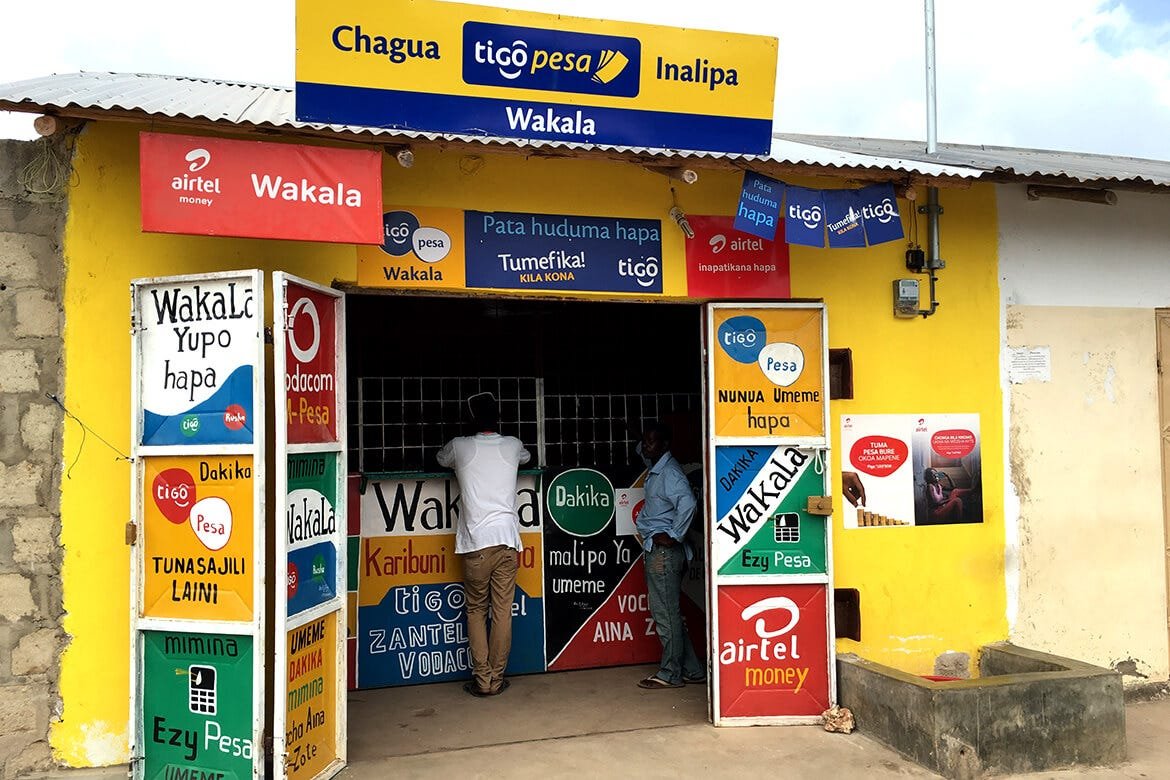
Tanzania's nearly 2 million mobile money agents are the physical expression of a financial distribution network whose reach exceeds any bank branch or ATM network by orders of magnitude. The largest commercial banks in Tanzania, NMB with 73,592 Wakala agents and CRDB with 38,883, together account for approximately 112,000 of the agent total. The remaining 1.88 million agents are the mobile money operators' own networks whose density across the country's geography makes financial services physically accessible in locations where no bank branch has ever operated.
The economic significance of that distribution infrastructure extends beyond financial services into the broader services whose delivery it enables. Mobile money agents in rural areas are increasingly combining payment facilitation with agricultural input distribution, insurance premium collection, government benefit disbursement, and utility payment acceptance. The agent as a multi-service rural commercial node is not yet the dominant operating model, but the distribution infrastructure's existence creates the commercial foundation on which that model is being built by the fintechs, agricultural companies, insurance providers, and government agencies whose service delivery economics improve when last-mile distribution infrastructure already exists.
For Tanzania's Vision 2050 industrial and agricultural transformation, the agent network's rural penetration is the financial services delivery infrastructure that connects the smallholder farmers, rural traders, and agricultural processors whose commercial integration into formal value chains requires the payment, credit, and insurance access that the agent network is physically positioned to provide. A coffee washing station in Rwanda or a smallholder cotton farmer in Tanzania's western regions requires the same financial services infrastructure as an urban business: the ability to receive payments digitally, access working capital credit, and manage operational expenses through a documented financial system. Tanzania's agent network, at nearly 2 million points, has reached the density at which rural financial services delivery becomes operationally credible rather than aspirationally planned.
Tanzania's quiet lead and why it has not been noticed
The relative absence of Tanzania from the global mobile money narrative despite the scale of its digital financial system reflects several factors that the 2025 data makes increasingly difficult to sustain.
M-Pesa's 2007 launch in Kenya generated the academic research, journalistic coverage, and development sector attention whose cumulative weight created a brand association between Kenya and mobile money that has persisted through two decades of subsequent development. Tanzania's mobile money growth has been built on a less dramatically timed foundation, without a single origin narrative as compelling as M-Pesa's launch story, and across multiple operators whose competitive dynamic makes attribution of the ecosystem's development to any single brand more complex.
The competitive multi-operator structure that makes Tanzania's ecosystem less narratively compelling is also, as argued above, the architectural property that makes it more robust as a foundation for advanced digital economy development. A story told across three competing operators and an interoperable infrastructure is harder to package as a case study than M-Pesa's single-platform dominance. It is not less economically significant. It may be more so.
Tanzania's digital finance community, its regulators, its banks, and its mobile money operators have built a system that serves 75.8 million active users, 2.79 million merchants, and nearly 2 million agents across a national infrastructure whose breadth and interoperability quality rank among the most advanced in Africa. The 2025 data is the moment at which the quiet building whose results the numbers describe becomes difficult to overlook. Tanzania has not been catching up to Kenya's mobile money story. It has been writing a different one. The 2025 data is the chapter that makes that argument impossible to dismiss.
FAQ
How many mobile money users does Tanzania have? Tanzania had 75.8 million active mobile money users in 2025, according to the Bank of Tanzania's National Payment Systems Report. The market is served by three primary operators: M-Pesa with 41 percent market share and 33.2 million accounts, Mixx by Yas with 31 percent and 25.1 million accounts, and Airtel Money with 18 percent and 14.4 million accounts.
Is Tanzania's mobile money market bigger than Kenya's? Tanzania's active mobile money user base of 75.8 million is larger in absolute terms than Kenya's, which serves a smaller population. The comparison requires nuance: Kenya's M-Pesa commands 90.8 percent market share and has developed deep financial products including M-Shwari, KCB M-Pesa, and Fuliza on its single-platform base. Tanzania's more competitive multi-operator market has produced broader interoperability and the TIPS instant payment infrastructure whose 84 percent value growth describes a system advancing at a rapid pace. The two markets have built different architectures rather than one simply being ahead of the other.
What are Tanzania's mobile money trust account balances? Mobile money trust account balances reached TZS 2.83 trillion in 2025, up 35.7 percent from the prior year. This represents money that users have chosen to store in mobile money wallets rather than withdraw to cash, reflecting the system's graduation from transaction medium to savings infrastructure and creating the financial system asset whose mobilisation through bank products and credit facilities is a growing commercial opportunity for Tanzania's banking sector.
Why is Tanzania's mobile money architecture described as more interoperable than Kenya's? Tanzania's three-operator competitive structure created market pressure toward interoperability as an operational necessity: operators whose customers could not transact with other operators' users had insufficient network reach to sustain commercial viability. The Bank of Tanzania formalised this through the TIPS infrastructure connecting banks, mobile money operators, fintechs, and government payment gateways on unified rails. Kenya's M-Pesa dominance at 90.8 percent market share reduced the market pressure for cross-platform interoperability. Both architectures have advantages. Tanzania's is more open for third-party innovation. Kenya's is more deeply developed within its single-platform ecosystem.
What does Tanzania's mobile money development mean for its economy? Mobile money at Tanzania's scale and integration depth is national financial infrastructure rather than a financial service. Its economic consequences include improved business cash flow through instant settlement, reduced transaction costs from elimination of cash handling overhead, improved fiscal visibility from the digital transaction trails that replace cash-based commerce, enhanced credit access from the transaction histories that support lending decisions, and accelerated commercial activity from the frictionless payment environment that high merchant acceptance density creates. Tanzania's 2025 data suggests these consequences are now operating at the national scale that characterises infrastructure rather than service adoption.
 Uchumi360
Business Intelligence
Uchumi360
Business Intelligence
- Bank of Tanzania, National Payment Systems Report 2025
- Active mobile money users 75.8 million, agent network nearly 2 million, trust account balances TZS 2.83 trillion up 35.7 percent, merchant network 2.79 million, TIPS value TZS 54.95 trillion up 84.28 percent, total transactions 672.24 million worth TZS 412.1 trillion, M-Pesa 41 percent market share 33.2 million accounts, Mixx by Yas 31 percent 25.1 million accounts, Airtel Money 18 percent 14.4 million accounts, 114 licensed payment providers.Available at bot.go.tz
- Kenya Communications Authority, M-Pesa 90.8 percent mobile money market share Q1 2025.Available at ca.go.ke
- Uchumi360, "NMB Made TZS 760 Billion
- CRDB Made TZS 729 Billion," June 2026
- NMB 73,592 Wakala agents, CRDB 38,883 agents.Available at uchumi360.com
- Uchumi360, "Tanzania Processed TZS 412 Trillion in Digital Payments in 2025," June 2026.Available at uchumi360.com
- Uchumi360, "Tanzania's 2.79 Million Digital Merchants Could Transform the Economy," June 2026.Available at uchumi360.com
- GSMA, East Africa mobile money market data and financial inclusion research.Available at gsma.com
- World Bank, Tanzania financial inclusion and digital finance development data
- Available at worldbank.org
- African Development Bank, East Africa digital financial services research.Available at afdb.org
- IMF, Tanzania financial sector assessment and mobile money regulatory framework.Available at imf.org
- National Bureau of Statistics Tanzania, population and economic data.Available at nbs.go.tz
Uchumi360 covers business, investment, and economic policy across East, Central, and Southern Africa.
For the serious reader
You read to the end. That places you in a small group.
Uchumi360 is built for readers who demand precision over speed, structure over sentiment, and analysis that holds uncomfortable conclusions rather than softening them. If this work sharpens how you think about Africa's economy, help us keep building the infrastructure behind it.
Institutional Partners
Commission intelligence. Shape the conversation.
Uchumi360 works with development finance institutions, investment firms, sovereign bodies, and strategic organisations across the coverage region. Institutional partnership unlocks:
- Commissioned sector and country intelligence reports
- Branded research series under your institution's authority
- Exclusive data briefings for internal strategy teams
- Speaking and editorial presence at Uchumi360 events
- Co-published investment outlooks for your markets
Support Our Work
Independent analysis has a cost. Help us bear it.
Uchumi360 does not carry advertising. It does not take editorial direction from sponsors. Every article is produced without commercial compromise. Your contribution funds the reporting, research, and editorial infrastructure that keeps this analysis free from influence.
Secure checkout: One-time and monthly support are processed securely. Add payment credentials to enable checkout here.
Stay Connected
Keep up with every new insight.
Follow our latest analysis, policy coverage, and market intelligence as soon as it is published. If you need something specific, reach out directly and we will point you to the right research.
