
South Africa, Mauritius And Namibia Lead Africa’s Financial Markets
Ready
South Africa, Mauritius and Namibia lead the 2026 Absa Africa Financial Markets Index as 21 of 29 economies improve their scores. The continental average reached a ten year high of 56, but weak liquidity remains one of the biggest constraints on deeper capital markets.
South Africa remains Africa’s most developed financial market, followed by Mauritius and Namibia, giving Southern Africa all three of the leading positions in the 2026 Absa Africa Financial Markets Index at a time when financial systems across the continent have recorded their strongest average performance since the index was introduced in 2017. The tenth edition, produced by OMFIF and Absa with support from the United Nations Economic Commission for Africa, covers 29 economies representing approximately 80 percent of Africa’s population and gross domestic product and evaluates them across six areas: market depth, access to foreign exchange, market transparency, pension fund development, the macroeconomic environment and legal, tax and regulatory standards.
The wider direction is positive. Twenty one of the 29 countries improved their scores in 2026 and the average reached 56, the highest level in the index’s ten year history and six points above the inaugural 2017 reading. Inflation improved in 20 countries, external debt as a share of GDP improved in 20, and all 29 economies recorded stronger scores for GDP growth, giving financial markets a more supportive macroeconomic backdrop than they faced in the previous edition.
The report nevertheless exposes a weakness that remains common across African capital markets. Countries have made considerable progress in building regulations, exchanges, products, settlement systems and institutional infrastructure, but improvements in market architecture have not always generated an equivalent increase in actual trading. Liquidity remains one of the main constraints separating a market that exists institutionally from one in which investors can enter and exit substantial positions efficiently.
South Africa Remains In A Category Of Its Own
South Africa retained first place in the 2026 index, supported by the scale and liquidity of its capital markets, a broad range of financial products, sophisticated market infrastructure and a large institutional investor base. The country’s equity, bond, asset management, pension and insurance industries operate at a depth that remains unusual elsewhere on the continent, giving both government and companies access to funding channels that extend well beyond conventional bank lending.
That financial depth matters because domestic capital markets reduce reliance on external borrowing and foreign currency funding. Governments can issue local currency debt, companies can raise equity or bonds and institutional investors can allocate long term savings into domestic financial assets. South Africa therefore illustrates how the sophistication of a financial system can remain substantial even when the underlying economy is growing slowly.
The IMF’s October 2026 World Economic Outlook puts South Africa’s real GDP growth at about 1 percent this year, far below the 4.5 percent projected for Sub Saharan Africa as a whole. South Africa is therefore an important example of why financial market development and economic growth should not be treated as the same measure. A slow growing economy can still possess deep and sophisticated financial institutions capable of mobilising capital at a scale that faster growing economies have not yet developed.
Mauritius Shows What Institutional Design Can Achieve Without Economic Scale
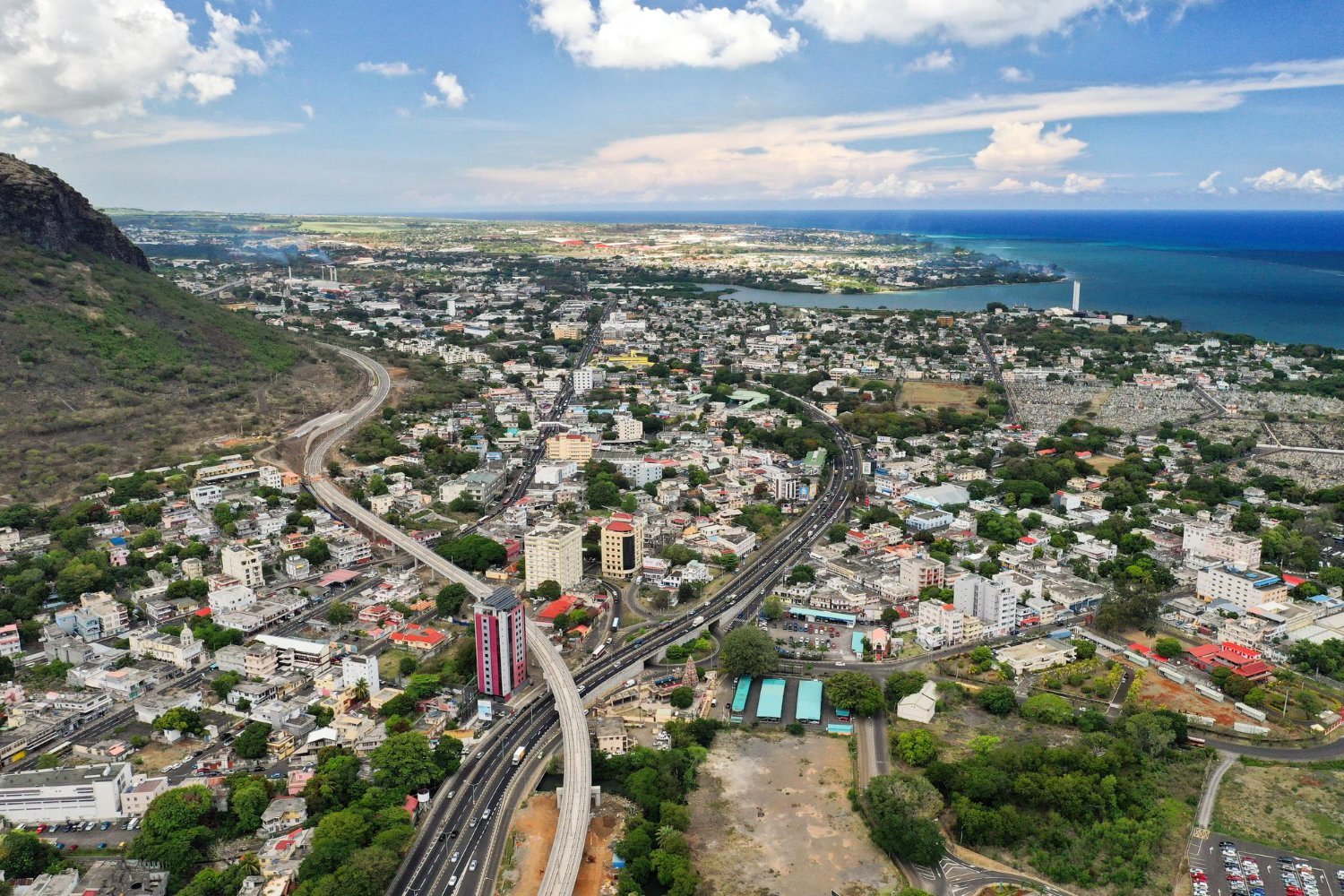
Mauritius remains second in the index, but its model differs substantially from South Africa’s. Its position is not based on a large domestic economy or an unusually large population, but on openness, product availability, market infrastructure, transparency and a comparatively supportive legal and regulatory environment. OMFIF identifies Mauritius as one of the index’s strongest performers across those dimensions.
That distinction is important because Mauritius demonstrates how a small economy can build a financial industry whose relevance extends far beyond its domestic market. The country has deliberately positioned itself as a platform for cross border investment and financial services, particularly for transactions connected to Africa and other emerging markets. Its strength therefore comes less from the amount of domestic capital generated by its population and more from institutional credibility, financial specialisation and international connectivity.
The result is one of the clearest African examples of financial development being driven by policy design rather than economic size alone.
Namibia’s Pension Industry Pushes It Into The Top Three
Namibia ranks third in the 2026 index, supported in part by one of Sub Saharan Africa’s largest pension industries relative to the size of its economy. OMFIF specifically highlights the strength of Namibia’s pension sector, while Reuters confirms the country’s third place overall.
The significance of pension capital extends beyond retirement savings. Pension funds and other institutional investors provide a pool of long term domestic capital capable of purchasing government bonds, equities, corporate debt and potentially infrastructure assets. That gives countries with large institutional savings pools greater ability to finance investment domestically and reduces dependence on foreign portfolio investors whose capital can reverse quickly when global conditions deteriorate.
Namibia’s performance therefore illustrates why pension fund development is treated as a separate pillar within the AFMI. The central issue is not only whether households save but whether those savings are accumulated inside institutions capable of financing productive investment over long periods.
South Africa, Mauritius and Namibia reach the top three through different combinations of market scale, international openness, institutional savings and regulatory development, but their collective position gives Southern Africa an unusually strong presence at the top of the continental ranking.
Uganda Stands Out For Foreign Exchange Access
Uganda provides one of the strongest East African findings in the 2026 index. The country returned to second place in the foreign exchange access pillar and has consistently ranked among the strongest performers in that category since 2022.
Foreign exchange access matters because an investor must consider more than whether an attractive asset exists. Capital also needs to be converted, repatriated and moved across borders without excessive delay, shortages or distortions caused by multiple exchange rates and administrative restrictions. A market with good securities but unreliable foreign exchange access can still be difficult for international investors to use.
Uganda’s performance therefore gives it a competitive characteristic that may not appear in simple comparisons of stock market capitalisation or bond market size. It also demonstrates why the AFMI is more useful when individual pillars are examined rather than reading the overall ranking as the only measure of financial market quality.
Kenya also improved substantially in 2026, moving to fifth place overall, helped by stronger market activity and new dollar denominated instruments on the Nairobi Securities Exchange.
Tanzania Is Bringing Climate Risk Into Financial Supervision
Tanzania is among 11 markets identified in the 2026 index as having implemented climate stress testing, alongside countries including Seychelles and Benin. Nineteen of the 29 markets also reported environmental, social and governance initiatives, showing that sustainability considerations are increasingly being incorporated into financial regulation and market development rather than remaining confined to voluntary corporate commitments.
For Tanzania, the relevance lies in the widening definition of financial stability risk. Climate shocks can affect banks through agricultural loan defaults, damage to property and infrastructure, insurance losses, changes in the value of carbon intensive assets and fiscal pressures on government following extreme weather events. Stress testing attempts to measure how institutions might perform under those conditions before actual losses occur.
This does not immediately deepen Tanzania’s capital market or increase trading volumes, but it indicates that financial supervision is beginning to incorporate risks that can affect asset quality and balance sheets over longer periods.
Africa’s Financial Markets Recorded Their Strongest Average Score Yet
The most important continental finding is the breadth of improvement. Twenty one of the 29 countries recorded higher overall scores in 2026 compared with only 10 countries improving in the previous edition. The average score of 56 is the highest recorded since the index began and stands six points above the 2017 starting point.
Macroeconomic conditions contributed substantially to that improvement. Inflation outcomes strengthened in 20 countries, external debt relative to GDP improved in 20 economies and all 29 countries recorded stronger GDP growth scores. These changes matter because capital markets operate within the wider macroeconomic environment. Persistent inflation makes long term local currency assets more difficult to price, heavy public borrowing can absorb savings that might otherwise finance companies, foreign exchange shortages complicate repatriation and high sovereign borrowing costs eventually influence financing costs across the private sector.
Improved macroeconomic stability therefore creates better conditions for market development, but it does not guarantee deep capital markets. The structure of the investor base, availability of securities, trading infrastructure and willingness of companies to raise capital publicly remain equally important.
Africa Has Improved Market Infrastructure Faster Than Trading Activity
This is where the 2026 findings become most important for investors. African markets have expanded their range of financial products, improved regulation, introduced new infrastructure and strengthened market transparency, but the volume and frequency of actual trading have not always advanced at the same pace. Reuters identifies limited trading activity as one of the central constraints highlighted by the latest index.
Liquidity determines whether financial assets are usable at scale. An investor may technically be able to buy a listed equity or government bond, but if there are few active buyers and sellers it may be difficult to dispose of a meaningful position without moving the price significantly. A government bond yielding 12 percent in a liquid market therefore represents a different risk from an identical bond in a market where the investor may need to hold the instrument until maturity because there is little secondary trading.
The same principle applies to stock exchanges. The number of listed companies and total market capitalisation do not by themselves establish whether a market is deep. Turnover, trading frequency, free float and the diversity of participants determine whether listed securities actually function as liquid investment assets.
That gap between institutional development and market usage remains one of the most important challenges for African financial systems.
Domestic Institutional Capital Is Central To Solving The Liquidity Problem
Pension funds, insurance companies and other institutional investors are important because they provide the long term domestic capital needed to sustain active financial markets. The experience of Namibia and South Africa demonstrates what becomes possible when substantial savings are accumulated through institutions that can participate continuously in equities, bonds and other financial assets.
The problem in many African markets is that domestic institutional capital remains concentrated in a narrow range of government securities and established instruments. At the same time, companies hesitate to list or issue corporate bonds because the active investor base is small, while investors hesitate to enter markets where trading is thin. The result can become self reinforcing: illiquid markets attract fewer issuers and investors, while the absence of issuers and investors keeps markets illiquid.
Breaking that cycle requires more than creating an exchange or introducing new products. It requires companies willing to raise public capital, credible disclosure standards, institutional investors prepared to diversify portfolios, reliable settlement systems, strong investor protection and a sufficient number of participants to produce continuous trading. South Africa’s advantage is that much of this architecture already operates at meaningful scale.
Deeper Domestic Markets Matter More When External Borrowing Becomes Expensive
The 2026 ranking also arrives during a period in which African governments remain under pressure from debt service costs and expensive global financing. The IMF says debt service is consuming about 12 percent of government revenue across Sub Saharan Africa, while global financing conditions remain an important source of pressure for many economies.
Deep domestic financial markets give governments and companies more financing options. Governments can issue local currency securities, firms can sell bonds rather than depending entirely on bank credit and companies can raise equity without increasing leverage. Pension funds and insurers can potentially provide long term funding for infrastructure and productive assets.
The implication extends beyond financial markets themselves. An economy that cannot mobilise its own domestic savings remains more exposed to changes in global interest rates and international investor appetite. When external capital becomes expensive or scarce, investment can slow sharply. Economies with deeper domestic financial systems possess more capacity to absorb those shocks internally.
This is why the different strengths of Namibia, Mauritius and South Africa matter beyond their ranking positions. Each demonstrates a different mechanism through which a country can build greater domestic financing capacity.
The New Methodology Improves Comparability, But Requires Care With Older Rankings
The 2026 edition introduced a significant methodological change. Scores are now measured against fixed reference bounds representing achievable standards of good practice rather than being determined primarily by performance relative to the other countries in the sample. OMFIF says this allows countries to be assessed against a more consistent benchmark.
The change does not make all historical comparison impossible. The 2026 framework recalculates scores back to 2022 under the new methodology, allowing recent trends to be examined on a consistent basis. Tanzania’s restated scores, for example, are available from 2022 through 2026 under the revised system
Comparisons with older published editions still require caution because rankings produced under the previous methodology may not be directly equivalent to the new scores. Analysts should therefore distinguish between recalculated historical data and the rankings originally published in earlier editions rather than assuming that every movement represents an underlying economic change.
Three Different Routes To Financial Development
South Africa, Mauritius and Namibia occupy the first three positions in 2026, but the more useful lesson lies in why each country is there. South Africa demonstrates the value of scale, deep securities markets and a large institutional investor base. Mauritius shows how openness, legal infrastructure and deliberate financial specialisation can give a small economy influence beyond its domestic size. Namibia demonstrates the importance of accumulated pension capital in creating a strong domestic investor base.
Other countries illustrate different strengths. Uganda remains one of Africa’s stronger markets for foreign exchange access, Kenya has improved its overall standing through stronger market activity and new instruments, while Tanzania and Seychelles are incorporating climate risk more directly into financial supervision. Across the full sample, 21 of 29 countries improved their scores.
Africa’s financial architecture is therefore becoming stronger, but the next stage is more demanding. Better regulation, stronger institutions and broader product availability need to translate into markets where companies actually raise capital, investors trade continuously and domestic savings finance productive investment.
The critical distinction is between creating financial market infrastructure and using it. Africa has spent a decade improving the institutions through which capital can move. The next measure of progress will be how much capital actually moves through them.
FAQ
Which country has Africa’s most developed financial market in 2026? South Africa ranks first in the 2026 Absa Africa Financial Markets Index, supported by deep capital markets, a broad range of financial products, sophisticated infrastructure and strong institutional investor participation.
Which countries complete Africa’s top three? Mauritius ranks second and Namibia third.
What does the index measure? The AFMI assesses 29 African economies across six pillars covering market depth, access to foreign exchange, market transparency, pension fund development, the macroeconomic environment and legal, tax and regulatory standards.
How much of Africa does the index cover? The 29 participating economies represent approximately 80 percent of Africa’s population and gross domestic product.
How did African financial markets perform in 2026? Twenty one countries improved their scores and the average reached 56, the highest level in the index’s ten year history.
Why does Uganda stand out? Uganda returned to second place in the foreign exchange access pillar and has consistently ranked among the strongest performers in that category since 2022.
What remains one of the biggest weaknesses? Liquidity. Many markets have improved regulation, financial infrastructure and product availability faster than actual trading activity has developed.
Can the 2026 index be compared with earlier years? Yes, but carefully. The new methodology uses fixed reference bounds and the index has recalculated scores back to 2022, allowing recent comparisons on a consistent basis. Comparisons with unrecalculated rankings from older editions require more caution.
 Uchumi360
Business Intelligence
Uchumi360
Business Intelligence
Uchumi360 covers business, investment, and economic policy across East, Central, and Southern Africa.
For the serious reader
You read to the end. That places you in a small group.
Uchumi360 is built for readers who demand precision over speed, structure over sentiment, and analysis that holds uncomfortable conclusions rather than softening them. If this work sharpens how you think about Africa's economy, help us keep building the infrastructure behind it.
Institutional Partners
Commission intelligence. Shape the conversation.
Uchumi360 works with development finance institutions, investment firms, sovereign bodies, and strategic organisations across the coverage region. Institutional partnership unlocks:
- Commissioned sector and country intelligence reports
- Branded research series under your institution's authority
- Exclusive data briefings for internal strategy teams
- Speaking and editorial presence at Uchumi360 events
- Co-published investment outlooks for your markets
Support Our Work
Independent analysis has a cost. Help us bear it.
Uchumi360 does not carry advertising. It does not take editorial direction from sponsors. Every article is produced without commercial compromise. Your contribution funds the reporting, research, and editorial infrastructure that keeps this analysis free from influence.
Secure checkout: One-time and monthly support are processed securely. Add payment credentials to enable checkout here.
Stay Connected
Keep up with every new insight.
Follow our latest analysis, policy coverage, and market intelligence as soon as it is published. If you need something specific, reach out directly and we will point you to the right research.
