
Burundi’s Avocado Trade Is Growing Into a New Export Industry
Ready
Burundi’s avocado trade is moving beyond local consumption into a regional export business, with growers, collectors and traders increasingly supplying Tanzania and Kenya. Rising demand is giving farmers a new source of cash income and helping diversify an export base still dominated by coffee and tea, although poor cold chain infrastructure, certification gaps and limited quality control could constrain how far the industry can scale.
In the hills of Rukoba, Rutegama district, Gitega commune and province, in central Burundi, Joseph Ndibikiye walks amongst his avocado trees with the confidence of a man who has found a solution to his daily worries. An elderly former coffee grower, he no longer sees himself merely as a farmer. He now sees himself as a grower of a fruit that brings him money without having to rush from one market to another.
“I’m not young any more; I’m an elder,” he begins, before recounting his long experience with coffee cultivation. For years, he planted, weeded, picked and transported coffee. But the income, he says, came slowly and with great difficulty.
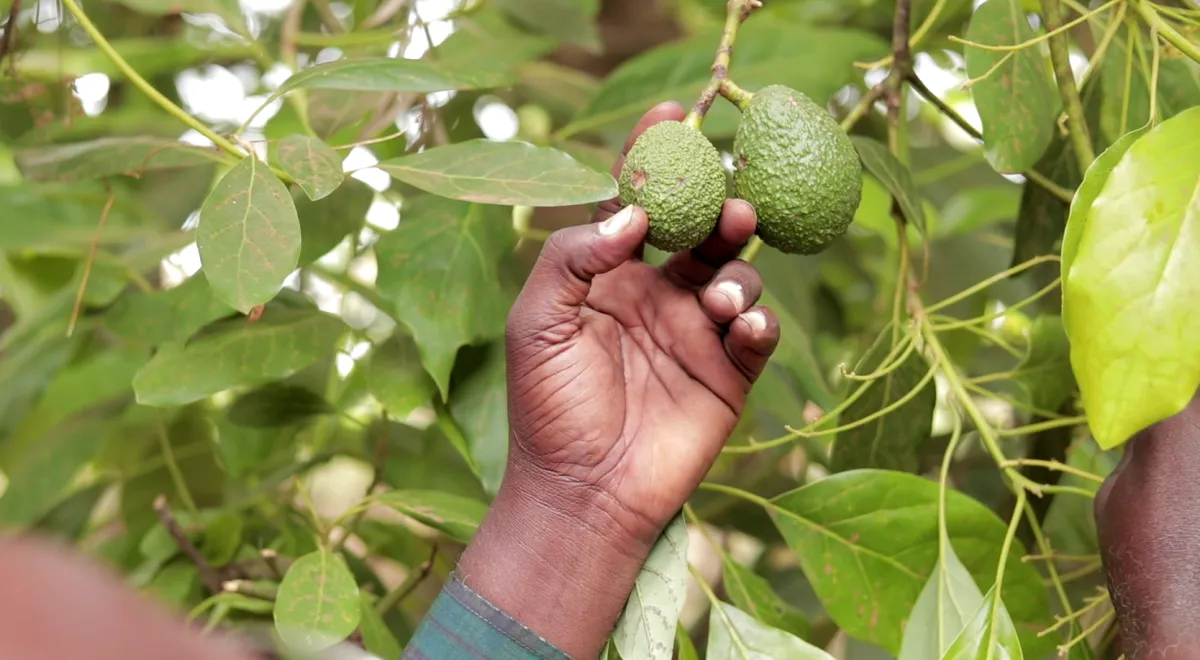
These days, his focus has shifted to avocados. Not because it’s fashionable, but out of necessity and by design. For on this hill in Gitega, the avocado tree is becoming much more than just a fruit tree: it is a source of income, a means of security for the family and, for some growers, a gateway to the markets of Tanzania and Kenya.
Joseph Ndibikiye owns 35 avocado trees. Among them, eight are of the variety known in Kirundi as Ruhere, also known as the Hass avocado. Last year, traders from Kayanza visited his plot. They bought six sacks full of avocados from these eight trees.
‘ I was paid 100,000 francs per sack. So I received 600,000 francs,” he says proudly.
This sum has been a game-changer for him. It has helped to support his family, particularly by paying for his children’s secondary school fees. “I feel relieved,” he confides.
The thing that attracts Joseph Ndibikiye is not just the amount. It is, above all, the way the money comes in. With coffee, the grower picks the beans, carries his load on his back, goes to the collection point, waits to be registered and often receives a voucher before payment. With avocados, traders come directly to his home.
“When you have avocado trees at home, you pick the fruit and stay put. The money comes to you at home,” he explains.
He describes a scene that has become familiar: traders arrive with bags, pack the fruit, load their vehicle and pay on the spot. “It’s as if you were picking money,” he sums up.
This simplicity contrasts with the long days he used to spend picking coffee. “Usually, you’d pick coffee, pick some more, then set off again with your load on your back,” he remembers.
A tree that empowers farmers
For Joseph Ndibikiye, the avocado tree offers another major advantage: once planted and fully grown, it requires less effort than the coffee tree. Farmers can continue to grow other crops around the trees, without having to devote all their time to a single crop.
“The main advantage is that once the avocado tree is planted, you can grow other things all around it,” he says.
He adds that, once the tree has grown, it mainly requires monitoring. “You’re like a king; nothing causes you any trouble. You just wait for the time to harvest, without tiring yourself out,” he says with a smile.
On his hill, he has also benefited from support received from ISABU, the Burundi Institute of Agricultural Sciences. Avocado saplings, including the Ruhere, Choice and other varieties, have been distributed to farmers. This initiative has encouraged several households to diversify their sources of income.
Joseph Ndibikiye does not rely on just one variety, however. He is waiting for the other trees to bear fruit so that he can spread out his sales and minimise risks. “A tree can bring in 30,000 or 50,000 francs,” he estimates.
A more profit-making crop than coffee?
Angelos Kamana, an agricultural technician since 1989 and a specialist in avocado cultivation, agrees with this view. He works in fields where several varieties grow side by side: Hass, Choquette, Bouth 7 and Bouth 8.
For him, the difference compared to coffee is clear. “Maintaining coffee plants takes a lot of time, whereas for avocado trees, it’s done just once a year,” he explains.
He estimates that a single avocado tree can produce between 300 and 500 kilograms of fruit. To obtain the same quantity of coffee cherries, many more coffee trees or a significantly larger area would be required.
“The avocado tree is more productive than the coffee tree. Maintaining coffee plants is also more expensive than maintaining avocado trees,” emphasises Mr Kamana.
According to him, climate change affects coffee just as it does other crops. However, the avocado tree is said to pose fewer risks, particularly because it roots deeply and firmly in the ground. The coffee plant, on the other hand, has suffered from numerous diseases, which has contributed to some families losing interest in growing it.
“The avocadotree is more productive than the coffee plant, yielding two or three harvests a year, compared with just one for coffee – or sometimes none at all,” explains the agricultural technician.
He adds, however, that coffee prices are currently on the rise. But for producers like Joseph Ndibikiye, avocados remain more immediately profitable, as they enable them to receive substantial sums of money quickly.
Varieties that are in demand
Angelos Kamana explains that Burundi mainly markets three varieties of avocado based on their vegetable oil content: the Fuerte, which is the most widely sold, as well as the Bouth 7 and the Bouth 8. The Hass and Choquette varieties are also available, the latter being highly sought after for its large size.
He notes the existence of several avocado collection centres in Muyinga, Ngozi and Busiga. These centres serve as transit points for exports to countries in the East African Community (EAC), notably Tanzania and Kenya.
Joseph Ndibikiye has personally observed this supply chain. The six sacks sold last year were transported to Kayanza. “They came in a Toyota Probox and loaded them up,” he explains.
He says that these traders then look for large-scale buyers with Fuso-type lorries to transport the avocados to Tanzania. “I believe these lorries travel by sea and cross the border. They are in high demand on the other side,” he explains.
This trend confirms what other players in the sector are saying: Burundi is already exporting avocados to Tanzania and Kenya. Available data show that the country exported around 3,551 tonnes of avocados in 2020, mainly to Tanzania, worth approximately $327,000. In 2021, these exports to Tanzania reached nearly 6,870 tonnes, worth approximately $995,000.
AfCFTA and EAC: what market lies ahead for Burundian avocados?
Ratified by Burundi in June 2021, the African Continental Free Trade Area (AfCFTA) agreement aims to create a single African market of 1.3 billion consumers. Combined with the already integrated market of the East African Community, it places the horticultural sector, and avocados in particular, amongst the national priorities for diversifying exports beyond coffee and tea.
Nevertheless, the gradual removal of tariff barriers will not be enough to realise this ambition. To compete with regional giants such as Kenya and Tanzania, the Burundian sector must overcome several strategic obstacles. This involves obtaining the necessary sanitary and phytosanitary certifications, establishing quality control laboratories and cold chain infrastructure, whilst harmonising customs rules of origin.
The challenge is all the more pressing given that the competition is already well-organised. Tanzania exported 11,237 tonnes of avocados in 2021, worth 33 million dollars. Kenya, for its part, remains one of the leading avocado producers in East Africa.
An income that supports the family
For Joseph Ndibikiye, growing avocados is not just a farming activity: it is a safeguard against financial hardship.
“Since I started growing these avocados, I no longer struggle for money as I used to,” he says.
He recalls a time when having 500,000 Burundian francs without having sold a bundle of grass seemed impossible. Today, he can raise that amount thanks to his avocado trees.
“If a kid gets ill, I don’t panic any more, thanks to the avocado,” he says.
He also owns a cow that he milks. But even if he gets into debt, he knows where to find the money. “I won’t be hounded. I know where I’ll find the money, and no one spends the day chasing me for repayment,” he adds.
This financial security explains why he encourages other Burundians to take up this crop. “I think others should take the plunge, plant avocado trees and look after them everywhere. They help the country move forward,” he says.
The pitfalls of success
However, Joseph Ndibikiye’s journey also highlights the vulnerabilities of this sector. The first challenge, he says, is space. To thrive, the avocado tree needs room for its roots and branches.
“Don’t mix it with other trees. Some people prefer to plant lots of eucalyptus,” he warns.
Pests are another problem. Some fruits have rotten patches whilst others remain healthy. “You cut a fruit open: it’s rotten on one side, the other side is healthy. It’s a disease that attacks them,” he explains.
The strong winds also cause the fruit to fall when the tree is not yet properly established. And when hail strikes, the damage can be considerable.
“When it comes, you don’t harvest anything that day. Some fruit is crushed, others are damaged, and you only gather up the leftovers,” he laments.
The challenges serve as a reminder that the avocado tree, despite its relative resilience, remains vulnerable to the vagaries of the weather and requires a minimum level of technical support.
Gaspard Ntabangana, the avocado entrepreneur
At Masanganzira coach station in Gitega, avocados are not just grown: they are sold, transported and turned into a daily income. Every morning, fruit sellers gather around this bus station, which serves the country’s main cities. Even before entering Gitega, a multitude of avocado trees line the outskirts of the town. At the small market in Magarama, avocados dominate the fruit stalls.
Gaspard Ntabangana, originally from Rutegama hillside in the commune and province of Gitega, is one of the faces of this dynamic industry. The man in his fifties has been selling avocados at Masanganzira station for thirty years.
His business is not restricted to selling fruit from his own field. He also buys avocados from local growers and resells them. He is a true small-scale entrepreneur who has recognised the economic value of a product long regarded as merely a fruit for consumption.
“There is no other business more profitable for me than selling avocados,” he says.
He says that a single avocado tree can yield up to five sacks of fruit. A sack weighing around 150 kilograms sells for between 60,000 and 70,000 Burundian francs, or approximately 21 to 24.8 US dollars. Each day, he can sell two to three sacks at retail.
A small basket containing between seven and ten avocados costs between 3,000 and 4,000 Burundian francs, or around 1 to 1.4 dollars, depending on the size of the fruit. Thanks to this business, Gaspard Ntabangana says he has built a fine house. He himself owns a field with around 20 avocado trees.
‘’Customers come from almost everywhere: Tanzania, Rwanda and even Kenya,’’ he explains. According to him, a large proportion of Burundian avocados are sold in the United Republic of Tanzania.
 Uchumi360
Business Intelligence
Uchumi360 covers business, investment, and economic policy across East, Central, and Southern Africa.
For the serious reader
You read to the end. That places you in a small group.
Uchumi360 is built for readers who demand precision over speed, structure over sentiment, and analysis that holds uncomfortable conclusions rather than softening them. If this work sharpens how you think about Africa's economy, help us keep building the infrastructure behind it.
Institutional Partners
Commission intelligence. Shape the conversation.
Uchumi360 works with development finance institutions, investment firms, sovereign bodies, and strategic organisations across the coverage region. Institutional partnership unlocks:
- Commissioned sector and country intelligence reports
- Branded research series under your institution's authority
- Exclusive data briefings for internal strategy teams
- Speaking and editorial presence at Uchumi360 events
- Co-published investment outlooks for your markets
Support Our Work
Independent analysis has a cost. Help us bear it.
Uchumi360 does not carry advertising. It does not take editorial direction from sponsors. Every article is produced without commercial compromise. Your contribution funds the reporting, research, and editorial infrastructure that keeps this analysis free from influence.
Secure checkout: One-time and monthly support are processed securely. Add payment credentials to enable checkout here.
Stay Connected
Keep up with every new insight.
Follow our latest analysis, policy coverage, and market intelligence as soon as it is published. If you need something specific, reach out directly and we will point you to the right research.
