
Who Controls Africa’s Trading Landscape? The Balance Sheet Points to China
Ready
Africa talks frequently about economic sovereignty, but its trade balance sheet tells a more uncomfortable story. The continent’s commercial map is still shaped heavily by external powers, and no country has positioned itself more effectively than China.
Africa talks frequently about economic sovereignty, but its trade balance sheet tells a more uncomfortable story. The continent’s commercial map is still shaped heavily by external powers, and no country has positioned itself more effectively than China.
This is not because China discovered Africa yesterday. Beijing built a system. It combined infrastructure finance, construction companies, state-backed risk appetite, industrial inputs, consumer imports, mining demand, port access, diplomatic repetition and low-cost manufactured goods. While many Western economies debated Africa’s risk, China priced the risk, entered early and embedded itself inside the continent’s physical economy.
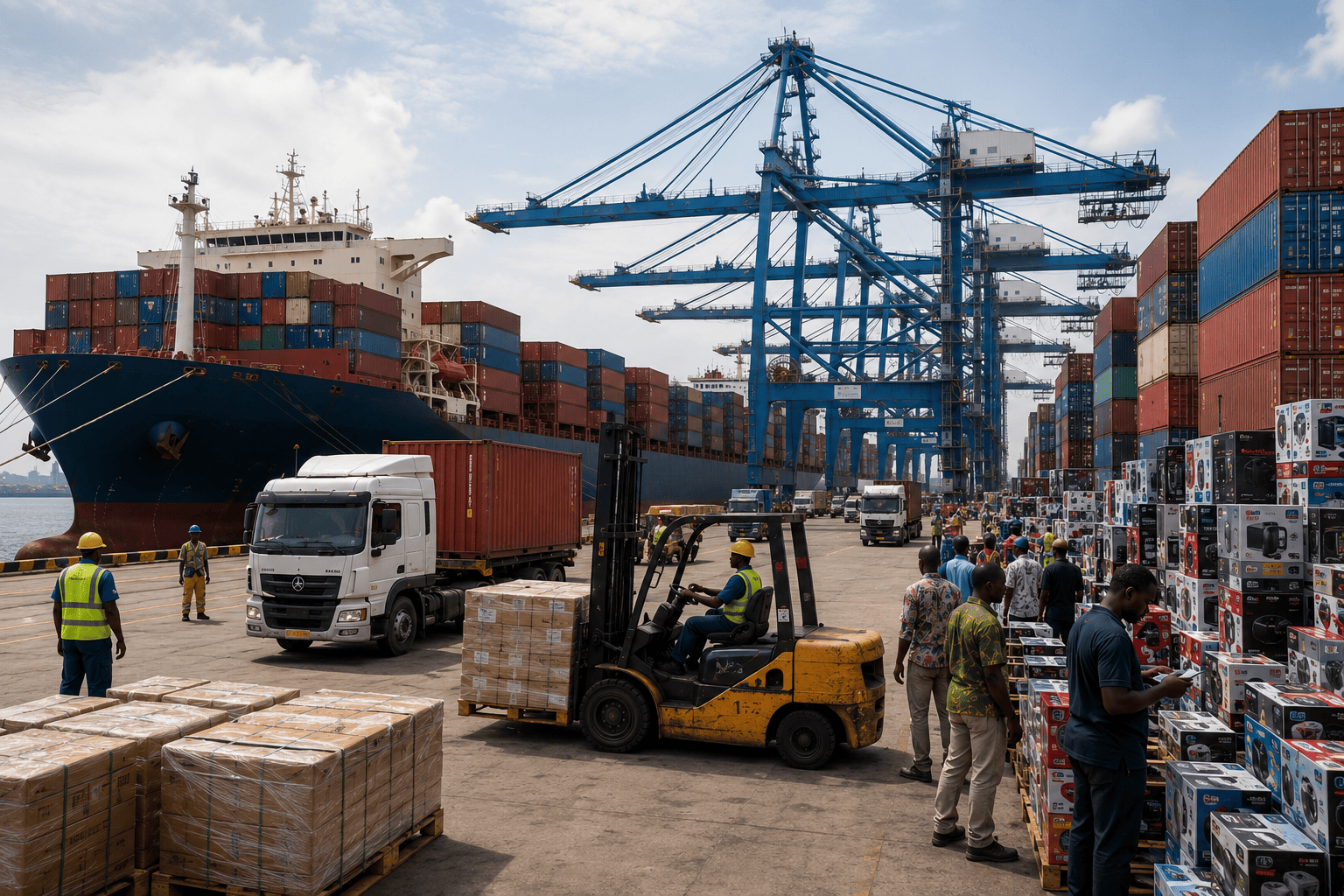
The result is visible in African markets every day. Construction materials, electronics, household goods, machinery, textiles, motorcycles, solar components, packaging, industrial equipment, plastics, tiles, steel products and low-cost consumer goods often trace back to Chinese supply chains. African traders are not merely importing from China. Many African business models are now built around Chinese production.
That is the real meaning of trade influence. It is not only who buys African exports. It is who supplies African shops, builds African roads, finances African ports, equips African factories and controls the inputs used by African small businesses.
The global trade environment makes the contest sharper. The World Trade Organization says world trade in goods and commercial services rose by 7% in 2025 to USD 34.65 trillion, with goods trade growing by 6% and services by 8%. In such a large global marketplace, Africa remains commercially underweight despite its population, minerals, land, energy potential and demand growth.
Afreximbank’s 2025 African Trade Report gives the African side of the equation. Africa’s merchandise trade recovered by 13.9% in 2024 to USD 1.5 trillion, while intra-African trade grew by 12.4% to USD 220.3 billion. But the same report notes that Africa still accounted for only 3.3% of global exports, a signal that the continent is active in trade but not yet powerful enough in global value chains.
That is where the rhetoric of global powers begins to matter. The United States, European Union, China, India, the Gulf and others all speak the language of partnership. But their balance sheets tell different strategic stories.
China’s rhetoric is “mutual development.” Its balance sheet says manufacturing dominance.
China had been Africa’s largest trading partner for 16 consecutive years by the end of 2024, according to China’s General Administration of Customs, as cited by China’s State Council. In the first five months of 2025, China-Africa trade reached 963.21 billion yuan, up 12.4% year on year.
Full-year 2024 data show the scale more clearly. China-Africa trade reached USD 295.56 billion, up 4.8% from 2023. Chinese exports to Africa totalled USD 178.76 billion, while African exports to China reached USD 116.79 billion, leaving Africa with a trade deficit of about USD 61.93 billion.
That deficit is not just a number. It is an industrial structure. China sells manufactured goods, machinery, electronics, equipment, vehicles, textiles and consumer products into African markets. Africa sells back commodities, minerals, oil, agricultural goods and raw or semi-processed materials. China earns industrial margins. Africa remains exposed to commodity cycles.
Beijing knows this imbalance is politically sensitive. That is why China’s recent rhetoric has shifted toward market access for African products. In June 2025, China said it would negotiate a new economic pact removing tariffs on exports from 53 African countries with which it has diplomatic relations. Reuters reported that the move would extend duty-free and quota-free access beyond least developed countries to include middle-income African economies such as Kenya, South Africa, Nigeria, Egypt and Morocco.
That offer matters, but it does not automatically solve the trade imbalance. Tariff-free access is useful only if African countries have competitive products to export. If the continent does not expand processing, packaging, standards compliance, logistics and industrial capacity, zero tariffs may mostly benefit a narrow group of agricultural and mineral exporters, not a broad African manufacturing base.
The United States’ rhetoric is “strategic partnership.” Its balance sheet is smaller but politically important.
The Office of the United States Trade Representative says United States goods and services trade with Africa totalled USD 104.9 billion in 2024, up 8.3% from 2023. In 2025, United States goods trade with Africa reached USD 83.4 billion, with exports to Africa of USD 40.4 billion and imports from Africa of USD 43.0 billion. The United States goods trade deficit with Africa was USD 2.6 billion in 2025, down 64% from 2024.
Compared with China’s nearly USD 296 billion in 2024 trade with Africa, the United States is commercially smaller. But Washington’s influence sits in strategic sectors: energy, aviation, financial services, technology, agribusiness, critical minerals, development finance, defence-linked supply chains and preferential market access through the African Growth and Opportunity Act.
The African Growth and Opportunity Act remains central to United States-Africa trade rhetoric. The United States Trade Representative says the law provides duty-free entry into the United States for almost all African products and has helped expand and diversify African exports, while also tying eligibility to governance and business-environment conditions.
That is the United States model: market access plus rules. It is not as physically visible as China’s roads, railways, ports and containers, but it shapes trade incentives. The problem is utilisation. Many African countries still underuse United States market access because they lack industrial capacity, standards compliance, reliable electricity, export finance and regional supply chains.
The European Union’s rhetoric is “partnership, sustainability and values.” Its balance sheet is older, deeper and more regulatory.
The European Union remains one of Africa’s most important trade and investment partners, especially through Economic Partnership Agreements, development finance, green transition programmes, standards regimes and market access. For African, Caribbean and Pacific countries, the European Commission says total trade with the European Union was EUR 114 billion in 2023, with a surplus of EUR 13 billion in favour of African, Caribbean and Pacific countries. The European Union accounted for 19% of those countries’ total trade flows, 23% of their exports and 16% of their imports.
In East Africa, the European Union says total trade with East African Community countries reached EUR 8.1 billion in 2025. The European Union is the East African Community’s fourth-largest trading partner and its second-largest export market after the United Arab Emirates. East African exports to the European Union are mainly coffee, cut flowers, tobacco, cocoa beans, avocados, gold and fish fillets, while European Union exports into the region are dominated by machinery and appliances, chemicals, foodstuffs and wood products.
That structure is revealing. Europe buys African agricultural and resource-linked exports, then sells machinery, chemicals and higher-value goods. It also exports regulation. European Union standards on sustainability, deforestation, labour, climate, traceability, food safety and carbon can shape African supply chains even before goods reach European ports.
This is both an opportunity and a constraint. Europe can reward African exporters who upgrade traceability, processing and standards. But it can also exclude producers who cannot afford compliance. The European model is less about flooding African markets with low-cost goods and more about controlling access to a wealthy market through rules.
India’s rhetoric is “South-South cooperation.” Its balance sheet is becoming more serious.
India is not China, but it is no longer a minor actor. Its Africa play is built around pharmaceuticals, petroleum products, automobiles, rice, machinery, technology, education, health, digital public infrastructure, diaspora networks and development cooperation. Indian official reporting in 2026 referred to bilateral trade with Africa reaching USD 100 billion in financial year 2024-25, confirming that India has become a major competitor in the African trade landscape.
India’s appeal is different from China’s. It is strong in generic medicines, affordable vehicles, information technology, education, hospital systems, agricultural products and mid-cost manufacturing. For many African consumers and businesses, India is a pragmatic supplier: cheaper than Europe, often more familiar than China in pharmaceuticals and services, and culturally connected through long-standing diaspora communities in East and Southern Africa.
But India’s model still creates asymmetry. Africa imports medicines, vehicles, rice, refined petroleum products, machinery and manufactured goods, while exporting crude oil, gold, coal, cashew nuts, pulses, minerals and other commodities. India’s trade rhetoric may be South-South, but the structure still often looks like industrialised supplier versus commodity exporter.
The Gulf’s rhetoric is “investment and logistics.” Its balance sheet is ports, food security, aviation and capital.
The United Arab Emirates, Saudi Arabia and Qatar increasingly see Africa through ports, agribusiness, logistics, mining, aviation, real estate, renewable energy and food security. The United Arab Emirates has become one of Africa’s most important trade intermediaries, especially for gold, re-exports, logistics and port-linked commerce. Its role in African trade often exceeds what traditional geopolitical analysis captures.
The Gulf strategy is commercially disciplined. Ports create corridors. Corridors create trade flows. Trade flows create storage, finance, insurance, shipping, food-security and re-export opportunities. The Gulf does not need to manufacture everything to influence African trade. It can control nodes.
That is why African port concessions, logistics parks, dry ports and aviation hubs are now strategic assets. Whoever controls the nodes can shape the flows.
France and the wider European national economies are trying to re-enter through a new language.
France’s older Africa model was political, monetary and security-heavy, especially in Francophone Africa. But after military withdrawals, anti-French sentiment and shifting alliances in parts of West Africa, France is trying to reposition through investment, infrastructure, climate finance and business diplomacy. Reuters reported in May 2026 that the Africa-France Summit in Kenya produced more than EUR 23 billion in joint investments from French and African companies, including clean energy, artificial intelligence, technology and a major port investment by CMA CGM in Mombasa.
This matters because it shows how the rhetoric has changed. France is no longer only defending historic influence. It is trying to compete commercially in Anglophone Africa, where China, the Gulf, India, the United States and the United Kingdom already have strong positions.
The deeper African problem is not that external powers are competing. Competition can be useful. It can lower costs, expand options and increase bargaining power. The problem is that Africa often enters the competition as a market, not as a strategist.
The balance sheet points to China because China understood demand. It understood that African governments needed roads, ports, bridges, power plants and railways. It understood that African traders needed affordable consumer goods. It understood that African small businesses needed machinery, electronics, packaging and inputs. It understood that influence is built through patience, repetition and supply-chain presence.
The United States understood market access but often underinvested in the production capacity needed for African firms to use it. Europe understood standards and sustainability but often made compliance expensive for African producers. India understood affordability, health and diaspora-linked commerce. The Gulf understood logistics and trade nodes. China understood the full loop: finance the infrastructure, build the project, supply the equipment, sell the goods, buy the commodities, repeat.
That is why China’s role should be studied, not merely criticised.
The problem is not trade with China. The problem is structural dependence.
African traders are not absent. They dominate markets, wholesale networks, shops, border routes, informal distribution and retail. But too often, they do not control production, shipping, financing, standards, branding or platforms. They are commercially active but structurally dependent.
A trader who imports containers from Guangzhou is entrepreneurial. But a continent that depends on Guangzhou for basic manufactured goods has not built commercial sovereignty.
The same pattern appears across Africa’s external partnerships. Europe buys cocoa, coffee, flowers, fish, minerals and energy, then sells machinery, chemicals and processed goods. The United States offers market access, but African firms often lack the capacity to scale exports. India sells pharmaceuticals and manufactured goods while buying commodities. The Gulf controls trade nodes and re-export channels. China supplies the visible architecture of daily commerce.
Africa’s strategic weakness is not lack of trade. It is lack of control over the highest-value parts of trade.
Afreximbank’s 2025 report makes this point indirectly. Africa’s trade recovery is real, but the continent’s 3.3% share of global exports remains too small, and its estimated USD 100 billion trade-finance gap limits its ability to industrialise, process and trade at scale.
That trade-finance gap is not technical. It is political economy. If African manufacturers cannot access affordable finance, they cannot compete with imported goods. If African traders cannot finance regional sourcing, they default to Asian supply chains. If African exporters cannot meet standards, they remain raw-material sellers. If African logistics companies cannot scale, foreign operators control corridors. If African banks finance consumption more easily than production, the continent imports what it could gradually learn to make.
This is why customs revenue is not industrial strategy. Import duties may raise money, but they do not build factories. Import bans may protect weak producers temporarily, but they do not create competitiveness. Local-content slogans may sound patriotic, but they fail without power, finance, skills, standards, logistics and patient capital.
Real trade power comes from production capability, logistics efficiency, standards compliance, financing depth, regional scale and bargaining discipline.
The African Continental Free Trade Area is the most important answer on paper. It gives the continent a route toward scale. But the agreement will matter only if African countries build the productive base behind it. A tariff reduction does not automatically create a factory. A customs protocol does not automatically create a regional brand. A single market does not automatically produce competitive suppliers.
Africa must now move from import participation to supply-chain ownership.
That means building regional manufacturing where viable, processing minerals and agricultural products before export, developing African shipping and logistics companies, financing industrial parks that actually produce, using pension funds and sovereign wealth funds for productive investment, harmonising standards, improving ports and railways, and helping African wholesalers source from African factories, not only from Asia and Europe.
It also means understanding the rhetoric of every external power.
When China says “win-win cooperation,” Africa should ask: how much processing will happen in Africa?
When the United States says “market access,” Africa should ask: who will finance export capacity?
When the European Union says “sustainability,” Africa should ask: who pays for compliance?
When India says “South-South cooperation,” Africa should ask: how do African firms enter Indian value chains?
When the Gulf says “logistics investment,” Africa should ask: who owns the corridor margins?
When France says “renewed partnership,” Africa should ask: what has changed in the balance of value?
The goal is not to reject any partner. Africa needs all of them. The goal is to stop entering every negotiation as a fragmented market and start entering as a coordinated production frontier.
China controls more of Africa’s trading landscape because it built systems around African demand. If African countries want more control, they must build systems too.
The containers may land in African ports, but the margins still tell the truth. Until Africa owns more of the factories, ships, warehouses, payment systems, standards bodies, logistics corridors, brands and trade finance behind those containers, its trading landscape will remain energetic at street level but externally controlled at structural level.
Africa does not need less trade with China, Europe, the United States, India or the Gulf for symbolic reasons. It needs more African production, more African logistics, more African finance and more African bargaining power.
The balance sheet points to China today. Africa’s task is to make sure the next balance sheet points more clearly to Africa itself.
 Uchumi360
Business Intelligence
Uchumi360
Business Intelligence
Uchumi360 covers business, investment, and economic policy across East, Central, and Southern Africa.
For the serious reader
You read to the end. That places you in a small group.
Uchumi360 is built for readers who demand precision over speed, structure over sentiment, and analysis that holds uncomfortable conclusions rather than softening them. If this work sharpens how you think about Africa's economy, help us keep building the infrastructure behind it.
Institutional Partners
Commission intelligence. Shape the conversation.
Uchumi360 works with development finance institutions, investment firms, sovereign bodies, and strategic organisations across the coverage region. Institutional partnership unlocks:
- Commissioned sector and country intelligence reports
- Branded research series under your institution's authority
- Exclusive data briefings for internal strategy teams
- Speaking and editorial presence at Uchumi360 events
- Co-published investment outlooks for your markets
Support Our Work
Independent analysis has a cost. Help us bear it.
Uchumi360 does not carry advertising. It does not take editorial direction from sponsors. Every article is produced without commercial compromise. Your contribution funds the reporting, research, and editorial infrastructure that keeps this analysis free from influence.
Secure checkout: One-time and monthly support are processed securely. Add payment credentials to enable checkout here.
Stay Connected
Keep up with every new insight.
Follow our latest analysis, policy coverage, and market intelligence as soon as it is published. If you need something specific, reach out directly and we will point you to the right research.
