
Ethiopia Banned Petrol and Diesel Car Imports in 2024, EVs Now Dominate New Vehicle Supply
Ready
Ethiopia restricted imports of gasoline and diesel passenger vehicles in early 2024 as part of an effort to reduce dependence on imported petroleum and preserve scarce foreign exchange. Electric vehicles subsequently accounted for about 60 percent of vehicle imports in 2024, while the national EV fleet increased from roughly 7,000 in 2022 to more than 115,000 by 2025. The government now targets 500,000 EVs and more than 2,200 charging stations by 2030, while at least 15 firms are already involved in local assembly. The transition is lowering the future dependence of new vehicles on imported fuel, but it is also forcing dealers, assemblers, utilities and charging providers to adapt faster than the supporting infrastructure has developed.
Ethiopia made one of Africa’s most aggressive transport policy decisions in January 2024 when it restricted the importation of gasoline and diesel-powered passenger vehicles, effectively forcing the country’s formal vehicle market toward electric alternatives at a pace that most other African governments have only discussed. The policy was introduced partly as an environmental measure, but the stronger economic motivation was foreign exchange. Ethiopia imports almost all of the petroleum products consumed by its transport sector, and government officials estimate that the country now spends between $5 billion and $6 billion a year on fuel imports, an unusually large burden for an economy that spent several years operating under severe foreign currency shortages.
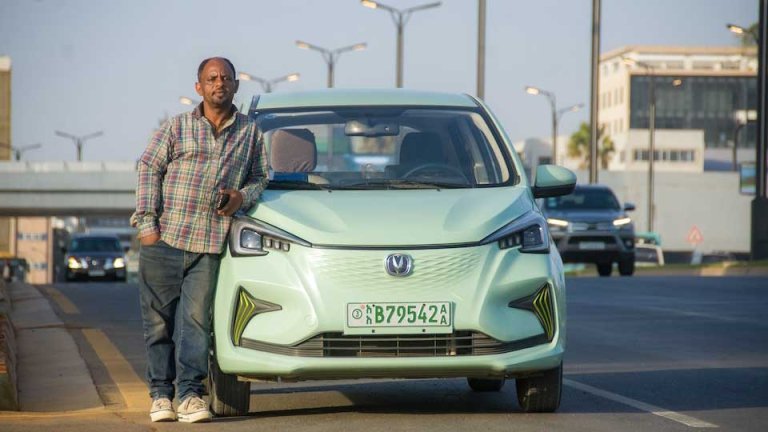
The effect on the vehicle market has been rapid. Electric vehicles accounted for about 60 percent of Ethiopia’s vehicle imports in 2024, according to Ministry of Transport and Logistics data reported by The Reporter, while the number of EVs on Ethiopian roads increased from about 7,000 in 2022 to more than 115,000 by 2025. Government figures also show that at least 15 private investors are assembling electric vehicles domestically, while a growing number of importers have reorganised their businesses around Chinese and other electric models because the conventional petrol and diesel passenger car import market has effectively been closed.
Ethiopia has therefore done something very different from the subsidy driven electric vehicle transitions taking place in Europe, China and parts of North America. Instead of waiting for EV prices, charging networks and consumer preferences to gradually displace internal combustion vehicles, the government changed the rules of market entry and required importers to adapt. That decision accelerated adoption much faster than would likely have occurred through tax incentives alone, but it also shifted several costs and risks onto dealers, consumers, power utilities and charging infrastructure providers before the supporting market was fully developed.
Ethiopia Used Import Policy to Reduce a Foreign Exchange Problem
The underlying economic logic is rooted in Ethiopia’s balance of payments rather than only climate policy. For several years, foreign currency availability was one of the country’s most serious macroeconomic constraints. The IMF reported that before the July 2024 exchange rate reform, Ethiopia’s foreign exchange reserves had fallen below one month of prospective imports for extended periods, while fuel, fertiliser and medicine became some of the few essential imports receiving priority access to official foreign currency. The National Bank of Ethiopia and Commercial Bank of Ethiopia were consequently required to allocate substantial amounts of scarce dollars simply to keep petroleum imports moving.
Against that background, every petrol or diesel vehicle imported into Ethiopia created a future stream of petroleum demand that would have to be financed in foreign currency for years. An electric vehicle creates a different demand structure because the vehicle itself may still be imported, along with batteries and spare parts, but much of its future energy consumption can be supplied through Ethiopia’s domestic electricity system, which is dominated by renewable generation, particularly hydropower.
Transport and Logistics Minister Alemu Sime said in 2025 that Ethiopia was spending approximately $4 billion annually on fuel imports, while more recent government estimates place the bill between $5 billion and $6 billion. The National E Mobility Strategy therefore treats electrification as an energy security and foreign exchange policy as much as an environmental programme, with the government targeting 500,000 electric vehicles and more than 2,200 charging stations by 2030.
The numbers explain why policymakers were willing to intervene so aggressively. Even a modest reduction in transport fuel demand can preserve hundreds of millions of dollars in foreign currency that would otherwise leave the economy every year. For a country that has repeatedly faced foreign exchange shortages, those savings can support imports of industrial machinery, medicines, fertiliser and other goods that are harder to substitute domestically.
This also changes the economics of electricity investment. Ethiopia has spent heavily on generation capacity, including the Grand Ethiopian Renaissance Dam and other hydroelectric projects. Electrifying transport allows some of that domestically generated electricity to substitute for imported petroleum, meaning investment in power infrastructure can begin reducing the import bill beyond the electricity sector itself.
Dealers Have Been Forced to Rebuild Their Business Around EVs
The policy has also reshaped Ethiopia’s automotive market more quickly than a normal technology transition would have done. Dealers that previously imported Japanese, Korean, European and Chinese petrol vehicles have had to shift toward electric models, establish battery support, train technicians and develop new after sales capabilities because the product mix permitted into the market has changed.
The government has reinforced that shift through tax policy. Imported electric vehicles have received significant tax advantages, including VAT exemptions, while partially assembled electric vehicles have received even more favourable treatment. Government officials have also required that new vehicle purchases by public institutions increasingly favour electric vehicles, creating institutional demand alongside private consumer purchases.
By 2025, however, the transition was already exposing the operational difficulty of forcing an automotive market to change faster than the supporting infrastructure. New import regulations required dealers to provide battery warranties, technical support, trained mechanics, charging infrastructure and regular performance reporting. Importers complained that some of these requirements were costly enough to push smaller dealers out of the market, particularly requirements to establish charging stations and fully equipped service facilities.
This matters because Ethiopia’s policy has not merely changed what dealers sell. It has changed what qualifies as a viable vehicle dealership. A company that previously needed capital, inventory, a showroom and conventional mechanical support must increasingly understand software, batteries, electrical systems, chargers and high voltage maintenance. The state is therefore creating an entirely new automotive service market alongside the vehicle transition.
The same pressure has reached domestic assemblers. In July 2025, local assemblers complained that the government had stopped permitting imports of components used to assemble conventional fuel powered vehicles and had instructed plants to shift toward EVs and hybrids. Some manufacturers warned that the sudden transition could threaten existing factories and jobs because their assembly lines, supply chains and technical staff were originally designed around combustion vehicles.
The policy therefore illustrates the trade off between speed and adjustment costs. Ethiopia has accelerated electric vehicle adoption dramatically, but it has also forced firms to write off or repurpose existing investments before the market would naturally have required them to do so.
More Than 115,000 EVs Are Already on Ethiopian Roads
The scale reached in only a few years is unusual by African standards. Government figures put Ethiopia’s electric vehicle fleet above 115,000 by mid 2025, compared with only about 7,000 in 2022. Officials have also said the long-term objective is to exceed 500,000 electric vehicles within the next decade, while the national strategy aims for electric vehicles to account for almost all new vehicle imports over time.
The rapid increase has been helped by Ethiopia’s vehicle market structure. The country has historically had one of Africa’s lowest vehicle ownership rates relative to population, partly because imported vehicles were expensive and foreign exchange was scarce. This means a large share of future vehicle demand will come from first-time additions to the national fleet rather than replacement of millions of existing petrol vehicles.
That gives Ethiopia an unusual opportunity. Countries with large existing combustion fleets must wait decades for those vehicles to age out. Ethiopia can influence the technology of its fleet while motorisation is still relatively low, allowing a much larger share of future vehicles to enter the market as electric from the beginning.
The government is also attempting to build local assembly around that growth. More than 15 firms are already involved in electric vehicle assembly, according to officials, while companies from Europe and other markets have expressed interest in establishing further production operations. If those investments move beyond basic assembly of imported kits, Ethiopia could eventually retain more automotive value domestically through vehicle bodies, interiors, wiring, chargers, software, maintenance and battery services.
The economic objective is therefore broader than replacing one type of imported car with another. Ethiopia wants to substitute imported petroleum with domestic electricity while simultaneously moving part of vehicle manufacturing and servicing into the domestic economy.
Charging Infrastructure Is Now the Main Constraint
The speed of vehicle adoption has created a parallel infrastructure problem because charging networks have not expanded as quickly as the EV fleet. Ethiopia’s National E Mobility Strategy and Implementation Plan for 2025 to 2030 targets more than 2,200 charging centres across Addis Ababa and regional cities by 2030, while Ethiopian Electric Power has begun studying how widespread fast charging will affect the national grid.
The government inaugurated another 11 fast charging stations across six cities at the end of October 2026, but the scale of the long term requirement is considerably larger. A country with hundreds of thousands of electric vehicles will need charging infrastructure not only in Addis Ababa but along intercity corridors, regional towns, apartment developments, commercial centres, workplaces and fleet depots.
Electricity generation alone is therefore insufficient. The economic test is whether distribution networks can deliver enough power to the locations where vehicles charge without creating new bottlenecks. Fast chargers can draw significant amounts of electricity over short periods, which can strain local transformers and distribution systems even when national generation capacity is adequate.
Ethiopian Electric Power has already created a technical team to study the implications of EV growth on the power system over the next five years. The work is necessary because the government is effectively moving part of national transport energy demand from petroleum supply chains into the electricity network, transferring pressure from fuel importers and petrol stations toward utilities and grid operators.
The shift can still produce a substantial national saving because electricity is domestically generated while oil is imported, but the infrastructure required to capture that saving must be financed in advance.
Ethiopia Is Also Trying to Create a Domestic EV Industry
The next stage of the transition will determine whether Ethiopia merely becomes a large market for imported Chinese electric vehicles or develops an automotive industry around the policy.
Government officials are openly encouraging domestic EV assembly and battery related investment, while the National E Mobility Strategy includes local production, charging infrastructure, public transport electrification and private investment as explicit objectives. Foreign manufacturers and suppliers from several countries have already approached the government about production and assembly opportunities.
This is where Ethiopia’s population and domestic market become an advantage. With more than 120 million people and still low vehicle ownership, the country potentially offers manufacturers a large future customer base. If enough vehicles are sold locally, assembly plants can operate at larger scale and suppliers may eventually find it economical to produce components inside Ethiopia rather than import complete kits.
The challenge is that automotive manufacturing requires consistency. Investors need predictable import rules, tax policy, electricity prices, financing conditions and access to components. Ethiopia’s rapid regulatory changes have already generated complaints from dealers and assemblers, while the possibility that the combustion vehicle import ban may have to be modified during World Trade Organization accession introduces another layer of uncertainty.
Trade Minister Kassahun Gofe said in May 2026 that Ethiopia could replace the outright restriction on fuel powered vehicle imports with customs duties as part of its WTO accession negotiations. That does not necessarily mean Ethiopia is abandoning electrification, because high tariffs and tax incentives could still strongly favour electric vehicles, but it means the current prohibition may not remain permanent in its present form.
The government has also begun allowing duty free imports of certain public transport and cargo vehicles powered entirely by domestically sourced natural gas, showing that the wider objective is reducing imported petroleum rather than enforcing battery electric technology in every vehicle category.
Ethiopia Has Turned Vehicle Policy Into Energy Policy
The most consequential aspect of Ethiopia’s experiment is that it treats the car market as part of national energy policy. For most African countries, transport policy begins with roads, vehicle standards, public transport and fuel taxation. Ethiopia has added another calculation: every new combustion vehicle creates years of future demand for imported petroleum, while an electric vehicle can consume energy produced domestically.
That calculation is particularly compelling for countries with large renewable electricity resources and chronic foreign exchange constraints. Ethiopia is attempting to convert hydropower capacity into a transport fuel substitute, reducing the amount of hard currency required to keep cars moving.
The policy is not costless. EVs remain expensive for many households, charging access is uneven, batteries create new technical and replacement risks, and rapid regulatory changes have imposed significant adjustment costs on importers and domestic assemblers. The electricity distribution system will also need substantial investment if the vehicle fleet approaches the government’s 500,000 target.
The experience nevertheless provides one of the clearest African examples of regulation changing a market faster than consumer preference would have done by itself. Ethiopia moved from roughly 7,000 electric vehicles in 2022 to more than 115,000 within a few years, EVs reached around 60 percent of vehicle imports in 2024, and the country is now building charging networks, assembly capacity and technical regulation around a transport market that has already been pushed decisively toward electricity.
Whether the policy ultimately reduces Ethiopia’s overall import bill will depend on more than the number of electric cars on the road. EVs still require imported vehicles, batteries, electronics and spare parts, and the foreign exchange saving becomes much larger only if domestic assembly deepens and petroleum demand actually falls. The economic case will therefore be measured through declining fuel imports, growing local production and the ability of the power system to absorb transport demand without creating new infrastructure shortages.
What Ethiopia has already demonstrated is that a government does not have to wait for the global vehicle market to determine the composition of its national fleet. By treating imported fuel as a balance of payments problem and domestic electricity as a strategic substitute, Addis Ababa has forced its automotive market to change within a few years. The remaining test is whether the infrastructure and industrial base can now catch up with the policy.
 Uchumi360
Business Intelligence
Uchumi360 covers business, investment, and economic policy across East, Central, and Southern Africa.
For the serious reader
You read to the end. That places you in a small group.
Uchumi360 is built for readers who demand precision over speed, structure over sentiment, and analysis that holds uncomfortable conclusions rather than softening them. If this work sharpens how you think about Africa's economy, help us keep building the infrastructure behind it.
Institutional Partners
Commission intelligence. Shape the conversation.
Uchumi360 works with development finance institutions, investment firms, sovereign bodies, and strategic organisations across the coverage region. Institutional partnership unlocks:
- Commissioned sector and country intelligence reports
- Branded research series under your institution's authority
- Exclusive data briefings for internal strategy teams
- Speaking and editorial presence at Uchumi360 events
- Co-published investment outlooks for your markets
Support Our Work
Independent analysis has a cost. Help us bear it.
Uchumi360 does not carry advertising. It does not take editorial direction from sponsors. Every article is produced without commercial compromise. Your contribution funds the reporting, research, and editorial infrastructure that keeps this analysis free from influence.
Secure checkout: One-time and monthly support are processed securely. Add payment credentials to enable checkout here.
Stay Connected
Keep up with every new insight.
Follow our latest analysis, policy coverage, and market intelligence as soon as it is published. If you need something specific, reach out directly and we will point you to the right research.
