
China Did Not Develop Through Free Markets. It Developed Through Strategic State Intervention. Africa Is Being Told to Do the Opposite, The Contradiction Is Worth Examining Honestly.

Ready
China's development model combined strategic state intervention in industry selection, directed credit through state banks, domestic firm protection during learning periods, and managed trade whose combination produced the fastest large-scale poverty reduction in economic history. South Korea, Taiwan, Japan, and Singapore applied comparable frameworks across their industrialisation phases. The IMF's standard conditionality programme for African economies prescribes fiscal consolidation, market liberalisation, privatisation, reduced industrial policy space, and trade openness whose combination is structurally different from the policy framework the successful industrialisers applied. The development economics literature, through Ha-Joon Chang's kicking away the ladder argument, Dani Rodrik's industrial policy revival, Joseph Stiglitz's post-Washington Consensus framework, and the structural transformation research of the UNU-WIDER and African Development Bank, has documented this gap extensively. The honest question is not whether state intervention works in theory but under what institutional conditions it produces development rather than predation, and whether African states have or can build those conditions. The article examines the China model's specific mechanisms, the IMF's prescription and its African outcomes, the development economics debate whose resolution has practical policy consequences, and what the evidence suggests African economies at their current stage should actually do, with reference to the specific East African cases whose trajectories Uchumi360 has documented. The question is not whether the state should intervene in development. Every successful industrialiser intervened. The question is how, with what institutional quality, and toward what strategic objectives. That is the conversation African development policy needs to be having instead of the free markets versus state control binary that makes both sides feel righteous while the industrialisation gap compounds.
China's economic transformation lifted approximately 800 million people out of poverty across four decades. It is the largest and fastest large-scale poverty reduction in human history by any measurement whose application produces a comparable result, and its mechanism has been studied comprehensively enough that the development economics consensus on how it happened is less contested than the political economy of what its implications are for other developing economies.
China picked industries. The government identified the sectors whose development would produce the structural transformation from agricultural economy to industrial economy to technology economy that Vision 2049's targets describe as the endpoint, and it directed resources toward those sectors with the intentionality whose absence in market-driven development is precisely what the developmental state model is designed to address. It directed credit through state-owned banks whose lending priorities reflected strategic industrial objectives rather than the short-term risk-adjusted return calculations that commercial banking's incentive structure produces. It protected domestic firms during the learning period whose completion, across ten to twenty years of sheltered market development, made Chinese manufacturers competitive enough to survive in international markets rather than being outcompeted by more experienced foreign producers before the learning curve's descent reached the competitiveness threshold. It managed trade with the export promotion and import substitution combination whose calibration changed across development stages as the industrial capacity whose building the protection enabled matured into the export competitiveness that protection was no longer required to sustain.
And it worked. At a scale and speed that has no precedent in economic history.
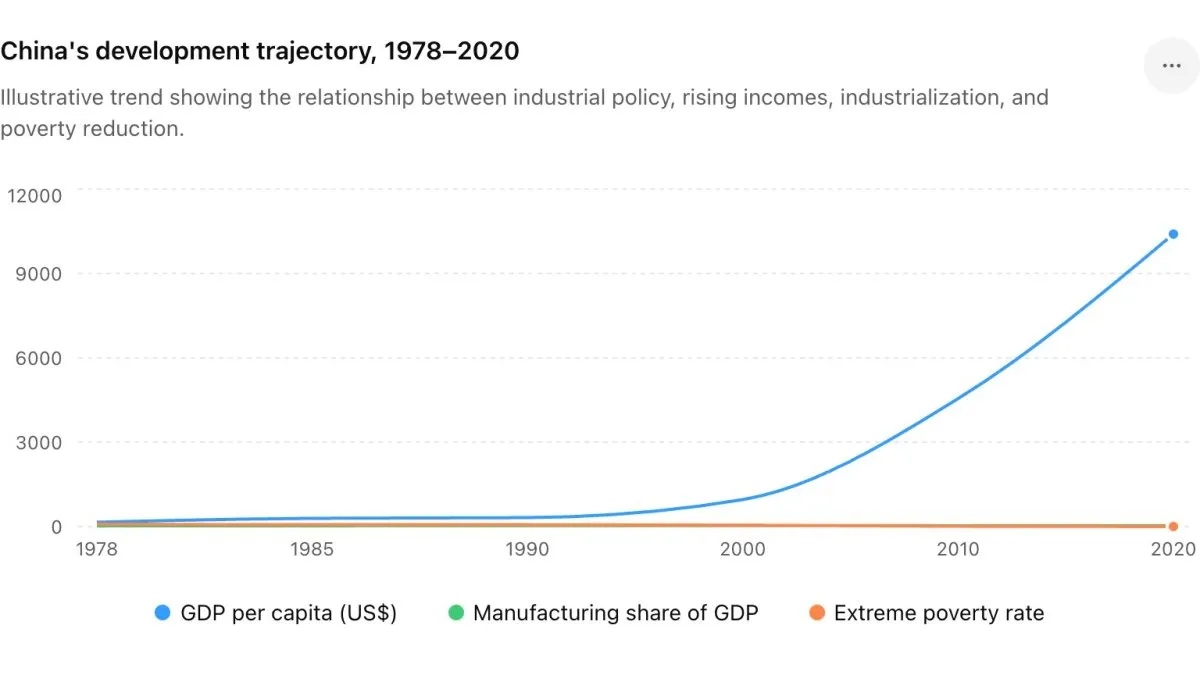 China development trajectory from 1978 t9 2020
The IMF's standard prescription for African economies in financial difficulty is structurally different from the policy framework that produced this outcome. Fiscal consolidation, market liberalisation, privatisation of state assets, trade openness, and the reduction of the industrial policy space whose existence the prescription treats as a source of distortion rather than a development tool are the Washington Consensus's operational components whose application across Africa since the 1980s has produced outcomes whose assessment by the development economics literature is more mixed than the official policy discourse typically acknowledges.
What the successful industrialisers actually did
The historical record of successful industrialisation is sufficiently clear that its summary does not require ideological commitment to produce. South Korea protected its steel industry, its electronics industry, and its shipbuilding industry behind tariff walls during the decades whose learning curve descent made Korean firms internationally competitive. The government directed credit to the chaebols whose industrial expansion it had selected as the vehicles for Korea's development strategy, and it imposed export performance requirements on those same firms whose receipt of public support was conditional on demonstrated export competitiveness rather than mere domestic market dominance. The result was Samsung, Hyundai, POSCO, and the industrial economy whose per capita income has risen from the equivalent of Ghana's in 1960 to OECD membership in 1996.
Taiwan's industrial policy applied comparable principles through a different institutional vehicle, using the Industrial Technology Research Institute and the science park system to transfer technology from international firms to domestic manufacturers while simultaneously protecting the domestic market segments whose development the technology transfer was intended to enable. The result was TSMC and the semiconductor industry whose global strategic significance the current chip war has elevated to the most consequential supply chain competition in the modern global economy.
Japan's Ministry of International Trade and Industry is the developmental state institution whose influence on development economics was most extensively studied and most directly cited in Chalmers Johnson's foundational 1982 work on the developmental state model. MITI picked industries, allocated foreign exchange for technology imports, coordinated investment to avoid destructive duplication, and protected the domestic market during the learning periods whose completion produced the Toyota, Sony, and Nippon Steel that Japan's postwar industrial transformation built. The result was the economic miracle whose speed and scale made Japan the first non-Western economy to achieve developed country status.
Singapore under Lee Kuan Yew combined meritocratic state capacity with deliberate industrial policy in the specific sectors whose development the government had identified as consistent with Singapore's factor endowments and strategic positioning. The financial services industry, the electronics manufacturing sector, the petrochemical industry, and the logistics hub ambition were each the subject of deliberate state investment, regulatory framework design, and targeted incentive deployment whose combination produced the city-state's transformation from a colonial trading post with no natural resources into the highest-income economy in Southeast Asia.
What all of these cases share is the specific combination that Ha-Joon Chang's 2002 book Kicking Away the Ladder documented most directly: the successful industrialisers used the industrial policy tools during their development phase that they subsequently, having achieved their development objectives, advocated other developing countries should not use. The ladder they climbed was kicked away before the countries whose development they were now advising could reach the rungs they had used.
What the IMF has prescribed and what has resulted
The International Monetary Fund's structural adjustment programmes, whose African application began in the early 1980s and whose evolution into the Poverty Reduction and Growth Facility and subsequent programme variants has moderated the conditionality's specific terms without fundamentally altering its underlying framework, have applied the market liberalisation prescription across African economies at the precise development stages whose equivalent in the East Asian industrialisers was characterised by the state intervention the IMF prescription was designed to reduce.
The prescription's components are not without economic justification in specific circumstances. Fiscal consolidation is necessary when public debt dynamics are unsustainable and inflation is undermining macroeconomic stability. Trade liberalisation can improve consumer welfare and resource allocation efficiency in economies whose protection is primarily serving incumbent interests rather than strategic industrial development. Privatisation can improve operational efficiency in state enterprises whose management has been captured by the patronage dynamics that Uchumi360's developmental state analysis documented as the mechanism through which concentrated authority without meritocracy becomes predatory rather than developmental.
The problem that the post-Washington Consensus development economics literature, including Joseph Stiglitz's 2002 critique in Globalisation and Its Discontents, Dani Rodrik's 2004 industrial policy revival, and the UNU-WIDER structural transformation research, has documented is not that these prescriptions are wrong in all circumstances. It is that their application across African economies at development stages whose equivalent in the successful industrialisers was characterised by state-directed credit, protected domestic markets, and deliberate industrial policy has removed the policy tools whose use the historical record identifies as necessary conditions for the structural transformation that the IMF's own long-term development objectives require.
Ghana's structural adjustment experience is the African case whose documentation is most extensively cited in this literature. The agricultural import liberalisation whose conditionality required Ghana to open its poultry and rice markets to subsidised imports from the United States and the European Union destroyed the domestic poultry and rice production whose development would have been a structural transformation step, replacing it with imported produce whose consumption generated the foreign exchange outflow and the structural import dependence that the liberalisation was supposed to reduce by making Ghana's economy more competitive. The prescription whose application was designed to improve Ghana's long-term competitiveness removed the protection whose maintenance was the condition for the domestic industry's survival long enough to reach the competitiveness that protection-free operation would require.
Tanzania's own IMF engagement history is relevant to Uchumi360's coverage geography. The structural adjustment conditions whose acceptance was required for IMF programme access in the 1980s and 1990s included the privatisation of state enterprises, the removal of agricultural marketing boards, and the trade liberalisation whose combined effect on Tanzania's industrial capacity Uchumi360's coverage of the manufacturing GDP share gap, at approximately 8 to 10% against the 20 to 30% that successful industrial transformation requires, documents as a persistent structural deficit whose causes the historical policy context helps explain.
What the development economics literature actually says
The development economics literature's assessment of the free market versus strategic state intervention debate has moved considerably from the Washington Consensus's 1990s orthodoxy toward a more nuanced and evidence-based position whose honest summary challenges both the pure free market prescription and the uncritical developmental state advocacy that the reaction to Washington Consensus failures sometimes produces.
Dani Rodrik's industrial policy work, synthesised most accessibly in his 2007 book One Economics, Many Recipes, argues that the question is not whether the state should intervene in industrial development but how, with what institutional quality, and under what accountability framework. The successful interventions, Korea, Taiwan, Singapore, and China, shared the characteristic that Rodrik terms embedded autonomy: the state had the capacity to formulate and implement industrial policy without being captured by the private sector interests whose lobbying, if successful, converts industrial policy from a development tool into a rent extraction mechanism. The unsuccessful interventions, which the Latin American import substitution experiences of the 1970s document most extensively, produced the rent-seeking, inefficient protected industries, and fiscal strain whose occurrence is the mechanism through which industrial policy without institutional quality produces economic deterioration rather than development.
Ha-Joon Chang's research establishes the historical documentation whose reading is the most direct available correction to the Washington Consensus's selective historical memory. The United States protected its infant industries behind tariff walls throughout the 19th century, achieving the world's highest manufacturing productivity by 1890 through exactly the policy tools whose application to developing countries the US Treasury and the IMF subsequently prescribed against. The United Kingdom used industrial policy, trade management, and state coordination of infrastructure investment throughout its industrial revolution. Germany's economic development in the 19th century was explicitly guided by Friedrich List's national system of political economy, whose state-directed industrial development framework the free market economics that Germany subsequently advocated for other economies directly contradicted.
For Africa specifically, the most directly relevant development economics research is the structural transformation literature whose assessment of how African economies can move from the agricultural and commodity extraction base that characterises their current production structure toward the manufacturing and services employment whose generation is the mechanism through which the conversion efficiency argument that Uchumi360's analysis of African GDP versus HDI performance identifies as the binding development constraint can be resolved. According to UNU-WIDER research, the structural transformation from agriculture to manufacturing to services that produced the income growth in every successful industrial economy requires the deliberate policy choices whose market provision is insufficient: the investment in industrial infrastructure, the technology transfer facilitation, the domestic market protection during learning periods, and the export promotion whose combination is what the East Asian developmental states did and what the IMF prescription's application has made institutionally difficult for the African economies whose programme conditionality has constrained the policy space that structural transformation requires.
The institutional quality question that determines whether intervention works
The honest engagement with the China model's implications for Africa requires addressing the institutional quality question whose answer determines whether the developmental state framework produces development or predation, because the argument that China's success demonstrates Africa should adopt industrial policy without that engagement is the version of the argument that ignores the variable whose variation explains why some state interventions produce Samsung and some produce the inefficient protected industries whose rent extraction is the developmental state model's failure mode.
China's industrial policy worked, among other reasons, because the cadre evaluation system whose performance metrics the Chinese Communist Party applies to government officials at every level creates the accountability mechanism that makes state intervention for development rather than for patronage the path of least resistance for the officials making the intervention decisions. The official whose promotion depends on the GDP growth, the foreign investment attraction, and the industrial output of the region whose governance is their responsibility has the incentive structure whose alignment with development outcomes the patronage-based appointment systems that Uchumi360's developmental state analysis documented as the most common African public administration failure mode does not produce.
Rwanda's development trajectory is the East African case whose institutional quality has produced the closest available approximation to the developmental state model's productive combination of concentrated authority and meritocratic accountability. According to UNDP HDR 2025 data, Rwanda ranks 4th in Africa by Human Development Index despite ranking outside the top fifteen by GDP, the conversion efficiency whose source is the institutional quality that the performance contract system applying from ministers to district mayors creates. Tanzania's reform trajectory under President Samia, whose investment code modernisation, PPP Act, and TISEZA institutional merger Uchumi360 has documented as producing the one-factory-per-day manufacturing investment pace, is the most direct available East African evidence that institutional quality improvement produces the investment attraction outcomes that pure free market prescription does not automatically generate.
The question for African development policy is therefore not the binary whose framing the free markets versus state intervention debate typically produces. It is the specific institutional question: which African states have or can build the meritocratic accountability mechanisms that make state intervention for strategic development rather than for patronage distribution the operative mode of the institutional behaviour whose quality the development outcome depends on. That question has specific answers in specific countries rather than the continental generalisation that both the Washington Consensus and its critics sometimes produce.
What the evidence suggests African economies should actually do
The evidence's honest reading, without the Washington Consensus's selective historical memory or the developmental state model's occasional romanticisation of East Asian authoritarianism, produces a more specific and more actionable set of conclusions than either framework's pure application.
African economies at their current development stage need the policy space to implement the industrial policy tools whose use the successful industrialisers demonstrate is necessary for structural transformation. That means the IMF's conditionality frameworks should be redesigned to protect the fiscal sustainability and macroeconomic stability whose maintenance is the legitimate core of the IMF's mandate while preserving the industrial policy space whose use the conditionality has historically constrained beyond what macroeconomic necessity requires. According to Dani Rodrik's research, the specific industrial policy tools whose application is most directly supported by the development evidence are not the blunt import substitution whose indiscriminate application produced Latin America's 1970s experiences, but the more targeted interventions: special economic zones, export processing zones, directed credit to specific sectors, public investment in infrastructure and technology, and the institutional frameworks for public-private coordination whose design the TISEZA model Uchumi360 has documented provides an East African example of.
The institutional quality investment whose absence makes state intervention predatory is therefore the prerequisite rather than the alternative to industrial policy. Building the meritocratic public administration whose presence is the East Asian developmental states' most consistently identified enabling condition is the investment that produces the returns from industrial policy rather than the substitution for it. Rwanda's performance contract system, Tanzania's institutional reform programme, and the broader East African governance improvement whose documentation Uchumi360's coverage of the developmental state argument has provided are the policy investments whose compounding over time produces the institutional capacity that makes the state's industrial policy interventions developmental rather than predatory.
And the international development architecture whose redesign would most directly improve African economies' development outcomes would make the IMF's conditionality more consistent with the development evidence, preserving macroeconomic stability requirements while restoring the industrial policy space whose historical use by every successful industrialiser the Washington Consensus's application to Africa has selectively and consequentially ignored.
China did not develop through free markets. It developed through strategic state intervention of exceptional quality, implemented by an institutional architecture whose meritocratic accountability created the incentive structure that made the intervention developmental. Africa is being told to do the opposite of what China did. The development economics literature has spent thirty years explaining why that prescription has produced the outcomes it has. The conversation that actually needs to happen is not whether the state should intervene but how African states can build the institutional quality that makes intervention work, and whether the international development architecture will create the space for that work to proceed.
FAQ
How did China actually develop economically? China's development combined strategic state intervention across four specific mechanisms: picking industries whose development the government identified as producing structural transformation from agriculture to manufacturing to technology, directing credit through state-owned banks toward those strategic sectors, protecting domestic firms from foreign competition during the learning periods whose completion made them internationally competitive, and managing trade through export promotion and calibrated import substitution. These mechanisms produced the fastest large-scale poverty reduction in economic history, lifting approximately 800 million people from poverty across four decades according to World Bank data.
What does the IMF typically prescribe for African economies and why is it different? The IMF's standard conditionality programme combines fiscal consolidation, market liberalisation, privatisation of state assets, trade openness, and reduction of industrial policy space. These prescriptions are structurally different from the policy framework the successful industrialisers applied because they reduce the state's capacity to pick industries, direct credit, protect domestic firms, and manage trade, the specific tools whose use characterised every economy that successfully industrialised since 1950. The development economics literature documents this gap without disputing the legitimate macroeconomic stability goals that form the IMF conditionality's core rationale.
Does the China model prove that all state intervention works in Africa? No. The development economics literature's most important contribution to this debate is identifying the institutional quality conditions that make state intervention produce development rather than predation. China's intervention worked partly because the cadre evaluation system whose performance metrics create accountability between officials' promotion and the development outcomes of the regions they govern. State intervention without that institutional quality produces rent-seeking, inefficient protected industries, and patronage distribution. The honest question for African policy is not whether to intervene but how to build the institutional accountability whose presence makes intervention developmental, as Rwanda's performance contract system and Tanzania's institutional reform programme demonstrate is achievable.
Which African economies are closest to the developmental state model? Rwanda is the East African case whose institutional combination of concentrated executive authority, meritocratic performance contracts from ministers to district mayors, and disciplined long-horizon consistency produces the HDI outcomes whose 4th place African ranking despite outside top-fifteen GDP positioning reflects conversion efficiency closest to the developmental state model's documented outcomes. Tanzania's institutional reform trajectory under President Samia, producing over 900 investment approvals in 2025 and one new factory per day in 2024, is the most directly documented East African evidence that institutional quality improvement produces the investment attraction and manufacturing development outcomes that the developmental state framework predicts.
What should African development policy actually look like based on the evidence? The evidence supports preserving the macroeconomic stability whose maintenance is the IMF's legitimate core mandate while restoring the industrial policy space whose historical use by every successful industrialiser the conditionality has constrained beyond what macroeconomic necessity requires. Targeted industrial policy tools including special economic zones, export processing zones, directed credit to strategic sectors, public infrastructure investment, and public-private coordination frameworks produce the development outcomes whose evidence base is strong when applied by states with sufficient institutional quality. Building the meritocratic public administration whose presence is the enabling condition for productive rather than predatory state intervention is therefore the investment whose priority should precede rather than follow the industrial policy whose effectiveness it determines.
 Uchumi360
Business Intelligence
Uchumi360
Business Intelligence
- Ha-Joon Chang, Kicking Away the Ladder: Development Strategy in Historical Perspective
- Anthem Press, 2002
- Historical documentation of successful industrialisers' policy tools and the Washington Consensus contradiction
- Dani Rodrik, One Economics, Many Recipes: Globalization, Institutions, and Economic Growth
- Princeton University Press, 2007
- Industrial policy revival and embedded autonomy framework
- Joseph Stiglitz, Globalisation and Its Discontents
- W.W
- Norton, 2002
- Post-Washington Consensus critique and IMF conditionality assessment
- Chalmers Johnson, MITI and the Japanese Miracle: The Growth of Industrial Policy 1925-1975
- Stanford University Press, 1982
- Foundational developmental state framework
- Peter Evans, Embedded Autonomy: States and Industrial Transformation
- Princeton University Press, 1995
- Institutional quality conditions for developmental state success
- UNU-WIDER, structural transformation and African industrial policy research
- Available at wider.unu.edu
- World Bank, China poverty reduction data
- Approximately 800 million lifted from poverty across four decades
- Available at worldbank.org
- UNDP, Human Development Report 2025
- Rwanda HDI 4th in Africa
- Available at hdr.undp.org
- IMF, Poverty Reduction and Growth Facility documentation and conditionality frameworks
- Available at imf.org
- African Development Bank, structural transformation and industrial policy research
- Available at afdb.org
- Gilead Teri, Director General TISEZA, Divya Briefing podcast, May 2026
- One factory per day 2024 manufacturing context
- TSMC, Taiwan Semiconductor Manufacturing Company historical development context
- Available at tsmc.com
- Samsung Group, South Korea chaebol development history
- Available at samsung.com
- Korea Development Institute, South Korean industrial policy historical documentation
- Available at kdi.re.kr
- Ministry of International Trade and Industry Japan historical records, MITI industrial policy documentation
- Rwanda Development Board, performance contract system and governance quality data
- Available at rdb.rw
- National Bureau of Statistics Tanzania, manufacturing GDP share data approximately 8 to 10%
- Available at nbs.go.tz
- Friedrich List, The National System of Political Economy, 1841
- Historical reference for German industrial development framework
Uchumi360 covers business, investment, and economic policy across East, Central, and Southern Africa.
For the serious reader
You read to the end. That places you in a small group.
Uchumi360 is built for readers who demand precision over speed, structure over sentiment, and analysis that holds uncomfortable conclusions rather than softening them. If this work sharpens how you think about Africa's economy, help us keep building the infrastructure behind it.
Institutional Partners
Commission intelligence. Shape the conversation.
Uchumi360 works with development finance institutions, investment firms, sovereign bodies, and strategic organisations across the coverage region. Institutional partnership unlocks:
- Commissioned sector and country intelligence reports
- Branded research series under your institution's authority
- Exclusive data briefings for internal strategy teams
- Speaking and editorial presence at Uchumi360 events
- Co-published investment outlooks for your markets
Support Our Work
Independent analysis has a cost. Help us bear it.
Uchumi360 does not carry advertising. It does not take editorial direction from sponsors. Every article is produced without commercial compromise. Your contribution funds the reporting, research, and editorial infrastructure that keeps this analysis free from influence.
Secure checkout: One-time and monthly support are processed securely. Add payment credentials to enable checkout here.
Stay Connected
Keep up with every new insight.
Follow our latest analysis, policy coverage, and market intelligence as soon as it is published. If you need something specific, reach out directly and we will point you to the right research.
