
Kenya Has Signed a Sovereign Wealth Fund Into Law. Here Is What It Does, How It Will Be Governed, and What It Means for East Africa's Fiscal Landscape.

Ready
Kenya has enacted a Sovereign Wealth Fund law, signed by President Ruto on July 8, 2026. The fund will invest surplus revenues from natural resources and other public assets across three functions: saving for future generations, stabilising the economy during downturns, and financing strategic infrastructure. Governance structures include accountability, transparency, and oversight mechanisms. The law is part of Kenya's broader public finance management reform agenda, which also includes the conditions attached to the World Bank's Third Fiscal Sustainability DPO. Kenya's SWF is the most significant new fiscal institution in East Africa since Rwanda established its Agaciro Development Fund in 2012.
NAIROBI — President William Ruto signed the Kenya Sovereign Wealth Fund Bill into law at State House Nairobi on July 8, 2026, establishing the legal and institutional framework for managing Kenya's national wealth through a dedicated fund separate from the general budget.
The signing marks the conclusion of a legislative process that positions Kenya as one of the few Sub-Saharan African economies with a formally enacted sovereign wealth fund, joining Botswana, Nigeria, Angola, Ghana, and Rwanda among the continent's countries that have created dedicated structures for managing public wealth across generations.
What the fund is designed to do
The legislation establishes three distinct functions for the Sovereign Wealth Fund, each addressing a different dimension of Kenya's fiscal management challenge.
The first is intergenerational savings. Surplus revenues generated from natural resources and other public assets will be invested to benefit both current and future generations rather than being absorbed into the recurrent budget. This function is the classic sovereign wealth mandate, separating windfall revenues from operational spending to prevent the Dutch Disease dynamic in which resource revenues crowd out productive investment and inflate costs across the non-resource economy.
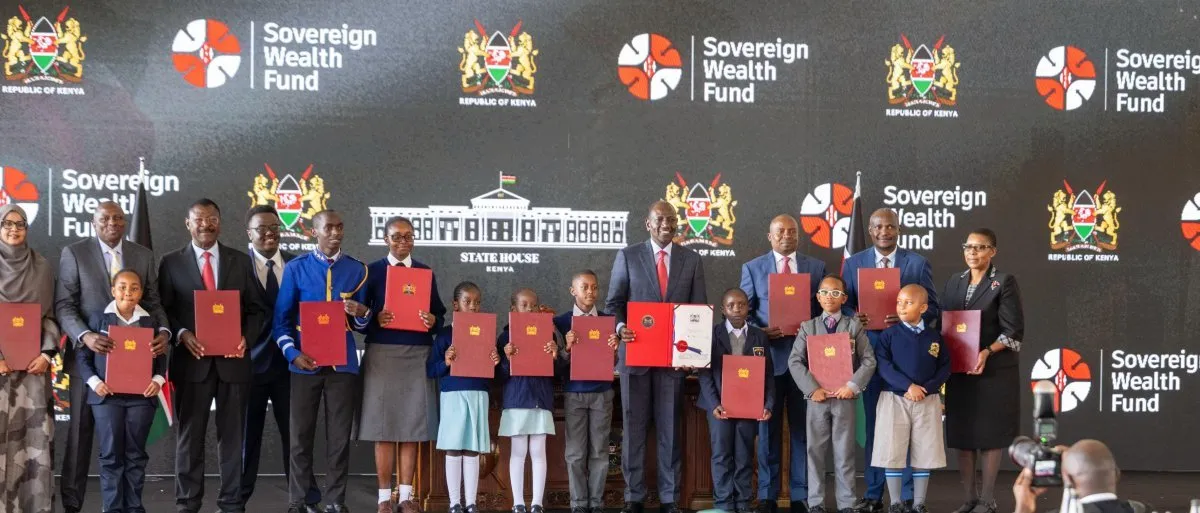 William Ruto, President of Kenya alongside Kenyan children during the signing ceremony of the Sovereign Wealth Fund.
The second is economic stabilisation. The fund will serve as a financial buffer during periods of economic instability, reducing Kenya's vulnerability to the revenue volatility that commodity price cycles, drought, and external shocks periodically create. A stabilisation buffer is a fiscal tool that Kenya has historically lacked at an institutional level, relying instead on supplementary budgets, emergency borrowing, and development partner assistance during stress periods.
The third is strategic infrastructure investment. The fund will finance priority national development projects, providing a capital source whose patient, long-duration character is appropriate for infrastructure investment in ways that short-term borrowing is not. This function directly connects the SWF to Kenya's infrastructure pipeline, including the JKIA expansion and the SGR extension to Malaba, whose financing requirements exceed what any single budget cycle can accommodate.
Governance and oversight
The legislation includes governance structures covering accountability, transparency, and oversight in the investment and utilisation of public resources. The specific institutional architecture, board composition, investment mandate parameters, eligible asset classes, and reporting requirements, has not been detailed in the initial announcement and will likely be specified in subsidiary regulations and fund rules published following enactment.
The governance question is the most consequential design element. Sovereign wealth funds whose governance frameworks are insufficiently independent from executive direction have historically underperformed both financially and in terms of their stated developmental objectives. Nigeria's experience with the Nigeria Sovereign Investment Authority, established in 2011 with a similar three-pillar architecture, illustrates both the potential and the implementation challenge: the NSIA has operated with reasonable independence and professional management but has been chronically undercapitalised relative to its mandate because political pressure for current spending has competed with the long-term savings objective.
Kenya will face the same political economy tension. The law creates the institution. Whether the institution operates with genuine independence and receives adequate capitalisation from future surplus revenues will determine whether the SWF becomes a meaningful fiscal asset or a legal framework in search of resources.
The regional context
Kenya's SWF is the most significant new fiscal institution established in East Africa since Rwanda created the Agaciro Development Fund in 2012, whose mandate covers both development financing and economic resilience.
Tanzania has not established a comparable institution, though the Bank of Tanzania's gold reserve accumulation programme, which purchased 17.64 tonnes valued at USD 2,616.77 million in FY2025/26 and reached a cumulative holding of 24.21 tonnes, represents a form of strategic reserve management whose institutional architecture differs from a sovereign wealth fund but whose objectives partially overlap.
Uganda's oil revenues, once EACOP is operational, will create exactly the kind of surplus revenue stream that a sovereign wealth fund is designed to manage. Uganda has discussed establishing such a fund in the context of its oil development planning, and Kenya's enacted legislation may accelerate that conversation.
The connection to Kenya's broader reform agenda
The SWF enactment coincides with and complements the governance reform conditions attached to the World Bank's Third Kenya Fiscal Sustainability and Resilient Growth Development Policy Operation, which Uchumi360 reported on this week. Those conditions require beneficial ownership transparency, whistleblower protection, PPP procurement reform, payroll integration, and green building standards, all designed to strengthen Kenya's public financial management architecture.
The SWF adds an asset management dimension to what has been primarily a liability and expenditure management reform agenda. A government that borrows less efficiently and spends with less oversight than its peers will not benefit from a sovereign wealth fund regardless of how well the fund itself is designed. The two reform streams need to advance together.
Kenya's fiscal position, with public debt at approximately 68 percent of GDP and a structural deficit of 6.4 percent of GDP projected for both 2025 and 2026, also raises a legitimate question about sequencing. Sovereign wealth funds are most effective when governments have surplus revenues to direct into them. A government running a structural deficit is, by definition, not generating surpluses. The SWF's capitalisation in the near term will depend on specific revenue streams, natural resource royalties or asset sale proceeds, being ring-fenced for the fund rather than on budget surplus generation.
That is a solvable design problem, not a fundamental objection to the institution. But it is the question Kenya's Treasury and the fund's inaugural board will need to answer before the SWF moves from legal framework to operational reality.
FAQ
What is the Kenya Sovereign Wealth Fund? A legally established institution created by the Sovereign Wealth Fund Act signed by President Ruto on July 8, 2026, designed to invest surplus public revenues across three functions: saving for future generations, stabilising the economy during downturns, and financing strategic infrastructure investment.
What revenues will the fund receive? Surplus revenues from natural resources and other public assets. The specific ring-fencing arrangements, which revenue streams are directed to the fund and at what share, will be specified in subsidiary regulations and fund rules following enactment.
How does Kenya's SWF compare to similar funds in Africa? Kenya joins Botswana, Nigeria, Angola, Ghana, and Rwanda among Sub-Saharan African economies with formally enacted sovereign wealth structures. Rwanda's Agaciro Development Fund, established in 2012, is the closest regional precedent. Nigeria's NSIA, established in 2011 with a similar three-pillar architecture, offers both a model and a cautionary example on the importance of capitalisation and governance independence.
Does Kenya's fiscal deficit affect the fund's viability? Kenya is currently running a structural fiscal deficit of approximately 6.4 percent of GDP, which means it is not generating general budget surpluses to direct into the fund. Viable capitalisation in the near term depends on specific revenue streams being ring-fenced for the fund rather than on overall budget surplus generation. This is a solvable design challenge but the critical question the fund's inaugural board must address.
What governance mechanisms does the law establish? The legislation includes structures for accountability, transparency, and oversight. Specific details on board composition, investment mandate parameters, eligible asset classes, and reporting requirements will be specified in subsidiary regulations. The strength and independence of those governance arrangements will be the primary determinant of whether the fund achieves its stated objectives.
 Uchumi360
Business Intelligence
Uchumi360
Business Intelligence
Uchumi360 covers business, investment, and economic policy across East, Central, and Southern Africa.
For the serious reader
You read to the end. That places you in a small group.
Uchumi360 is built for readers who demand precision over speed, structure over sentiment, and analysis that holds uncomfortable conclusions rather than softening them. If this work sharpens how you think about Africa's economy, help us keep building the infrastructure behind it.
Institutional Partners
Commission intelligence. Shape the conversation.
Uchumi360 works with development finance institutions, investment firms, sovereign bodies, and strategic organisations across the coverage region. Institutional partnership unlocks:
- Commissioned sector and country intelligence reports
- Branded research series under your institution's authority
- Exclusive data briefings for internal strategy teams
- Speaking and editorial presence at Uchumi360 events
- Co-published investment outlooks for your markets
Support Our Work
Independent analysis has a cost. Help us bear it.
Uchumi360 does not carry advertising. It does not take editorial direction from sponsors. Every article is produced without commercial compromise. Your contribution funds the reporting, research, and editorial infrastructure that keeps this analysis free from influence.
Secure checkout: One-time and monthly support are processed securely. Add payment credentials to enable checkout here.
Stay Connected
Keep up with every new insight.
Follow our latest analysis, policy coverage, and market intelligence as soon as it is published. If you need something specific, reach out directly and we will point you to the right research.
