
Tanzania Needs Industrial National Champions the Way South Korea Built Samsung. The Market Will Not Produce Them on Its Own.
Ready
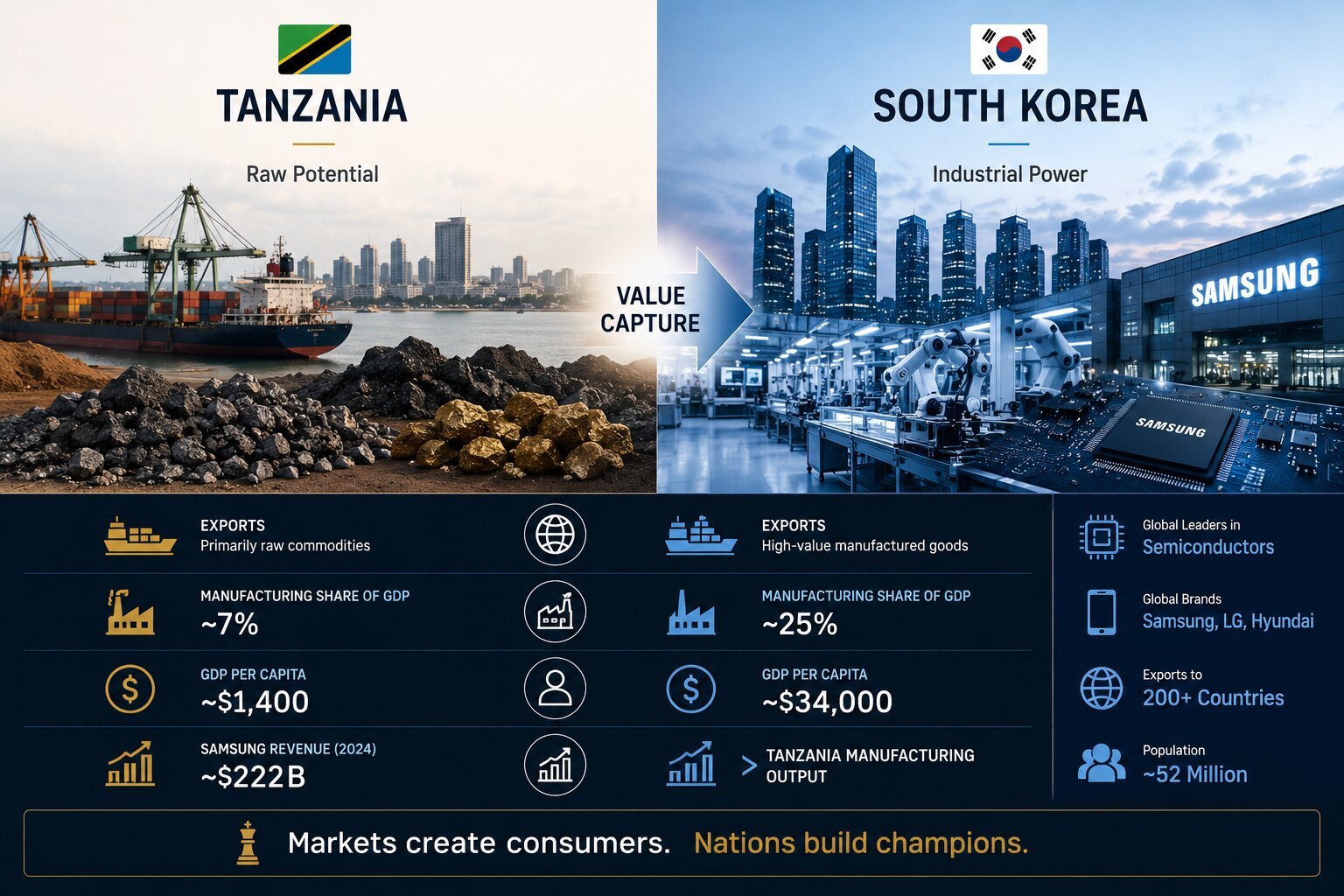
No country in modern economic history became an industrial power through small business activity alone. South Korea deliberately backed large industrial conglomerates through subsidised financing, export incentives, and infrastructure support, with Samsung, Hyundai, POSCO, and LG functioning as anchor institutions that pulled entire manufacturing ecosystems upward around them. China built Huawei, BYD, CATL, and CRRC as institutional expressions of decades of industrial policy alignment around manufacturing depth, engineering capability, and supply chain control. Tanzania possesses expanding electricity capacity, natural gas, critical minerals, strategic geography, and the SGR corridor infrastructure that would make large-scale industrial institutions viable, but the country's policy discourse remains concentrated on SMEs and startups whose employment multipliers and industrial complexity generation cannot substitute for the anchor institution role that national industrial champions perform. This article identifies what industrial champions produce beyond revenue, why the market alone does not create them in developing economies, what Tanzania's specific asset base makes possible for anchor institution development, and what the distinction between industrial policy that transforms economies and industrial policy that merely redistributes favours means for the design of Tanzania's next development phase. Industrial economies are not built only by entrepreneurs. They are built by institutions large enough to organise production at scale, and Tanzania's development discourse has not yet confronted that distinction with the policy seriousness it demands.
Industrialisation does not happen accidentally, and no country in modern economic history became an industrial power simply because thousands of small businesses emerged organically and somehow coordinated themselves into globally competitive production systems without the anchor institutions whose scale, capital absorption capacity, and sectoral depth create the industrial ecosystem within which smaller firms can develop and compound. Industrial transformation required something much more deliberate in every documented case of success: the creation of national industrial champions capable of operating at scale, accumulating technical capability across multiple technology generations, absorbing the long-horizon capital that manufacturing investment demands, and competing internationally in ways that pulled the productive capability of the broader economy upward rather than simply capturing a domestic market share that import competition would otherwise fill. South Korea had Samsung, Hyundai, LG, and POSCO. Japan had Toyota, Mitsubishi, Sony, Hitachi, and Toshiba. China built Huawei, BYD, CATL, CRRC, Sinopec, and hundreds of state-supported industrial institutions across the sectors considered critical for long-term national productive power. The United States built Boeing, General Electric, Ford, Intel, and Apple on top of decades of industrial and state-supported infrastructure investment that created the engineering workforce, the supply chain depth, and the technological capability that each of those companies subsequently organised at commercial scale. Tanzania still largely does not have equivalent industrial-scale institutions, and that gap matters enormously for the trajectory of the country's economic transformation because industrial champions do not simply generate revenue. They create ecosystems, absorb engineering talent, deepen supply chains, build manufacturing standards, finance technical learning, create export capacity, train future entrepreneurs and managers, force infrastructure improvements, and pull entire sectors upward around them.
Tanzania's policy conversations remain heavily concentrated on SMEs, startups, and innovation ecosystems, and the concentration reflects a genuine recognition of the commercial energy, entrepreneurial dynamism, and adaptive problem-solving that small and medium enterprises demonstrate across Tanzania's economy. Small businesses matter. Entrepreneurship matters. But historically, no serious industrial economy emerged from small enterprise activity alone, and the distinction between what SME activity produces and what anchor industrial institutions produce for an economy's productive complexity is the distinction between a vigorous commercial ecology and an industrial transformation. A country producing globally competitive vehicles, electronics, industrial machinery, chemicals, pharmaceuticals, steel, batteries, semiconductors, or advanced logistics systems requires firms operating at enormous scale whose capital intensity, supply chain coordination requirements, and export market demands cannot be sustained through fragmented micro-enterprise structures whose resources and time horizons are calibrated to the opportunities available within a domestic market rather than to the demands of international industrial competition. The capital intensity of a steel plant, a fertiliser facility, a mineral processing operation, or a battery precursor manufacturing complex requires institutional investors, long-tenor financing, and management structures whose depth is incompatible with the SME model whose celebration has displaced the industrial champion argument from Tanzania's development conversation.
What South Korea actually built and how it built it
South Korea in the 1960s was poorer than many African countries today by per capita income measures, according to World Bank historical national accounts data, and the transformation it executed across the following three decades into one of the world's most sophisticated industrial economies is the most compressed and most analytically legible example of what deliberate national industrial champion development produces when the policy design is coherent and the institutional commitment is sustained. According to Korean Development Institute research on South Korea's structural transformation, the Korean state deliberately backed large industrial conglomerates, the chaebol, through subsidised financing from the Korea Development Bank and associated policy institutions, export incentives that rewarded production oriented toward international markets rather than protected domestic consumption, industrial policy coordination that identified priority sectors and directed resources toward them, and infrastructure support that reduced the logistics, energy, and communications costs that manufacturing operations required. The objective was not simply corporate growth in the commercial sense. The objective was national industrial capability, and the chaebol were the institutional vehicle through which that capability was accumulated at the scale required to make South Korea's manufacturing internationally competitive rather than merely domestically present.
Samsung itself began as a trading company before the deliberate industrial policy environment created the conditions under which expansion into manufacturing, electronics, semiconductors, shipbuilding, and industrial technology across decades was commercially rational and institutionally supported. As Samsung expanded, thousands of suppliers, component manufacturers, engineers, logistics providers, technical institutions, financiers, and secondary manufacturers grew around it in a pattern that reflects the industrial ecosystem dynamics that anchor institutions generate. Industrial complexity deepened because a large institution continuously pulled productive capability upward by creating demand for intermediate goods, technical services, and specialised labour that the broader economy then developed the capability to supply. According to Harvard Growth Lab Economic Complexity Index data, South Korea's rise in the complexity rankings across the 1970s through the 1990s tracked the expansion of its chaebol-anchored manufacturing ecosystem rather than the independent emergence of small enterprise activity, confirming the directional relationship between anchor institution development and productive complexity accumulation. Hyundai did the same in automobiles and heavy industry. POSCO did the same in steel, becoming one of the world's most efficient steel producers after years of state-directed investment that initially produced losses before the industrial learning curve generated the cost structure required for international competitiveness. LG did the same in electronics and chemicals.
What China understood about systems competition
China scaled the industrial champion logic to unprecedented levels across the three decades from 1990 to 2020, and the result is the most significant example of state-directed industrial institution building in economic history, both in its scale and in its strategic coherence. According to National Bureau of Statistics of China industrial output data, Beijing understood that global industrial competition is ultimately about systems rather than isolated companies, and the country strategically supported firms capable of dominating sectors considered critical for long-term national productive power: telecommunications through Huawei and ZTE, renewable energy through Longi and Goldwind, batteries through CATL and BYD, high-speed rail through CRRC, electric vehicles through BYD and NIO, shipbuilding through COSCO and CSSC, and semiconductors through SMIC and Yangtze Memory Technologies. The investment in these firms combined state bank financing at concessional terms, public procurement that guaranteed domestic market share during early development phases, export support through the China Development Bank and China Export-Import Bank, and industrial park infrastructure whose development reduced the logistics and energy costs that manufacturing scale requires.
Today, companies like BYD and CATL are not simply private businesses competing commercially in open markets. They are institutional expressions of decades of industrial policy alignment around manufacturing depth, engineering capability, supply chain control, and export competitiveness whose accumulation makes them difficult to displace because the productive knowledge they embody is embedded across their supplier networks, their engineering workforces, their manufacturing process systems, and their research infrastructure in ways that represent decades of industrial learning rather than simply the capital value of their physical assets. According to Bloomberg's analysis of the global electric vehicle supply chain, CATL's dominance of battery cell manufacturing reflects not only its current production scale but the accumulated process engineering knowledge, supply chain relationships, and materials science expertise that its manufacturing experience across millions of cells has generated, creating the kind of institutional productive knowledge that Harvard Growth Lab research identifies as the primary determinant of long-run industrial competitiveness.
What Tanzania's asset base makes possible for anchor institution development
Tanzania's current development stage creates a specific and rare opening to begin building the industrial anchor institutions whose absence has constrained the country's productive complexity accumulation, because the combination of expanding energy capacity, strategic minerals, natural gas, logistics infrastructure, and regional market access creates the enabling conditions that industrial champions require without yet having generated the institutional actors capable of organising production around them at the required scale. According to Tanzania Electric Supply Company operational records, electricity generation capacity has crossed approximately 4,000 megawatts following the commissioning of the Julius Nyerere Hydropower Project, altering the industrial possibilities for energy-intensive manufacturing and processing operations whose viability in a power-constrained environment was commercially questionable and whose viability in an energy-surplus environment is materially improved. The Standard Gauge Railway, whose USD 2.33 billion financing Standard Chartered arranged in April 2026 according to the bank's official announcement, restructures logistics economics along the Central Corridor in ways that reduce the transport cost component of industrial production and processing for facilities sited along the railway route. Tanzania's natural gas reserves, whose 57 trillion cubic feet figure the Tanzania Petroleum Development Corporation documents, create the feedstock opportunity for a fertiliser production industry whose anchor institution could simultaneously affect agricultural economics, logistics demand, port activity, energy infrastructure utilisation, and the technical workforce development that industrial chemistry requires.
The critical minerals dimension provides additional anchor institution opportunities whose commercial logic is aligned with the global supply chain diversification demand that Uchumi360's May 2026 coverage of Tanzania's minerals strategy documented. A Tanzanian graphite processing company operating at scale, producing spherical graphite battery anode material from the Mahenge and Epanko deposits for export to battery manufacturers in South Korea, Japan, and increasingly Europe and the United States, would function as an anchor institution in precisely the way that Samsung functioned for South Korea's electronics ecosystem: creating demand for engineering services, logistics capability, chemical processing expertise, environmental management systems, and technical education whose supply would deepen Tanzania's industrial complexity around a processing operation that the country's geological endowment makes commercially viable but that requires the deliberate institutional investment and industrial policy support that market incentives alone will not generate. A nickel processing facility operating at battery-grade nickel sulphate production scale would produce equivalent ecosystem effects in a different mineral category, and the combination of graphite and nickel processing around a shared energy and logistics infrastructure creates the conditions for the industrial clustering whose compounding effects exceed what either facility would generate in isolation.
The regional comparison that Tanzania should draw lessons from
East Africa's regional industrial landscape provides a comparative framework for assessing Tanzania's anchor institution opportunity that the global South Korean and Chinese cases, while analytically instructive, cannot fully substitute for given the different institutional, financial, and market context. Ethiopia's industrial park strategy, executed through the Hawassa Industrial Park and its successor facilities according to Ethiopian Investment Commission data, represents the most deliberate attempt in East Africa to create anchor manufacturing institutions capable of pulling industrial ecosystems upward around them, using foreign garment and textile manufacturers as the anchor institutions whose presence creates the supplier development, logistics demand, technical workforce development, and infrastructure improvement pressure that domestic industrial complexity requires. The strategy has been disrupted by conflict and political economy instability in ways that limit its applicability as a simple model, but its underlying institutional logic, identifying anchor manufacturers large enough to reshape the productive structure around them and creating the conditions under which they locate and scale in Ethiopia, is directly applicable to Tanzania's industrial strategy design.
Rwanda's approach to industrial anchor institution development, documented in the Rwanda Development Board's Annual Report 2025, has focused on agro-processing, mining value addition, and light manufacturing in sectors where Rwanda's small economy can develop globally competitive positions without requiring the capital intensity of heavy industry, with the Rwanda Development Bank providing long-tenor financing for industrial investment at terms that commercial banks do not offer. Kenya's industrial and manufacturing base, despite its relative development, has struggled to produce truly globally competitive industrial champions in sectors beyond horticulture and food processing, according to Kenya National Bureau of Statistics manufacturing data, partly because the policy environment has not consistently provided the industrial policy coordination and patient capital that anchor institution development requires. Tanzania's larger geography, its energy surplus, its mineral endowment, and its SGR logistics corridor together create the conditions for industrial champion development at a scale that neither Rwanda nor Kenya can currently access, which positions Tanzania as the potential anchor of a regional industrial ecosystem if the institutional investment and policy coordination required to create that anchor is made deliberately rather than deferred to the market conditions that have not historically produced it.
The distinction that separates transformative from redistributive industrial policy
The most important analytical point for Tanzania's industrial champion strategy is the distinction between industrial policy that creates globally competitive capability over time and industrial policy that merely redistributes commercial favour to politically connected actors insulated from competitive discipline. Every successful industrial economy used state support to develop its anchor institutions, but the design of that support determined whether the institutions became competitive or captured. According to Korean Development Institute research on South Korea's chaebol experience, the Korean state's industrial policy succeeded partly because it attached export performance requirements to the preferential financing that state banks provided, ensuring that firms receiving concessional capital on long-horizon terms were required to demonstrate international competitiveness as the condition for continued support rather than simply domestic market dominance in a protected environment. POSCO's steel production competitiveness was measured against international benchmarks rather than domestic market share. Samsung's electronics manufacturing was evaluated against export performance rather than domestic sales volumes. The performance discipline converted state support from a subsidy into an industrial development instrument whose output was globally competitive productive capability rather than commercially protected domestic monopoly.
China's industrial champion policy succeeded for comparable reasons despite its different institutional context: the state maintained competitive pressure among multiple firms in priority sectors rather than designating single national monopolies, so that CATL's battery dominance emerged from competition with BYD and SVOLT rather than from protection that eliminated competitive discipline. The lesson for Tanzania is precise: industrial champions should not become politically connected monopolies insulated from competition permanently. They should become internationally competitive firms whose performance is measured against global benchmarks, whose concessional support is conditioned on measurable capability development rather than simply on production volume, and whose evolution from state-supported anchor institutions into commercially self-sustaining industrial giants reflects the industrial learning that the South Korean and Chinese models demonstrate is the intended output of effective industrial policy rather than a fortunate byproduct of commercial success that occurred despite state involvement.
Tanzania's development requires both the entrepreneurial dynamism that its startup ecosystem generates and the institutional scale that industrial champions provide, but the policy priority that the current development stage demands is the one whose absence is most consequential for the country's productive complexity trajectory. Small businesses populate industrial ecosystems. They do not create them from nothing. Industrial ecosystems require anchor institutions large enough to organise production at a scale that reshapes the productive structure around them, creates the engineering workforce demand that technical education responds to, builds the supply chain depth that secondary manufacturers can enter, and establishes the export relationships that give Tanzania's manufacturing a commercial connection to global markets rather than a protected domestic position whose sustainability depends on import restrictions rather than productive competitiveness. The question Tanzania faces is whether it intends to build those anchor institutions through deliberate industrial policy designed to produce globally competitive capability, or whether it will spend the next generation importing the industrial output of other countries' champions while its own entrepreneurs demonstrate the commercial energy that a more complete development strategy would give a productive system large enough to express at industrial scale.
FAQ
What is an industrial national champion and why does it matter? An industrial national champion is a firm operating at large enough scale to reshape the productive structure of the economy around it by creating demand for engineering services, intermediate goods, logistics capability, technical education, and secondary manufacturing that smaller firms then develop the capability to supply. Samsung, Hyundai, POSCO, and LG performed this function in South Korea. BYD and CATL perform it in China. The anchor institution matters because it creates the industrial ecosystem within which productive complexity accumulates, rather than simply generating revenue from its own operations.
Why does the market not naturally produce industrial champions in developing economies? According to Korean Development Institute research, the risks are too high, the timelines too long, the infrastructure dependencies too extensive, and commercial finance consistently prefers imports and trading whose capital recovery is faster than factory investment. Industrial champion development requires patient capital at tenors that commercial banking systems in developing economies do not provide, protected market conditions during early development phases that unrestricted import competition eliminates, and export performance requirements that create the discipline preventing state support from becoming permanent inefficiency insulation. Market incentives in developing economies consistently direct capital toward commercial activity rather than industrial investment without the industrial policy framework that redirects those incentives.
What sectors could Tanzania's first industrial champions anchor? Tanzania's energy surplus, natural gas reserves, and critical minerals create specific anchor institution opportunities. A fertiliser production company using domestic natural gas would simultaneously affect agriculture, logistics, port activity, energy infrastructure utilisation, and industrial chemistry technical education. A graphite processing company at Mahenge or Epanko producing battery anode material would anchor a processing ecosystem serving global battery manufacturers. A nickel processing facility producing battery-grade nickel sulphate would create equivalent ecosystem effects. Each represents a sector where Tanzania's geological and infrastructure endowment creates the commercial viability that anchor institution development requires.
How does Tanzania distinguish between effective and ineffective industrial policy for champion development? According to Korean Development Institute research, South Korea's chaebol policy succeeded by attaching export performance requirements to preferential financing, ensuring state-supported firms demonstrated international competitiveness rather than domestic market capture. Tanzania's industrial champion policy should embed performance requirements from the outset, measuring recipient firms against global production and export benchmarks rather than domestic market share, maintaining competitive pressure among multiple firms in priority sectors rather than designating single protected monopolies, and designing concessional support as time-limited capability development instruments whose withdrawal is conditional on achieved competitive viability rather than permanent subsidisation.
How does Ethiopia's industrial park strategy relate to Tanzania's anchor institution opportunity? Ethiopia's Hawassa Industrial Park used foreign garment and textile manufacturers as anchor institutions whose presence created supplier development, logistics demand, technical workforce development, and infrastructure improvement pressure around them, according to Ethiopian Investment Commission data. The strategy's institutional logic, identifying anchor manufacturers large enough to reshape the productive structure and creating conditions for their location and scaling, is applicable to Tanzania's design despite Ethiopia's different political economy context. Tanzania's energy surplus, SGR logistics corridor, mineral endowment, and larger geography create anchor institution opportunities at a scale that Ethiopia's industrial park strategy addressed in labour-intensive light manufacturing, extended toward capital-intensive mineral processing and industrial chemistry.
 Uchumi360
Business Intelligence
Uchumi360
Business Intelligence
- Korean Development Institute, South Korea industrial policy research and chaebol development
- Samsung, Hyundai, POSCO, and LG development timelines and state financing support
- Available at kdi.re.kr
- World Bank, historical national accounts data
- South Korea per capita income in the 1960s
- Available at data.worldbank.org
- Harvard Growth Lab, Economic Complexity Index
- South Korea complexity trajectory data and productive knowledge research
- Available at growthlab.hks.harvard.edu
- National Bureau of Statistics of China, industrial output and state-supported firm development data
- Available at stats.gov.cn
- Bloomberg, CATL battery manufacturing competitive position analysis
- Ethiopian Investment Commission, Hawassa Industrial Park and successor facility data
- Available at invest.gov.et
- Rwanda Development Board, Annual Report 2025
- Rwanda industrial anchor institution strategy and RDB financing data
- Available at rdb.rw
- Kenya National Bureau of Statistics, manufacturing sector GDP data
- Available at knbs.or.ke
- Tanzania Electric Supply Company, operational records
- 4,000 MW capacity figure
- Standard Chartered Bank, SGR financing announcement, 28 April 2026
- Available at sc.com
- Tanzania Petroleum Development Corporation, natural gas reserve data
- Available at tpdc.go.tz
- Tanzania Investment Centre, investment approvals and industrial park data
- Available at tic.go.tz
- Benchmark Mineral Intelligence, graphite supply chain data
- Mahenge and Epanko deposit data
Uchumi360 covers business, investment, and economic policy across East, Central, and Southern Africa.
For the serious reader
You read to the end. That places you in a small group.
Uchumi360 is built for readers who demand precision over speed, structure over sentiment, and analysis that holds uncomfortable conclusions rather than softening them. If this work sharpens how you think about Africa's economy, help us keep building the infrastructure behind it.
Institutional Partners
Commission intelligence. Shape the conversation.
Uchumi360 works with development finance institutions, investment firms, sovereign bodies, and strategic organisations across the coverage region. Institutional partnership unlocks:
- Commissioned sector and country intelligence reports
- Branded research series under your institution's authority
- Exclusive data briefings for internal strategy teams
- Speaking and editorial presence at Uchumi360 events
- Co-published investment outlooks for your markets
Support Our Work
Independent analysis has a cost. Help us bear it.
Uchumi360 does not carry advertising. It does not take editorial direction from sponsors. Every article is produced without commercial compromise. Your contribution funds the reporting, research, and editorial infrastructure that keeps this analysis free from influence.
Secure checkout: One-time and monthly support are processed securely.
Stay Connected
Keep up with every new insight.
Follow our latest analysis, policy coverage, and market intelligence as soon as it is published. If you need something specific, reach out directly and we will point you to the right research.
