
What Do Big Economies See in Africa That Africa Itself Cannot Fathom?
Ready
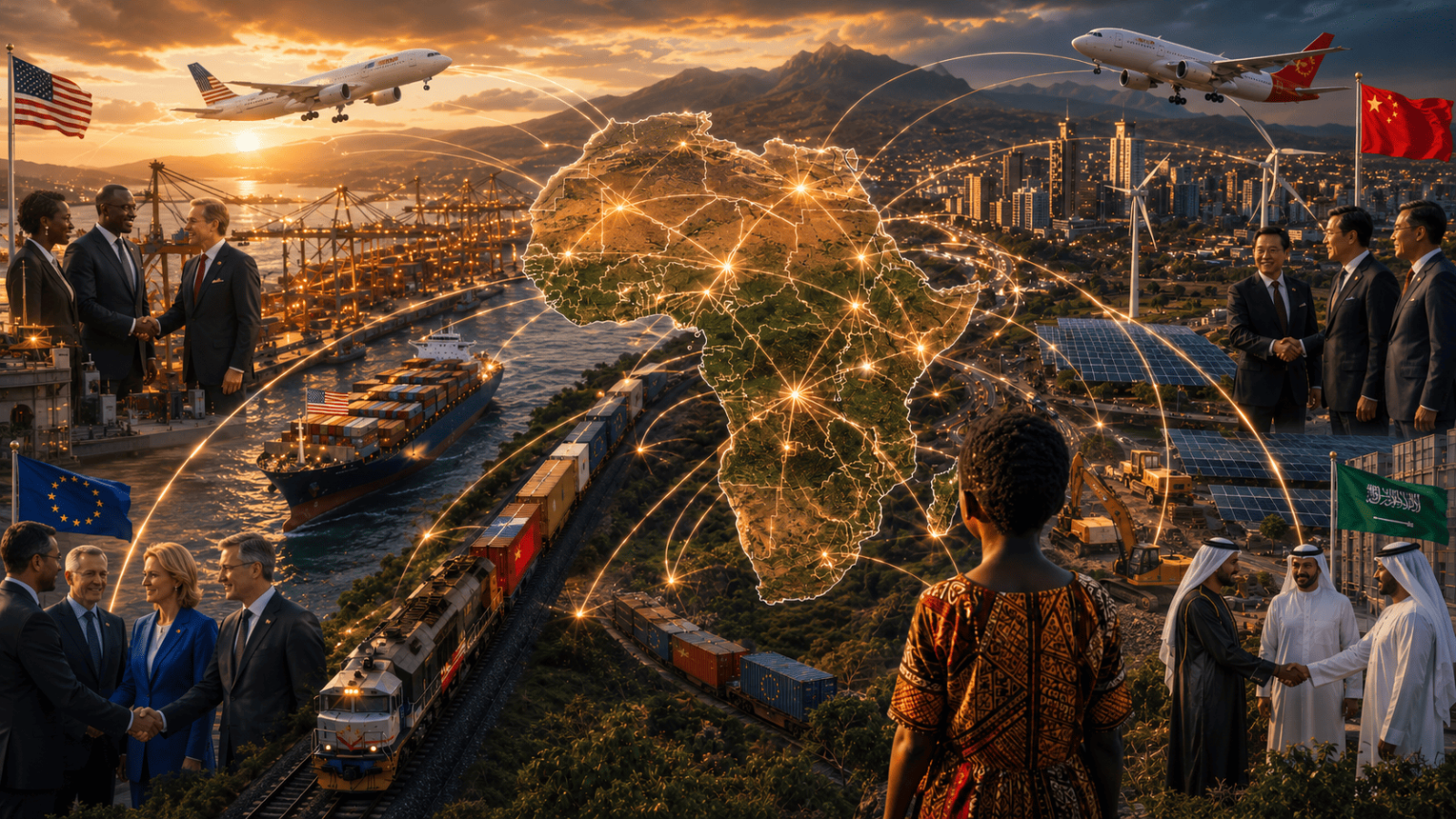
Africa has become the world’s most courted underpriced asset. The United States sees critical minerals, supply-chain security, digital markets and geopolitical balance. The European Union sees green energy, strategic raw materials, migration management and a neighbouring continent too important to leave to rivals. China sees infrastructure, industrial markets, minerals, ports, agriculture and diplomatic depth. The Gulf sees food security and logistics. Russia sees strategic disruption and political leverage.
Africa has become the world’s most courted underpriced asset. The United States sees critical minerals, supply-chain security, digital markets and geopolitical balance. The European Union sees green energy, strategic raw materials, migration management and a neighbouring continent too important to leave to rivals. China sees infrastructure, industrial markets, minerals, ports, agriculture and diplomatic depth. The Gulf sees food security and logistics. Russia sees strategic disruption and political leverage.
The strange part is not that global powers are obsessed with Africa. The strange part is that Africa often behaves as if it is still waiting to be validated.
The numbers explain the attention. The African Development Bank projects Africa’s real GDP growth to rise from 3.3% in 2024 to 3.9% in 2025 and 4.0% in 2026, despite tariff tensions, high debt costs and a tighter global financing environment. The World Bank’s Africa Pulse projects Sub-Saharan Africa to grow 3.8% in 2025, rising to an annual average of 4.4% in 2026–27, while warning that job creation remains far too weak for the scale of population growth ahead.
But Africa’s real value is not GDP growth alone. It is demographic, geological, agricultural, maritime, digital and geopolitical. By 2050, Sub-Saharan Africa is projected to add more than 620 million working-age people, one of the largest labour-force expansions anywhere in the world. That is why the continent is not only a development question. It is a market question, a production question, a supply-chain question and a power question.
The mistake many African leaders and investors make is to read this attention as charity, partnership language or diplomatic theatre. It is not. Big economies do not chase continents for sentimental reasons. They chase leverage.
Washington sees Africa as supply-chain insurance
The United States’ Africa policy is no longer framed only through aid, democracy promotion or counterterrorism. It is increasingly commercial, strategic and industrial.
The U.S. Strategy Toward Sub-Saharan Africa describes Africa’s governments, institutions and people as a “major geopolitical force” and frames the region as important to U.S. national security interests. In economic terms, Washington’s focus is clear: open societies, trade, investment, digital transformation, energy transition and resilient supply chains.
The clearest signal is critical minerals. U.S. policy documents and State Department initiatives repeatedly frame minerals as a supply-chain security issue, not just a development opportunity. The Minerals Security Partnership was created to accelerate diverse and sustainable critical energy mineral supply chains, working with host governments and the private sector. In practical terms, that means the U.S. wants access to the minerals needed for batteries, electric vehicles, defence systems, renewable energy and advanced manufacturing without depending excessively on China-dominated supply chains.
This is why the Democratic Republic of Congo, Zambia, Tanzania, South Africa, Namibia, Mozambique and other resource-rich African countries are now more strategically important than many of them fully price into their own negotiations. Copper, cobalt, graphite, lithium, manganese, nickel, rare earths and platinum-group metals are not ordinary commodities. They are the raw material of industrial sovereignty.
The U.S. also sees Africa through market access. The African Growth and Opportunity Act has long been at the centre of U.S. trade policy toward Sub-Saharan Africa, giving eligible countries duty-free access to the American market for more than 1,800 products, in addition to thousands of other products eligible under the Generalized System of Preferences framework. USTR says U.S. goods and services trade with Africa totalled an estimated $104.9 billion in 2024, up 8.3%from 2023.
That figure is still modest relative to Africa’s potential, but the policy direction matters. Washington is not merely looking at Africa as a recipient of aid. It is looking at Africa as a market, a supply-chain partner, a geopolitical voting bloc, a mineral base and a digital-growth frontier.
The uncomfortable question for Africa is this: if the U.S. sees African minerals as strategic to American industrial security, why do some African governments still negotiate them as isolated mining concessions?
Brussels sees Africa as Europe’s green and security frontier
Europe’s view of Africa is shaped by geography. Africa is not far away from Europe. It is across the Mediterranean, connected by migration flows, energy systems, security concerns, trade routes, climate pressure and historical ties.
The European Union’s Global Gateway Africa–Europe Investment Package aims to mobilise up to €150 billion in investments, with priorities including green transition, digital transition, sustainable growth and job creation, health systems, education and training. That is not a random development package. It is Europe’s attempt to remain relevant in the global infrastructure race while positioning Africa inside Europe’s energy, digital and climate-security architecture.
The green-transition element is central. Europe needs renewable energy partnerships, green hydrogen, critical raw materials, battery inputs, transmission systems, climate-resilient agriculture and lower-carbon industrial supply chains. The Africa-EU Green Energy Initiative, for example, is designed to mobilise more than €20 billion for green energy investments in Africa, supported by European Commission grants, guarantees and blending instruments.
This is where Africa’s bargaining power should be obvious. Europe wants to decarbonise, but decarbonisation requires minerals, land, renewable energy potential and new industrial partnerships. Africa has all four. The continent has solar corridors, wind corridors, hydropower basins, geothermal potential, natural gas transition assets, critical minerals and young labour markets.
Yet the risk is that Africa becomes the raw-material warehouse of Europe’s green transition while importing the finished technologies of that transition at a premium. If African countries export lithium and import batteries, export graphite and import electric buses, export green hydrogen and import industrial equipment, the continent will have repeated the old commodity trap in a cleaner colour palette.
Europe’s policy language speaks of partnership, sustainability and local value creation. Africa’s job is to make that language contractually binding. That means insisting on processing, skills transfer, industrial parks, African manufacturing, technology partnerships, local capital-market development and value-chain participation.
Europe sees Africa as indispensable. Africa must stop negotiating as if it is replaceable.
Beijing sees Africa as infrastructure, markets, and long-cycle influence
China’s view of Africa is the most structurally consistent. For more than two decades, Beijing has treated the continent as a long-cycle economic and diplomatic partner: infrastructure, natural resources, construction, industrial zones, consumer goods, telecoms, ports, railways, power plants, roads, trade finance and political alignment.
The Forum on China-Africa Cooperation remains the main architecture for that relationship. The 2024 Beijing Action Plan lays out cooperation across trade, investment, industrial chains, agriculture, e-commerce, digital economy, infrastructure, green development and people-to-people exchanges. China’s language is not abstract. It is sectoral. It talks about e-commerce cooperation, country pavilions, industrial supply chains, economic cooperation zones and practical trade mechanisms.
At the 2024 FOCAC Summit, China announced about $51 billion in financial support for Africa over three years, with commitments around infrastructure, jobs and modernization. Reuters reported that the package included credit lines, direct investment and support for clean energy and infrastructure projects.
China’s Africa strategy is often criticised for debt exposure and resource-backed infrastructure, sometimes fairly. But the deeper lesson is that China understood African demand before many others did. It understood that African governments needed roads, power, ports and railways. It understood that African traders needed affordable consumer goods. It understood that African telecom and construction markets were underbuilt. It understood that diplomatic consistency creates commercial advantage.
That is why China’s presence is visible not only in presidential palaces but in ordinary markets: phones, tiles, machinery, solar panels, motorcycles, packaging, household goods, construction materials and industrial equipment. China is not only financing infrastructure; it is embedded in the daily operating system of African commerce.
Africa’s problem is not that China trades aggressively. The problem is that many African countries still participate mostly as importers, raw-material suppliers and project recipients. The margin is made elsewhere. The machinery is made elsewhere. The technology is owned elsewhere. The shipping is often controlled elsewhere. The financing is structured elsewhere.
China sees Africa as a market to be served and a production geography to be shaped. Africa should study that discipline instead of only complaining about it.
The continent is rich, but too often commercially underpriced
Africa sits at the centre of several global transitions at once.
The energy transition needs African minerals. Global food security needs African land, water and agribusiness potential. The digital economy needs African users, mobile payments, data centres and young consumers. Global logistics needs African ports and corridors. Climate adaptation needs African forests, carbon markets and renewable projects. Global growth needs new demand as mature economies age.
That is why Africa is courted by Washington, Brussels, Beijing, the Gulf, Ankara, Moscow, New Delhi and Tokyo. Each sees a different balance sheet.
The United States sees supply-chain diversification, strategic minerals, digital markets and geopolitical alignment. The European Union sees green transition, energy security, migration management, regulatory influence and climate partnerships. China sees infrastructure demand, industrial markets, raw materials, diplomatic scale and commercial distribution. Gulf states see ports, food security, farmland, logistics, aviation and tourism. Russia sees arms, energy, mining and political leverage. India sees pharmaceuticals, technology, education, trade and diaspora-linked opportunity.
The common thread is not generosity. It is strategic calculation.
Africa’s difficulty is that it often approaches these engagements country by country, project by project, ministry by ministry. Larger powers think in blocs and systems. Africa often negotiates in fragments.
This fragmentation is expensive. Fifty-four countries negotiate separately with powers that have continental strategies. Mineral-rich countries compete against one another instead of coordinating value-addition rules. Port economies compete without harmonising corridor efficiency. Agricultural countries export raw produce while importing processed food. Countries with young labour forces underinvest in vocational systems. Governments announce industrial parks without power, logistics or anchor tenants.
This is the gap between ownership and power. Africa owns many of the assets the world needs, but it does not yet control enough of the value chains those assets feed.
Foreign capital is necessary, but weak bargaining is optional
Africa needs foreign capital. That point should not be romanticised away. Infrastructure gaps are large, domestic capital markets are shallow in many countries, and the cost of capital remains punishing. UNCTAD’s World Investment Report 2025 says global FDI fell 11% on a like-for-like basis to $1.5 trillion in 2024, marking a second consecutive year of double-digit decline once volatile conduit flows are stripped out. In that environment, attracting serious investment is not easy.
But attracting capital is not the same as building power. The quality of capital matters. So do the terms.
Good capital builds productive capacity. Bad capital extracts margins without technology transfer. Good infrastructure lowers national costs. Bad infrastructure creates debt without competitiveness. Good mining investment builds processing and local supplier ecosystems. Bad mining investment exports raw value and leaves environmental liabilities. Good trade agreements open markets. Bad ones lock countries into low-value participation.
Africa should not reject external interest. It should price it better.
That means stronger negotiation units, continental benchmarking of contracts, better legal capacity, regional industrial policies and public investment agencies that understand balance sheets as well as politics. It means treating ports, minerals, data, land, carbon credits and energy systems as strategic assets, not isolated projects.
Africa must move from potential to pricing power
The most dangerous word in African economics is “potential.” It sounds flattering, but it can become a trap. Potential is what outsiders praise before they capture value. Pricing power is what countries build when they know what they own, what the market needs, and what terms they should demand.
Africa’s next economic leap will depend on whether it can move from destination to strategist.
That means regional value chains instead of raw exports. Local processing instead of commodity dependency. Sovereign wealth thinking instead of short fiscal cycles. Industrial policy instead of project announcements. Trade corridors instead of border delays. Data centres, ports, railways, energy grids and factories instead of endless conferences about opportunity.
It also means the African Continental Free Trade Area must become more than a political achievement. If Africa can make it easier to move goods, services, capital, and people across its own borders, it can negotiate externally from a position of scale. If it fails, external powers will continue to negotiate with fragmented markets and capture the coordination premium.
The world sees Africa clearly because the world reads Africa commercially. It sees population, land, minerals, ports, food systems, energy demand, carbon assets, digital adoption, and geopolitical votes. Africa must now learn to see itself with the same discipline.
The tragedy is not that big economies are obsessed with Africa. That obsession is rational.
The tragedy would be if Africa remains the only major stakeholder that underestimates the value of African leverage.
 Uchumi360
Business Intelligence
Uchumi360
Business Intelligence
Uchumi360 covers business, investment, and economic policy across East, Central, and Southern Africa.
For the serious reader
You read to the end. That places you in a small group.
Uchumi360 is built for readers who demand precision over speed, structure over sentiment, and analysis that holds uncomfortable conclusions rather than softening them. If this work sharpens how you think about Africa's economy, help us keep building the infrastructure behind it.
Institutional Partners
Commission intelligence. Shape the conversation.
Uchumi360 works with development finance institutions, investment firms, sovereign bodies, and strategic organisations across the coverage region. Institutional partnership unlocks:
- Commissioned sector and country intelligence reports
- Branded research series under your institution's authority
- Exclusive data briefings for internal strategy teams
- Speaking and editorial presence at Uchumi360 events
- Co-published investment outlooks for your markets
Support Our Work
Independent analysis has a cost. Help us bear it.
Uchumi360 does not carry advertising. It does not take editorial direction from sponsors. Every article is produced without commercial compromise. Your contribution funds the reporting, research, and editorial infrastructure that keeps this analysis free from influence.
Secure checkout: One-time and monthly support are processed securely. Add payment credentials to enable checkout here.
Stay Connected
Keep up with every new insight.
Follow our latest analysis, policy coverage, and market intelligence as soon as it is published. If you need something specific, reach out directly and we will point you to the right research.
