
The Economics of Pharmaceuticals in East Africa: Foreign Giants, Local Players and the Fight for Market Control
Ready
East Africa is already paying for a pharmaceutical industry. The question is whether it will keep paying foreign factories, foreign ingredient suppliers and foreign distributors or build a regional industrial base capable of supplying its own hospitals, pharmacies and public-health programmes. Medicine is not only a health product. It is one of East Africa’s clearest tests of whether demand can become industry.
East Africa’s pharmaceutical market is no longer just a health-sector story. It is becoming a contest over industrial policy, public procurement, foreign exchange, health security and regional market control.
The region has demand. It has a growing population, expanding cities, rising chronic diseases, more private pharmacies, wider health-insurance ambitions and governments under pressure to provide affordable medicines. What it does not yet have is enough competitive local pharmaceutical manufacturing.
That gap has created a market dominated by imports, foreign manufacturers, donor procurement systems, regional distributors and private wholesalers. East Africa is buying medicine, but it is not yet building enough of the industrial economy behind that medicine.
The import numbers tell the story.
Kenya, the region’s most developed pharmaceutical manufacturing base, still imported roughly USD 705 million to USD 743 million worth of pharmaceutical products in 2024, depending on the trade database used. Tanzania imported about USD 359 million to USD 403 million in 2024. Uganda’s imports of medical and pharmaceutical products rose from USD 306.3 million in 2019 to USD 534.2 million in 2023, after reaching USD 578.4 million in 2022. Rwanda imported roughly USD 77 million to USD 101 million in medicinal and pharmaceutical products in 2024, depending on classification.
Taken together, Kenya, Tanzania, Uganda and Rwanda alone represent more than USD 1.6 billion in recent annual pharmaceutical imports. That excludes Democratic Republic of Congo, Burundi, South Sudan and Somalia, which would make the regional demand pool much larger.
This is not a small medicine market. It is a fragmented import market waiting to become a regional manufacturing and distribution market.
The East African Community has known this for years. Its Second East African Community Regional Pharmaceutical Manufacturing Plan of Action, 2017–2027 identified import dependence, weak manufacturing capacity, regulatory fragmentation and limited competitiveness as core problems. The plan was designed to support local pharmaceutical production, improve compliance with Good Manufacturing Practice, strengthen regulation and help regional manufacturers compete.
The wider African picture confirms the problem. The United Nations Conference on Trade and Development has noted that Africa imports more than 70% of its pharmaceuticals, mainly from Asia, while local production is concentrated in a limited number of countries and often focused on lower-complexity medicines.
That means East Africa’s pharmaceutical challenge cannot be treated only as a healthcare issue. It is a manufacturing, trade, supply-chain and industrial-policy issue.
The real question is who controls the market
Pharmaceutical market control happens in four places.
First, it happens in manufacturing. Whoever makes the medicine captures factory value, technical know-how, employment, supplier contracts and quality systems.
Second, it happens in active pharmaceutical ingredients. These are the core ingredients used to make medicines. If local factories import nearly all active ingredients from Asia, they remain exposed to foreign suppliers, exchange-rate pressure, freight costs and global supply shocks.
Third, it happens in procurement. Governments, donor programmes, hospitals and insurance-linked buyers purchase medicines in large volumes. Whoever wins procurement contracts controls large parts of the market.
Fourth, it happens in distribution. Medicines must move through importers, wholesalers, pharmacies, hospitals, clinics, public-health programmes and sometimes donor-funded channels. A company that controls distribution can influence pricing, availability and market access even if it does not manufacture.
Foreign manufacturers still dominate because they have scale. Many benefit from large production runs, cheaper inputs, mature supply chains, established regulatory approvals, stronger technical capacity and lower unit costs. Indian and Chinese manufacturers, in particular, have become powerful suppliers of affordable generic medicines across Africa.
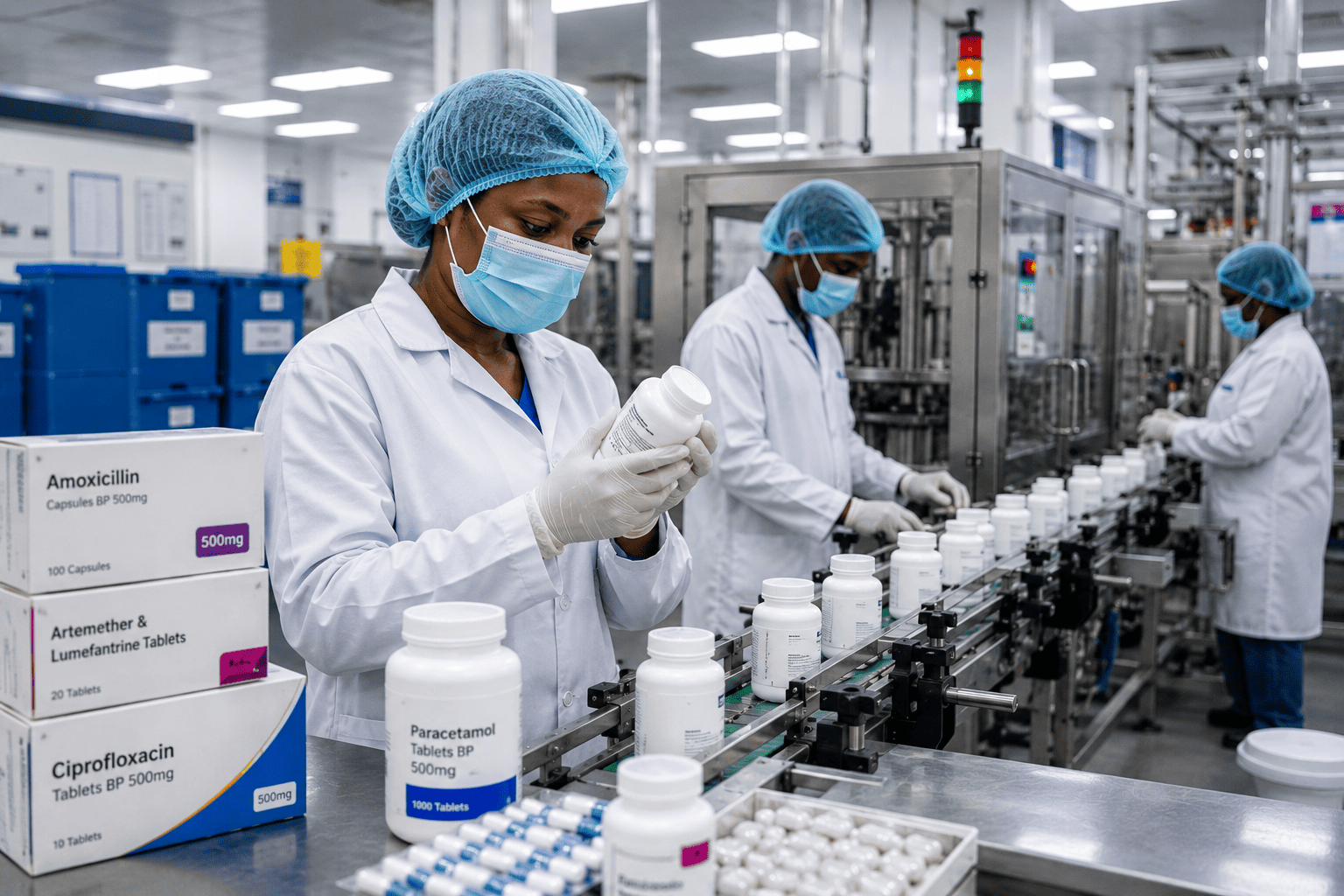
Local firms are present, but many remain concentrated in basic generics, oral tablets, syrups, creams, selected antibiotics, painkillers and essential medicines. Those products matter, but the highest-value parts of the pharmaceutical economy are often elsewhere: active pharmaceutical ingredients, sterile injectables, vaccines, biologics, insulin, oncology drugs, advanced formulations, diagnostics, medical devices, quality-testing laboratories and specialised cold-chain systems.
That is where the fight for market control is moving.
Kenya has the strongest base, but still imports heavily
Kenya is East Africa’s most mature pharmaceutical manufacturing market. It has more established local manufacturers, better industrial depth, a larger private healthcare market and stronger distribution networks than most of its neighbours.
But Kenya’s import bill shows the limits of that advantage. A country can have local pharmaceutical companies and still remain structurally dependent on imported medicines. Kenya’s 2024 pharmaceutical imports of roughly USD 705 million to USD 743 million show that local manufacturing has not yet displaced imported supply at scale.
The issue is not that Kenya lacks pharmaceutical firms. The issue is that many imported products come from manufacturers with deeper scale, cheaper active ingredients and stronger export pricing. Local companies must compete not only against foreign brands, but against entire foreign industrial systems.
This is why Kenya’s challenge is no longer simply to have pharmaceutical manufacturers. It is to help those manufacturers upgrade, specialise, reduce costs, meet stricter standards and access regional markets.
Tanzania is trying to turn demand into industry
Tanzania has population scale, rising healthcare demand and an industrial-policy reason to reduce dependence on imports. Its 2024 pharmaceutical import bill, estimated at about USD 359 million to USD 403 million, shows a sizeable market.
The government has been positioning healthcare manufacturing as an investment priority. In 2026, the United States International Trade Administration reported that Tanzania had hosted its first Pharmaceutical Production Investment Forum to attract investment in drug manufacturing equipment, vaccine research, medical instruments and local production of essential medicines.
That is the right direction, but the economics are difficult. Pharmaceutical manufacturing needs reliable electricity, clean water, laboratories, technical staff, specialised equipment, regulatory capacity, expensive quality systems and patient capital. It is not the same as basic consumer-goods manufacturing.
Tanzania’s opportunity is to build around essential medicines, medical consumables, selected formulations, packaging, diagnostics and regional distribution. Over time, it can move into more complex products, but only if the industrial base is built carefully.
Uganda is import-dependent, but has a serious upside story
Uganda’s import trend is one of the clearest signals of rising pharmaceutical demand. Medical and pharmaceutical imports rose from USD 306.3 million in 2019 to USD 534.2 million in 2023, after peaking at USD 578.4 million in 2022.
That growth is not just a cost. It is a map of unmet industrial capacity.
Uganda is also attracting attention because of investments in more advanced local manufacturing. Gavi has highlighted Dei BioPharma in Uganda among African companies beginning to work on local pharmaceutical ingredient production, a shift that could matter if it moves beyond announcement into consistent, regulated production.
The upside is regional. Uganda does not need to think only about its domestic market. If it builds credible manufacturing capacity, it can serve parts of East Africa and Central Africa, especially Democratic Republic of Congo and South Sudan. But that requires strong regulation, quality assurance, procurement access and distribution discipline.
Rwanda’s opportunity is regional, not domestic
Rwanda is a smaller pharmaceutical market, with medicinal and pharmaceutical imports estimated at roughly USD 77 million to USD 101 million in 2024 depending on product classification.
Its limitation is scale. Its advantage is execution.
Rwanda can position itself around specialised manufacturing, diagnostics, regulatory coordination, health innovation, medical technology, pharmaceutical logistics and regional procurement systems. It is unlikely to become East Africa’s largest medicine producer by volume, but it can become a high-trust node in the regional health economy.
For Rwanda, the pharmaceutical opportunity must be regional from the beginning. The domestic market alone is too small to support large-scale manufacturing in many categories.
Democratic Republic of Congo, South Sudan and Somalia are demand markets
Democratic Republic of Congo, South Sudan and Somalia matter because they represent demand-heavy, supply-constrained markets. Their pharmaceutical needs are large, especially around essential medicines, maternal health, infectious diseases, emergency care, humanitarian supply chains and basic medical consumables.
But they also face serious constraints: weak infrastructure, fragile regulation, logistics challenges, security risks and fragmented distribution. For East African manufacturers, these markets are not easy, but they are important. If regional producers can meet standards and manage logistics, these countries can become major downstream markets.
That is why East Africa’s pharmaceutical strategy should not be limited to Kenya, Tanzania, Uganda and Rwanda. It should include the wider regional demand belt.
Local production cannot survive on patriotism
The case for local pharmaceutical manufacturing is strong, but it must be honest.
Patients do not owe local companies loyalty if medicines are poor quality. Pharmacies do not owe local manufacturers shelf space if supply is unreliable. Governments cannot safely buy locally if products fail standards. Hospitals cannot accept weak medicines in the name of industrialisation.
Local production must win on quality, reliability, price discipline and regulatory compliance.
That is where Good Manufacturing Practice becomes important. Good Manufacturing Practice refers to internationally recognised systems that ensure medicines are consistently produced and controlled according to quality standards. The East African Community Good Manufacturing Practice roadmap argues that local pharmaceutical manufacturing can succeed only if companies produce safe, high-quality and effective medicines and comply with recognised standards.
This is the difference between serious industrial policy and protected inefficiency. A local manufacturer that meets quality standards deserves strategic support. A local manufacturer that cannot meet standards should not be protected at the expense of patients.
Procurement is the hidden battlefield
Public procurement is one of the largest sources of pharmaceutical demand. Governments, hospitals, donor programmes and public-health institutions buy medicines in large volumes.
But procurement often rewards the cheapest compliant supplier. That usually favours large foreign producers with lower costs and deeper supply chains. Local manufacturers then struggle to compete, even when governments publicly support local production.
This creates a contradiction. Governments want local pharmaceutical industries, but their procurement systems often reinforce import dependence.
The solution is not careless local preference. The solution is smarter procurement. East African governments can design procurement rules that support local manufacturers only when they meet Good Manufacturing Practice standards, deliver reliably, maintain price discipline and produce priority medicines.
A badly designed local-preference policy creates expensive inefficiency. A well-designed one creates regional champions.
Regulation can make or break the industry
Medicine is not ordinary trade. Quality failures can harm or kill people. That makes regulation central to the economics of pharmaceuticals.
East Africa needs stronger medicine regulators, faster product registration, better inspection systems, more testing laboratories, stronger post-market surveillance and regional recognition of approvals.
Regulatory harmonisation is especially important. A manufacturer in Tanzania, Kenya, Uganda or Rwanda should not have to go through slow, duplicative and expensive approval processes in every East African market for the same product. A real regional pharmaceutical market requires faster mutual recognition, shared standards and credible enforcement.
Without regulatory harmonisation, local manufacturers remain trapped in small national markets. With harmonisation, they can scale regionally.
Distribution decides who reaches the patient
Even when a medicine is manufactured locally, it still has to reach patients. Distribution is one of the most powerful parts of the pharmaceutical economy.
Importers, wholesalers, pharmacy chains, hospital suppliers, donor-funded programmes and private clinics shape what medicines are available, at what price, and from which suppliers. In many East African markets, established import-distribution systems are stronger than local manufacturing-distribution systems.
This means local manufacturers are not only competing with foreign factories. They are competing with foreign-linked distribution channels that already have relationships, credit systems, pharmacy access and procurement experience.
A serious local pharmaceutical strategy must therefore include distribution. Factories alone are not enough.
The Covid-19 lesson remains relevant
The Covid-19 pandemic exposed Africa’s dependence on global health supply chains. The continent learned that purchase orders do not equal production power. When global shortages appear, countries with manufacturing capacity are treated differently from countries waiting in procurement queues.
That lesson applies beyond vaccines. Antibiotics, antimalarials, antiretrovirals, insulin, oncology medicines, cardiovascular medicines, maternal-health drugs, diagnostic reagents, syringes, gloves, intravenous fluids and medical consumables are not just trade goods. They are health-security assets.
East Africa cannot make everything locally. But it must make more of what it reasonably can.
The market-control question
The future of East Africa’s pharmaceutical industry will be decided by five questions.
Can local firms move beyond basic generics into higher-value products such as sterile injectables, diagnostics, medical consumables, advanced formulations and selected active pharmaceutical ingredients?
Can governments use procurement to build local industry without compromising quality or overpaying for weak products?
Can the East African Community become a real medicines market, where manufacturers can produce for the region rather than only for one country?
Can foreign pharmaceutical firms be encouraged to transfer technology, manufacture locally, package locally or enter serious contract-manufacturing partnerships?
Can local capital understand pharmaceuticals as long-term industrial infrastructure rather than quick trading?
These questions matter because the market is already there. The patients are there. The pharmacies are there. The import bills are there. The procurement budgets are there. The disease burden is there.
What remains underbuilt is the regional industrial machine.
The way forward
East Africa should not aim for pharmaceutical isolation. That would be unrealistic. Some advanced medicines require global research, deep capital and highly specialised production systems. Imports will remain necessary.
The smarter strategy is more precise: import what the region cannot yet make, manufacture what it reasonably can, and negotiate better terms for everything in between.
The first priority should be essential medicines, selected generics, medical consumables, pharmaceutical packaging, diagnostics, intravenous fluids, basic sterile products and quality-testing laboratories.
The second priority should be regional scale. A Kenyan, Tanzanian, Ugandan or Rwandan manufacturer should be able to serve the wider East African market efficiently.
The third priority should be quality. Local production must be tied to Good Manufacturing Practice, strong regulation and post-market surveillance.
The fourth priority should be industrial finance. Pharmaceutical manufacturing needs patient capital, not short-term trading loans.
The fifth priority should be supplier ecosystems. Packaging, laboratories, cold-chain logistics, active ingredient sourcing, equipment maintenance and technical training all matter.
The final test
East Africa is already paying for a pharmaceutical industry. The question is whether it will keep paying foreign factories, foreign ingredient suppliers and foreign distributors or build a regional industrial base capable of supplying its own hospitals, pharmacies and public-health programmes.
Medicine is not only a health product. It is one of East Africa’s clearest tests of whether demand can become industry.
The fight for market control will not be won by slogans about health sovereignty. It will be won by factories that meet standards, regulators that protect patients, procurement systems that reward quality, investors that understand long-term manufacturing economics, and governments that turn the East African Community from a policy bloc into a real pharmaceutical market.
 Uchumi360
Business Intelligence
Uchumi360
Business Intelligence
Uchumi360 covers business, investment, and economic policy across East, Central, and Southern Africa.
For the serious reader
You read to the end. That places you in a small group.
Uchumi360 is built for readers who demand precision over speed, structure over sentiment, and analysis that holds uncomfortable conclusions rather than softening them. If this work sharpens how you think about Africa's economy, help us keep building the infrastructure behind it.
Institutional Partners
Commission intelligence. Shape the conversation.
Uchumi360 works with development finance institutions, investment firms, sovereign bodies, and strategic organisations across the coverage region. Institutional partnership unlocks:
- Commissioned sector and country intelligence reports
- Branded research series under your institution's authority
- Exclusive data briefings for internal strategy teams
- Speaking and editorial presence at Uchumi360 events
- Co-published investment outlooks for your markets
Support Our Work
Independent analysis has a cost. Help us bear it.
Uchumi360 does not carry advertising. It does not take editorial direction from sponsors. Every article is produced without commercial compromise. Your contribution funds the reporting, research, and editorial infrastructure that keeps this analysis free from influence.
Secure checkout: One-time and monthly support are processed securely. Add payment credentials to enable checkout here.
Stay Connected
Keep up with every new insight.
Follow our latest analysis, policy coverage, and market intelligence as soon as it is published. If you need something specific, reach out directly and we will point you to the right research.
