
10 Sectors That Will Create Kenya's Next Generation of Millionaires Over the Next Decade. The Window Is Open Now.
Ready
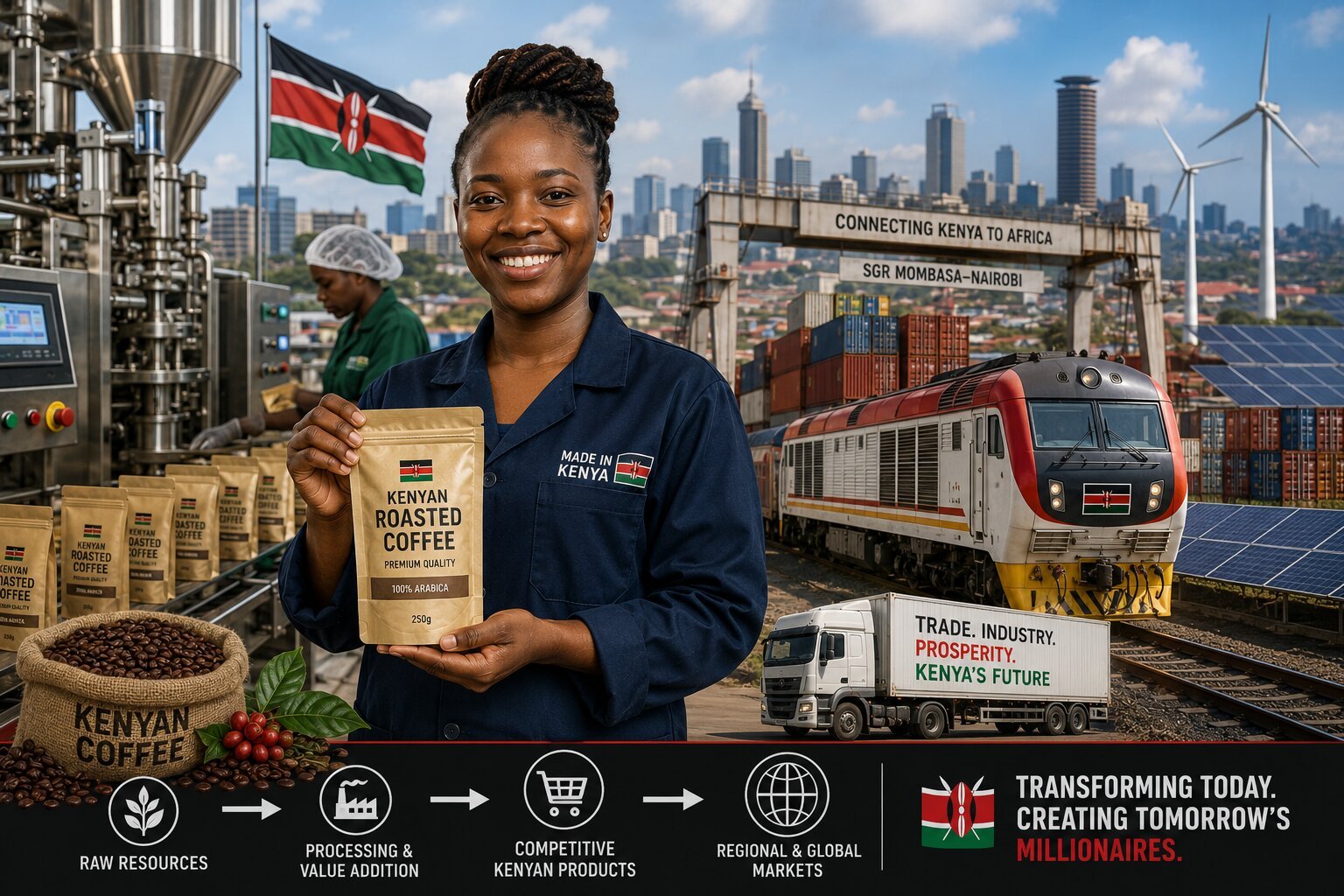
Kenya's economy is poised for a decade of structural transformation driven by the government's Bottom-Up Economic Transformation Agenda, a manufacturing sector targeted to reach 15% of GDP by 2027 from its current 7 to 8%, tourism revenues that reached a record KSh 500 billion in 2025, renewable energy attracting USD 537 million in investment in 2024 alone, and the AfCFTA's regional market of 1.4 billion people whose opening is restructuring the commercial logic of every export-oriented business decision made in Nairobi. Agriculture accounts for approximately 22 to 23% of GDP and employs 42% of Kenyans but processes only a fraction of its output domestically. Kenya imports the majority of its pharmaceutical needs despite having 35 or more local drug formulation firms. Tourism is growing at approximately 10% annually with a government target of 5 million international visitors by 2027. The circular economy is estimated to hold over USD 700 million in unlocked value by 2030. These are not abstract opportunity categories. They are specific structural gaps between what Kenya produces and what it could produce, between what it exports raw and what it could export processed, between what it imports and what it could manufacture domestically. The entrepreneurs who close those gaps over the next decade will generate the wealth that structural transformation historically produces for those positioned ahead of the inflection point. Kenya's wealth creation opportunity is concentrated in the gap between what the economy currently does with its resources and what it could do with them. The entrepreneurs who close that gap over the next ten years will be the millionaires of 2035.
Kenya is entering one of the most consequential decades in its economic history, and the entrepreneurs who understand what is driving the transformation and position themselves ahead of its peak will generate the kind of wealth that structural economic shifts have always produced for those who read them correctly. The government's Bottom-Up Economic Transformation Agenda is directing policy resources toward the productive economy whose expansion the manufacturing, agriculture, and construction sectors require. Tourism revenues hit a record KSh 500 billion, approximately USD 3.84 billion, in 2025 according to Kenya Tourism Board data, with 7.9 million total visitors including 5.2 million domestic travellers. Kenya attracted USD 537 million in energy and environmental investment in 2024, the highest of any African country. Manufacturing created approximately 347,000 new jobs in 2024, the single largest sectoral contribution to formal employment. The AfCFTA's market of 1.4 billion people across 55 countries is the commercial backdrop for every export-oriented business decision made in Kenya over the next decade.
The sectors that follow are structural gap analyses rather than trend predictions. Capital entry ranges, growth rates, and break-even timelines are drawn from Kenya National Bureau of Statistics data, Central Bank of Kenya sector reports, InvestKenya assessments, and industry associations. The entrepreneurs named have already demonstrated the model works. The question is who scales it next.
1. Agriculture and agribusiness
Agriculture accounts for approximately 22 to 23% of GDP and employs roughly 42% of Kenyans according to Kenya National Bureau of Statistics data, making it the single largest sector by employment and one of the most consequential by output. Kenya's competitive position in global agricultural markets is already established: coffee, tea, and spices exports reached approximately USD 1.7 billion in 2024 according to Kenya Revenue Authority trade data, and floriculture exports, cut flowers and plants, reached approximately USD 790 million in the same year according to Kenya Flower Council data. Yet the value addition opportunity remains substantially uncaptured. Dairy processors handled approximately 572,000 tonnes of milk in 2023 according to Kenya Dairy Board data, up from 488,000 tonnes in 2022, but the market for processed dairy products, milk powder, yoghurt, cheese, and premium packaged milk, is growing faster than domestic processing capacity is expanding to serve it.
The government's push into specialty orthodox tea, targeting capacity expansion from 15,000 to 200,000 tonnes by 2030 according to the Kenya Tea Development Agency, illustrates the value addition logic precisely: specialty auction prices reach USD 3 to 10 per kilogram against approximately USD 2.28 per kilogram for bulk tea, meaning the same agricultural output generates two to four times the revenue when processed and positioned for premium markets. Gerald Kungu invested approximately KSh 1 million in dairy farming and now earns approximately KSh 150,000 per month, demonstrating the income generation that disciplined agribusiness produces for entrepreneurs who move beyond primary production into processing and branded product development.
Entry capital ranges from under USD 1,000 for input trading and aggregation to USD 200,000 or more for a small processing plant. A citrus juice processing facility serving East African regional markets can reach USD 1 to 2 million in annual revenue by year five. A branded specialty coffee roaster targeting export and domestic café markets requires USD 50,000 to 100,000 in equipment. Break-even is typically achievable in three to five years for operations that secure reliable raw material supply through contract farming or cooperative models.
2. Manufacturing and industry
Manufacturing currently contributes approximately 7 to 8% of Kenya's GDP according to Kenya National Bureau of Statistics data but is targeted to reach 15% by 2027 under national industrial policy, a doubling whose achievement over a decade would make manufacturing the single most consequential structural shift in the Kenyan economy and the source of the largest concentrated wealth creation opportunity available to entrepreneurs who position early in its expansion. Kenya is already the most competitive manufacturing hub in East Africa by GDP share contribution, and the sector employs approximately 22% of the formal workforce. Key sub-sectors include agro-processing, textiles and apparel, pharmaceuticals, and automobile and electric vehicle assembly.
The pharmaceutical dimension is particularly compelling. Kenya's pharmaceutical market reached approximately USD 1.3 billion in 2024 according to the Pharmaceutical Society of Kenya, with 35 or more local drug formulation firms supplying the domestic market and exporting to regional neighbours whose pharmaceutical import dependence creates demand that Kenyan manufacturers are commercially positioned to serve. The sector grew from KSh 36.9 billion in 2022 to KSh 41 billion in 2023 according to Kenya Pharmacy and Poisons Board data, representing 11.1% annual growth whose trajectory is being accelerated by regional pharmaceutical harmonisation and the AfCFTA's preferential market access.
Special Economic Zones at Konza, Naivasha, and other locations offer one-stop government services, tax incentives, and reduced operational friction for manufacturing investment. Apparel exports could reach USD 600 million by 2030 according to InvestKenya projections as new industrial parks come online. A small garment unit with USD 50,000 initial investment generating USD 150,000 in annual sales can reach a mid-sized factory with USD 1 million or more in regional revenue by year five to seven with disciplined reinvestment and the brand development that higher manufacturing margin requires.
3. Construction and real estate
Kenya's rapid urbanisation and sustained infrastructure investment make construction and real estate one of the decade's most structurally supported growth sectors. The sector's output grew by approximately 33.7% between 2019 and 2023 according to Kenya National Bureau of Statistics construction data, and real estate contributes approximately 11% of GDP. The government's affordable housing programme is targeting 500,000 new units over five years, creating sustained public procurement demand alongside the private residential and commercial development whose pace Nairobi's expansion as a regional financial hub is driving.
Construction grew approximately 9% in 2023 and is forecast to grow 6 to 10% annually through 2030 driven by both public infrastructure budgets and private estate development. The Dar es Salaam to Dodoma corridor equivalent in Kenya is the Nairobi to Mombasa and Nairobi to Kisumu urban expansion whose commercial and residential demand is creating opportunities across every sub-sector from building materials manufacturing to specialist contracting to property development. Real estate in Nairobi's listed companies and institutional property funds generated profits measured in tens of billions of Kenya shillings in 2025 according to Capital Markets Authority Kenya filings.
A specialist contracting firm, electrical installation, plumbing, roofing, or landscaping, can begin with capital of USD 10,000 to 50,000 and scale by reinvesting profits to pursue progressively larger project contracts. A brick or concrete block manufacturing operation with capital of USD 50,000 can supply the large construction projects whose material procurement is currently drawing from whatever domestic supply is available. A property development partnership that pools capital through a savings and credit cooperative to acquire land and build rental housing in periurban areas represents the entry pathway whose returns compound with land appreciation and rental income across the development horizon.
4. Tourism and hospitality
Tourism contributed KSh 500 billion, approximately USD 3.84 billion, to Kenya's economy in 2025 according to Kenya Tourism Board data, up 10% from 2024, with 7.9 million total visitors of whom 5.2 million were domestic travellers. The government's target of 5 million international visitors by 2027 alongside the sustained growth of domestic tourism driven by a rising urban middle class creates the demand trajectory that tourism sector investment requires to justify multi-year capital commitment. The sector is projected to grow 8 to 10% annually to 2035 according to World Travel and Tourism Council projections.
The domestic tourism dimension is particularly important for understanding the scale and accessibility of the opportunity. Kenya Airways and Jambojet's domestic route networks, combined with improved road access to national parks and the expanding range of accommodation options from budget hostels to premium bush camps, have made domestic tourism one of the fastest-growing segments of the overall visitor economy. Niche positioning is the competitive strategy that outperforms scale in this sector: safari companies specialising in bird-watching, photography, cultural heritage, or adventure sports command premium pricing from smaller but higher-spending visitor segments whose willingness to pay reflects the differentiated experience rather than the conventional safari commodity.
A small boutique eco-lodge investment of USD 500,000 to USD 2 million in a conservation area or coastal location can generate USD 100,000 or more in annual net profit once established. A safari company starting with a small fleet and specialist positioning can achieve break-even within two to three years and generate cash flows sufficient to acquire owned accommodation assets by year four to five. Visa reforms and the East African Community's expanded visa-free access for African nationals are expanding the regional tourist source market in ways that businesses positioned for African travellers will benefit from disproportionately.
5. Renewable energy and clean technology
Kenya is a continental leader in renewable energy: approximately 90% of its grid power is generated from renewables as of 2024 according to Kenya Energy and Petroleum Regulatory Authority data, comprising geothermal at 47%, hydro at 21%, wind at 16%, and solar at 4%. Kenya attracted USD 537 million in energy and environmental investment in 2024, the highest of any African country, according to cross-border investment tracking data. Yet electrification remains incomplete in off-grid rural areas, and clean cooking access reaches only approximately 34% of the population according to the Kenya National Cooking Survey, creating structural demand for renewable energy solutions whose economics the falling cost of solar photovoltaic technology has made commercially viable for private sector deployment.
The National Energy Compact's 2025 to 2030 targets call for nearly doubling Kenya's renewable capacity to 5,952 megawatts, with private sector targets including 200,000 solar home systems per year and 400,000 new mini-grid and stand-alone connections by 2030. The national clean cooking strategy targets 100% access by 2030 and offers tax breaks on imported clean stoves and fuel whose combined effect is creating policy-backed demand that commercial renewable energy businesses can serve. The Sustainable Waste Management Act and Extended Producer Responsibility regulations are simultaneously creating circular economy opportunities whose intersection with renewable energy in waste-to-energy applications creates adjacent business models for entrepreneurs serving both sectors.
Leroy Mwasaru's biogas initiative, recognised in Forbes 30 Under 30 in 2020, demonstrates the model whose replication and scaling the policy environment supports. A solar home system leasing operation can begin with inventory of USD 5,000 to 20,000 and build a recurring revenue base as the customer portfolio grows. Off-grid solar growing at approximately 30% annually provides the demand trajectory that small and medium renewable energy enterprises require to justify expansion investment. A plastic recycling plant handling 100 tonnes per month can reach USD 1 million in annual revenue within two to three years given the raw material availability and the export demand for recycled content that European and North American manufacturers are creating.
6. Logistics and transport
Kenya's position as the gateway to East and Central Africa fuels demand for logistics and transport whose scale the Standard Gauge Railway's inland logistics restructuring, the Mombasa port's capacity expansion, and the Lamu port's new operational status are collectively increasing. The logistics sector comprises approximately 10 to 12% of GDP including transport services, and is projected to grow 6 to 9% annually to 2035 driven by trade volume growth whose AfCFTA acceleration is beginning to materialise in cross-border freight flows to Uganda, Rwanda, Burundi, and South Sudan.
The trucking opportunity is the most accessible entry point for young entrepreneurs without specialised technical training. A single used truck acquired for approximately USD 50,000 operating on haul contracts from Mombasa to Nairobi or Nairobi to Kampala can generate approximately USD 150,000 in annual revenue at a net margin of approximately 15%. A fleet of 10 to 20 trucks acquired through reinvestment over five to six years represents the business whose equity value and cumulative profit surpasses USD 1 million within the decade. Cold chain logistics for horticultural and fisheries exporters who require refrigerated transport from production zones to Nairobi international airport or Mombasa port commands a premium over standard freight whose margin reflects the product's temperature sensitivity and the infrastructure investment required to serve it reliably.
Courier and last-mile delivery services connecting e-commerce merchants and wholesale distributors to retail and household customers in secondary cities and periurban areas represent the growth frontier whose commercial viability is increasing as domestic consumer spending growth creates demand that national courier networks are not yet configured to serve at the density and speed that the market requires. A courier service achieving 50,000 deliveries monthly by year five at an average of KSh 1,000 per delivery generates KSh 50 million in monthly revenue whose profit margin at 15% creates the cash flow that fleet expansion and geographic coverage expansion require.
7. Health and pharmaceuticals
Kenya's healthcare market is worth approximately USD 3 to 4 billion annually and growing at 7 to 8% per year according to Kenya Medical Research Institute and health sector analysis data. Private healthcare accounts for approximately 50% of hospital beds, and high-end clinics in Nairobi and Mombasa are attracting medical tourists from Uganda, Tanzania, Rwanda, South Sudan, and Ethiopia whose public health system quality makes Kenyan private healthcare commercially attractive at premium price points. The pharmaceutical sector grew from KSh 36.9 billion in 2022 to KSh 41 billion in 2023, representing 11.1% growth, and local firms now supply approximately 70% of generic medicines by volume to the Kenyan market while exporting to regional neighbours.
The government's universal health coverage programme and NHIF reforms are expanding the insured population in ways that increase private sector healthcare utilisation and create the patient volume that private clinic profitability requires. The Universal Health Coverage rollout, combined with county-level devolution of health budget allocation, is creating demand for private healthcare services in secondary cities whose public infrastructure is insufficient to serve growing populations at the quality standard that rising incomes create expectations for.
A private multi-specialty clinic or diagnostic centre in an underserved secondary city requires initial capital of USD 20,000 to 50,000 for a small facility and can scale to a chain of three to four clinics generating USD 2 to 3 million in combined annual revenue by year seven to ten. A pharmaceutical distribution operation serving a regional territory, acquiring smaller pharmacy outlets and consolidating distribution logistics, can reach significant scale through systematic acquisition whose financing is available through commercial bank sector lending to healthcare businesses.
8. Education and training
Kenya's education market is worth several billion dollars annually and grows at 7 to 9% per year driven by a population whose 50% youth composition creates continuous new enrolment demand and whose rising income is shifting preference from public to private education at both primary and secondary levels. The owner of Makini Schools reported approximately KSh 15 billion in profit in 2025, demonstrating the wealth generation potential of the sector's most successful operators. Hundreds of private school chains operating across Kenya at smaller scale are generating the recurring revenue and asset appreciation whose combination creates millionaire-level net worth for their founders over a decade of disciplined growth.
The vocational and technical training dimension is particularly relevant to the broader industrial transformation that Kenya's manufacturing and construction targets require. Technical and vocational education institutions training mechanics, electricians, plumbers, welders, solar technicians, and logistics operators are experiencing demand growth driven by the infrastructure investment and manufacturing expansion whose workforce requirements the public technical education system cannot meet at the pace the economy requires.
A private secondary school with 1,000 students generating USD 2 to 3 million in annual revenue and a net margin of 20 to 25% produces annual profit of USD 400,000 to 750,000 whose reinvestment into additional campuses compounds the asset base toward USD 1 million net worth within eight to ten years. A specialist vocational training institute positioned around the skills that Kenya's manufacturing, construction, and renewable energy expansion require can achieve strong enrolment growth and premium fee structures that reflect the employment placement rate which skills scarcity in technical occupations supports.
9. Circular economy and recycling
Kenya generates approximately 22,000 tonnes of waste daily according to National Environment Management Authority data, of which only approximately 4% is recycled, creating an efficiency gap whose economic value a recent analysis estimates at over USD 700 million by 2030. The Sustainable Waste Management Act and Extended Producer Responsibility regulations are creating the legal framework that obliges manufacturers to manage plastic and electronic waste, generating predictable input supply for recycling operations and the corporate procurement demand that gives recycled material businesses bankable revenue contracts.
Kenya already has approximately 120 circular economy startups in waste and recycling according to SystemIQ industry mapping, demonstrating the commercial model's viability across plastic recycling, organic waste composting, e-waste refurbishment, and upcycled product manufacturing. The off-grid solar connection between this sector and the renewable energy sector creates natural business combinations: biogas from organic waste serving household cooking energy demand, and solar-powered recycling processing facilities serving the export market for recycled materials.
Entry capital is among the lowest of any sector on this list. A waste collection hub with sorting and baling equipment requires less than USD 10,000 to establish. A small plastic pipe extrusion unit producing PVC products from recycled plastic waste requires USD 30,000 to 50,000. The business that achieves 1 tonne per day processing scale by year three generates approximately USD 200,000 in annual revenue at circular economy margins, with the novelty and social impact narrative that attracts impact investor capital whose availability in this sector is increasing as European and North American corporate sustainability commitments create demand for verifiable recycled content.
10. Fisheries and aquaculture
Kenya's blue economy targets 450,000 tonnes of fish production by 2030, up from approximately 188,000 tonnes in 2018 according to Kenya Fisheries Service data, requiring the aquaculture expansion whose commercial investment the government's extension services, fingerling subsidies, and Blue Economy strategy are designed to catalyse. Aquaculture is growing at an estimated 10 to 12% annually as wild fish stocks plateau, making fish farming one of East Africa's fastest-growing food production sectors by growth rate. The domestic fish consumption growth driven by health consciousness and protein demand among Kenya's rising urban middle class is creating the offtake demand that aquaculture operations require to justify production investment.
Lake Victoria, Lake Baringo, Lake Naivasha, and Kenya's Indian Ocean coastline create the geographic diversity of aquaculture opportunity whose scale ranges from small family tilapia ponds requiring initial capital of approximately KSh 100,000 to large floating cage farms on Lake Victoria requiring hundreds of thousands of Kenya shillings in equipment and feed inventory. The value addition opportunity in fish processing, filleting, freezing, smoking, and packaging for retail distribution and export, commands substantially higher prices per kilogram than fresh fish trading and creates the margin whose accumulation builds the wealth that primary production alone does not generate at the scale required.
An integrated fish farming and processing enterprise producing 1,000 tonnes annually and selling value-added fillets and processed products can generate approximately USD 1 million in annual revenue by year eight to ten, with the processing premium over raw fish pricing providing the margin that funds the asset accumulation whose value constitutes the millionaire net worth. Youth fish farming cooperatives pooling land and capital on lake shores or coastal areas, sharing the overhead of cold storage and processing equipment among multiple small producers, represent the collective model whose risk distribution and capital efficiency make aquaculture accessible at lower individual investment than standalone farm development requires.
The common thread
Ten sectors. One underlying logic. Kenya's wealth creation opportunity over the next decade is concentrated in the gap between what the economy currently does with its resources and what it could do with them. Agriculture employs 42% of Kenyans but processes only a fraction of its output domestically. Manufacturing is targeted to double its GDP share. Tourism revenues are growing at 10% annually with a government commitment to double international visitor numbers. Renewable energy is attracting more investment than any other African market. The circular economy holds over USD 700 million in estimated unlocked value. Healthcare is growing at 7 to 8% annually with an expanding insured population. Logistics is restructuring with new port capacity and SGR freight economics.
These are not predictions about future possibilities. They are descriptions of present structural gaps whose closure by entrepreneurs over the next decade will generate returns commensurate with the scale of the transformation they are participating in. The enabling infrastructure is more serious now than at any previous point. The AfCFTA market is open. The government's sectoral targets are backed by budget commitments. The regional demand for Kenyan-produced goods and services is growing with East Africa's urbanisation and income growth. The entrepreneur who reads those conditions correctly, positions in the right sector, and executes with the discipline that Gerald Kungu demonstrated in dairy, that Leroy Mwasaru demonstrated in biogas, and that Kenya's most successful young industrialists are demonstrating across manufacturing and construction, will be among the millionaires whose success the next decade of Kenya's transformation will produce.
FAQ
Which sector offers the lowest capital entry point for young Kenyan entrepreneurs? The circular economy and recycling sector offers the lowest entry capital requirements, with waste collection hub operations requiring less than USD 10,000 to establish. Renewable energy installation and solar home system leasing can begin with USD 5,000 to 20,000 in inventory. Small-scale agribusiness, seed trading, milk collection, or fresh produce aggregation, can begin with under USD 1,000. All three sectors offer break-even timelines of two to four years for well-executed operations with reliable market access.
Why is manufacturing the most strategically important sector on the list? Because the government's target of doubling manufacturing's GDP share from 7 to 8% to 15% by 2027 represents the single largest structural shift in the Kenyan economy and the source of the most concentrated wealth creation opportunity over the decade. Manufacturing created approximately 347,000 new jobs in 2024, the largest single sectoral contribution, and the Special Economic Zone infrastructure, tax incentives, and AfCFTA regional market access that support manufacturing expansion are more comprehensively developed than in any previous period of Kenya's economic history.
How does the AfCFTA change the opportunity for Kenyan entrepreneurs specifically? The AfCFTA's market of 1.4 billion people across 55 countries changes the commercial logic of every export-oriented business decision by replacing 55 separate bilateral market access negotiations with a single preferential trade framework whose implementation, though uneven as Abdul Samad Rabiu described at the Africa CEO Forum in Kigali, is creating the regional market scale that manufacturing, agro-processing, and pharmaceutical businesses require to justify the capital investment that domestic market size alone cannot support. Kenyan manufacturers accessing Uganda, Rwanda, Burundi, Tanzania, and the broader COMESA market under AfCFTA preferential terms can achieve the production volumes that competitive manufacturing economics requires.
What makes tourism particularly accessible for young Kenyan entrepreneurs? Tourism's niche positioning opportunity, the commercial advantage of specialising in specific visitor segments rather than competing with established operators on conventional safari volume, allows young entrepreneurs to build profitable businesses with relatively modest initial capital and strong brand differentiation. Record revenues of KSh 500 billion in 2025 and the government's target of 5 million international visitors by 2027 confirm the demand trajectory. Domestic tourism's 5.2 million visitor contribution to 2025's total demonstrates that the market is not entirely dependent on international travel whose COVID vulnerability has historically discouraged investment.
Which sectors have the strongest regional comparison with Tanzania and Uganda? Agribusiness and agro-processing are the strongest regional comparison sectors, with Tanzania facing the same processing gap, approximately 90% of cashew exported raw, that Kenya faces across coffee, tea, and horticultural commodities. Manufacturing expansion is the central economic policy priority in both Kenya and Tanzania, with Tanzania's Vision 2050 and Kenya's BETA agenda targeting comparable manufacturing GDP share increases. Renewable energy and fisheries both offer cross-border collaboration opportunities, with Kenya's solar technology deployment experience and Tanzania's energy surplus creating complementary positions in a regional energy transition market whose development will reward entrepreneurs operating across national boundaries rather than within them.
 Uchumi360
Business Intelligence
Uchumi360
Business Intelligence
Kenya National Bureau of Statistics, quarterly GDP data and sectoral growth rates. Agriculture 22 to 23% of GDP, manufacturing 7 to 8% GDP share, construction growth approximately 9% in 2023, and real estate approximately 11% of GDP figures. Available at knbs.or.ke.
Kenya Revenue Authority, trade statistics. Coffee, tea, and spices exports approximately USD 1.7 billion in 2024. Available at kra.go.ke.
Kenya Flower Council, floriculture export data. Approximately USD 790 million in 2024. Available at kenyaflowercouncil.org.
Kenya Dairy Board, milk processing data. Approximately 572,000 tonnes processed in 2023. Available at kdb.co.ke.
Kenya Tea Development Agency, specialty tea capacity targets. 15,000 to 200,000 tonnes expansion by 2030. Available at ktdateas.com.
Kenya Tourism Board, annual tourism revenue data. KSh 500 billion approximately USD 3.84 billion in 2025, 7.9 million total visitors. Available at tourism.go.ke.
Kenya Energy and Petroleum Regulatory Authority, renewable energy mix data. Approximately 90% grid renewables in 2024. Available at epra.go.ke.
Kenya National Energy Compact 2025 to 2030, capacity targets. 5,952 MW target, 200,000 solar home systems per year, 400,000 new connections. Available at energy.go.ke.
Pharmaceutical Society of Kenya and Kenya Pharmacy and Poisons Board, pharmaceutical sector data. Market approximately USD 1.3 billion in 2024, KSh 36.9 billion to KSh 41 billion growth 2022 to 2023. Available at pharmacyboardkenya.go.ke.
National Environment Management Authority Kenya, waste generation data. Approximately 22,000 tonnes daily, approximately 4% recycled. Available at nema.go.ke.
SystemIQ, circular economy startup mapping. Approximately 120 circular businesses in Kenya.
Kenya Fisheries Service, fish production data. Approximately 188,000 tonnes in 2018, 450,000 tonne target by 2030. Available at fisheries.go.ke.
InvestKenya, manufacturing projections. Apparel exports USD 600 million by 2030 projection and manufacturing growth data. Available at investkenya.go.ke.
AfCFTA Secretariat, market coverage and implementation framework. Available at au-afcfta.org.
East African Community Secretariat, free movement and regional integration data. Available at eac.int.
Rwanda Development Board, regional investment comparative data. Available at rdb.rw.
Uganda Bureau of Statistics, manufacturing and agricultural sector data for regional comparative context. Available at ubos.org.
Tanzania Investment Centre, sectoral investment data for regional comparative context. Available at tic.go.tz.
Zambia Statistics Agency, trade and manufacturing data for Southern African regional context. Available at zamstats.gov.zm.
African Export-Import Bank, African Trade Report 2024. Intra-African trade share data. Available at afreximbank.com.
Uchumi360 covers business, investment, and economic policy across East, Central, and Southern Africa.
For the serious reader
You read to the end. That places you in a small group.
Uchumi360 is built for readers who demand precision over speed, structure over sentiment, and analysis that holds uncomfortable conclusions rather than softening them. If this work sharpens how you think about Africa's economy, help us keep building the infrastructure behind it.
Institutional Partners
Commission intelligence. Shape the conversation.
Uchumi360 works with development finance institutions, investment firms, sovereign bodies, and strategic organisations across the coverage region. Institutional partnership unlocks:
- Commissioned sector and country intelligence reports
- Branded research series under your institution's authority
- Exclusive data briefings for internal strategy teams
- Speaking and editorial presence at Uchumi360 events
- Co-published investment outlooks for your markets
Support Our Work
Independent analysis has a cost. Help us bear it.
Uchumi360 does not carry advertising. It does not take editorial direction from sponsors. Every article is produced without commercial compromise. Your contribution funds the reporting, research, and editorial infrastructure that keeps this analysis free from influence.
Secure checkout: One-time and monthly support are processed securely.
Stay Connected
Keep up with every new insight.
Follow our latest analysis, policy coverage, and market intelligence as soon as it is published. If you need something specific, reach out directly and we will point you to the right research.
