
10 Sectors That Will Create Uganda's Next Generation of Millionaires Over the Next Decade. The Opportunity Is Physical, Not Digital.
Ready
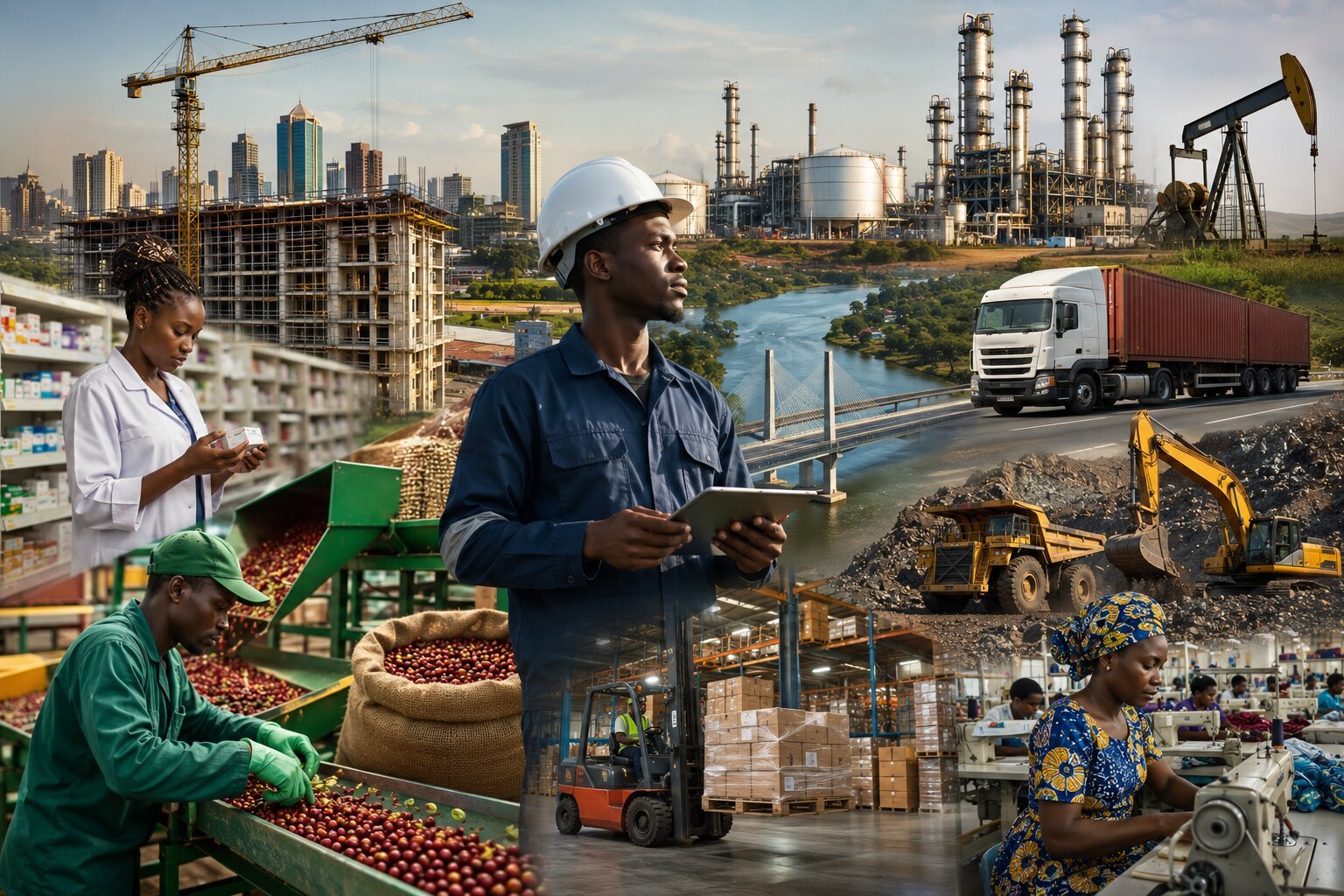
Uganda's economy is projected to grow above 7% in the 2025/26 fiscal year according to Reuters reporting on the Finance Minister's statement, with oil production expected to push growth into double digits according to IMF projections. The East African Crude Oil Pipeline connecting Uganda and Tanzania represents a multibillion dollar infrastructure system whose supply chain creates thousands of secondary business opportunities. Agriculture remains Uganda's largest employer but processes only a fraction of its output domestically, creating the agro-processing gap whose closure generates the manufacturing margin that commodity trading does not. Uganda imports enormous quantities of furniture, packaging, plastics, textiles, soap, steel products, and household goods that domestic manufacturing could produce, with the AfCFTA's regional market of 1.4 billion people creating the export demand that justifies production at scale. Population growth among the highest in the world is creating a permanent housing deficit, sustained healthcare demand, and waste management requirements that are becoming commercial opportunities as Uganda's cities expand. This article identifies ten sectors, explains the specific opportunity within each, and names the entrepreneurs who have already demonstrated the model works in the Ugandan context. The countries that became rich first learned how to produce. Everything else came later. Uganda's wealth is not in its apps. It is in the gap between what the economy currently does with its agriculture, its minerals, its oil, its regional position, and its growing urban population, and what it could do with them. The entrepreneurs who close that gap over the next ten years will be the millionaires of 2035.
Uganda is entering the most economically important decade in its modern history. Oil production is starting. Regional trade is expanding. Infrastructure spending is accelerating. Urbanisation is increasing. Population growth remains among the highest in the world. The country is shifting from a low-income agrarian economy into a resource and industrial economy whose transformation will create the concentrated wealth that structural transitions have always generated for entrepreneurs positioned ahead of their peak.
Yet much of Uganda's youth conversation still revolves around startups, apps, coding bootcamps, and digital entrepreneurship. That is not where the largest wealth transfer will happen. No country has ever industrialised through apps alone. Uganda's economy expanded 8.5% in the quarter ended December 2025 according to Reuters reporting on Uganda Bureau of Statistics data, and is projected to grow above 7% in the 2025/26 fiscal year according to Reuters reporting on the Finance Minister's statement, with oil production expected to push growth into double digits according to IMF projections. The question is not whether opportunity exists. The question is whether Uganda's youth are positioning themselves in the sectors where real capital formation will occur.
The sectors that follow are structural gap analyses rather than trend predictions. The entrepreneurs named have already demonstrated the model works. The question is who scales it next.
1. Agro-processing and food manufacturing
Agriculture remains Uganda's largest employer and economic backbone. Coffee, maize, dairy, fruits, fish, cassava, poultry, and grains already dominate domestic production, employing the majority of Uganda's rural population and contributing significantly to export earnings according to Uganda Bureau of Statistics national accounts data. But the real money is no longer in farming alone. It is in processing.
Uganda still exports large volumes of raw agricultural products while importing processed consumer goods at higher value. That gap creates extraordinary opportunity for young entrepreneurs whose entry into grain milling, peanut butter processing, dairy packaging, poultry feed production, fruit juice processing, coffee roasting, and fish packaging captures the manufacturing margin that raw commodity trading transfers to processors elsewhere. Julian Adyeri Omalla built a business around locally processed beverages rather than raw commodity trading, demonstrating the commercial model whose replication across Uganda's agricultural value chains the decade ahead rewards.
Uganda's coffee sector illustrates the opportunity with particular precision. Uganda is one of Africa's most significant coffee producers, exporting primarily green beans whose roasting, packaging, and brand value accumulates in European and North American processing facilities rather than in Ugandan manufacturing operations. A specialty coffee roasting operation targeting export and domestic café markets requires modest initial investment in roasting equipment and packaging infrastructure while capturing the price premium that origin-branded specialty coffee commands over commodity green beans in global markets. The agro-processing entrepreneur who secures reliable raw material supply through cooperative or contract farming models and builds the food safety, packaging, and supply chain management capability that both domestic retail and regional export markets require will generate returns that commodity trading cannot approach.
2. Oil and gas supply chains
Uganda's oil sector changes everything about the economy's capital structure, its infrastructure investment trajectory, its fiscal position, and the commercial opportunities available to entrepreneurs who understand how oil economies actually generate wealth beyond the extraction itself. Commercial production is expected to begin in 2026, with Uganda planning to produce up to 240,000 barrels per day according to Reuters reporting on IMF projections. The East African Crude Oil Pipeline connecting Uganda to Tanzania's Tanga port represents a multibillion dollar infrastructure system whose construction and operational requirements are creating supply chain demand that most entrepreneurs are not yet positioned to serve.
Most youth assume oil wealth only benefits multinational corporations. That assumption is incorrect and commercially costly. Every oil economy creates thousands of secondary businesses whose combined revenue substantially exceeds what the extraction operation itself generates for local entrepreneurs: logistics, catering, welding, steel fabrication, construction supply, transport, accommodation, equipment leasing, security, waste management, and the full range of industrial and commercial services that large oil field operations and pipeline infrastructure require continuously throughout their operational lives. Many future Ugandan millionaires will not own oil wells. They will own businesses serving the oil economy, positioned in the supply chain whose demand the extraction operation creates regardless of global oil price cycles.
The EACOP's construction phase alone requires the kind of sustained material, equipment, and service procurement that creates businesses rather than transactions, and the operational phase's ongoing requirements for the maintenance, catering, transport, and technical services that field operations demand create recurring revenue whose predictability supports the business investment that one-off procurement contracts do not. The entrepreneur who builds the supply chain relationship, the quality certification, and the operational track record during the construction phase will be positioned for the operational phase's more valuable long-term contracts.
3. Construction and building materials
Uganda's population growth is creating a permanent housing deficit whose scale the current construction industry is not producing at the rate the demographic arithmetic demands. Urbanisation is accelerating in Kampala, Wakiso, Mukono, Mbarara, Gulu, and secondary cities, creating sustained demand for housing, commercial space, urban infrastructure, and the building materials whose domestic production reduces the import dependency that current construction economics reflects. Uganda's economy grew 8.5% in the quarter ended December 2025 according to Reuters reporting, with construction activity contributing heavily to that expansion.
The biggest opportunity is not luxury real estate. It is mass market housing. Uganda needs affordable homes faster than the market can currently supply them, and the entrepreneurs who build the manufacturing and construction service operations to serve that demand will generate the recurring revenue and asset appreciation whose combination creates millionaire-level net worth over a decade of disciplined growth. Cement products, bricks, steel fabrication, roofing materials, aluminium works, plumbing supply, paint, and interior finishing are all categories where domestic production serves the construction demand that population growth is creating continuously and whose volume the import alternative cannot serve at competitive cost given transport economics.
A brick-making operation requires modest initial capital for a brick press and raw material supply and can produce tens of thousands of bricks monthly for the large construction projects whose material procurement is currently drawing from whatever domestic supply is available at competitive pricing. Steel fabrication serving the construction and oil sector supply chain requirements combines two of the decade's most powerful demand drivers in a single business whose product range can expand with the capital that initial operations generate. Specialist contracting in electrical installation, plumbing, roofing, or landscaping creates the entry pathway whose project experience and working capital accumulation funds the transition to materials manufacturing at the scale that regional supply can justify.
4. Transport and logistics
Every growing economy creates logistics millionaires, and Uganda's strategic position between Kenya, Tanzania, Rwanda, South Sudan, and the Democratic Republic of Congo makes the logistics opportunity more regionally significant than the domestic market alone suggests. Regional trade flows are increasing under the East African Community and AfCFTA frameworks, with goods moving across Uganda's borders in volumes whose growth with regional trade integration creates sustained freight demand that the current logistics infrastructure is not fully serving. Many wealthy East African business families began with transport before diversifying into manufacturing, and Uganda will repeat that pattern because physical economies depend on movement whose cost determines the commercial viability of every productive sector that depends on it.
Trucking, warehousing, clearing and forwarding, cold chain logistics, fuel transport, agricultural distribution, motorcycle delivery, and inland container depot operations are all commercial categories whose demand is growing with the infrastructure investment, oil sector development, and regional trade expansion that the current decade is delivering simultaneously. The Central Corridor's importance to Rwanda, Burundi, and the eastern DRC creates transit freight demand that Uganda's road and rail infrastructure positions it to serve for origins and destinations beyond its own borders. A trucking operation starting with one or two vehicles and growing through reinvestment of freight revenue into fleet expansion is the oldest wealth creation model in East African business history, and its continued viability reflects the physical economy's dependence on movement that no digital alternative has yet replaced.
Cold chain logistics for Uganda's agricultural exports, whose horticulture, fisheries, and dairy products require temperature-controlled transport from production zones to Entebbe international airport or regional border crossings, commands a premium over standard freight that reflects the product's temperature sensitivity and the infrastructure investment that serving it reliably requires. The entrepreneur who builds the cold chain capability serving Uganda's agricultural export sector is simultaneously serving the domestic food processing industry and the regional consumer market whose premium food product demand is growing with urbanisation and rising incomes.
5. Mining and mineral processing
Uganda possesses commercially significant deposits of gold, copper, iron ore, limestone, tin, tungsten, and rare earth minerals whose development is becoming a strategic national priority according to Uganda Investment Authority sector documentation. Mining and petroleum are the two sectors whose combined development trajectory makes Uganda's current decade economically distinctive, and the opportunities they create extend well beyond primary extraction into the industrial supply chain whose servicing generates the recurring revenue that extraction alone does not.
The largest opportunities are often indirect. Mineral transport, quarry operations, stone crushing, equipment leasing, industrial chemicals, metal fabrication, and mineral processing are the commercial activities whose demand the extraction sector creates and whose servicing generates the business revenue that the extraction licence itself does not require. Uganda's future industrial economy cannot function without mining inputs, and the entrepreneurs who position early around extraction and industrial supply chains will build businesses whose value compounds with the sector's development rather than depending on the extraction licence whose acquisition is competitive and capital-intensive.
Gold processing and gemstone cutting represent the value addition opportunity whose margin over raw mineral prices demonstrates the same processing gap that agro-processing illustrates in its sector. A gold buying and small-scale processing operation serving artisanal miners in Uganda's established gold production areas requires modest initial capital relative to the margins that value-added gold products command over raw ore, and the relationship network whose development creates the supply security that processing operations require is itself a competitive advantage whose accumulation takes time rather than capital.
6. Manufacturing and import substitution
Uganda imports enormous quantities of products it could manufacture domestically, including furniture, packaging, plastics, textiles, soap, food products, steel products, and household goods whose combined import value represents a foreign exchange outflow that domestic manufacturing could redirect into Ugandan industrial margins. Amos Nzeyi built major wealth through beverages, manufacturing, and transport rather than through digital speculation, demonstrating the commercial model whose replication at smaller but scalable levels the current decade's import substitution opportunity supports.
Import substitution is becoming economically attractive because population growth increases domestic demand, regional markets are expanding under AfCFTA, transport costs remain high enough to create a natural cost advantage for domestic producers serving nearby markets, and governments across East Africa are increasingly supporting industrialisation through the policy instruments and infrastructure investment that manufacturing investment requires. The AfCFTA's regional market of 1.4 billion people creates the export demand that justifies production at a scale whose economics domestic demand alone cannot support for many manufacturing categories.
The entrepreneur who builds a manufacturing operation during the current period of government industrial policy support, improving infrastructure, and expanding regional market access will be positioned for the market leadership whose brand equity and first-mover distribution advantages compound over time in ways that later entrants cannot replicate at equivalent cost. Soap manufacturing, packaging production, furniture manufacturing, and textile assembly are all categories where the capital requirements are accessible to young entrepreneurs who can secure the patient financing that manufacturing investment requires and whose returns justify the longer break-even timeline that production businesses demand relative to trading alternatives.
7. Healthcare services
Uganda's healthcare demand is rising faster than public infrastructure can handle, with population growth alone guaranteeing expansion in clinics, diagnostic centres, pharmacies, medical supply distribution, laboratory services, and specialised treatment facilities whose private sector provision is becoming commercially necessary rather than supplementary to an adequate public system. Middle-income households are increasingly paying privately for healthcare whose quality and reliability the public system cannot consistently deliver at the standard that rising incomes create expectations for, and that commercial dynamic is creating the patient volume that private healthcare profitability requires.
The business opportunities extend well beyond clinical practice itself. Medical logistics, hospital equipment supply, pharmaceutical distribution, health insurance brokerage, and ambulance services are all commercial activities whose demand the healthcare sector's expansion creates without requiring the medical qualification whose acquisition barriers limit the entrepreneur pool for clinical services. A pharmaceutical distribution operation serving a regional territory, acquiring distribution relationships with manufacturers and building the cold chain and last-mile delivery capability that medicine distribution requires, can scale to significant revenue as the healthcare market's expansion creates continuously growing procurement demand.
A private multi-specialty clinic or diagnostic centre in an underserved secondary city, whose public hospital capacity is insufficient to serve its growing population at the quality standard that private patients require, requires initial capital that bank lending to healthcare businesses can support and can scale to a chain of facilities whose combined revenue generates the millionaire-level net worth that healthcare's recurring demand profile makes more predictable than most other sectors on this list.
8. Tourism and hospitality
Uganda remains one of Africa's most underexploited tourism markets despite possessing some of the continent's most distinctive natural assets: mountain gorillas in Bwindi Impenetrable National Park and Mgahinga, chimpanzees, the Nile at Jinja, Queen Elizabeth National Park, Murchison Falls, and a lake and wetland system whose biodiversity and scenic quality make Uganda a compelling destination for the wildlife, adventure, and eco-tourism markets whose premium spending power makes them commercially attractive relative to mass-market alternatives.
Tourism is a government priority sector whose infrastructure investment, regional air connectivity expansion, and destination marketing are creating the visitor access improvements that tourism investment requires to justify the multi-year capital commitment that hospitality infrastructure demands. As infrastructure improves and regional air connectivity expands, Uganda's tourism economy will grow substantially, and the entrepreneurs who build the tour operations, lodges, transport services, food supply chains, photography businesses, cultural products, and event services that experience economies create around them will generate returns whose compounding reflects the destination's improving commercial attractiveness rather than any single property's individual performance.
The gorilla trekking permit whose premium pricing Uganda's Wildlife Authority manages reflects the rarity value of an experience that a small number of global destinations can offer, and the supply chain that feeds, transports, accommodates, and guides the high-spending international visitors who pay for that experience creates commercial opportunity across every service category that the tourism operation requires. The entrepreneur who builds the tour operation, transport, or lodge infrastructure now, while visitor numbers are growing from a low base, will benefit from the demand trajectory rather than entering a market already serving its peak volume.
9. Waste management and recycling
Africa's urbanisation crisis is simultaneously an industrial opportunity, and Uganda's rapidly expanding cities are generating waste streams whose commercial value the current waste management infrastructure is not capturing. Kampala and secondary cities generate plastics, organic waste, construction debris, scrap metal, and electronic waste whose volume is growing with urban population expansion and whose recycling and reprocessing creates the circular economy businesses that Franc Kamugyisha has already demonstrated can generate commercial returns from materials that the conventional economy treats as cost rather than resource.
This sector remains early in Uganda, and that is precisely why the upside is large. Waste becomes profitable when cities become bigger, and Uganda's cities are becoming much bigger at a pace whose trajectory makes the waste management and recycling opportunity one of the decade's most structurally supported growth markets by demand volume. A waste collection hub with sorting and baling equipment requires modest initial capital. A plastic recycling operation producing pellets for sale to packaging manufacturers, or construction materials produced from recycled plastic and aggregate, creates the value addition that transforms waste collection from a service business into a manufacturing business whose margins reflect the industrial processing it performs.
The Extended Producer Responsibility frameworks that regional governments are beginning to introduce create the regulatory demand signal that recycling businesses require to attract the corporate procurement relationships whose revenue predictability supports the processing capacity investment that scale recycling requires. The entrepreneur who builds the collection network, the processing capability, and the corporate customer relationships during the current early phase will be positioned for the market leadership that a growing regulatory environment rewards.
10. Regional trade and wholesale distribution
Uganda sits inside one of the fastest-growing regional consumer markets in Africa, with its strategic position between Kenya, Tanzania, Rwanda, South Sudan, and the DRC giving its entrepreneurs access to regional trade flows that extend well beyond the domestic market whose size alone understates the commercial opportunity available to distribution businesses operating across East Africa's expanding trade network. Many future Ugandan millionaires will emerge from building distribution dominance before building manufacturing capacity, because the distribution relationship, the customer network, and the market intelligence that regional trade generates are the commercial foundation on which manufacturing investment makes its most rational case.
FMCG distribution, agricultural exports, industrial supply, consumer goods importation, and wholesale trade networks are the commercial categories whose AfCFTA market access and EAC free movement of goods provisions are making more viable at regional scale than at any previous point in Uganda's economic history. The distribution entrepreneur who builds the relationships, the logistics infrastructure, and the market intelligence that regional wholesale trade requires will be positioned to add manufacturing capacity whose product distribution the existing trade network can absorb without the market development cost that new entrants face when building distribution from zero.
This is how industrial families historically emerge: trade first, then distribution, then manufacturing, then finance and property. Uganda's regional position gives its entrepreneurs access to the trade volumes whose management generates the capital, the relationships, and the market knowledge that each subsequent stage requires. The real opportunity is not Kampala alone. It is East Africa, and the entrepreneur who builds a regional distribution business now is building the foundation for the manufacturing business that the next decade of import substitution opportunity rewards.
The common thread
Ten sectors. One underlying logic. Uganda's wealth creation opportunity over the next decade is concentrated in the gap between what the economy currently does with its resources and what it could do with them. Agriculture employs most Ugandans but processes only a fraction of its output domestically. Oil production is creating a supply chain whose secondary business opportunities most entrepreneurs have not yet positioned for. Urban population growth is creating housing, healthcare, and waste management demand faster than current supply can serve. Regional trade flows are expanding with infrastructure investment and AfCFTA implementation. Import substitution opportunities exist across every consumer goods category that Uganda currently imports.
Apps are tools. Economies are built by production. Uganda still needs factories, warehouses, roads, processed food, housing, energy systems, logistics networks, and industrial materials whose provision creates the durable wealth that software valuations describe but physical industries deliver. Uganda is entering its infrastructure decade, its oil decade, and potentially its industrial decade simultaneously. The youth who understand that early will have a very different future from those still chasing trends imported from Silicon Valley. The countries that became rich first learned how to produce. Everything else came later.
FAQ
Why are apps and digital businesses not the primary wealth creation opportunity? Because economies are built by production and Uganda still needs factories, warehouses, roads, processed food, housing, energy systems, logistics networks, and industrial materials whose provision creates the durable wealth that software valuations describe but physical industries deliver. No country has ever industrialised through apps alone. The digital economy amplifies productive systems that already exist. It does not substitute for their absence, and Uganda's current development stage requires the physical industry investment whose returns create the productive foundation that digital tools can subsequently optimise.
Why is the oil supply chain more important than oil production itself for young entrepreneurs? Because multinational oil companies dominate primary extraction while the supply chain whose demand the extraction operation creates is accessible to Ugandan entrepreneurs with more modest capital requirements. Every oil economy creates thousands of secondary businesses in logistics, catering, steel fabrication, transport, accommodation, equipment leasing, security, and waste management whose combined revenue substantially exceeds what extraction generates for local entrepreneurs. With commercial production expected in 2026 and the EACOP representing a multibillion dollar infrastructure system, the supply chain opportunity is immediate and does not require the extraction licence whose acquisition is competitive and capital-intensive.
What is the import substitution manufacturing opportunity? Uganda imports large quantities of furniture, packaging, plastics, textiles, soap, steel products, and household goods that domestic manufacturing could produce at competitive cost for the growing domestic market and the AfCFTA's regional market of 1.4 billion people. Population growth is increasing domestic demand continuously. Regional markets are expanding. Transport costs create a natural cost advantage for domestic producers serving nearby markets. Government industrial policy is supporting manufacturing investment. The combination creates the commercial conditions that Amos Nzeyi's generation exploited at smaller scale and that the current generation can replicate with the regional market access that AfCFTA implementation is making commercially viable.
Why is regional trade and distribution the starting point rather than manufacturing? Because distribution generates the capital, customer relationships, and market intelligence that manufacturing investment subsequently requires to be commercially rational. The historical pattern of East African industrial family formation is trade first, then distribution, then manufacturing, then finance and property. Uganda's regional position between Kenya, Tanzania, Rwanda, South Sudan, and the DRC gives its entrepreneurs access to trade flows that extend well beyond the domestic market, and building the distribution dominance that regional wholesale trade requires creates the foundation on which manufacturing investment makes its most rational case without the market development cost that new manufacturers face when building distribution from zero.
How does Uganda's tourism opportunity compare with Kenya's and Tanzania's? Uganda's tourism market is smaller than Kenya's KSh 500 billion 2025 revenue or Tanzania's 1.5 million annual visitors but is growing from a lower base whose trajectory makes early positioning more commercially valuable than entering either of those more mature markets. Mountain gorilla trekking, whose permit pricing reflects the global rarity of the experience, creates a premium revenue stream that neither Kenya nor Tanzania can offer, and the adventure, eco-tourism, and Nile-based tourism products that Uganda's geography supports create differentiated market positioning whose development the improving infrastructure and expanding regional air connectivity are making commercially accessible to entrepreneurs who position now rather than after the market has reached the scale that attracts larger competitors.
 Uchumi360
Business Intelligence
Uchumi360
Business Intelligence
- Uganda Bureau of Statistics, national accounts data
- Economy expanded 8.5% in quarter ended December 2025, cited from Reuters reporting on UBOS data, 25 March 2026
- Available at ubos.org
- Reuters, Uganda Finance Minister statement on economic growth projection
- Economy projected to grow above 7% in 2025/26 fiscal year, 12 June 2025
- Available at reuters.com
- Reuters, IMF projection on Uganda oil production and economic growth
- Commercial production expected 2026, 240,000 barrels per day target, double-digit growth projection, 12 September 2024
- Available at reuters.com
- East African Crude Oil Pipeline project documentation
- Uganda to Tanzania pipeline infrastructure
- Available at eacop.com
- Uganda Investment Authority, mining and petroleum sector data
- Gold, copper, iron ore, limestone, tin, tungsten, and rare earth mineral deposits
- Available at ugandainvest.go.ug
- Julian Adyeri Omalla, business history in Ugandan beverage processing
- Wikipedia reference cited from source document
- Amos Nzeyi, business history in Ugandan beverages, manufacturing, and transport
- Wikipedia reference cited from source document
- Franc Kamugyisha, business history in Ugandan waste recycling
- Wikipedia reference cited from source document
- AfCFTA Secretariat, regional market coverage and implementation framework
- 1.4 billion people across 55 countries
- Available at au-afcfta.org
- East African Community Secretariat, free movement of goods and regional trade data
- Available at eac.int
- Tanzania Investment Centre, EACOP and regional infrastructure data for comparative context
- Available at tic.go.tz
- Kenya National Bureau of Statistics, regional trade data for East African comparative context
- Available at knbs.or.ke
- Rwanda Development Board, regional investment and institutional quality data
- Available at rdb.rw
- DRC Institut National de la Statistique, mineral production data for regional comparative context
- Available at ins-rdc.org
- Zambia Statistics Agency, copper production data for regional comparative context
- Available at zamstats.gov.zm
- Uganda Wildlife Authority, gorilla trekking permit and tourism sector data
- Available at ugandawildlife.org
- National Environment Management Authority Uganda, urban waste generation data
- Available at nema.go.ug
- African Export-Import Bank, African Trade Report 2024
- Intra-African trade share data
- Available at afreximbank.com
Uchumi360 covers business, investment, and economic policy across East, Central, and Southern Africa.
For the serious reader
You read to the end. That places you in a small group.
Uchumi360 is built for readers who demand precision over speed, structure over sentiment, and analysis that holds uncomfortable conclusions rather than softening them. If this work sharpens how you think about Africa's economy, help us keep building the infrastructure behind it.
Institutional Partners
Commission intelligence. Shape the conversation.
Uchumi360 works with development finance institutions, investment firms, sovereign bodies, and strategic organisations across the coverage region. Institutional partnership unlocks:
- Commissioned sector and country intelligence reports
- Branded research series under your institution's authority
- Exclusive data briefings for internal strategy teams
- Speaking and editorial presence at Uchumi360 events
- Co-published investment outlooks for your markets
Support Our Work
Independent analysis has a cost. Help us bear it.
Uchumi360 does not carry advertising. It does not take editorial direction from sponsors. Every article is produced without commercial compromise. Your contribution funds the reporting, research, and editorial infrastructure that keeps this analysis free from influence.
Secure checkout: One-time and monthly support are processed securely. Add payment credentials to enable checkout here.
Stay Connected
Keep up with every new insight.
Follow our latest analysis, policy coverage, and market intelligence as soon as it is published. If you need something specific, reach out directly and we will point you to the right research.
