
Crude Reaches $105 as the Middle East Crisis Continues
Ready
Brent crude has reached US$105 as the Iran war intensifies and Houthi forces seize Yemen's strategic port of Mocha. For Africa's oil importing economies, the deeper danger is not simply higher fuel prices but the exposure of weak storage, narrow import corridors, foreign exchange constraints and fragile energy infrastructure.
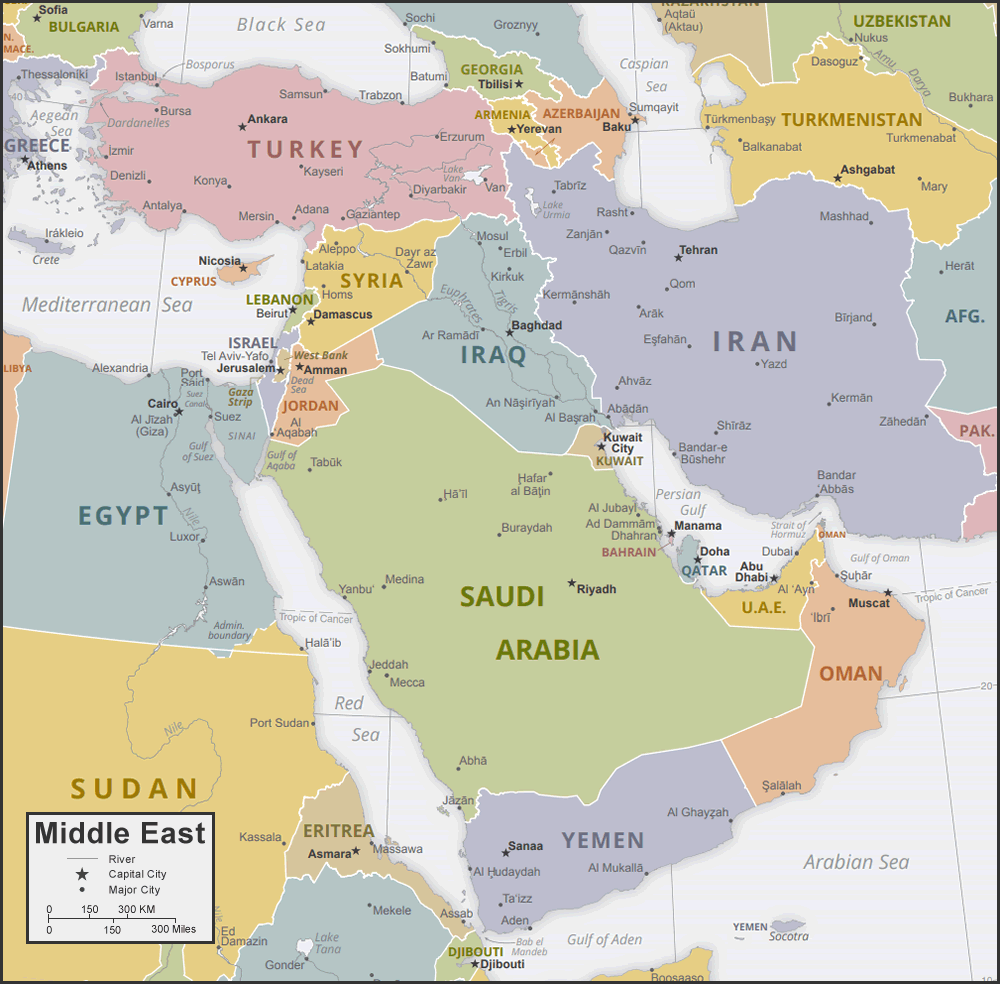
The oil market has entered another phase of the Middle East crisis, and the significance of Brent crude reaching US$105.26 a barrel on Thursday extends far beyond the price of fuel at a filling station. Oil rose by roughly 4 percent as attacks on commercial shipping around the Strait of Hormuz intensified, with Iran saying it had attacked 10 ships after the United States struck five Iranian tankers. At the same time, Iran aligned Houthi forces seized Yemen's strategic port of Mocha on the Red Sea coast, bringing the group closer to the Bab el Mandeb, another maritime chokepoint through which energy and merchandise move between the Middle East, Asia, Africa and Europe. The two developments matter together because the global energy system is now facing simultaneous risks around two of the most important maritime gateways through which Middle Eastern energy reaches international markets.
For oil importing countries, particularly those in Africa, the central issue is therefore no longer simply whether crude will remain above US$100. The more consequential question is how an external energy shock travels through an economy that depends on imported fuel to move people and goods, operate machinery, support agriculture, power industries and maintain trade. When the international price rises, the immediate effect is a larger import bill, but the consequences do not stop there. Importers require more foreign currency to purchase the same quantity of petroleum, transport operators face higher operating costs, manufacturers pay more to move inputs and finished products, food distribution becomes more expensive and governments face pressure to prevent fuel prices from rising too quickly. If the shock persists, the resulting pressure appears in inflation, exchange rates, current account balances, interest rates and public finances.
Hormuz Has Become the Centre Of The Energy Shock
The Strait of Hormuz is particularly important because of the sheer quantity of energy normally passing through it and the limited number of practical alternatives available when the route becomes dangerous. Current vessel tracking indicates that only seven vessels crossed Hormuz on Wednesday, compared with a much higher normal flow, and no liquefied natural gas tanker made the transit. Although some ships may have crossed with their transponders switched off, the scale of the visible reduction illustrates how dramatically the conflict has altered commercial shipping.
The market does not need every barrel passing through Hormuz to disappear before prices rise. Energy prices respond to expectations about future availability as well as confirmed physical shortages. When shipping companies face higher war risk insurance, when vessels avoid a particular route, when cargoes take longer journeys and when traders become uncertain about whether supplies will arrive on schedule, the cost of obtaining energy rises even before the physical shortage becomes absolute. This is why the present crisis has created a risk premium in crude markets. The market is pricing the possibility that today's disruption could become tomorrow's shortage.
That distinction is especially important for developing economies because they generally have less financial room to absorb the additional cost. A wealthy economy can draw on strategic stocks, access international credit, subsidise selected consumers or absorb a temporary deterioration in its trade balance. A lower income oil importing economy has fewer such options. The same US$10 increase in the international price of a barrel therefore produces very different consequences depending on the country's foreign exchange reserves, fiscal position, import infrastructure and ability to pass higher costs through to consumers.
Yemen Has Turned A Second Chokepoint Into A Strategic Risk
The seizure of Mocha changes the calculation because the conflict is no longer concentrated around Hormuz. Mocha lies on Yemen's Red Sea coast, close to the Bab el Mandeb, the narrow maritime passage connecting the Red Sea with the Gulf of Aden. Reuters estimates that roughly 7 percent of global oil supply passes through the strait, while the route is also important for the movement of other commodities between Asia, Europe and the Middle East. Houthi attacks since late 2023 have already forced large numbers of commercial vessels to reroute around the Cape of Good Hope, increasing journey times and freight costs.
The economic significance of Mocha is therefore not simply that another Yemeni port has changed hands. Control of territory around a maritime chokepoint gives a military actor greater capacity to influence the cost and reliability of international trade. That influence becomes considerably more valuable when another major chokepoint is already under pressure. Saudi Arabia has been increasing crude and condensate loadings from Yanbu on the Red Sea, which functions as an alternative route around Hormuz, but the value of that alternative depends on the security of the Red Sea itself. The fact that Yanbu loadings have increased while Hormuz traffic has collapsed demonstrates how quickly energy traders attempt to rearrange the geography of supply when a conventional route becomes dangerous.
This is the deeper lesson of the current crisis. Energy security is partly a question of how many alternative paths exist between a producer and a consumer. If one route fails and there is another route with sufficient capacity, the market can adjust. If several routes are threatened simultaneously, the cost of adjustment rises sharply. Shipping companies need longer voyages, ports must handle cargoes they were not originally designed to receive, storage facilities come under greater pressure and buyers compete for replacement supplies. What begins as a military problem therefore becomes a logistics problem, and the logistics problem eventually becomes an inflation problem.
The Oil Shock Travels Through The Balance Of Payments
For an oil importing country, the most important transmission mechanism is the balance of payments. A country purchasing 1 million barrels of petroleum products at US$80 a barrel spends US$80 million on that cargo. If the effective price rises to US$105 while the volume remains unchanged, the same cargo costs US$105 million. Nothing about the physical quantity consumed has changed, yet the country has suddenly needed an additional US$25 million in foreign currency.
That additional demand for dollars matters because petroleum is rarely the only major import requirement. Countries also need foreign currency for machinery, medicines, industrial inputs, vehicles, food and debt service. When oil prices rise sharply, the energy sector competes with these other requirements for scarce foreign exchange. If the adjustment occurs through currency depreciation, the problem can become self reinforcing because imported fuel becomes more expensive in local currency even if the international oil price stops rising.
Rwanda provides an unusually clear illustration because the International Monetary Fund has explicitly modelled the consequences of a US$105 oil price. In its 2026 assessment, the IMF estimates that such an oil price would increase Rwanda's imports by the equivalent of 1.4 percent of GDP and raise fiscal spending by 0.8 percent of GDP. Under a more severe scenario involving oil prices of US$115 in 2026 and US$131 in 2027, Rwanda's real GDP growth would be reduced by 1.2 percentage points in 2026 and 2.3 percentage points in 2027, while the current account deficit would widen by 1.9 percent and 3.4 percent of GDP respectively. Foreign exchange reserves would also fall significantly.
The importance of this calculation is that it shows why an oil shock cannot be treated as merely an energy sector problem. The fuel is purchased in dollars, but its economic consequences are felt throughout the domestic economy. Higher fuel costs increase transportation costs, transportation affects the cost of food and manufactured goods, higher prices increase inflation, inflation can influence monetary policy, higher interest rates affect investment and government borrowing, while the additional import bill places pressure on the external account. An energy shock can therefore slow an economy even when factories, farms and businesses remain physically operational.
Africa's Vulnerability Is Determined Before The Crisis Begins
The countries that suffer most from an oil shock are not necessarily those that import the largest number of barrels. Vulnerability depends on how the energy system is organised before the disruption occurs. A country with substantial storage capacity can continue supplying the domestic market while waiting for new cargoes. A country with two functioning import corridors can shift purchases when one route becomes expensive or unavailable. A country with reliable pipelines can reduce dependence on road transport. A country with strong procurement institutions can negotiate longer term supplies instead of buying everything on the spot market. A country with sufficient foreign exchange liquidity can pay higher import bills without immediately destabilising its currency.
These capabilities determine how much of an international shock is transmitted into the domestic economy. Two countries can therefore face exactly the same US$105 oil price and experience very different outcomes. The difference lies in the infrastructure and institutions sitting between the international market and the domestic consumer.
This is where Tanzania's position in East Africa becomes particularly interesting. Tanzania is not only an oil importing economy; it is also becoming an increasingly important energy corridor for landlocked countries. Fuel entering Tanzania through its ports can ultimately serve markets in Rwanda, Burundi, Zambia, Malawi, the Democratic Republic of Congo and Uganda. The security of Tanzania's petroleum infrastructure consequently has implications beyond the domestic market because disruptions affecting Tanzanian ports, storage or inland distribution can propagate into several neighbouring economies.
Tanga Shows Why Regional Infrastructure Matters
The proposed Tanga Regional Energy Hub provides an important example of how East Africa can respond to this structural vulnerability. In August, Tanzania, Uganda and Vitol Bahrain signed an agreement to develop the hub around petroleum storage, refining, logistics, trading and distribution. The Ugandan government describes the project as complementary to Uganda's Hoima refinery and the East African Crude Oil Pipeline, while the Tanzanian government has said the wider development could attract more than US$20 billion in investment.
The strategic importance of Tanga lies in the possibility of creating another route through which petroleum products can enter and move through East Africa. Uganda currently imports the overwhelming majority of its petroleum products and has historically depended heavily on the Mombasa corridor. Additional access through Tanga does not make Mombasa irrelevant. Its value lies precisely in giving importers another option. When there are several functioning routes, traders can compare freight costs, port congestion, availability and security conditions. When there is only one practical route, a disruption along that route becomes a national supply problem.
The proposed Tanga system is therefore more consequential than the construction of storage tanks or another pipeline considered individually. Its real value emerges from the relationship between the pieces. Storage can hold fuel when arrivals are disrupted. A port can receive alternative cargoes. Pipelines can move larger volumes inland at lower unit cost than road transport. Refining can create another source of supply where the economics support it. Regional trade allows countries to share infrastructure and demand. Procurement arrangements can then determine how efficiently the entire system responds when international prices move sharply.
That is what energy security looks like in practice. It is not the absence of exposure to international markets. It is the capacity to remain functional when those markets become hostile.
Storage Is A Financial Asset During A Crisis
Storage is often treated as passive infrastructure because tanks do not appear to produce anything while they are full. During an energy crisis, however, stored fuel effectively purchases time for an economy. An importer that has several weeks of supply available does not have to purchase a replacement cargo immediately after a shipping disruption. It can wait for prices to settle, redirect a vessel, use another port or coordinate with neighbouring countries.
The financial value of that flexibility becomes significant when the market is rising rapidly. Buying fuel at the worst possible moment can increase the import bill substantially, while buying earlier and holding sufficient stocks can reduce exposure to temporary price spikes. Storage therefore has an economic function beyond physical supply. It provides an option to delay a purchase until market conditions improve.
The same principle applies to pipelines and ports. Infrastructure is most valuable when it reduces the cost and uncertainty of moving energy through the economy. A port that can handle several types of petroleum cargo, a pipeline capable of moving products inland efficiently and a distribution system connected to multiple markets give importers more ways to respond when one part of the supply chain becomes constrained.
Procurement And Foreign Exchange Are Part Of Energy Security
The financial side of energy security is frequently overlooked because public discussion tends to focus on physical infrastructure. Yet a country can have tanks, ports and pipelines and still experience a fuel shortage if importers cannot obtain dollars to pay for their cargoes. The current crisis makes this vulnerability more visible because every additional dollar spent on fuel represents foreign currency that cannot be spent elsewhere.
Procurement arrangements also become more important during periods of disruption. When supply is abundant, purchasing decisions can remain largely commercial. When the market is tightening, the timing of purchases, the creditworthiness of the buyer, the reliability of suppliers and the availability of shipping become strategic considerations. Countries that have institutional capacity to coordinate procurement and maintain relationships with several suppliers have more room to manoeuvre than countries that respond only after shortages appear.
This is why energy policy should be connected to monetary policy, trade policy and industrial policy rather than treated as a narrow petroleum issue. A country cannot secure its energy supply sustainably if it does not also understand how the resulting import bill affects its foreign exchange market, its current account and its productive sectors.
The Long Term Solution Is To Reduce Exposure
There is also a second response to an oil shock, which is to reduce the quantity of petroleum required to produce economic output. This does not mean that African economies can abandon oil in the immediate future. Road transport, aviation, agriculture, construction, mining and logistics will continue to depend heavily on liquid fuels for years. The realistic objective is to reduce the economy's sensitivity to every additional dollar added to the price of a barrel.
More reliable electricity can reduce dependence on diesel generators. Better public transport can reduce fuel consumption per passenger. More efficient freight systems can reduce the amount of fuel required to move each tonne of goods. Electrification of suitable forms of transport can gradually reduce petroleum demand where electricity supply is sufficient. Domestic natural gas can reduce the use of petroleum products in some industrial and power applications. These changes do not eliminate the oil import bill, but they reduce the number of economic activities whose costs rise automatically whenever crude prices rise.
That matters because the global energy market is becoming increasingly difficult for importing countries to predict. The present crisis is not simply a temporary increase in commodity prices. It is demonstrating how quickly military conflict can change shipping patterns, insurance costs, refinery economics, foreign exchange requirements and the availability of essential fuels.
Africa Needs Energy Systems That Can Absorb Shocks
The countries that are best positioned to withstand the current oil shock will not necessarily be those that correctly predicted that Brent would reach US$105. They will be the countries that built enough flexibility into their energy systems before the crisis occurred. A country with multiple import routes, sufficient storage, reliable ports, efficient pipelines, credible procurement institutions and adequate foreign exchange liquidity has more options when international supply is disrupted. Those options have an economic value because they prevent a temporary external shock from immediately becoming a domestic shortage.
The lesson for East Africa is particularly clear. Tanzania's role cannot be viewed solely through the amount of fuel consumed inside its borders because its ports and corridors increasingly serve a much larger regional market. Uganda's effort to diversify its supply routes through Tanga, Tanzania's interest in expanding the value of its energy infrastructure and the development of regional pipelines all point toward a future in which energy security becomes increasingly regional rather than purely national. The objective should be a market where countries can draw from several routes and suppliers instead of depending on a single maritime gateway or procurement channel.
The Middle East crisis will eventually change. Hormuz may reopen fully, shipping risks may decline and Brent may fall back from current levels. The strategic problem for African economies, however, will remain. The next disruption could come from another war, a shipping accident, a pipeline failure, a refinery shutdown, a currency crisis or a sudden restriction on exports. What matters is whether the economy has enough capacity to absorb the shock when it arrives.
The price of oil is determined in the global market. The size of the damage it does to an African economy is determined much closer to home.
FAQ
Why has Brent crude reached US$105? Brent rose to US$105.26 on 10 September 2026 as attacks on shipping around the Strait of Hormuz intensified and Houthi forces seized Yemen's port of Mocha, increasing fears of further disruption to global energy supplies.
Why is Yemen important to the oil market? Yemen sits beside Bab el Mandeb, a major maritime chokepoint connecting the Red Sea and Gulf of Aden. Disruption there can increase shipping costs and restrict one of the routes used to move energy between the Middle East, Asia, Africa and Europe.
How does an oil price shock affect African economies? Higher oil prices increase fuel import bills and foreign exchange requirements, while raising transport, food and production costs. The resulting pressure can widen current account deficits, weaken currencies, increase inflation and force governments to spend more on fuel or other subsidies. Rwanda's IMF assessment provides a quantified example.
What does energy security mean for an oil importing country? It means having sufficient flexibility to continue obtaining energy when international supply is disrupted. That includes storage, multiple import routes, reliable ports and pipelines, effective procurement, adequate foreign exchange liquidity and measures that gradually reduce petroleum dependence.
Why is Tanga strategically important? The proposed Tanga Regional Energy Hub is intended to combine petroleum storage, refining, logistics, trading and distribution and to complement Uganda's Hoima refinery and EACOP. Its wider significance is that it could give East Africa another major energy corridor and reduce dependence on a single supply route.
 Uchumi360
Business Intelligence
Uchumi360
Business Intelligence
Uchumi360 covers business, investment, and economic policy across East, Central, and Southern Africa.
For the serious reader
You read to the end. That places you in a small group.
Uchumi360 is built for readers who demand precision over speed, structure over sentiment, and analysis that holds uncomfortable conclusions rather than softening them. If this work sharpens how you think about Africa's economy, help us keep building the infrastructure behind it.
Institutional Partners
Commission intelligence. Shape the conversation.
Uchumi360 works with development finance institutions, investment firms, sovereign bodies, and strategic organisations across the coverage region. Institutional partnership unlocks:
- Commissioned sector and country intelligence reports
- Branded research series under your institution's authority
- Exclusive data briefings for internal strategy teams
- Speaking and editorial presence at Uchumi360 events
- Co-published investment outlooks for your markets
Support Our Work
Independent analysis has a cost. Help us bear it.
Uchumi360 does not carry advertising. It does not take editorial direction from sponsors. Every article is produced without commercial compromise. Your contribution funds the reporting, research, and editorial infrastructure that keeps this analysis free from influence.
Secure checkout: One-time and monthly support are processed securely. Add payment credentials to enable checkout here.
Stay Connected
Keep up with every new insight.
Follow our latest analysis, policy coverage, and market intelligence as soon as it is published. If you need something specific, reach out directly and we will point you to the right research.
