
DRC Signs 30-Year Rail Concession With Mota-Engil for Lobito Corridor
Ready
The Democratic Republic of Congo signed a 30-year concession with Mota-Engil Africa on 26 August 2026 to rehabilitate and operate the Dilolo-Sakania railway, the Congolese section of the Lobito Corridor connecting the copper and cobalt heartland of Lualaba and Haut-Katanga to Angola's Port of Lobito. The deal's headline investment figure moved within six weeks of government approval, from $1.258 billion when the DRC's cabinet cleared the project in July to $1.8 billion once Mota-Engil confirmed its own numbers at signing, a gap worth understanding rather than glossing over. What hasn't moved is the strategic logic: officials project the upgraded line could cut transit time from Congo's mining belt to the Atlantic coast from roughly 25 days via the traditional Durban route to a matter of days, while cutting logistics costs by as much as 30%.
KINSHASA — The Lobito Corridor's most important unfinished piece moved from political commitment to signed contract on 26 August 2026, when the Democratic Republic of Congo and Mota-Engil Africa concluded a 30-year concession for the Dilolo-Sakania railway, the stretch of track that actually runs through Congo's copper and cobalt mining heartland.
Presidents Félix Tshisekedi and João Lourenço witnessed the signing in Kinshasa, a detail that itself signals how central this specific agreement is to a corridor both governments have spent years positioning as a genuine alternative export route for Central Africa's mineral wealth.
What Was Actually Signed
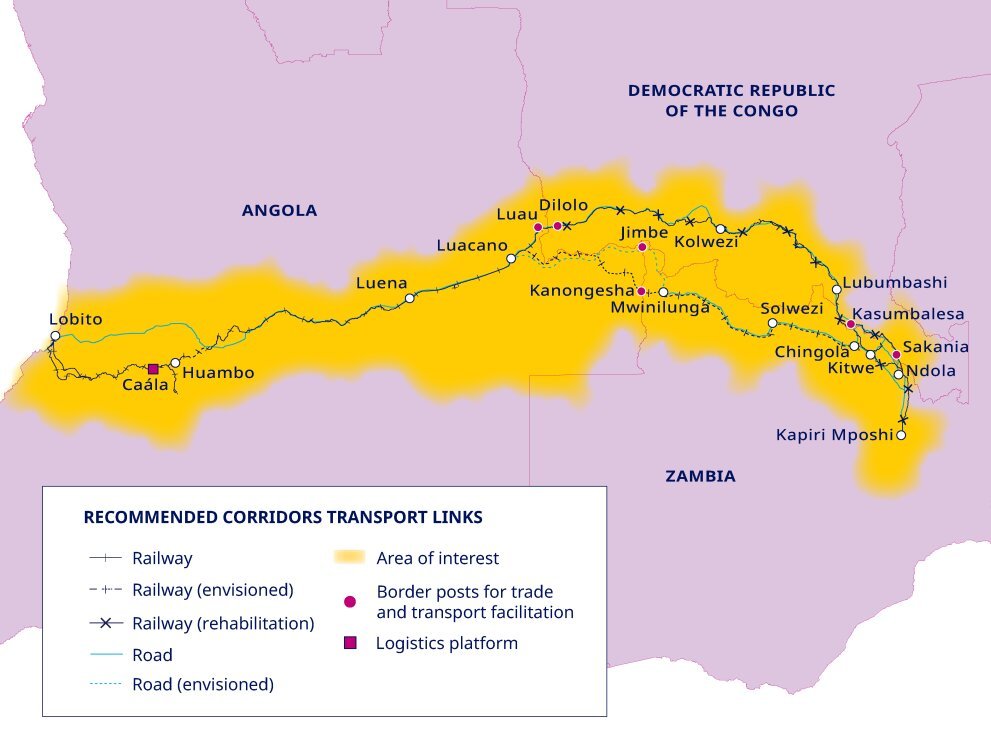
The concession covers a railway running approximately 1,004.5 kilometres, per most government and press disclosures, though Mota-Engil's own official announcement puts the concessioned section at roughly 1,037 kilometres, a modest but real discrepancy across sources describing the same asset. The line connects Dilolo, on the Angolan border, to Sakania, on the Zambian border, passing through Kolwezi, Tenke and Lubumbashi in the Lualaba and Haut-Katanga provinces, the two regions that together produce the overwhelming majority of the DRC's copper and cobalt.
Mota-Engil Africa takes responsibility for financing, rehabilitating, modernising, operating and maintaining the line for the full 30-year term, after which it transfers back to Congolese control. The freight mandate covers minerals, liquids and gases, positioning the railway as bulk mineral infrastructure first and general cargo carrier second.
The Investment Figure Moved, and That's Worth Explaining
Two different investment figures have circulated for this project, and the gap between them isn't a reporting error, it reflects two different moments in the deal's approval process. When the DRC's Council of Ministers approved the underlying public-private partnership on 10 July 2026, at its 94th ordinary meeting chaired by President Tshisekedi, the government's own indicative estimate was $1.258 billion. When Mota-Engil formally announced the signed concession on 26 August, the company's own disclosure put total expected investment over the full concession period at approximately $1.8 billion.
| Milestone | Date | Investment Figure | Source |
| DRC Council of Ministers approval | 10 July 2026 | $1.258 billion (indicative) | DRC Presidency |
| Mota-Engil signing announcement | 26 August 2026 | ~$1.8 billion (over concession life) | Mota-Engil S.G.P.S. |
Sources: DRC Presidency; Mota-Engil S.G.P.S. official disclosure.
The higher, more recent figure is Mota-Engil's own, made after the company had time to finalise the scope of rehabilitation, modernisation and new infrastructure construction the concession actually requires, and the company has said it plans to concentrate the majority of that spending in the first seven years of the 30-year term. Reading the $1.8 billion figure as the more current and more granular of the two is reasonable; treating the $1.258 billion figure as simply wrong understates that it was an honest indicative estimate made six weeks earlier, before the commercial terms were fully locked down.
A Concession Built With Explicit Anti-Monopoly Guardrails
The deal's structure carries more governance detail than most infrastructure concessions of this size, and President Tshisekedi addressed it directly at the signing: this agreement does not privatise the Société Nationale des Chemins de fer du Congo (SNCC), the DRC's national railway operator, and it does not create a rail monopoly. SNCC retains exclusive rights to passenger transport on the line and continues to operate freight services of its own, while the concession structure requires that qualified third-party operators be able to access the infrastructure under non-discriminatory conditions rather than exclusively through Mota-Engil.
The DRC government also retains an equity interest in the project company overseeing the concession, giving Kinshasa a direct financial stake in the railway's performance rather than a purely regulatory or landlord role. At the same time, project financing and traffic risk sit with Mota-Engil as concessionaire, explicitly without a Congolese sovereign guarantee backing the debt, meaning if freight volumes disappoint or financing costs rise, that risk is contractually Mota-Engil's to absorb, not the Congolese state's.
That combination, state equity stake plus concessionaire-borne risk plus mandated open access, is a notably more balanced allocation of risk and control than a straightforward build-operate-transfer concession would typically produce, and it reflects lessons the region has likely drawn from earlier, more contested African rail and port privatisations where a single foreign operator's exclusive control became a longer-term political liability.
The Economics Behind the Deal
The commercial case for the railway rests on numbers that would matter to any mining company weighing where to route its exports. Officials have said the upgraded line could cut the transit time for cargo moving from Kolwezi or Tenke to the Atlantic coast from roughly 25 days via the traditional route through Durban in South Africa, to a journey measured in days rather than weeks, while reducing logistics costs by as much as 30%. Congolese authorities have set a target annual capacity of up to 13.7 million tonnes across minerals, liquids and gases moving along the corridor toward Angola's Port of Lobito.
Those are not modest improvements. A mining operation currently absorbing three-and-a-half weeks of transit time and the associated working-capital and inventory costs would see a materially different cost structure if that journey shrinks to days, potentially changing calculations around production scheduling, contract terms with buyers, and even where future mining investment gets sited within the DRC's copper belt.
Part of a Larger, US-Backed Push
This concession doesn't stand alone. It builds directly on the corridor's Angolan-side progress, where the Africa Finance Corporation closed $753 million in financing in July 2026 for the rehabilitation of the Lobito Atlantic Railway running from the port itself to the Angola-DRC border, a deal this publication has covered separately as part of a broader pattern of Western development finance competing directly with Chinese-backed logistics infrastructure for access to Central Africa's mineral export routes. Mota-Engil already participates in that Angolan concession through the Lobito Atlantic Railway consortium, meaning the same company now holds a direct operational role across both the Angolan and Congolese legs of the corridor.
The US International Development Finance Corporation signed a letter of interest with Mota-Engil in December 2025 for up to $1 billion in potential financing support specifically tied to this Congolese railway section, a non-binding but meaningful signal that Washington sees this specific concession as strategically important enough to potentially back with American development capital. Whether that letter of interest converts into committed financing in the months ahead is one of the clearest near-term indicators of how seriously international financiers are treating the corridor's execution risk.
What Actually Determines Whether This Pays Off
None of the structural safeguards or financing signals guarantee commercial success on their own. Rehabilitating and modernising more than 1,000 kilometres of railway is capital-intensive by nature, and the concession's economics depend on freight volumes actually rising toward that 13.7-million-tonne target rather than modest incremental growth from current levels. Mining companies operating in Kolwezi, Tenke and Lubumbashi will make routing decisions based on realised transit times and costs once the line is operational, not on announced targets, and the corridor's ultimate value depends on whether it can compete on price and reliability against established routes through Durban, Dar es Salaam and other regional ports over the full 30-year concession term, not just in its opening years.
The DFC's still-unconverted letter of interest is the single most useful thing to track in the near term: a $1 billion commitment actually closing would signal that American development finance views the execution risk here as manageable, while continued delay would suggest financiers are waiting to see whether the concession's ambitious freight targets and Mota-Engil's revised $1.8 billion investment plan hold up once rehabilitation work is actually underway.
FAQ
What did the DRC and Mota-Engil actually sign? A 30-year concession agreement, signed 26 August 2026 in Kinshasa, covering the rehabilitation, modernisation, operation and maintenance of the Dilolo-Sakania railway, the Congolese section of the Lobito Corridor connecting the DRC's copper and cobalt mining belt to Angola's Port of Lobito.
Why do reports cite different investment figures for this deal? The $1.258 billion figure came from the DRC government's own indicative estimate when its Council of Ministers approved the project on 10 July 2026. The $1.8 billion figure is Mota-Engil's own, more detailed estimate disclosed after the concession was formally signed six weeks later, reflecting the finalised scope of work.
Does this deal privatise the DRC's national railway company? No. President Tshisekedi stated explicitly that the concession does not privatise SNCC or create a railway monopoly. SNCC retains exclusive passenger rights and continues operating freight services, while the concession requires that other qualified operators be able to access the infrastructure on non-discriminatory terms.
How much could this actually save mining companies on export costs? Officials project the upgraded line could cut transit time from Kolwezi or Tenke to the Atlantic coast from roughly 25 days via the traditional Durban route to a matter of days, while reducing overall logistics costs by as much as 30%.
Is US financing involved in this specific railway section? The US International Development Finance Corporation signed a non-binding letter of interest with Mota-Engil in December 2025 for up to $1 billion in potential financing support. Whether that converts into committed capital remains an open question worth tracking.
How does this connect to the broader Lobito Corridor? It completes the Congolese leg of a corridor whose Angolan section, running from the Port of Lobito to the DRC border, received $753 million in financing from the Africa Finance Corporation in July 2026. Mota-Engil holds an operational role in both the Angolan and Congolese sections of the same corridor.
 Uchumi360
Business Intelligence
Uchumi360
Business Intelligence
Uchumi360 covers business, investment, and economic policy across East, Central, and Southern Africa.
For the serious reader
You read to the end. That places you in a small group.
Uchumi360 is built for readers who demand precision over speed, structure over sentiment, and analysis that holds uncomfortable conclusions rather than softening them. If this work sharpens how you think about Africa's economy, help us keep building the infrastructure behind it.
Institutional Partners
Commission intelligence. Shape the conversation.
Uchumi360 works with development finance institutions, investment firms, sovereign bodies, and strategic organisations across the coverage region. Institutional partnership unlocks:
- Commissioned sector and country intelligence reports
- Branded research series under your institution's authority
- Exclusive data briefings for internal strategy teams
- Speaking and editorial presence at Uchumi360 events
- Co-published investment outlooks for your markets
Support Our Work
Independent analysis has a cost. Help us bear it.
Uchumi360 does not carry advertising. It does not take editorial direction from sponsors. Every article is produced without commercial compromise. Your contribution funds the reporting, research, and editorial infrastructure that keeps this analysis free from influence.
Secure checkout: One-time and monthly support are processed securely. Add payment credentials to enable checkout here.
Stay Connected
Keep up with every new insight.
Follow our latest analysis, policy coverage, and market intelligence as soon as it is published. If you need something specific, reach out directly and we will point you to the right research.
