
DRC's New Lake Tanganyika Kalemie Port Already Shipped Its First Lithium Cargo, Before It's Even Finished
Ready
DRC Vice-Prime Minister and Minister of Transport Jean-Pierre Bemba inspected construction of the Kalemie-Mutowa industrial port on 7 August 2026, accompanied by Tanganyika Vice-Governor Isidore Kabwe Longo and a delegation of provincial ministers, and pronounced himself satisfied with progress while urging the project team to hold its schedule. The port sits on a 40-hectare site at Mutowa, about 30 kilometres from Kalemie in Tanganyika Province, and is being delivered as a public-private partnership between the Congolese state and a consortium of Jintai Mining PTE Ltd and Tembo Majengo Company SARL, who signed their contract with Kinshasa in April 2025. Concessionaire Golden Lake Logistics SARL is executing the work through contractors CREC-7 and CREC-9. Phase I, valued at approximately $70 million and targeted for completion by the end of 2026, will provide 1 million tonnes of annual transit capacity; Phase II is designed to raise that to 1.8 million tonnes. A technical review by the Agence Congolaise des Grands Travaux (ACGT) on 3-4 June 2026 found progress satisfactory and aligned with Phase I targets: administrative building foundations complete with upper floors underway, commercial space advancing, the cofferdam for the first berthing zone finished, foundation excavation complete, rockfill ongoing, and dormitories and the perimeter wall already built. The port didn't wait for completion to start earning its keep: on 22 July 2026, in a ceremony led by Tanganyika Governor Christian Kitungwa Muteba, the first vessel departed Mutowa for Kigoma, Tanzania, carrying spodumene concentrate from the Manono lithium deposit, one of the earliest export shipments from a mine Zijin Mining had commissioned only weeks before, on 30 June 2026, after a delay from an original first-quarter target. Manono is expected to produce up to 500,000 tonnes of spodumene concentrate a year at scale, and Kalemie-Mutowa gives that output a lake route into Tanzania's rail network via Kigoma, an alternative to the country's traditional southern and Atlantic export corridors. Historical baseline volumes on the lake were modest: official data put 2021 imports at roughly 60,000 tonnes against coltan exports of about 2,400 tonnes, underscoring how large a jump the port's 1 to 1.8 million tonne target represents.
KALEMIE — DRC Vice-Prime Minister and Minister of Transport Jean-Pierre Bemba inspected construction of the new Kalemie-Mutowa industrial port on Friday, 7 August 2026, walking the site's various installations alongside Tanganyika Vice-Governor Isidore Kabwe Longo and a delegation of provincial ministers. Bemba described the level of execution as satisfactory and urged project managers to maintain their pace to keep the established schedule intact.
The visit was one stop in a broader pattern for Bemba's ministry this year: in early July he inspected the Banana deep-water port project on the Atlantic coast in Kongo-Central, part of a wider push across his tenure to move several of the DRC's flagship port projects from planning into visible construction.
What Is Actually Being Built
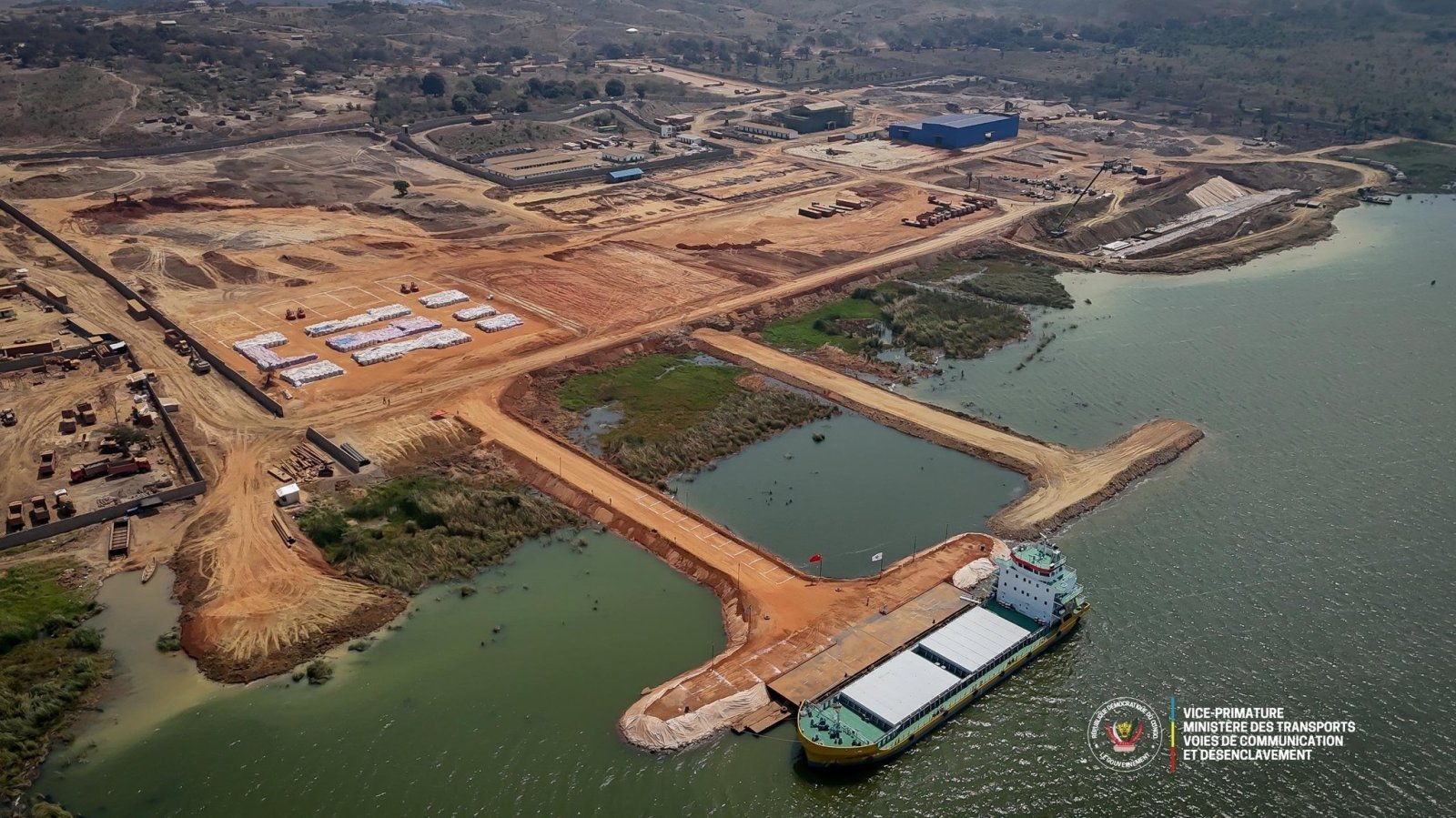
The port sits at Mutowa, roughly 30 kilometres from central Kalemie, on a 40-hectare site on the shores of Lake Tanganyika. It is being delivered as a public-private partnership between the Congolese state and a consortium of Jintai Mining PTE Ltd and Tembo Majengo Company SARL, which signed its concession contract with Kinshasa in April 2025. Concessionaire Golden Lake Logistics SARL is overseeing delivery, with the physical construction executed by contractors CREC-7 and CREC-9.
The project's scope covers dredging of the access channel, construction of quays and berths, logistics warehouses, storage areas, administrative and commercial buildings, and supporting water, electricity, control and telecommunications infrastructure. Phase I, valued at approximately $70 million and targeted for completion by the end of 2026, is designed to deliver 1 million tonnes of annual transit capacity. A second phase would raise that ceiling to 1.8 million tonnes a year, according to the government's own project documentation, though some industry reporting has cited a range extending as high as 2 million tonnes for the fully built-out facility.
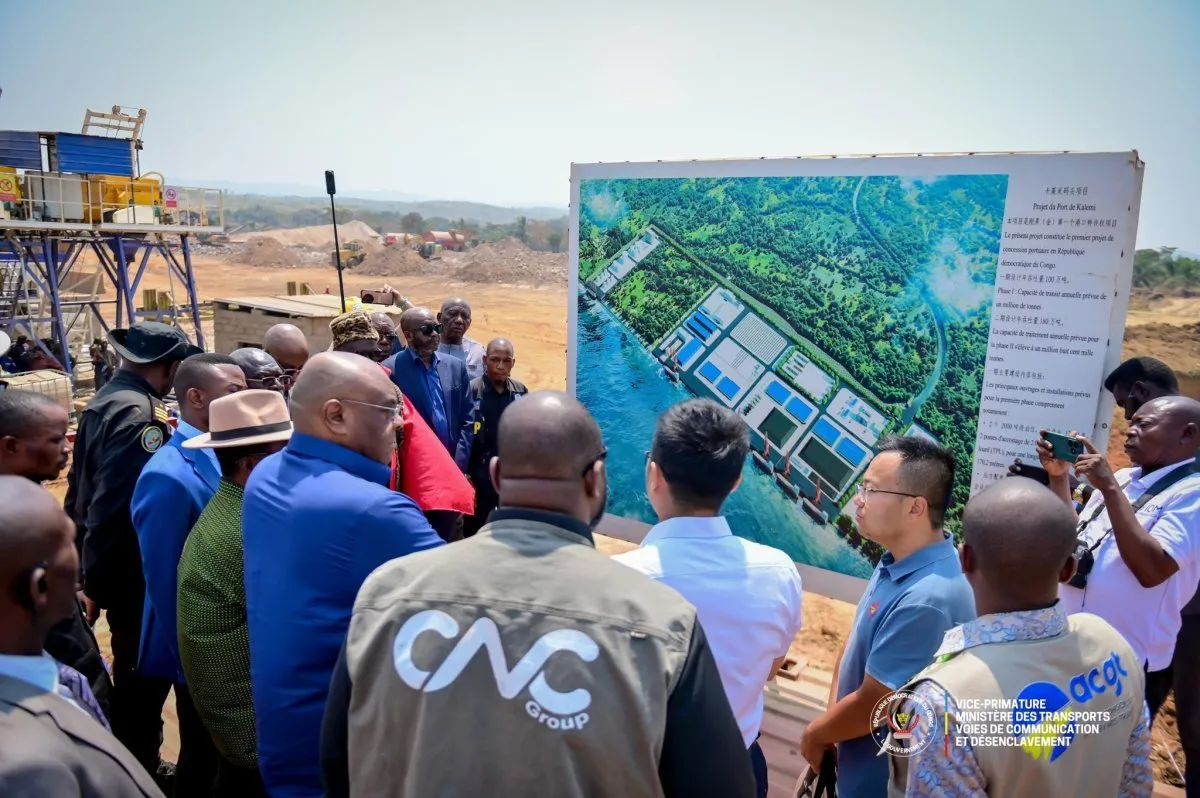 DRC Vice-Prime Minister and Minister of Transport Jean-Pierre Bemba inspected construction of the new Kalemie-Mutowa industrial port on Friday, 7 August 2026, walking the site's various installations alongside Tanganyika Vice-Governor Isidore Kabwe Longo and a delegation of provincial ministers.
A technical review conducted by the Agence Congolaise des Grands Travaux (ACGT) over 3-4 June 2026, bringing together the supervision mission, Golden Lake Logistics and both contractors, assessed the works as satisfactory and consistent with Phase I's targets. On the land side, the administrative building's foundations were complete with upper floors under construction, and commercial space was advancing. On the maritime side, the cofferdam protecting the first berthing zone was finished, foundation excavation was complete, and rockfill work was ongoing. Port camp facilities, including dormitories and the perimeter wall, were already finished at that point, roughly a year after the concession contract itself was signed.
A Port That Started Working Before It Was Finished
The most notable fact about Kalemie-Mutowa is not the construction timeline. It is that the port has already handled a cargo shipment significant enough to warrant its own ceremony, months before Phase I construction wraps up. On 22 July 2026, the first vessel departed Mutowa for Kigoma, Tanzania, carrying lithium spodumene concentrate from the Manono deposit, in an event led by Tanganyika Governor Christian Kitungwa Muteba.
The timing lines up closely with developments at Manono itself. Zijin Mining, which holds 54.9% of the Manono Lithium joint venture alongside state miner Cominiere's 35.1% and a 10% Congolese state stake, commissioned the project on 30 June 2026, after the launch had already slipped once from an original first-quarter target. Cominiere's own managing director had told reporters at the Mining Indaba conference in February that exports would begin immediately once first tons were produced. The 22 July shipment through Mutowa fits that description closely enough that it likely counts among Manono's earliest export cargoes of any kind, making Kalemie-Mutowa's first commercial voyage and one of the DRC's newest lithium mine's first export shipments effectively the same event.
Why a Lake Route Matters for a Mine Built for Global Battery Supply
Manono is not a small deposit. At scale, Zijin's own guidance points to spodumene concentrate output of up to 500,000 tonnes a year, translating to a lithium carbonate equivalent output the company has put at 120,000 tonnes in 2026, rising toward 270,000 to 320,000 tonnes by 2028, a scale that CRU Group estimates could account for roughly 5% of global mined lithium supply at peak. A May 2026 DRC-China mining agreement removing duties on Congolese mineral exports bound for China adds further commercial logic to moving that concentrate efficiently and cheaply.
Historically, DRC minerals moving to global markets have relied heavily on southern routes through Zambia and South Africa, or longer paths to Atlantic ports. A functioning lake corridor through Kalemie-Mutowa to Kigoma offers a shorter alternative into Tanzania's rail network and onward to the Indian Ocean, a route this same publication has tracked developing on the Tanzanian side through the Tabora-Kigoma Standard Gauge Railway extension. Whether that eastern route becomes genuinely competitive against established southern and Atlantic corridors will depend on cost and reliability once the port's full capacity comes online, but a working shipment in July 2026, before Phase I is even complete, is a stronger early signal than most infrastructure projects can point to at a comparable stage.
The Scale of the Jump
Official data on the lake's historical cargo volumes puts the scale of ambition in sharp relief. In 2021, annual imports through the corridor stood at roughly 60,000 tonnes, against coltan exports of only about 2,400 tonnes. Phase I's 1 million tonne target represents more than 400 times that historical export baseline, and Phase II's 1.8 million tonne target would extend that further still. Numbers of that size only mean something if the infrastructure and the mineral output arrive together, which is precisely the test the July shipment and the ongoing construction schedule are both now running simultaneously.
What Comes Next
Officials involved in the project, from ACGT's technical reviewers to Bemba himself, have been consistent in emphasising that sustained quality control and adherence to timelines remain the binding constraint, not the underlying demand. With Manono's own output still ramping toward its 2028 target and Kalemie-Mutowa's Phase I due by the end of this year, the two projects are effectively racing each other: a mine trying to reach full production, and a port trying to reach full capacity to move what that mine produces. President Félix Tshisekedi's broader transport agenda, aimed at opening up the DRC's interior provinces, will be judged in this corridor specifically by whether the port's construction pace keeps up with a mine that has already started shipping.
FAQ
What did Vice-Prime Minister Jean-Pierre Bemba announce on 7 August 2026? He did not announce anything new. Bemba conducted an inspection visit of the Kalemie-Mutowa port construction site, reported satisfaction with the pace of works, and urged project managers to maintain momentum to meet the established Phase I completion schedule.
Who is building the Kalemie-Mutowa port, and how is it financed? It is a public-private partnership between the Congolese state and a consortium of Jintai Mining PTE Ltd and Tembo Majengo Company SARL, who signed their contract with Kinshasa in April 2025. Concessionaire Golden Lake Logistics SARL manages delivery, with contractors CREC-7 and CREC-9 executing the physical construction.
How much cargo will the port be able to handle? Phase I, valued at approximately $70 million and due by the end of 2026, is designed for 1 million tonnes of annual transit capacity. A second phase would raise that to 1.8 million tonnes a year, against a historical 2021 baseline of just 2,400 tonnes of coltan exports.
Has the port already handled any cargo? Yes. On 22 July 2026, before Phase I construction was even complete, the first vessel departed Mutowa for Kigoma, Tanzania, carrying lithium concentrate from the Manono mine, in a ceremony led by Tanganyika Governor Christian Kitungwa Muteba.
Why does the Manono lithium mine matter to this port specifically? Manono, commissioned by Zijin Mining on 30 June 2026, is projected to become one of the world's largest hard-rock lithium sources, with output potentially reaching roughly 5% of global mined lithium supply at peak. Kalemie-Mutowa offers Manono's concentrate a lake-based export route into Tanzania's rail network via Kigoma, an alternative to the DRC's traditional southern and Atlantic export corridors.
How does this port connect to Tanzania's own infrastructure investments? Lake Tanganyika links Kalemie-Mutowa to Kigoma, the western terminus of Tanzania's expanding Standard Gauge Railway network, which this publication has covered separately as it extends from Tabora to Kigoma, creating a potential end-to-end corridor from DRC mines to the Indian Ocean via Tanzanian rail.
 Uchumi360
Business Intelligence
Uchumi360
Business Intelligence
Uchumi360 covers business, investment, and economic policy across East, Central, and Southern Africa.
For the serious reader
You read to the end. That places you in a small group.
Uchumi360 is built for readers who demand precision over speed, structure over sentiment, and analysis that holds uncomfortable conclusions rather than softening them. If this work sharpens how you think about Africa's economy, help us keep building the infrastructure behind it.
Institutional Partners
Commission intelligence. Shape the conversation.
Uchumi360 works with development finance institutions, investment firms, sovereign bodies, and strategic organisations across the coverage region. Institutional partnership unlocks:
- Commissioned sector and country intelligence reports
- Branded research series under your institution's authority
- Exclusive data briefings for internal strategy teams
- Speaking and editorial presence at Uchumi360 events
- Co-published investment outlooks for your markets
Support Our Work
Independent analysis has a cost. Help us bear it.
Uchumi360 does not carry advertising. It does not take editorial direction from sponsors. Every article is produced without commercial compromise. Your contribution funds the reporting, research, and editorial infrastructure that keeps this analysis free from influence.
Secure checkout: One-time and monthly support are processed securely. Add payment credentials to enable checkout here.
Stay Connected
Keep up with every new insight.
Follow our latest analysis, policy coverage, and market intelligence as soon as it is published. If you need something specific, reach out directly and we will point you to the right research.
