
10 Sectors That Will Create Tanzania's Next Generation of Millionaires Over the Next Decade. Youth Who Position Now Will Profit First.
Ready
Tanzania's economy is poised for a decade of structural transformation driven by the Julius Nyerere Hydropower Project's energy surplus, the Standard Gauge Railway's logistics restructuring, the AfCFTA's regional market opening, Vision 2050's industrialisation ambitions, and global demand for the critical minerals whose deposits Tanzania holds in globally significant quantities. Agriculture employs approximately 65% of Tanzanians but processes less than 10% of its output. Tanzania imports approximately 72% of its edible oil needs. Only 10% of its hides are processed locally. Tourism contributes 9.5% of GDP and is projected to reach 2.25 million jobs by 2034. The renewable energy sector is growing at approximately 12% annually. These are not abstract opportunity categories. They are specific structural gaps between what Tanzania produces and what it could produce, between what it exports raw and what it could export processed, between what it imports and what it could manufacture domestically, and the entrepreneurs who close those gaps over the next decade will generate the wealth that structural transformation historically produces for those positioned ahead of the inflection point. This article identifies ten sectors, explains the specific opportunity within each, provides the capital entry range and timeline, and names the entrepreneurs who have already demonstrated the model works. Tanzania's wealth is not underground. It is in the gap between what the economy currently does with its resources and what it could do with them. The entrepreneurs who close that gap over the next ten years will be the millionaires of 2035.
Tanzania is entering one of the most consequential decades in its economic history, and the entrepreneurs who understand what is driving the transformation and position themselves ahead of its peak will generate the kind of wealth that structural economic shifts have always produced for those who read them correctly. The Julius Nyerere Hydropower Project has pushed installed electricity generation above 4,000 megawatts, creating an energy surplus whose industrial investment significance is only beginning to be priced by private capital. The Standard Gauge Railway's extension toward Mwanza is restructuring Central Corridor logistics economics in ways that change the cost structure of manufacturing, agro-processing, and cold chain distribution across the entire interior. The AfCFTA's market of 1.4 billion people across 55 countries is the commercial backdrop for every export-oriented business decision made in Tanzania over the next decade. Global demand for graphite, nickel, helium, and rare earths is making Tanzania's geological endowment strategically consequential in ways that a previous generation of entrepreneurs could not have anticipated.
The sectors that follow are not trend predictions. They are structural gap analyses, specific categories where the distance between what Tanzania currently does with its resources and what it could do with them is large enough, and the enabling infrastructure is now sufficient enough, that the entrepreneurs who close that gap over the next ten years will generate returns commensurate with the opportunity. Capital entry ranges, growth rates, and break-even timelines are drawn from Tanzania Investment Centre data, Bank of Tanzania sector reports, and industry assessments. The entrepreneurs named have already demonstrated the model works. The question is who scales it next.
1. Agro-processing and food manufacturing
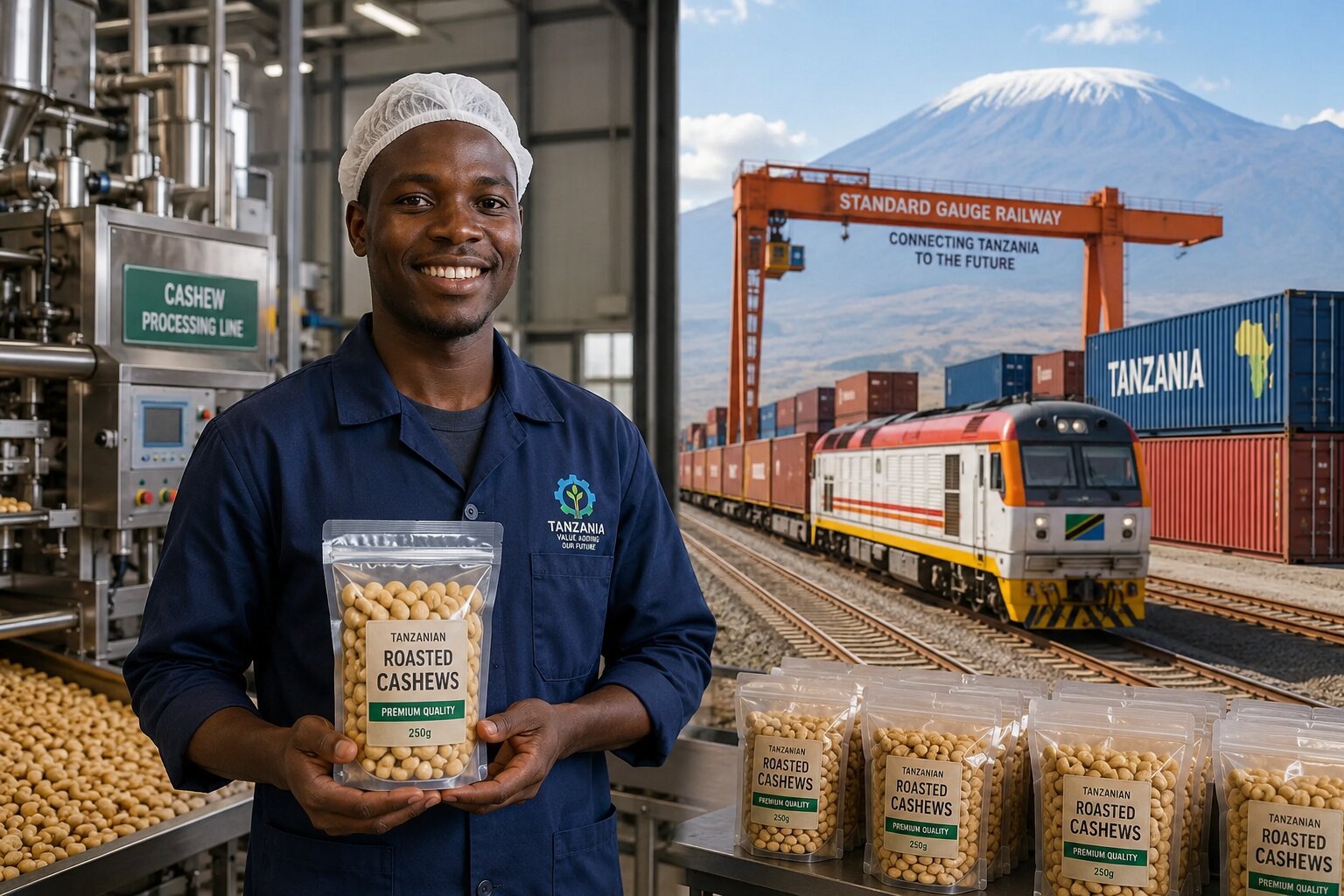
Agriculture employs approximately 65% of Tanzanians and contributes roughly 26.5% of GDP according to Bank of Tanzania economic data, making it the single largest sector in the economy by employment and one of the largest by output. Less than 10% of Tanzania's fruits and vegetables are processed locally. Approximately 90% of Tanzania's cashew, the country's most significant agricultural export commodity and one whose global market value runs into billions of dollars annually, leaves the country raw, with the processing margin, the roasting, flavouring, packaging, and branding value, accruing to facilities in India, Vietnam, and Europe rather than to Tanzanian entrepreneurs.
The opportunity is in the gap. Fahad Awadh, founder of YYTZ Agro-Processing, identified it precisely. Tanzania is the world's eighth-largest cashew producer and was exporting almost all of it raw. Awadh built a mechanised processing plant in Zanzibar that peels, roasts, and flavours cashews for export and local retail, benchmarking his factory against Vietnamese processing operations whose efficiency standards the global market rewards. His insight was simple: the value is not in growing the cashew. It is in what happens to the cashew after it is grown. The same logic applies across mangoes, tomatoes, citrus, maize, rice, and the full range of crops whose raw export prices tell only the first chapter of the economic story.
A citrus juice processing plant with capital expenditure of approximately USD 200,000 sited near production zones in Morogoro or Kilimanjaro could reach USD 1 to 2 million in annual revenue by year five serving East African regional markets. A branded specialty coffee roaster targeting export and domestic cafés requires USD 50,000 to 100,000 in equipment and connects Tanzania's established coffee heritage to the premium pricing that origin-branded coffee commands in European and American markets. The Southern Agricultural Growth Corridor of Tanzania provides infrastructure and policy support for agro-processing investment along the SAGCOT corridor. Entry capital ranges from USD 50,000 to 500,000 depending on scale, with break-even typically achievable in three to five years for operations that secure reliable raw material supply through contract farming or cooperative models.
2. Edible oils and animal feeds
Tanzania produces approximately 28% of its own edible oil needs according to Tanzania Bureau of Standards industry data, importing the remaining 72% in refined form despite growing millions of tonnes of sunflower, sesame, groundnut, and coconut whose crushing and refining would substitute those imports with domestically produced alternatives. The import bill for edible oils represents an annual foreign exchange outflow that domestic processing capacity could redirect into Tanzanian manufacturing margins.
The business case is straightforward. A medium-scale sunflower or coconut oil mill with capital expenditure of USD 100,000 to 500,000, positioned near oilseed production areas in Singida, Dodoma, or the coast for coconut, can produce branded Tanzanian edible oils for retail and food service markets while generating oilseed cake byproducts that feed directly into the adjacent animal feed manufacturing opportunity. Tanzania produced approximately 6.4 million tonnes of maize in 2022 according to Ministry of Agriculture crop production data, creating the feed grain supply that animal feed manufacturing requires alongside the oilseed cake that provides the protein component. A feed mill with capital expenditure of approximately USD 150,000 supplying poultry and dairy farmers across Dar es Salaam's periurban production belt could reach USD 500,000 in annual revenue within three years of operation.
The competitive pressure from imported palm and soybean oil is real, but the government is introducing protective tariffs on some import categories and providing processing incentives whose combination is beginning to change the relative economics of domestic production versus importation. The entrepreneur who builds the local brand, the supply chain relationships with oilseed farmers, and the distribution network into retail and food service while protective conditions exist will be positioned for the market leadership that brand equity and first-mover distribution advantages compound over time.
3. Livestock, dairy, and leather
Tanzania has one of Africa's largest livestock herds, a resource base whose economic conversion rate is among the continent's lowest relative to its scale. Approximately 16,746 tonnes of hides and skins were produced in Tanzania in 2019 and 2020 according to Ministry of Livestock and Fisheries data. Only approximately 10% of those hides are processed into leather locally. The remaining 90% leave Tanzania as raw hides whose tanning, finishing, and manufacturing into shoes, belts, bags, and upholstery occurs in Chinese, Indian, and Italian factories whose margins Tanzania's livestock producers are subsidising through their export pricing.
The dairy processing gap is equally significant. Urban demand for packaged milk, yoghurt, and processed dairy products is growing with the pace of urbanisation and income growth whose combined effect is expanding the formal retail food market in Dar es Salaam, Arusha, Mwanza, and secondary cities. A dairy cooperative that collects milk from smallholder farmers and operates a pasteurisation and packaging plant with capital expenditure of USD 100,000 to 300,000 creates a branded Tanzanian dairy product capable of competing with imports at the premium pricing that quality and local branding command. Ann-Elizabeth Swai's AKM Glitters poultry franchise network, which provides day-old chicks, feed, and training to rural farmers while guaranteeing buyback of mature chickens, demonstrates the franchise model whose application to dairy, beef, and leather would create similar networks of rural income generation anchored by urban processing and distribution operations.
A tannery and leather goods factory producing shoes, belts, and bags from Tanzanian hides can access export processing zone benefits including duty-free inputs under EPZ bonds while serving both domestic import substitution demand and export markets. Capital expenditure ranges from USD 200,000 to USD 1 million depending on scale and product range, with break-even achievable in three to six years for operations that secure consistent hide supply and develop the quality management systems that export market buyers require.
4. Fisheries and aquaculture
Tanzania's coastline on the Indian Ocean, its shores on Lake Victoria, Lake Tanganyika, and Lake Nyasa, and its Exclusive Economic Zone collectively represent one of the most significant untapped fisheries and aquaculture opportunities in East Africa. Only approximately 30% of Tanzania's fish catches are utilised for human food. Commercial fishing in the EEZ for tuna and other offshore species is underdeveloped relative to the resource's scale. Aquaculture, specifically tilapia, catfish, and shrimp farming, is growing slowly despite ecological conditions well-suited to intensive production.
The demand trajectory is compelling. Rising urbanisation across Tanzania and the broader East African region is driving seafood consumption growth. Export markets for shrimp and high-value fish species offer premium pricing that domestic commodity markets do not. A small tilapia farming operation with startup capital of approximately USD 50,000 can reach USD 200,000 in annual sales by year three. A larger shrimp pond project with capital expenditure of USD 500,000 can supply the hotel sector in Dar es Salaam and Zanzibar whose imported shrimp represents a foreign exchange outflow that domestic aquaculture could capture.
Diana Mbogo's Millennium Engineers company in Mwanza demonstrates the adjacent opportunity in solar-powered fishing infrastructure, providing solar lamps for fishermen that replace kerosene lighting and solar fish-drying facilities that quintupled the usable portion of catches whose spoilage rates under traditional drying conditions waste a significant share of the landed catch's potential value. The multiplier effect of fisheries is particularly high: every fish farmer creates demand for hatcheries, feed suppliers, cold storage, transport, and packaging whose combined employment effect extends well beyond the primary production operation. Infrastructure constraints, particularly the absence of ice plants at landing sites and cold chain logistics connecting production zones to urban markets, are the primary barriers whose resolution by private entrepreneurs creates the enabling infrastructure that subsequent entrants in the sector require.
5. Textiles and apparel
Tanzania produces approximately 49,000 tonnes of cotton annually according to Tanzania Cotton Board production data, but local ginning and weaving capacity processes only a fraction of that output, with the majority leaving Tanzania as raw cotton whose spinning, weaving, dyeing, and garment manufacturing margins accumulate in factories elsewhere. Clothing imports dominate Tanzania's retail market despite the raw material base that a domestic textile industry would require being available domestically.
Vision 2050's textile sector development agenda, combined with government incentives including duty exemptions on imported textile machinery, is creating the policy environment within which vertically integrated textile ventures from cotton farming through ginning, weaving, and garment assembly can compete. A sewing factory with capital expenditure of approximately USD 300,000 producing clothing for local retail chains and export niche markets including safari wear, beachwear, and youth fashion can reach meaningful scale within four to seven years. The larger opportunity is the vertically integrated model, combining cotton farming, a ginnery, and a garment factory into an operation that captures the full value chain whose combined margin substantially exceeds what any single stage delivers independently.
The AfCFTA's regional market access and potential preferential access to international markets under trade agreements create the export demand that scale textile manufacturing requires to justify the capital investment. Labour costs in Tanzania compare favourably to competing garment manufacturing locations in Asia, making Tanzania commercially attractive for garment assembly whose value addition is labour-intensive rather than capital-intensive. The entrepreneur who builds the brand, the supply chain, and the export relationships during the current policy environment will be positioned when the sector reaches the scale that government investment in textile parks and industrial zones is designed to catalyse.
6. Construction and building materials
Tanzania's construction sector grew approximately 9% in 2023 according to National Bureau of Statistics quarterly data and is forecast to grow 7 to 8% annually through 2029, driven by public infrastructure budgets that reached TZS 56 trillion in the 2025/26 government budget, private real estate development along the Dar es Salaam to Dodoma corridor, and the urbanisation whose pace is expanding secondary cities including Mwanza, Arusha, Mbeya, and Dodoma at rates that create sustained demand for housing, commercial space, and urban infrastructure.
Real estate contributes approximately 11% of GDP according to Bank of Tanzania sectoral data, making the built environment one of the economy's most significant productive categories. Local manufacturing of cement, concrete blocks, steel rebar, tiles, and roofing replaces imports with domestically produced alternatives while serving the construction demand that government infrastructure spending is creating. A brick-making operation with capital expenditure of approximately USD 50,000 for a brick press and raw material supply can produce tens of thousands of bricks monthly for the large construction projects whose material requirements government contractors are currently sourcing from wherever supply is available at competitive pricing. Medium-scale factories producing tiles, roofing sheets, or cement blocks require USD 200,000 to USD 2 million but can supply national demand in product categories whose domestic production is insufficient to meet current construction activity.
Construction services, covering electrical installation, plumbing, carpentry, and design-build housing for the growing middle class, create the entry pathway for entrepreneurs without the capital for manufacturing investment. Prefabricated housing systems whose panel and truss components speed construction timelines and reduce material waste are an opportunity whose time-to-market is accelerating as urbanisation creates demand for housing that traditional construction methods cannot deliver at the required pace and price point.
7. Transport and logistics
The Standard Gauge Railway's extension toward Mwanza, whose USD 2.33 billion financing Standard Chartered arranged in April 2026 according to the bank's official announcement, is restructuring the logistics economics of the Central Corridor in ways that create new commercial opportunities for private logistics operators at every stage of the supply chain between Dar es Salaam port and the landlocked markets of Rwanda, Burundi, Uganda, and the eastern DRC. The logistics sector is projected to grow 10% annually as the SGR reaches operational scale and Dar es Salaam port's expansion improves handling efficiency and reduces dwell time for the cargo whose volume is increasing with regional trade growth.
The commercial opportunities are specific. A trucking operation connecting SGR terminals to last-mile delivery points in inland cities requires capital of USD 30,000 to 50,000 per vehicle and serves the freight whose inland distribution the railway cannot handle directly. A refrigerated transport company specialising in fish, horticulture, and processed foods connecting production zones to the SGR's freight network can reach USD 500,000 in annual revenue within a few years of operation. Inland container depot operations, cold storage warehousing near SGR terminals, and freight forwarding services connecting Tanzanian exporters to regional and international buyers are all commercial categories whose demand is growing with the infrastructure investment whose completion is creating the market they will serve.
The technology-enabled logistics opportunity is equally significant. Platforms that match cargo owners with available truck capacity, optimise routing for refrigerated distribution, and provide supply chain visibility for agricultural exporters connecting to regional buyers under the AfCFTA framework are early-stage businesses whose commercial viability is increasing as the infrastructure whose data they would organise becomes operational.
8. Tourism and hospitality
Tourism contributes approximately 9.5% of Tanzania's GDP according to World Travel and Tourism Council data for 2023 and employs approximately 1.4 million people, with projections indicating growth to 2.25 million tourism-related jobs by 2034. The government's target of 5 million visitors and USD 6 billion in annual tourism revenue represents a doubling of current visitor numbers and a substantial increase in per-visitor spending, achievable through the combination of product diversification beyond conventional safari into cultural, heritage, eco-tourism, and adventure categories that command higher per-night spending from niche markets whose size is growing with global travel market expansion.
Alice Manupa's African Queen Adventures demonstrates the entrepreneurial model whose replication and scaling the market supports. By founding a tour company at age 30 that specialised in unique safari experiences and pivoted to serve African-American heritage tourism, Chinese visitor groups, and Israeli market segments through direct international marketing and social media outreach, Manupa brought more than 100 groups of high-end tourists in a single season, outmanoeuvring legacy tour companies through niche positioning and personal branding rather than scale. The boutique eco-lodge opportunity, a lodge investment of USD 500,000 to 2 million in a conservation area or coastal location commanding high nightly rates from international travellers, represents the capital-intensive version of the same strategy whose returns compound as international tourism to Tanzania grows with the government's destination marketing investment and airlift improvement.
Ancillary tourism services, covering car rental, camp catering, adventure sports, cultural programming, and domestic safari packages targeting Tanzania's growing urban middle class, create lower capital entry points whose combined scale of demand is sufficient to support multiple specialised operators in each category. The VAT exemption for hotel services and the government's active tourism sector investment incentives create the policy environment whose consistency the tourism investor requires to justify the multi-year capital commitment that hospitality infrastructure demands.
9. Renewable energy
Tanzania's electrification rate is rising with the Julius Nyerere Hydropower Project's generation contribution and the rural electrification programme's expansion, but significant portions of the rural population and many island communities remain off-grid in ways that create commercial demand for renewable energy solutions whose economics the falling cost of solar photovoltaic technology has made viable for private sector deployment at small and medium scale. The energy sector is projected to grow approximately 12% by 2026 according to Tanzania Energy and Water Utilities Regulatory Authority sector data, with off-grid solar and mini-grid investment accounting for a significant share of that growth.
Diana Mbogo's Millennium Engineers provides the most precisely relevant case study. Founded in 2016 in Mwanza, the company deploys solar lamps for fishing communities that replace kerosene lighting at a rental cost of approximately USD 1 per day, creating savings of thousands of shillings annually for fishermen whose income is directly improved by the switch. Solar fish-drying facilities installed by the company quintupled the usable portion of catches whose spoilage rate under traditional sun-drying conditions was eliminating a significant share of the economic value that fishing communities worked to land. The business model, combining rental financing of solar equipment with maintenance service contracts, creates recurring revenue that scales as the customer base expands rather than depending on repeated capital equipment sales.
A solar home system leasing operation serving rural households with startup inventory of USD 10,000 to 50,000 can build a recurring revenue base as the rental portfolio grows. A village mini-grid serving 1,000 households with a 100 kilowatt installation costing USD 200,000 to 300,000 generates long-term power sales revenue whose predictability improves as the customer base matures. The Rural Energy Agency's partial financing support for qualifying mini-grid projects reduces the capital requirement for private operators whose project economics are viable with the subsidy component that REA provides to accelerate rural electrification.
10. Mining and critical minerals
Tanzania's mining sector contributes approximately 8 to 9% of GDP according to Bank of Tanzania data and encompasses gold, tanzanite, nickel, graphite, cobalt, helium, and rare earth occurrences whose combined strategic significance for the global energy transition economy is greater than at any previous point in the country's economic history. The global demand for battery minerals is creating a commercial environment in which Tanzania's graphite at Mahenge and Epanko, nickel at Kabanga, and helium in the Rukwa Basin are attracting international investment capital at a pace whose acceleration the energy transition's mineral requirements are driving.
Saniniu Laizer's story is the most dramatic illustration of the sector's wealth potential. His workers pulled two tanzanite crystals weighing fifteen kilograms from his Simanjiro mine in 2020 and he sold them to the government for TZS 7.74 billion, approximately USD 3.35 million. Laizer's success was not accidental. He had built a mining and cattle operation employing approximately 200 people, invested in equipment and human capital, and was operating with the systematic approach to resource development that distinguishes wealth-generating mining from subsistence extraction. The tanzanite cutting and polishing workshop, requiring USD 20,000 to 50,000 for lapidary equipment, represents the value addition opportunity whose margin over raw gemstone prices demonstrates exactly the processing gap that the BUA Group and YYTZ Agro-Processing case studies demonstrate in their respective sectors.
Larger ventures including graphite or rare earth processing plants, with capital expenditure of USD 5 million to 20 million, are the industrial-scale opportunities whose development the government's mineral value addition policy is designed to incentivise through the 100% tax deduction for qualifying mining operations and the guaranteed purchase centres for artisanal miners that provide revenue certainty for smaller-scale operators. Supporting industries, drilling services, mining equipment leasing, explosives supply, and local fabrication and welding shops serving mine sites, create the lower capital entry points whose commercial viability is growing with the mining activity whose scale is increasing as critical mineral demand drives investment across Tanzania's mineral development pipeline.
The common thread
Ten sectors. One underlying logic. Tanzania's wealth creation opportunity over the next decade is concentrated in the gap between what the economy currently does with its resources and what it could do with them. Less than 10% of fruits and vegetables processed. 72% of edible oil imported. 90% of hides exported raw. 90% of cashew exported unprocessed. These are not market failures in the abstract. They are specific, quantifiable gaps between Tanzania's productive base and its productive potential, and the entrepreneurs who close those gaps, who build the processing plants, the cold chains, the branded products, the export relationships, and the manufacturing operations that convert Tanzania's raw material abundance into industrial output, will generate returns commensurate with the scale of the transformation they are participating in.
The enabling infrastructure is more serious now than at any previous point. The energy surplus exists. The SGR is being built. The port is expanding. The AfCFTA market is open. The global demand for critical minerals is accelerating. The entrepreneur who reads those conditions correctly, positions in the right sector, and executes with the discipline that Fahad Awadh, Ann-Elizabeth Swai, Alice Manupa, Diana Mbogo, and Saniniu Laizer all demonstrated in their respective fields, will be among the millionaires whose success the next decade of Tanzania's transformation will produce.
FAQ
Which sector offers the lowest capital entry point for young entrepreneurs? Renewable energy and agro-processing offer the lowest entry capital requirements. A solar home system leasing operation can begin with USD 10,000 to 50,000 in inventory. Small-batch agro-processing, a mango drying operation or a branded spice packaging unit, can start with USD 50,000 or less. Both sectors offer break-even timelines of two to four years for well-executed operations with reliable supply chains and clear market access.
Why is the processing gap the central wealth creation opportunity? Because Tanzania's economy produces significant volumes of agricultural commodities, hides, minerals, and raw materials whose value addition occurs almost entirely outside the country. Less than 10% of fruits and vegetables are processed locally. Approximately 90% of cashew is exported raw. Only 10% of hides are tanned domestically. The entrepreneur who builds the processing operation that closes those gaps captures the manufacturing margin that the raw exporter transfers to processors elsewhere, and that margin is where the millionaire-scale returns are concentrated.
How does the SGR change the logistics and transport opportunity? The SGR restructures the cost economics of moving goods from inland production zones to Dar es Salaam port and to landlocked regional markets in Rwanda, Burundi, Uganda, and the DRC. Lower freight costs improve the commercial viability of manufacturing and agro-processing operations in inland locations whose road transport economics previously made them uncompetitive. Private logistics operators connecting SGR terminals to last-mile delivery points, cold storage operators serving the SGR's perishable freight, and freight forwarders connecting Tanzanian exporters to regional buyers all benefit from the infrastructure investment whose commercial ecosystem is still forming.
What makes mining a viable opportunity for young entrepreneurs without large capital? The gemstone cutting and polishing workshop, which requires USD 20,000 to 50,000 for lapidary equipment, creates the value addition opportunity in tanzanite, tsavorite, and other gemstones whose polished value substantially exceeds their raw stone price. Artisanal mining cooperatives with proper licensing provide the raw material supply. Supporting industries, equipment leasing, drilling services, and mine site fabrication, create additional entry points at lower capital requirements than primary mining operations. The government's 100% tax deduction for qualifying mining operations and guaranteed purchase centres for artisanal miners provide the revenue certainty and fiscal incentive that improve the business case for smaller-scale operations.
Which regional markets should Tanzanian entrepreneurs target for exports? The East African Community's common market protocol creates preferential access to Kenya, Uganda, Rwanda, Burundi, and South Sudan. The DRC's large population and industrial demand, accessible through the Central Corridor's SGR connectivity and Lake Victoria waterborne transport, represents the highest-volume regional opportunity for manufactured goods, processed foods, and construction materials. The AfCFTA's broader market of 1.4 billion people creates the framework for exports beyond the EAC, with Mozambique, Zambia, Malawi, and Zimbabwe representing natural export markets for Tanzanian agro-processed goods, construction materials, and light manufactured products whose regional trade logistics the SGR corridor is improving.
 Uchumi360
Business Intelligence
Uchumi360
Business Intelligence
- Bank of Tanzania, annual economic data
- Agriculture GDP share of approximately 26.5%, mining GDP share approximately 8 to 9%, manufacturing growth rate, and sectoral lending data cited from BOT annual reports
- Available at bot.go.tz
- Tanzania Bureau of Standards and Ministry of Industry, edible oil production and import data
- Available at tbs.go.tz
- Ministry of Livestock and Fisheries, hides and skins production data
- Available at mifugo.go.tz
- Tanzania Cotton Board, cotton production data
- Available at cottonboard.go.tz
- National Bureau of Statistics Tanzania, construction sector growth data
- Approximately 9% growth in 2023 cited from NBS Q4 2023 quarterly GDP data
- Available at nbs.go.tz
- World Travel and Tourism Council, Tanzania tourism data
- Tourism contributing approximately 9.5% of GDP in 2023 and 1.4 million employment figure cited from WTTC Tanzania report
- Available at wttc.org
- Tanzania Energy and Water Utilities Regulatory Authority, energy sector growth projections
- Available at ewura.go.tz
- Standard Chartered Bank, SGR financing announcement, 28 April 2026
- Available at sc.com
- Tanzania Investment Centre, sectoral investment data and industrial park development records
- Available at tic.go.tz
- Rural Energy Agency Tanzania, mini-grid financing and rural electrification data
- Available at rea.go.tz
- Tanzania Mining Commission, mining sector regulatory framework and artisanal miner support programme documentation
- Available at mc.go.tz
- Southern Agricultural Growth Corridor of Tanzania, agro-processing support programme documentation
- Available at sagcot.co.tz
- AfCFTA Secretariat, market coverage and implementation framework
- Available at au-afcfta.org
- Kenya National Bureau of Statistics, regional trade data for East African comparative context
- Available at knbs.or.ke
- Rwanda Development Board, regional investment and free movement policy data
- Available at rdb.rw
- Uganda Bureau of Statistics, manufacturing and agricultural sector data for regional comparative context
- Available at ubos.org
- Zambia Statistics Agency, trade and manufacturing data for Southern African regional context
- Available at zamstats.gov.zm
- African Export-Import Bank, African Trade Report 2024
- Intra-African trade share data
- Available at afreximbank.com
- East African Community Secretariat, Common Market Protocol implementation data
- Available at eac.int
- Tanzania Petroleum Development Corporation, natural gas reserve data for energy sector context
- Available at tpdc.go.tz
Uchumi360 covers business, investment, and economic policy across East, Central, and Southern Africa.
For the serious reader
You read to the end. That places you in a small group.
Uchumi360 is built for readers who demand precision over speed, structure over sentiment, and analysis that holds uncomfortable conclusions rather than softening them. If this work sharpens how you think about Africa's economy, help us keep building the infrastructure behind it.
Institutional Partners
Commission intelligence. Shape the conversation.
Uchumi360 works with development finance institutions, investment firms, sovereign bodies, and strategic organisations across the coverage region. Institutional partnership unlocks:
- Commissioned sector and country intelligence reports
- Branded research series under your institution's authority
- Exclusive data briefings for internal strategy teams
- Speaking and editorial presence at Uchumi360 events
- Co-published investment outlooks for your markets
Support Our Work
Independent analysis has a cost. Help us bear it.
Uchumi360 does not carry advertising. It does not take editorial direction from sponsors. Every article is produced without commercial compromise. Your contribution funds the reporting, research, and editorial infrastructure that keeps this analysis free from influence.
Secure checkout: One-time and monthly support are processed securely. Add payment credentials to enable checkout here.
Stay Connected
Keep up with every new insight.
Follow our latest analysis, policy coverage, and market intelligence as soon as it is published. If you need something specific, reach out directly and we will point you to the right research.
