
Uganda Names Its Crude Oil "Pearl Sweet" as It Prepares for the Economic Reality of First Oil

Ready
President Yoweri Museveni named Uganda's crude oil blend "Pearl Sweet" on 2 September 2026 as the country moves toward commercial production from the Tilenga and Kingfisher fields. The naming itself is symbolic, a commercial identity a crude blend needs before international refiners will price and buy it. The economic substance underneath it is what actually matters: after roughly $15 billion in combined investment, Uganda is approaching the point where oil revenue, export volumes and industrial linkages, the refinery, gas-fired power, local employment, stop being projections in a feasibility study and start being figures that show up in an actual national budget. That transition is where the real test begins, and it's a considerably harder one than choosing a name.
KIKUUBE, UGANDA — For most of the past two decades, Uganda's oil sector has existed primarily as a set of projections: reserve estimates, investment commitments, production targets, revenue forecasts. President Museveni's naming of the country's crude oil blend "Pearl Sweet" on 2 September 2026 marks the point where those projections start converting into an actual, functioning economic sector with real prices, real export volumes and real revenue flowing through Uganda's national accounts.
The naming itself is a necessary but narrow commercial step: Pearl Sweet gives Uganda's crude the kind of recognisable identity, low sulphur content, tied to the country's own "Pearl of Africa" branding, that international refiners and traders need before they'll price and buy a new crude grade at scale. It will now appear on cargo documentation, refinery specifications and trading databases, the same infrastructure that lets buyers distinguish Brent from Bonny Light from any other named crude on the market. That's the symbolism. The economic substance is what happens next.
What "First Oil" Actually Changes
Uganda's oil sector has been discussed in Ugandan public life for so long, President Museveni referenced his 1986 decision, immediately after taking power, to send young Ugandans abroad to train in petroleum disciplines specifically in anticipation of a future industry, that the shift from planning to production risks being treated as simply another milestone in a long sequence. It isn't. Once Kingfisher and Tilenga are actually producing and exporting Pearl Sweet crude, several variables that have existed only as feasibility-study assumptions for years become live, measurable economic facts: how much revenue Uganda actually collects at prevailing global oil prices, whether that revenue arrives on the schedule the government's own budget planning assumes, and whether the industrial linkages Museveni and his ministers have repeatedly promised, a domestic refinery, gas-fired electricity, LPG production, local employment and skills, actually materialise at the scale projected or fall short of it.
That distinction between planning and reality is precisely why the scale details underneath this milestone matter more than the naming ceremony itself. Kingfisher, where the ceremony was held, is designed to produce approximately 40,000 barrels per day at peak, a genuine and hard-won milestone given CNOOC's Central Processing Facility reached mechanical completion on 24 August 2026. But Kingfisher represents less than a fifth of Uganda's total planned output. The considerably larger Tilenga field, operated by TotalEnergies, is designed for roughly 190,000 barrels per day, putting the combined peak target at approximately 230,000 barrels per day once both fields and the 1,443-kilometre East African Crude Oil Pipeline, reported at 92.7% complete and required to run heated along its full length to keep Uganda's waxy crude flowing, are operating together.
The Money Already Spent, and What It's Bought So Far
The scale of capital already committed gives a sense of how much is now riding on execution rather than planning. The combined Tilenga, Kingfisher and EACOP investment programme totals approximately $15 billion, with more than $12 billion already spent as Uganda approaches first oil. That capital has generated measurable domestic effects well before a single barrel has been exported: sector employment reached 22,234 people as of March 2026, 85% of them Ugandan nationals, with more than 14,000 Ugandans trained and certified in oil and gas disciplines over the course of the projects' development. Prime Minister Robinah Nabbanja pointed to tangible regional infrastructure built alongside the oil development itself, Kabalega International Airport, the Kabalega Industrial Park, more than 500 kilometres of tarmacked roads, and upgraded health facilities in Uganda's Bunyoro sub-region.
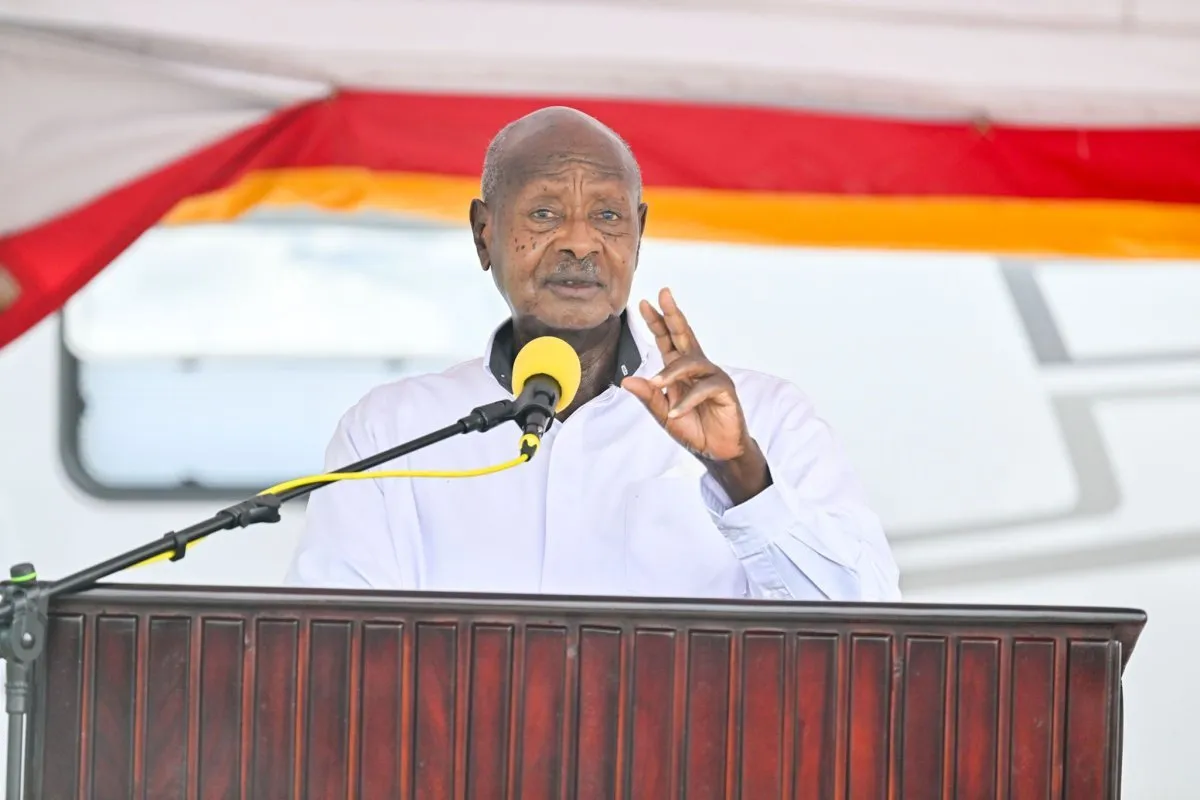 The President of Uganda, Yoweri Museveni, said Uganda’s oil resources should not simply be viewed as a commodity for export, but as an opportunity to establish industries and strengthen the country’s productive capacity.
Those figures represent the investment phase's economic footprint, jobs, training and infrastructure created by building the industry. The harder economic test starts once production begins: whether the revenue Uganda actually collects from selling Pearl Sweet crude on international markets translates into the same scale of durable national benefit the investment phase has already produced regionally, or whether it gets absorbed into government consumption without the same lasting effect.
The Industrial Linkages Museveni Is Betting On
Museveni used the naming ceremony to reiterate three specific commitments about what Uganda intends to do with its oil beyond simply exporting crude, each of which now shifts from stated policy into something that can actually be measured against outcomes. First, the domestic refinery: Museveni argued that refining crude locally eliminates the roughly $12.77-per-barrel cost of transporting it to Tanga Port and could save Uganda an estimated $2 billion currently spent importing refined petroleum products, and reiterated that Uganda's agreement with its oil partners requires the refinery to receive priority even as some crude is exported. Whether that refinery actually gets built on a competitive timeline, rather than remaining a stated priority indefinitely deferred behind export volumes, is now a genuine test of Uganda's industrial policy rather than an aspiration.
Second, gas utilisation: Uganda has committed not to flare associated gas produced at Kingfisher, instead using it to generate up to 80 megawatts of electricity, roughly half the output of the Nalubaale Power Station, potentially worth around $30 million annually, with remaining gas condensed into liquefied petroleum gas for domestic cooking. That's a genuinely different approach than many oil-producing nations have taken at a comparable stage of development, and its success will be measurable in actual megawatts delivered to Uganda's grid rather than gas flared off as a byproduct.
Third, and most explicitly stated by Museveni himself: how the revenue gets spent. "The money will be used to do durable things, to build power stations, build the railway and other things which will be there for the grandchildren," he said, an explicit warning against directing oil income toward consumption and luxury imports instead of long-term infrastructure. That is the single clearest economic commitment attached to this milestone, and also the one history suggests is hardest for resource-producing governments to actually keep once revenue starts flowing and near-term political pressure to spend it builds.
What the Government's Framing Leaves Out
A full accounting of this transition includes costs the government's own presentation of the naming ceremony did not address. Uganda's oil development has faced sustained, organised opposition from environmental groups over risks to biodiversity and water resources in the Albertine Graben and Lake Albert basin, and over the emissions implications of a substantial new oil frontier opening at a moment when global capital has grown considerably more cautious about financing fossil fuel infrastructure. The EACOP pipeline route has also required resettling thousands of households, a process the project's developers describe as fully compensated and conducted to international standards, a characterisation not universally accepted by affected communities and environmental groups.
Those costs don't cancel out the economic case Museveni and his ministers made at the ceremony. They are simply the other half of a ledger that any honest assessment of "the economic reality of first oil" needs to include alongside the investment figures, job numbers and revenue projections the government is understandably eager to emphasise.
The Test That Actually Matters Now
Uganda's oil sector has spent most of the past two decades being judged on inputs: how much capital was committed, how many wells were drilled, how close each facility was to mechanical completion. From this point forward, the more relevant questions are about outputs: whether first oil actually arrives on schedule by the end of September, whether export revenue matches the assumptions built into Uganda's fiscal planning, whether the refinery moves from stated priority to actual construction, and whether the revenue that does arrive gets channelled into the durable infrastructure Museveni promised rather than consumption. The naming ceremony answered a marketing question: what to call the crude. Everything that actually determines whether Uganda's oil investment was worth its cost is still ahead, and none of it will be settled by a ceremony.
FAQ
What actually changed with the "Pearl Sweet" naming, beyond the symbolism? The name gives Uganda's crude a commercial identity, used in cargo documentation, refinery specifications and trading databases, that international refiners and traders require before pricing and buying a new crude grade at scale, a necessary step ahead of Uganda's first oil exports.
Is Kingfisher the main source of Uganda's oil production? No. Kingfisher is designed for about 40,000 barrels per day at peak, while the larger Tilenga field, operated by TotalEnergies, is designed for roughly 190,000 barrels per day, together targeting approximately 230,000 barrels per day combined.
How much has Uganda invested in reaching this point? The combined Tilenga, Kingfisher and East African Crude Oil Pipeline investment programme totals approximately $15 billion, with more than $12 billion already spent as of the naming ceremony.
What economic commitments has Uganda's government made about how oil revenue will be used? President Museveni has said revenue should fund durable infrastructure, power stations, railways, rather than consumption or luxury imports, and reiterated that Uganda's planned domestic refinery must receive priority even as crude oil exports proceed.
What costs has Uganda's oil development generated beyond the investment figures? The projects have drawn sustained opposition from environmental groups over risks to biodiversity, water resources and emissions, and required resettling thousands of households along the pipeline route, costs not emphasised in the government's own account of the naming ceremony.
What should observers actually watch now to judge whether this investment pays off? Whether first oil arrives on schedule by the end of September, whether export revenue matches Uganda's fiscal planning assumptions, whether the domestic refinery moves from stated priority to actual construction, and whether oil revenue gets directed toward durable infrastructure rather than recurrent government spending.
 Uchumi360
Business Intelligence
Uchumi360
Business Intelligence
Uchumi360 covers business, investment, and economic policy across East, Central, and Southern Africa.
For the serious reader
You read to the end. That places you in a small group.
Uchumi360 is built for readers who demand precision over speed, structure over sentiment, and analysis that holds uncomfortable conclusions rather than softening them. If this work sharpens how you think about Africa's economy, help us keep building the infrastructure behind it.
Institutional Partners
Commission intelligence. Shape the conversation.
Uchumi360 works with development finance institutions, investment firms, sovereign bodies, and strategic organisations across the coverage region. Institutional partnership unlocks:
- Commissioned sector and country intelligence reports
- Branded research series under your institution's authority
- Exclusive data briefings for internal strategy teams
- Speaking and editorial presence at Uchumi360 events
- Co-published investment outlooks for your markets
Support Our Work
Independent analysis has a cost. Help us bear it.
Uchumi360 does not carry advertising. It does not take editorial direction from sponsors. Every article is produced without commercial compromise. Your contribution funds the reporting, research, and editorial infrastructure that keeps this analysis free from influence.
Secure checkout: One-time and monthly support are processed securely. Add payment credentials to enable checkout here.
Stay Connected
Keep up with every new insight.
Follow our latest analysis, policy coverage, and market intelligence as soon as it is published. If you need something specific, reach out directly and we will point you to the right research.
