
Forbes Ranks NMB, CRDB, Equity, KCB and Six Other African Banks in Global Top 500
Ready
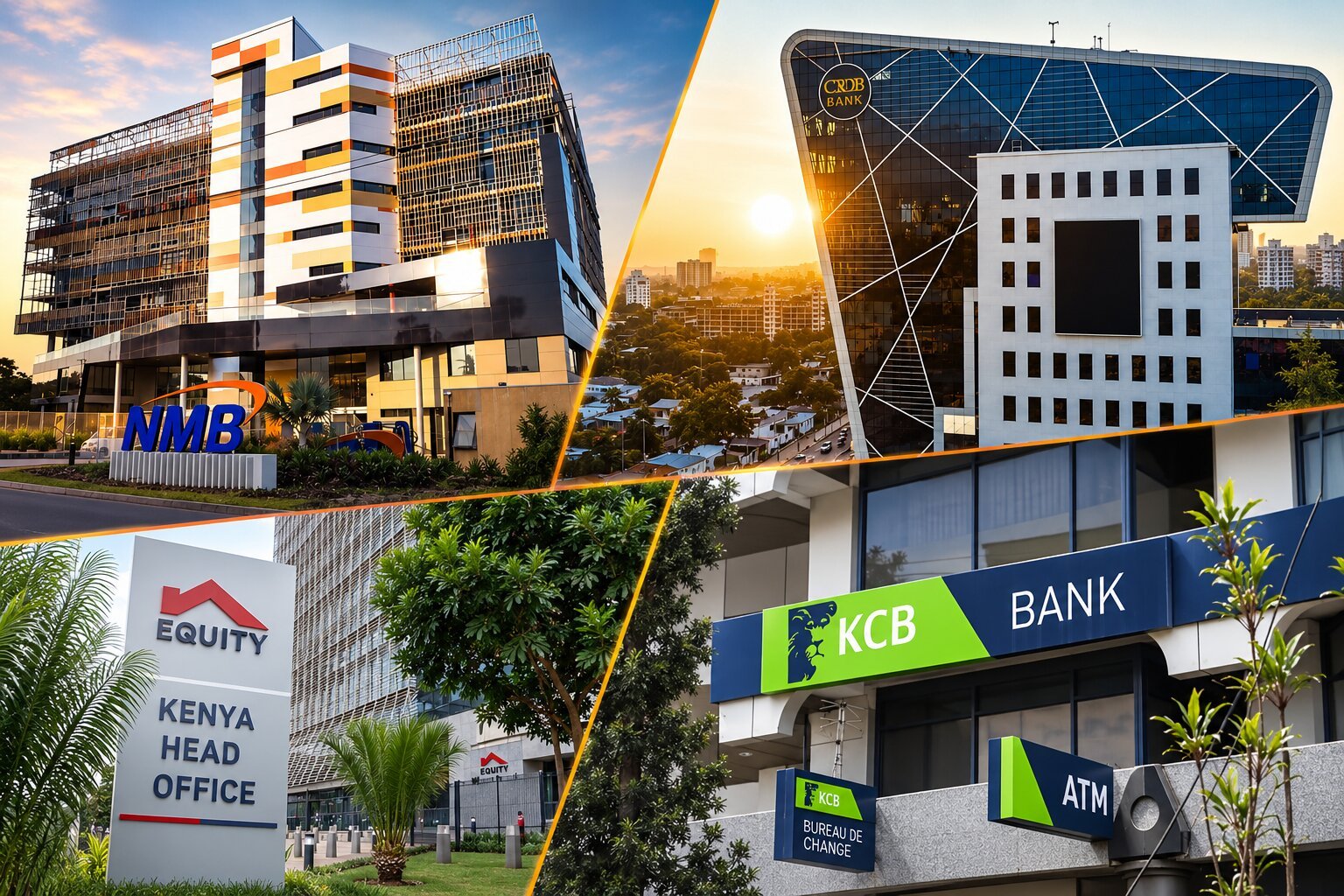
Forbes published its inaugural World's Top Performing Banks 2026 ranking on 10 September 2026, placing nine banks from Uchumi360's Eastern, Central and Southern Africa coverage region among 500 institutions assessed across 89 countries. Tanzania's NMB ranked ninth and CRDB 41st in the smallest asset tier; Kenya placed four banks across two tiers, with Equity and KCB reporting that nearly half and nearly a third of their profits, respectively, now come from operations outside their home country; and Zimbabwe's CBZ Bank topped its entire asset category outright. The ranking measures financial performance rather than customer perception, which makes it a genuinely useful signal of which African banks are building the balance sheets capable of financing what comes next, cross-border trade, mineral processing, and the kind of regional infrastructure this publication has covered extensively elsewhere.
DAR ES SALAAM/NAIROBI — Forbes published its inaugural World's Top Performing Banks 2026 ranking on 10 September 2026, and nine institutions from Uchumi360's Eastern, Central and Southern Africa coverage region made the cut among 500 banks assessed across 89 countries, a genuinely new benchmark for measuring African banking against global peers on financial substance rather than brand recognition.
What Did Forbes Actually Measure, and How Is It Different From Its Other Rankings?
This ranking departs deliberately from Forbes' existing "World's Best Banks" exercise, which relies on customer survey data. The 2026 ranking instead uses objective financial data sourced from providers including S&P Capital IQ, desk research and information submitted directly by banks, evaluating institutions across four weighted categories: profitability at 30%, incorporating measures like return on average assets, cost-to-income ratio and net interest margin; growth and earnings quality at 20%; and capital/funding resilience and asset quality/efficiency at 25% each, examining equity strength, loan-to-deposit ratios, credit quality and balance-sheet resilience. Eligible banks needed more than $3 billion in assets, audited financial statements for the latest fiscal year, and at least three consecutive years of financial data, meaning the ranking reflects sustained performance rather than a single strong reporting period.
Before ranking performance, Forbes split qualifying banks into six asset tiers, so that institutions were compared only against peers of genuinely comparable financial scale rather than against the world's largest banks outright. That structure matters directly for interpreting the results: a ninth-place finish means ninth within a specific asset tier, not ninth among all 500 banks globally.
Where Did Tanzania's Banks Actually Place?
NMB Bank placed ninth in Tier 6, the category covering banks with $3 billion to $10 billion in assets, with CRDB placing 41st in the same tier, giving Tanzania two banks within a single global peer group. NMB Managing Director and CEO Ruth Zaipuna connected the achievement directly to Tanzania's broader economic ambitions, saying: "Being ranked among the world's top-performing banks is a great recognition, but for us, its greater significance lies in what it says about the strength and potential of Tanzanian banking," adding that the bank's growth should be considered in the context of financing Tanzania's economic transformation as the country moves into implementing Dira 2050, the $3.6 trillion, 25-year investment framework this publication has covered in detail separately.
CRDB's own performance data reinforces the ranking: the bank controls roughly 28% market share of Tanzanian banking assets, 30% of loans and 27% of deposits, and has opened a representative office in Dubai specifically to unlock additional capital flows into the market. NMB's 2025 results, TZS760 billion in profit after tax (up 17.5%), total assets reaching TZS17.6 trillion, and a non-performing loan ratio declining from 2.9% to 2.5%, give a concrete sense of the underlying performance driving its ranking, while its first-half 2026 profit reached TZS405.8 billion against TZS18.44 trillion in total assets. CRDB's first-half 2026 profit after tax reached TZS416.9 billion, up 20%, with total assets expanding 33.9% year-on-year to TZS26.4 trillion. Tanzania's banking sector as a whole recorded roughly TZS1.38 trillion in profit after tax during the first half of 2026 across TZS91.3 trillion in total sector assets, with NMB and CRDB together accounting for 49.1% of sector assets and 59.6% of sector profit, a level of concentration worth watching as these two institutions increasingly define the direction of Tanzanian bank lending.
How Regional Have Kenya's Banks Actually Become?
Four Kenyan banks made the ranking: Equity Group at 71st and KCB Group at 79th, both in Tier 5 ($10-20 billion in assets), alongside Co-operative Bank of Kenya at 120th and Stanbic Holdings at 138th, both in Tier 6. But the specific positions matter less than what Equity and KCB's own disclosures reveal about how genuinely cross-border their operations have become. Equity Group CEO James Mwangi described the shift directly: "Our regional subsidiaries now contribute approximately half of our banking profitability, demonstrating the value of our pan-African presence and the resilience that diversification provides," a claim borne out by Equity's 2025 results, in which regional operations accounted for nearly half of the group's $582.6 million in annual profit. KCB reported a comparable, if somewhat smaller, cross-border contribution: nearly 30% of its 2025 net profit, out of $527 million in pretax profit, came from subsidiaries operating outside Kenya. Equity's momentum has continued into 2026, with first-half profit after tax rising 32% year-on-year to KSh45.5 billion and pretax profit up 39% to KSh57.8 billion.
That's a meaningful structural signal for how East African banking actually functions today. Equity's own operations span Kenya, Uganda, Tanzania, Rwanda, South Sudan and the DRC, and KCB carries comparable regional reach, meaning both institutions increasingly generate their profitability from operating across borders rather than from any single domestic market alone, precisely the kind of banking infrastructure a company moving goods, payments or working capital across multiple East African jurisdictions actually needs.
Why Does a Congolese Bank Appearing in This Ranking Matter?
Rawbank's 145th-place finish in Tier 6 places a Congolese institution in the same global performance category as NMB, CRDB and several other African banks, a detail that carries particular weight given the DRC's position at the centre of global copper and cobalt supply chains this publication has covered extensively, including the country's recent push to control more of its own mineral value chain through geological data sovereignty and export-linked value addition. Minerals require financial infrastructure at every stage, working capital for mining companies, equipment financing, export transaction handling, capital for surrounding infrastructure, and long-term investment in processing facilities, meaning a Congolese bank capable of appearing in a global performance ranking has implications well beyond financial services alone. As the DRC seeks to move from raw extraction toward processing and industrial activity, its own banking institutions will be among those actually capable of financing that transition.
Why Did Zimbabwe Produce the Highest-Placed Bank in the Entire Region?
Zimbabwe's CBZ Bank produced the single most striking individual result: it ranked first outright in Tier 2, covering institutions with $100 billion to $500 billion in assets, with FBC Holdings placing 25th in the same tier and NMBZ Holdings tenth in Tier 3 ($50-100 billion). These positions again need to be read through Forbes' tiered methodology rather than taken as a claim about CBZ being the largest bank in the world; its result means it ranked first among the specific institutions Forbes placed in its $100-500 billion asset category, a category that, for global context, also includes Saudi Arabia's Alinma Bank at the top of the adjacent $50-100 billion tier, while Singapore's OCBC and DBS led the largest tier globally and Egypt's CIB placed second in the $20-50 billion tier just above Kenya's leading banks. CBZ's result nonetheless demonstrates that a Zimbabwean institution can post genuinely strong financial performance within its asset category despite operating inside a complicated domestic economic and monetary environment, and it's a reminder of why Forbes' tiered approach exists in the first place: comparing every bank directly by raw position would otherwise obscure the genuine performance of smaller and mid-sized institutions entirely.
What Does the Regional Spread Actually Tell Us?
The geographic distribution across Kenya, Tanzania, Zimbabwe and the DRC reveals considerable diversity in how these different banking systems have reached this benchmark. Kenya has built the region's most visibly cross-border banking groups, with subsidiaries now generating close to, or exceeding, a third of total group profit at both Equity and KCB. Tanzania has produced two large domestic banks rapidly expanding both balance sheet and earnings, concentrated enough between them to represent roughly half of the entire domestic sector's assets and profit. The DRC has a banking institution closely tied to an economy whose global importance is being amplified by mineral demand rather than by domestic financial sector depth alone. Zimbabwe has produced banks performing strongly within Forbes' larger asset categories specifically despite, not because of, a complicated macroeconomic environment. There is no single African banking model emerging from this ranking. There are several distinct ones, operating under genuinely different conditions, that happen to share one underlying characteristic: financial institutions across the region are becoming more consequential economic actors than they were even five years ago.
Is This Growth Isolated, or Part of a Broader Trend?
Forbes' ranking arrives alongside broader evidence that African banking has become genuinely large enough to matter globally in its own right. McKinsey estimated African banking revenue exceeded $100 billion for the first time in 2025, reaching approximately $107 billion, with return on equity across African banking running around 19% in 2024 and expected to hold near 17% in 2025, compared with a global banking average of roughly 10%. Forbes separately cited McKinsey data showing global banking net income overall rose 7% between 2024 and 2025 to $1.3 trillion, giving useful context for how African banking's growth compares against the wider global industry it's now being measured alongside. That said, African banking revenue remains highly concentrated in a relatively small number of markets, meaning the continent still carries enormous room for genuine financial deepening, and the real question is whether these stronger, better-capitalised banks can use their growing scale to expand access to productive capital across considerably more sectors and countries than they currently reach.
Is the Real Competition Now About Regional Scale Rather Than Domestic Size?
For decades, African banks operated primarily as national institutions: domestic competition, domestic customers, domestic regulation, growth tied largely to the size of a single home economy. That model is visibly changing. Kenyan banks have expanded deep into neighbouring markets, Tanzanian banks are beginning to build stronger regional operations of their own, and Congolese institutions increasingly operate within an economy tightly connected to several regional markets simultaneously. This creates a genuine feedback loop worth naming directly: businesses cross borders, banks follow those businesses, banks provide the financing that enables more cross-border business, and that additional trade generates demand for still more financial services, meaning regional banking is becoming simultaneously a consequence of regional economic integration and a driver of it.
What Should Africa Actually Do With This Growing Financial Capacity?
The most useful way to read Forbes' ranking isn't to ask which African bank is objectively "best." It's to ask what these specific institutions are now capable of financing. Africa requires enormous investment in electricity, transport, manufacturing, agriculture, housing, digital infrastructure and logistics, the African Continental Free Trade Area requires businesses genuinely able to operate across borders, and industrialisation requires working capital and long-term lending at a scale government budgets alone cannot supply. Commercial banks will remain part of that financing architecture alongside pension funds, insurance companies, development finance institutions, private equity and international capital markets, but strong domestic and regional banks bring something distinctly valuable to that mix: direct, working knowledge of the specific markets where the actual projects get built.
It's worth being precise about what this ranking does and doesn't measure, though. A bank can be highly profitable without necessarily transforming the productive structure of the economy it operates in; high shareholder returns don't automatically translate into sufficient credit for manufacturers, growing deposits don't automatically mean adequate agricultural finance, and a larger balance sheet doesn't automatically mean more infrastructure projects are actually getting financed. Forbes measured banking performance specifically. It did not measure the developmental impact of that performance, and that distinction matters for anyone tempted to treat a strong ranking as evidence the underlying economic financing gap has already been solved.
What Comes Next for These Nine Banks?
The genuinely important questions the ranking itself doesn't answer are the ones that actually matter for the region's economic trajectory: can these banks finance more exporters, support manufacturers directly, extend affordable working capital to productive businesses rather than primarily to government securities, participate meaningfully in large infrastructure transactions, and help African companies expand across borders in the way Equity and KCB's own regional subsidiaries already demonstrate is commercially viable? Forbes has given the region a genuine, credible financial benchmark, NMB ninth, CRDB 41st, Equity 71st, KCB 79th, Co-operative Bank 120th, Stanbic Holdings 138th, Rawbank 145th, and Zimbabwe's CBZ leading its entire tier outright. The harder and more consequential question is what these institutions actually choose to build with the financial strength this ranking confirms they've already accumulated.
FAQ
Which African banks appear in Forbes' World's Top Performing Banks 2026 ranking? NMB and CRDB from Tanzania, Equity Group, KCB Group, Co-operative Bank and Stanbic Holdings from Kenya, Rawbank from the DRC, and CBZ Bank, FBC Holdings and NMBZ Holdings from Zimbabwe, alongside Egypt's CIB in a neighbouring tier.
What position did NMB Bank achieve, and does that mean it's the ninth-best bank in the world? NMB ranked ninth within Forbes' Tier 6 category specifically, covering banks with $3-10 billion in assets. It did not rank ninth among all 500 banks in the ranking overall.
How much of Equity Group's and KCB's profit actually comes from outside their home countries? Equity Group CEO James Mwangi said regional subsidiaries now contribute approximately half of the group's banking profitability, while KCB reported nearly 30% of its 2025 net profit came from subsidiaries operating outside Kenya.
Which bank achieved the highest individual ranking in the region? Zimbabwe's CBZ Bank, which ranked first outright in Tier 2, the category covering banks with $100 billion to $500 billion in assets.
How did Forbes actually assess the banks? Using objective financial data rather than customer surveys, weighting profitability at 30%, growth and earnings quality at 20%, and capital/funding resilience and asset quality/efficiency at 25% each.
Why does a Congolese bank appearing in this ranking matter beyond banking itself? Rawbank's inclusion is significant given the DRC's central role in global copper and cobalt supply chains; mining, processing and export activity all require substantial financial infrastructure, meaning a strong Congolese bank is positioned to help finance the DRC's push to capture more value from its mineral resources domestically.
Does a strong Forbes ranking mean these banks are effectively financing broader economic development? Not necessarily. Forbes measured banking performance, profitability, growth, capital strength and asset quality, not the developmental impact of that performance. Whether these banks translate their financial strength into expanded credit for manufacturers, exporters and infrastructure projects remains a separate, open question the ranking itself doesn't address.
 Uchumi360
Business Intelligence
Uchumi360
Business Intelligence
Uchumi360 covers business, investment, and economic policy across East, Central, and Southern Africa.
For the serious reader
You read to the end. That places you in a small group.
Uchumi360 is built for readers who demand precision over speed, structure over sentiment, and analysis that holds uncomfortable conclusions rather than softening them. If this work sharpens how you think about Africa's economy, help us keep building the infrastructure behind it.
Institutional Partners
Commission intelligence. Shape the conversation.
Uchumi360 works with development finance institutions, investment firms, sovereign bodies, and strategic organisations across the coverage region. Institutional partnership unlocks:
- Commissioned sector and country intelligence reports
- Branded research series under your institution's authority
- Exclusive data briefings for internal strategy teams
- Speaking and editorial presence at Uchumi360 events
- Co-published investment outlooks for your markets
Support Our Work
Independent analysis has a cost. Help us bear it.
Uchumi360 does not carry advertising. It does not take editorial direction from sponsors. Every article is produced without commercial compromise. Your contribution funds the reporting, research, and editorial infrastructure that keeps this analysis free from influence.
Secure checkout: One-time and monthly support are processed securely. Add payment credentials to enable checkout here.
Stay Connected
Keep up with every new insight.
Follow our latest analysis, policy coverage, and market intelligence as soon as it is published. If you need something specific, reach out directly and we will point you to the right research.
