
Tanzania's Most Recognised Political Cartoonist Stopped Drawing the Problem and Started Building the Answer. It Has Cost Him USD 300,000 So Far.

Ready
Ali Masoud 'Kipanya'is best known to Tanzanians as a political cartoonist whose work has shaped public discourse for decades. He is less well known as the founder of Kaypee Motors, a Tanzanian electric vehicle manufacturing company that has spent six years building working prototypes in a factory equipped with the same welding machines, grinders, and drills used to make residential gates. The first Kaypee Motors vehicle can travel approximately 150 kilometres on a full charge costing between TZS 4,000 and 5,000, a fraction of the TZS 60,000 to 70,000 a petrol vehicle requires for the same distance. Kipanya has spent more than USD 300,000 of personal capital on the project and has not stopped. What he has built so far is a prototype and a proposition: that Tanzania can manufacture, that Africans can produce rather than only consume, and that the door between idea and industrial reality, however heavy, can be opened by the people willing to push it.
Masoud Kipanya, Tanzania's most recognised political cartoonist, founded Kaypee Motors to build Tanzania's first locally manufactured electric vehicle, spending a minimum of USD 300,000 of personal capital over six years on working prototypes assembled with basic fabrication tools in conditions that most manufacturers in established economies would consider impossible. This interview, conducted for Uchumi360, captures Kipanya's analysis of Tanzania's industrial capability gap, his philosophy on capital, competition, and manufacturing complexity, his assessment of what government policy must deliver for local manufacturing to scale, and his conviction, expressed with the directness of someone who has already paid the cost of conviction, that Africa's economic transformation will not come from trading and will not wait for perfect conditions.
Kipanya has been drawing Tanzania's political and economic contradictions for long enough that most Tanzanians think of him primarily as an observer of the country's condition rather than a participant in changing it. Kaypee Motors, the electric vehicle manufacturing company he has been building for six years in Dar es Salaam, is his argument that observation without production is a form of complicity, and that the person who can accurately diagnose an economy's structural failure has an obligation to attempt the cure rather than simply document the symptoms. "For me, this decision came from a very simple understanding," Kipanya told Uchumi360. "If a country wants to prosper economically, it must produce. It must manufacture. It must build things."
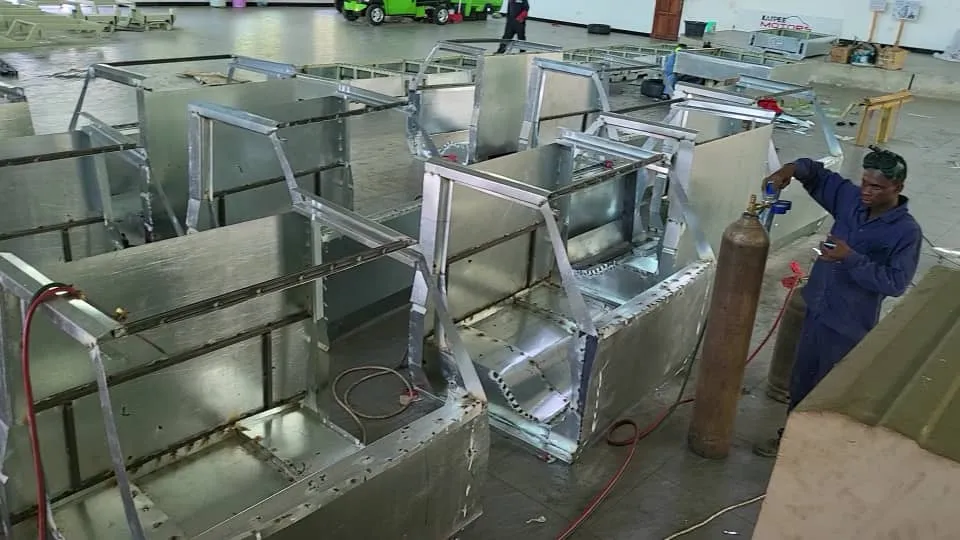
The company he has built toward that conviction does not yet resemble what most people imagine when they hear the phrase electric vehicle manufacturer. The factory he has built toward that conviction does not yet resemble what most people imagine when they hear the phrase electric vehicle manufacturer. The machines in use are small, general-purpose tools of the kind found in ordinary workshops across Tanzania, repurposed and applied to vehicle fabrication rather than their more common everyday functions. There are no robotic assembly lines, no climate-controlled production bays, no just-in-time component delivery systems. There is Kipanya, a small team, a set of working prototypes, and more than six years of iterative learning paid for largely from his own resources. "I am telling you, we do not have those big machines," he said. "We have very simple machines, small machines, but we are shaping the parts of that car and it is coming up very nicely."
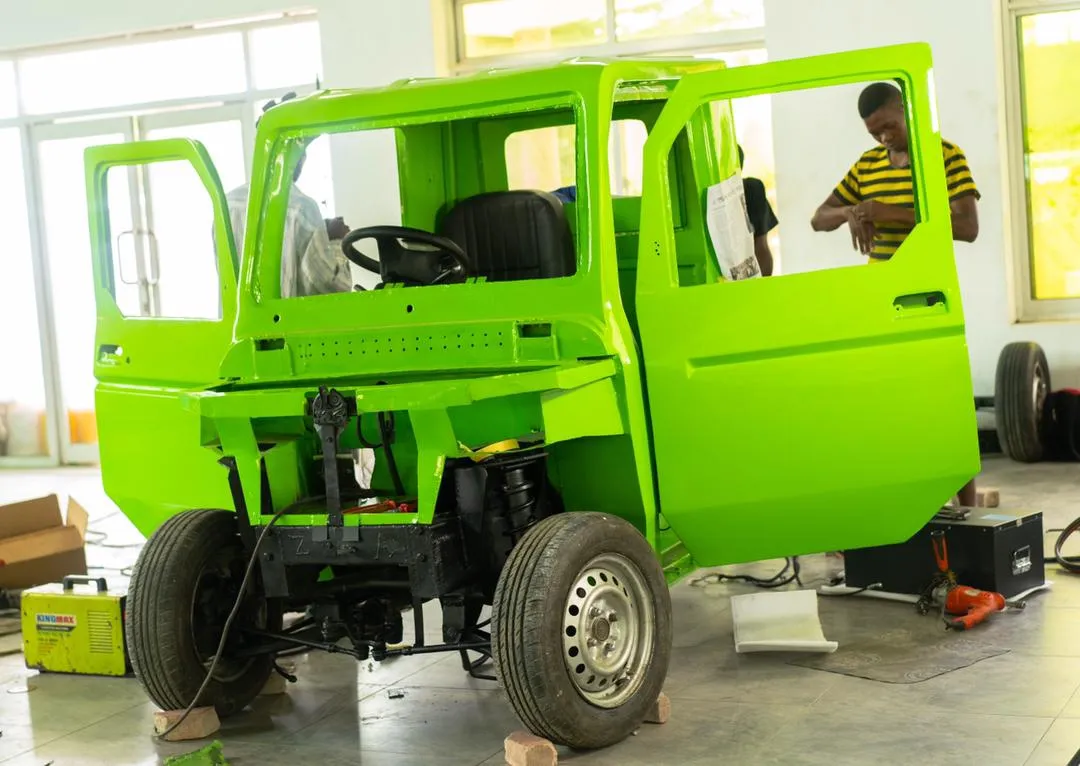
The first Kaypee Motors vehicle can travel approximately 150 kilometres on a full charge, according to Kipanya's own technical documentation of the prototype. A full charge requires approximately 10 units of electricity, costing between TZS 4,000 and 5,000 depending on the applicable tariff. A petrol vehicle covering the same 150 kilometres would consume between TZS 60,000 and 70,000 in fuel at current prices, meaning the Kaypee Motors vehicle operates at less than 10% of the running cost of its conventional equivalent for the same distance travelled. That cost differential is the economic proposition at the centre of Kaypee Motors' market case, and it is not incidental to the broader argument Kipanya is making about Tanzania's economy. "When you reduce the cost of transport, you also reduce the cost of doing business," he said. "Transport affects almost everything: food prices, logistics, distribution, and even inflation. If goods can move at a lower cost, then ordinary Tanzanians can benefit directly."
From cartoons to manufacturing: the logic of a creative person who wanted to make what he designs
Kipanya is careful not to frame his entry into manufacturing as a departure from his media identity. He is still a working political cartoonist. What he has done, in his own characterisation, is expand his world rather than leave it. The intellectual connection between the two activities is more direct than it might appear from the outside. "As an artist, I have always believed that a person who can draw can also build," he said. "A person who can imagine something in their mind and transfer that image onto paper or a tablet already has the foundation of creation. But I wanted to go beyond drawing. I wanted to make what I design."
The economic observation that accelerated that transition came during the COVID-19 pandemic, when the global supply chain disruptions that closed Chinese factories and grounded the African traders who depended on them made Tanzania's import dependency legible at scale in a way that years of trade statistics had not. "We saw clearly during COVID-19 that when China closed its doors, when Europe closed its doors, many of our traders were stranded," Kipanya said. "People could no longer travel to Dubai, China, or other countries to buy goods and bring them back. That moment showed us how vulnerable we are when we depend too much on other countries for finished products." The vulnerability COVID-19 exposed was not new. It was the structural condition of an economy whose commercial base had been built on importing and reselling manufactured goods rather than producing them, a condition that Uchumi360's April 2026 analysis of Tanzania's trader-to-industrialist conversion challenge documented with precision: the same working capital, distribution networks, and market knowledge that make Tanzania's trading class commercially sophisticated are precisely the assets that, redirected toward production, would give Tanzania's manufacturing sector the domestic demand intelligence and logistics infrastructure that industrial development requires.
The industrial gap that one vehicle makes visible
Kaypee Motors' first prototype required imported components for its most technically demanding systems, including the motor, the battery pack, and the electronic controller, sourced primarily from China and India. Kipanya does not present this as a failure of ambition. He presents it as an accurate description of Tanzania's current industrial ecosystem and a precise map of what must change. "China has reached where it is today because it created a strong industrial ecosystem," he said. "If you manufacture something there, you can find suppliers for almost every component you need. That is what we also need to build in Tanzania."
The supply chain dependency creates a manufacturing vulnerability that goes beyond cost. When critical components are ordered from Chinese or Indian suppliers, delivery timelines extend to three or four months, according to Kipanya's experience with Kaypee Motors' procurement. In a manufacturing operation whose production cycle depends on component availability, a four-month wait for a battery or motor is not a logistical inconvenience. It is a structural constraint on production planning that makes scaling operationally impossible at anything resembling competitive volume. "In manufacturing, time is very important," Kipanya said. "You cannot build a serious industry if you are always waiting months for essential components to arrive from outside."
The solution he identifies is not primarily technological. It is industrial policy. Tanzania holds lithium, cobalt, graphite, and other minerals that are critical inputs to battery technology and electric mobility, as Uchumi360's May 2026 coverage of the Southern Rukwa Helium Project and Tanzania's broader critical minerals pipeline documented in detail. The country exports most of those minerals in raw or minimally processed form and reimports them as finished battery cells and electronic components at multiples of the raw material export price, a structural irony whose economic cost compounds across every manufacturing sector that depends on those components. "The issue is not that we lack everything," Kipanya said. "The issue is seriousness, investment, planning, and building the right industrial ecosystem. We must stop thinking only about importing finished products. We must start thinking about how to produce the parts, the components, and the systems that support local manufacturing."
Competing in a market where 100,000 used vehicles arrive annually
Tanzania's vehicle import market presents a competitive environment that would discourage most rational capital allocation analyses from recommending local vehicle manufacturing as a priority investment. According to industry data that Kipanya cites in his assessment of the market, Tanzania imports approximately 5,000 brand new vehicles and close to 100,000 used vehicles annually, a combined import volume that reflects both the depth of suppressed domestic demand and the extent to which that demand is currently being served entirely by foreign production. Competing against established Japanese, Indian, Chinese, and Korean manufacturers with decades of production scale, optimised supply chains, and brand recognition built across multiple generations of consumer trust is not an obvious path to commercial viability for a startup assembling vehicles with gate-fabrication equipment in Dar es Salaam.
Kipanya's response to this competitive framing is characteristically direct. "Somebody has to start somewhere," he said. "Even the countries and companies that are now champions in exporting cars also started somewhere." He draws the comparison to Tesla, which entered the global automotive market in 2003 against established manufacturers with histories stretching back nearly a century, not because the comparison flatters Kaypee Motors' current scale, but because it illustrates the structural argument that market incumbency does not permanently foreclose new entrants who bring sufficient differentiation, persistence, and long-run conviction. "Tesla was not afraid to enter the market," Kipanya said. "That tells you that there is always room for new players if they bring a strong idea, persistence, and innovation."
His medium-term market strategy combines product placement with policy advocacy. In the early phase, Kaypee Motors is prepared to absorb a loss on each vehicle sold, selling below production cost to build market visibility and begin the trust formation that a new local brand requires in an environment where most consumers have never seen a Tanzanian-manufactured vehicle. "You may spend $10,000 to produce a car and sell it at $9,000," he said. "That means you are taking a loss. But sometimes that loss is part of market penetration. You want people to see the cars, see the vehicles moving, working, carrying goods, and solving real problems." Over the medium term, he believes that policy intervention, specifically the use of import tariffs calibrated to reduce the volume of used vehicle imports and create protected market space for local producers, is the structural complement to entrepreneurial effort that no amount of individual innovation can substitute. "When local manufacturing is more ready, I believe we can lobby the government to create policies that favour local production," he said.
Capital, passion, and the philosophy of walking toward the destination
Kaypee Motors has been funded primarily through Kipanya's personal resources. The figure of USD 50,000 that China Daily reported on the initial prototype underestimates the actual investment, according to Kipanya, who confirms that the total spent across six years of iterative prototype development exceeds USD 300,000. His analysis of the transition from passion-funded innovation to structured capital is among the most practically honest assessments of the African innovation financing gap that Uchumi360 has encountered in its coverage of the manufacturing sector.
"At the beginning, innovation usually starts as passion," he said. "But when you keep pushing it, it reaches a point where passion alone is no longer enough. At that stage, you need structured capital." The challenge he identifies in Tanzania and across Africa is that the risk assessment frameworks of local financial institutions, domestic venture capital, and angel investors are calibrated against the failure modes of conventional commerce rather than the development arc of manufacturing innovation, producing a systematic underinvestment in early-stage industrial ventures that are genuinely high-risk but whose economic multiplier effects, if successful, far exceed the returns available from the trading and real estate investments that attract the bulk of available private capital. "Financial institutions, venture capitalists, and angel investors often look at the risk first," Kipanya said. "They become very cautious before investing in something new, especially something as difficult as vehicle manufacturing."
His response to that financing gap is not to wait for it to close. He describes his approach through an analogy whose directness captures the operational philosophy behind Kaypee Motors more accurately than any strategic framework document. "Imagine I am at a bus station and I want to go to the city, but I do not have bus fare," he said. "Instead of sitting there waiting for someone to come and give me money, I have decided to start walking toward the city. If I get money along the way, I can board a bus and arrive faster. But if I do not get the money, I can still continue walking. It may take longer, but I can still get there." Kaypee Motors is applying for structured funding and welcoming investors and partners, he confirmed, but the application process has not been permitted to stop the walk.
Building a product in a system that does not yet exist
The infrastructure question that surrounds electric vehicle development in Tanzania is one that Kipanya has thought about with the same analytical clarity he applies to the manufacturing and financing challenges. Tanzania does not currently have a functioning public charging network, a regulatory framework specifically designed for electric vehicles, or an energy distribution system whose reliability would allow commercial EV operators to plan routes with confidence. Building an electric vehicle in that environment is, on one reading, a category error: the product requires a system that does not yet exist to deliver its core value proposition.
Kipanya's counter-argument draws on the logic of how industrial ecosystems actually form, rather than the logic of how they are planned. "When it comes to innovation, you cannot wait for everything to be perfect before you start," he said. "You start by doing. And while you are doing, you begin to create a value chain. Eventually, other people see opportunities and join that value chain." He draws the analogy to petrol stations, which were not built by Toyota or Ford in advance of vehicle sales but by independent entrepreneurs who saw a commercial opportunity created by the existence of vehicles requiring fuel. The charging infrastructure, battery supply chain, and maintenance ecosystem that electric mobility requires will follow the same logic, in his assessment, arriving not before electric vehicles are commercially present in the market but because they are. "You do not wait for the system to exist," he said. "Sometimes, you build first, and the system begins to form around you."
He also addresses the energy reliability objection, which critics of Tanzanian EV development cite in reference to the country's historical power supply inconsistency. Tanzania's energy generation capacity has expanded significantly in recent years, with the Julius Nyerere Hydropower Project adding 2,115 MW to the national grid according to Tanzania Electric Supply Company operational records, giving the country an installed generation base that now exceeds domestic peak demand for the first time in its history, according to Parliamentary Committee oversight records from February 2026 that Uchumi360 documented in its April 2026 analysis of Tanzania's energy surplus. The energy constraint that critics invoke is becoming a less accurate description of Tanzania's actual energy position with each passing year, a trajectory that Kipanya's medium-term product development timeline is built around rather than against.
The public persona as a manufacturing asset and its obligations
Masoud Kipanya's public profile is one of the most distinctive assets in Kaypee Motors' commercial position and one of its most demanding obligations simultaneously. Decades of work as a political cartoonist whose illustrations have appeared across Tanzania's media landscape have built a level of public recognition and trust that most manufacturing startups cannot purchase with any amount of marketing spend. "People know me. They have been reading my cartoons for a long time, so in a way, they know how my brain works." Kipanya said. That familiarity transfers to Kaypee Motors in ways that lower the initial skepticism barrier for a product category, locally manufactured vehicles, that Tanzanian consumers have had no previous experience evaluating.
The public recognition comes with accountability that a less visible founder would not face. "People expect seriousness. They expect consistency," Kipanya said. "Because they already know my voice, I have to make sure that Kaypee Motors also reflects that same level of commitment and honesty." He describes the public response to Kaypee Motors as a validation not just of the company but of the broader argument he has been making through his cartoons for years: that Tanzania's institutions and policy environment have failed to create the conditions for the productive economic activity that the country requires. "Some people say, 'You have been using your cartoons to criticise the government and society, showing us what is not being done properly. Now we are happy because you are showing us how things can be done.'" The shift from critic to builder is, in that framing, not a contradiction of his public role but its logical conclusion.
What must change and who must change it
Kipanya's assessment of what Tanzania's economy requires for manufacturing to move from individual pioneering acts into a structural economic shift covers four interconnected domains, none of which can substitute for the others. The first is capital access, specifically the development of financing instruments whose terms are calibrated to manufacturing payback periods rather than trading cycle lengths, a gap that the Development Bank of Tanzania and the Tanzania Agricultural Development Bank have the institutional mandate to address but have not yet addressed at the scale that industrial investment requires. The second is government policy, covering import tariff architecture that creates protected market space for local producers during the critical early scaling phase, tax incentives for manufacturing investment, and public procurement policies that direct government purchasing toward locally produced goods. "Manufacturing is not something that can grow strongly without policy support," Kipanya said. "If Tanzania wants to build serious local industries, then government has to create an environment where local manufacturers can survive, compete, and grow."
The third is technical education, whose current misalignment with the specific skill requirements of manufacturing operations limits the workforce available to companies attempting to scale production. The fourth, and the one Kipanya returns to most insistently throughout the interview, is mindset: the cultural and psychological disposition toward production rather than trade that determines whether individuals with capital, ideas, and market knowledge choose to invest in building things or in importing and reselling them. "What must change is the mindset," he said. "We must stop thinking only about trading and importing. We must start respecting the process of building."
His closing message, delivered in the voice of someone who has already paid a significant portion of the personal cost of the conviction he is asking others to share, is addressed to the innovators and entrepreneurs across Africa who have ideas they have not implemented. "If you go to a graveyard, there are millions of ideas that have been buried in those graves," he said. "People say, 'I am going to do it tomorrow. I am scared of what if I fail. I do not have money.' And eventually people leave this planet with a beautiful, wonderful idea." The alternative he proposes is not confidence or capital or infrastructure. It is a single step. "If you see one step, just step on it," he said. "The rest will appear."
Kaypee Motors is not yet Tanzania's answer to the question of whether African countries can manufacture at scale. It is the question asked at industrial volume, with real metal, real electricity, and six years of real cost. Whether Tanzania's policy environment, its capital markets, and its manufacturing ecosystem develop fast enough to meet that question with the infrastructure it requires will determine whether Masoud Kipanya opened a door or simply pushed against one. He is walking toward the city regardless
FAQ
What is Kaypee Motors and what does it produce? Kaypee Motors, founded by Masoud Kipanya, is a Tanzanian electric vehicle manufacturing company that has spent six years developing working prototypes of locally assembled electric vehicles. The current prototype can travel approximately 150 kilometres on a full charge costing between TZS 4,000 and 5,000, compared to TZS 60,000 to 70,000 in petrol for the same distance. The company operates from a workshop in Dar es Salaam using basic fabrication equipment and has funded its development primarily through Kipanya's personal resources.
How much has been invested in Kaypee Motors to date? Kipanya confirmed to Uchumi360 that the total personal investment in Kaypee Motors' development exceeds the USD 50,000 figure reported by China Daily in prior coverage of the company, without specifying the precise cumulative amount. The investment spans more than six years of prototype development across multiple iterations.
Why does Kaypee Motors still import critical components like motors and batteries? Tanzania does not yet have a domestic supplier ecosystem for the electronic and electromechanical components that electric vehicles require, including motors, battery packs, and controllers. Kaypee Motors sources these components primarily from China and India, with delivery timelines of three to four months that Kipanya identifies as one of the primary constraints on scaling production. He argues that Tanzania must build the supporting industrial ecosystem around manufacturing, using its domestic lithium, cobalt, and graphite resources to eventually produce components locally rather than importing them.
Is local vehicle manufacturing in Tanzania economically viable? Kipanya's assessment is that it is not yet profitable at current production volumes and with current equipment, and that Kaypee Motors is willing to sell vehicles below production cost in the early phase as a market penetration strategy to build visibility and trust. He believes viability improves with production volume, better machinery, greater component localisation, and supportive government policy on import tariffs. He also identifies regional integration across East Africa as a market expansion mechanism that would improve the economics of Tanzanian vehicle manufacturing significantly.
What does Kipanya say the government must do to support local manufacturing? He identifies import tariff architecture calibrated to protect local producers during the early scaling phase, tax incentives for manufacturing investment, public procurement directed toward locally produced goods, regulatory frameworks for electric vehicle standards and safety, and access to industrial land and infrastructure as the primary policy levers. "Entrepreneurs can start the work," he said, "but for the industry to scale, policy must support production."
 Uchumi360
Business Intelligence
Uchumi360
Business Intelligence
Masoud Kipanya, interview conducted for Uchumi360, May 2026. All direct quotations are drawn from written responses to structured interview questions. Quotations have been edited for length and clarity from spoken register but have not been altered in substance or meaning.
China Daily, reporting on Kaypee Motors prototype development cost. The USD 50,000 figure cited in China Daily's coverage has been noted by Kipanya as an underestimate of actual expenditure.
Tanzania Electric Supply Company, Julius Nyerere Hydropower Project operational records.
Tanzania Parliamentary Committee, energy infrastructure oversight records, February 2026. Installed capacity versus peak demand figures cited from Uchumi360's April 2026 energy analysis.
Tanzania vehicle import data. The 5,000 new vehicle and approximately 100,000 used vehicle annual import figures are cited by Kipanya as context for Kaypee Motors' market environment.
Uchumi360 covers business, investment, and economic policy across East, Central, and Southern Africa.
For the serious reader
You read to the end. That places you in a small group.
Uchumi360 is built for readers who demand precision over speed, structure over sentiment, and analysis that holds uncomfortable conclusions rather than softening them. If this work sharpens how you think about Africa's economy, help us keep building the infrastructure behind it.
Institutional Partners
Commission intelligence. Shape the conversation.
Uchumi360 works with development finance institutions, investment firms, sovereign bodies, and strategic organisations across the coverage region. Institutional partnership unlocks:
- Commissioned sector and country intelligence reports
- Branded research series under your institution's authority
- Exclusive data briefings for internal strategy teams
- Speaking and editorial presence at Uchumi360 events
- Co-published investment outlooks for your markets
Support Our Work
Independent analysis has a cost. Help us bear it.
Uchumi360 does not carry advertising. It does not take editorial direction from sponsors. Every article is produced without commercial compromise. Your contribution funds the reporting, research, and editorial infrastructure that keeps this analysis free from influence.
Secure checkout: One-time and monthly support are processed securely.
Stay Connected
Keep up with every new insight.
Follow our latest analysis, policy coverage, and market intelligence as soon as it is published. If you need something specific, reach out directly and we will point you to the right research.
