

The Global Constituency: Why Tanzania Can No Longer Ignore the Diaspora Vote
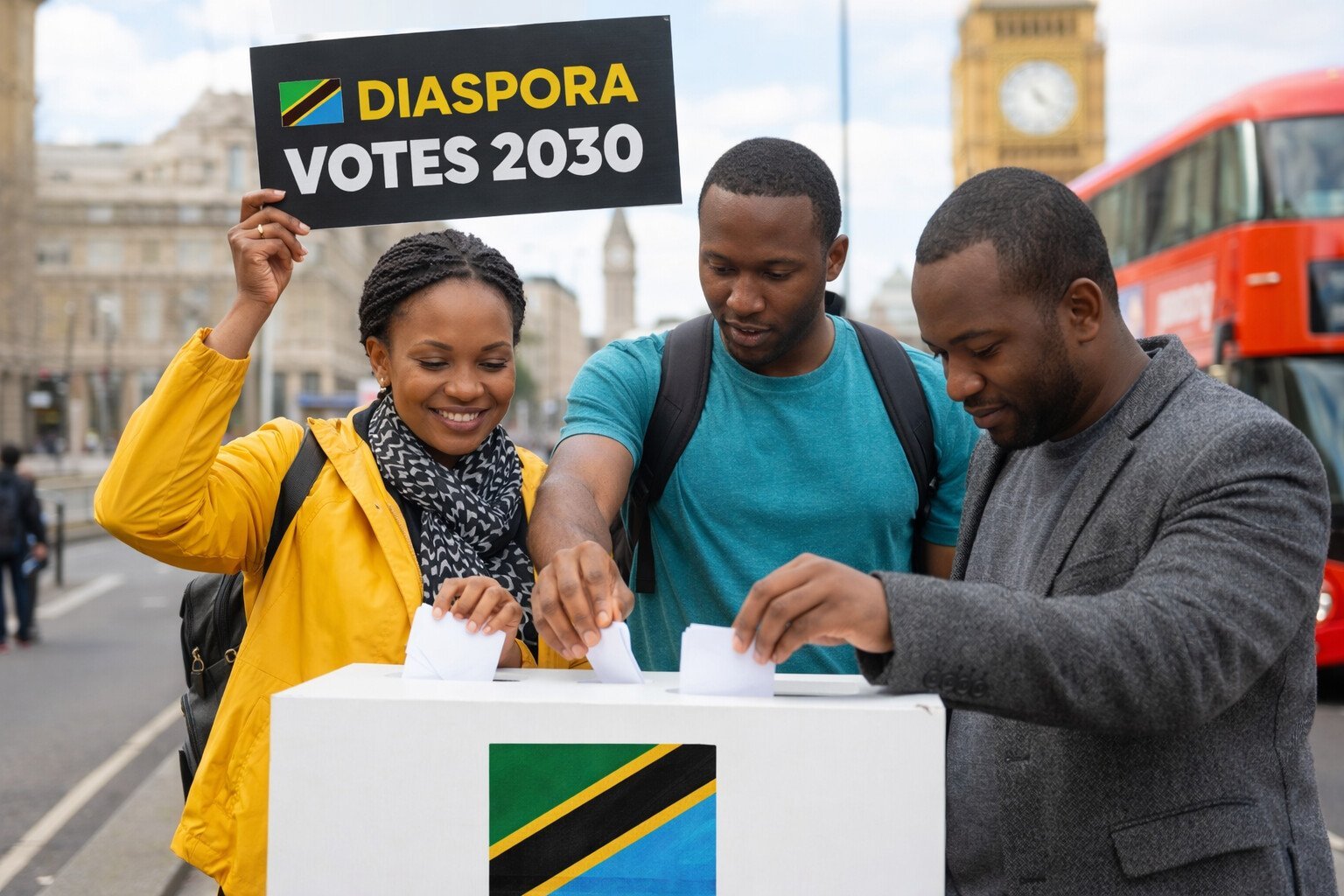
Tanzania’s diaspora is no longer just a social community abroad. It is a financial constituency that sends billions home each year. This op-ed argues that excluding it from the ballot box is not only a democratic gap, but an economic contradiction that weakens long-term development strategy.
Pete Lazaro (Op-ed)
From the streets of London to the suburbs of Manchester, many Tanzanians begin their day the same way. We follow news from Dar es Salaam, call family in Arusha or Mwanza, and send part of our earnings home. We remain Tanzanians by passport, by family ties, and by bank transfers. Yet every five years, when the country makes its most important political decision, we are treated as observers.
This is not only a democratic contradiction. It is an economic one.
Tanzania’s diaspora is no longer a marginal social group. It is a financial constituency. And excluding it from the ballot box weakens, rather than protects, the country’s development strategy.
A population that already behaves like a district
Estimates suggest more than 1.5 million Tanzanians live abroad, with close to 100,000 in the UK alone. Significant numbers also reside in the United States, the Middle East, South Africa, and across the East African Community.
In the 2025 General Election, over 37 million voters were registered inside the country. By excluding Tanzanians abroad, the state effectively sidelined a population larger than some administrative regions. This is a silent constituency whose economic behavior already shapes national outcomes, but whose political voice is absent from policy debates.
That mismatch matters.
A constituency that already finances development
In just the second half of 2024, Tanzanians abroad sent home approximately TZS 2.116 trillion (USD 810 million) in remittances. These flows pay school fees, finance medical treatment, build houses, and keep small businesses alive. They cushion foreign exchange shortages and stabilise household consumption.
Remittances are not charity. They are private capital flows into the domestic economy.
When the state depends on diaspora earnings to support economic resilience, it implicitly treats the diaspora as a development partner. Yet politically, it treats the same group as external to the nation’s future.
This contradiction carries economic risk. Trust shapes capital flows. People invest where they feel represented.
Regional lessons in political inclusion and economic return
Neighbouring countries have already drawn the connection between diaspora inclusion and national interest.
Kenya and Rwanda allow citizens abroad to vote through embassies and consulates. South Africa has streamlined external voting so that a citizen in London can participate as easily as one in Pretoria.
These countries did not extend voting rights as symbolism. They did so to maintain political bonds with populations that send remittances, return skills, and invest in businesses at home.
Tanzania already has key enablers in place: the NIDA system, biometric registration, and a digitally literate population. The infrastructure for external voting is partially built. What is missing is not capacity, but legal and political commitment.
Why the government should want the diaspora to vote
Allowing diaspora voting is often framed as a political risk. Economically, it is closer to a strategic asset.
Political inclusion strengthens economic loyalty. A citizen who votes is more likely to remain engaged, return with skills, and invest with confidence. Exclusion, by contrast, quietly erodes attachment and shifts long-term commitment elsewhere.
There is also an institutional benefit. A government that represents citizens inside and outside its borders gains credibility internationally. In an era where capital and labour are mobile, legitimacy is part of competitiveness.
As Tanzania looks toward Vision 2050, the diaspora is not a peripheral actor. It is one of the country’s most globally connected populations. Engaging it through the ballot box is a low-cost way of keeping it anchored to national priorities.
Beyond “special status” toward full citizenship
Recent debates on diaspora “special status” are welcome, but incomplete. Economic participation without political participation creates an imbalance. It asks people to contribute financially without sharing in national decision-making.
The issue is not favour. It is coherence.
If Tanzanians abroad are trusted to send money, build homes, and fund education, then trusting them with a vote is not radical. It is consistent.
A development choice, not only a democratic one
The diaspora vote is often framed as a moral question. It is also a development one.
Countries that politically integrate their diaspora tend to experience more stable remittance flows, higher investment confidence, and stronger skills circulation. Countries that do not risk turning their diaspora into purely private actors with declining attachment to national institutions.
Tanzania now faces a choice. It can continue to treat its diaspora as an external support system. Or it can recognise it as part of the national constituency whose voice strengthens, rather than threatens, long-term development.
We are ready to register. We are ready to queue at embassies and high commissions. We are ready to help shape the Tanzania of tomorrow.
The law simply needs to catch up with the economic reality.