
Tanzania's Hidden Army: The Diaspora Players Who Could Transform Taifa Stars
Ready
We made AFCON history.
Now look at what Morocco did, and ask yourself why we're not doing the same.
Let's start with a number: 20 out of 26.
That is how many players in Morocco's 2026 FIFA World Cup squad were born outside Morocco. At the tournament currently unfolding in the United States, Canada and Mexico, Morocco fielded the first-ever national team starting eleven in World Cup history made up entirely of players born abroad — captain Achraf Hakimi (born in Madrid), goalkeeper Yassine Bounou (born in Montreal), and nine others, all holding birth certificates from France, Spain, Belgium and the Netherlands.
They held Brazil to a 1-1 draw in their opening group game.
This is not a loophole. This is a strategy. A deliberate, painstaking, federation-led strategy to find every footballer with Moroccan blood anywhere on earth and bring them home. France alone has contributed 27 diaspora players to the Moroccan senior squad since 2017. And the results? Morocco became the first African nation to reach a World Cup semi-final in 2022, beating Belgium, Spain and Portugal along the way.
Now ask yourself: what is Tanzania doing with its own diaspora?
The Moment That Changed Everything
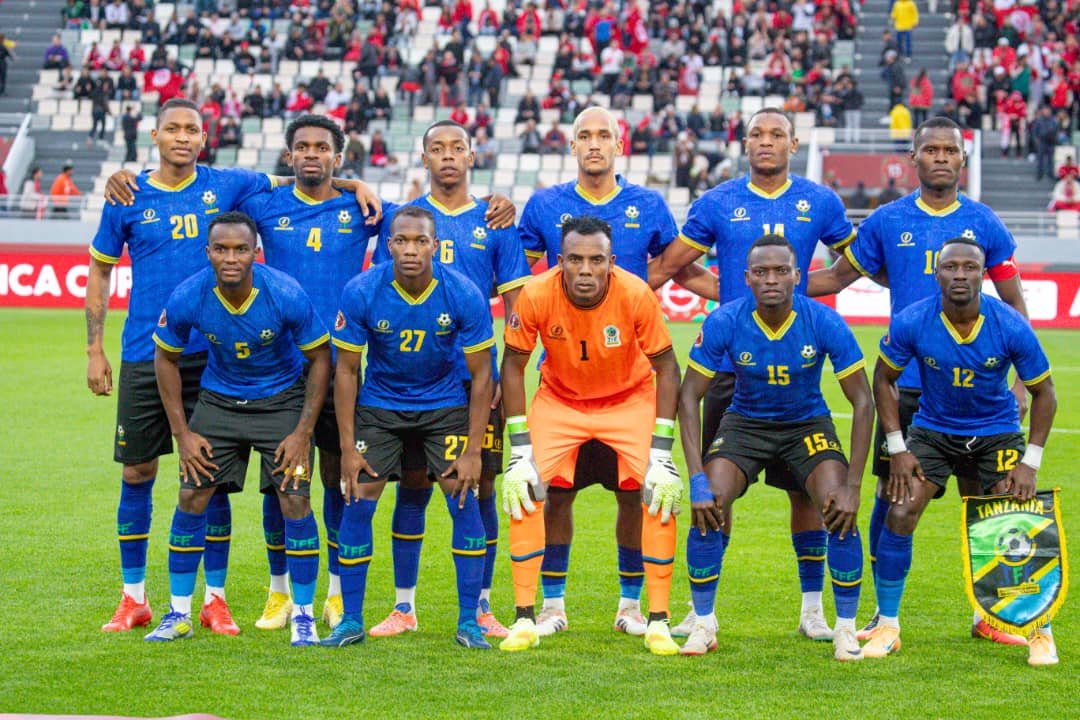
At AFCON 2025 in Morocco, the Taifa Stars did something they had never done in their entire history. They reached the Round of 16.
They pushed Nigeria to a 2-1 defeat, held Tunisia to a draw, and when Feisal Salum's equaliser against Tunisia in the 48th minute saw them through, the whole country erupted. President Samia sent a presidential plane to bring the squad home. Coach Ángel Miguel Gamondi, who had only taken over weeks before the tournament began, said it plainly: "I wanted to change this mentality of underdogs. We no longer aspire only for honourable participation — we believe in our ability to go far."
That belief is real. But belief alone will not win AFCON 2027.
Because here is the thing nobody is saying loudly enough: there are Tanzanian footballers playing professionally right now that most Tanzanians have never heard of. Some of them played at AFCON 2025. Some of them are training in the same countries that produced Hakimi, Bounou and Amrabat. And Tanzania has no formal system to find them, track them, or bring them in before another country does.
The Players Already Doing It
Tarryn Allarakhia is 28 years old, born in East London, and plays as a left winger for Rochdale in England's National League. His mother is English; his father's Tanzanian heritage made him eligible for the Taifa Stars. He played all four of Tanzania's AFCON 2025 matches — against Nigeria, Uganda, Tunisia, and Morocco in the Round of 16 — scoring his first international goal in a friendly against Kuwait just weeks before the tournament. At Rochdale, he was helping push the club towards promotion from the top of the National League when he left for AFCON. His club fully backed him going. He was Rochdale's first-ever representative at the Africa Cup of Nations.
When he was asked what it meant to go again after a difficult first AFCON: "I'm older, a bit wiser, and I feel stronger and fitter. Honestly, it would mean the world to me if I can help my country go far in a major tournament — especially when we're the underdogs. It just makes it better."
He is the product of no official scouting programme. He found his way to Tanzania by chance and by family connection. Imagine if we had gone looking.
Adi Yussuf was born in Zanzibar and raised in England through Leicester City's youth academy. He is now 33, winding down a career that took him through Mansfield Town, Blackpool, Wrexham on loan, Solihull Moors, Crawley Town and beyond — scoring over 90 goals in more than 360 appearances across various competitions. His most prolific season came at Oxford City, where he scored 27 goals in 39 games. He earned caps for Tanzania and featured in the 2019 AFCON squad. More recently, he has been working as assistant manager for Leicester City's under-18 team through the Premier League's Professional Player to Coach Scheme — a man who now carries Premier League football culture inside him that could benefit Tanzanian youth development.
Mbwana Samatta played for Aston Villa in the Premier League and Fenerbahçe in Turkey, and is Tanzania's most decorated modern export. At AFCON 2025, he was at Ligue 1 club Le Havre, leading the line as Tanzania's captain and most experienced attacker.
Novatus Miroshi is currently competing in Turkey's top flight — one of the most professionally demanding environments in European football.
Cyprian Kachwele, born in Shinyanga, has played in Canada with Vancouver Whitecaps and HFX Wanderers and has been in the national setup.
These players did not fall through the cracks because Tanzania lacks talent. They nearly fell through the cracks because Tanzania lacks a system.
Look at What Works
Morocco did not stumble into their diaspora strategy. They built it over years, across World Cup cycles. At the 2018 World Cup, 17 of their 23-man squad were born abroad. By 2022, it was 14 of 26 — and they reached the semi-finals. By the 2026 World Cup, it is 20 of 26. Coach Walid Regragui, himself born and raised in France to Moroccan parents, understood the cultural bridge these players walk. He did not just pick them — he created an environment where they felt genuinely Moroccan.
Senegal won AFCON 2021 and sent a squad to the 2022 World Cup that included goalkeeper Edouard Mendy, who was born in France and had just won the UEFA Champions League with Chelsea. That mentality — what it takes to succeed at the highest level under maximum pressure — does not come from reading about it. It comes from living it. Diaspora players import that culture directly into the squad.
Nigeria have leaned on players raised in the Netherlands and England for years. Cape Verde — a tiny island nation with far fewer resources than Tanzania — deliberately scout their diaspora in Portugal and have punched far above their weight at multiple AFCONs because of it.
According to research from the University of Oxford's COMPAS centre, nearly one in four players selected for the 2026 World Cup was born in a different country from the one they are representing. This is not a controversial strategy. It is now normal football.
The Clock Is Already Ticking
AFCON 2027 will be held from 19 June to 18 July 2027 — co-hosted by Tanzania, Kenya and Uganda in what will be the first AFCON in East Africa in five decades. Tanzania's proposed venues include the Benjamin Mkapa Stadium, the Samia Suluhu Stadium in Arusha, and stadiums in Zanzibar. CAF and the three governments held a high-level ministerial meeting in Kampala in April 2026 to review preparations, with August 2026 set as a key milestone for stadium readiness.
The eyes of the continent will be on us. The stadiums will be full of Tanzanian people. Taifa Stars will walk out on home soil.
We have just over a year to build the best possible squad. That means starting now.
What Needs to Happen
The government deserves real credit for what it has done. President Samia sent a presidential plane to bring the team home from Morocco. Bonuses were paid after CHAN 2024 wins. Coach Gamondi was kept on a permanent contract after he delivered the Round of 16. The minister said directly that the goal is to win AFCON 2027 on home soil. These are not empty words — that is a government that has decided football matters.
But good intentions are not a scouting programme.
Here is the ask: appoint someone whose specific job is to find footballers with Tanzanian roots in England, Germany, Canada, Italy, Portugal, and France. Track them from youth level. Build relationships before you need them. Make the process of choosing Tanzania easy, welcoming and fast. Make them feel the pull of home before a European federation gets there first.
The diaspora is not a replacement for local talent. Feisal Salum of Azam FC, Mudathir Yahya of Yanga, and Simon Msuva — Tanzania's most-capped player and likely record goalscorer — are the heart of this squad. Local football is growing. Simba SC and Yanga are getting stronger every season. That is real and it must continue.
But a diaspora pipeline adds something different: players who have trained professionally since their teenage years, who have experienced high-pressure leagues, who bring new habits and new standards into every training session. When Tarryn Allarakhia — shaped by English football — trains alongside a hungry local kid from Dar es Salaam, both get better. That is how national teams take the next step.
The Pipeline Exists. The Question Is Who Builds It.
Morocco did not wait for diaspora players to find them. They went looking, they built systems, and now they are holding Brazil to a draw at the World Cup with an XI entirely born outside their own borders.
Tanzania has players scattered across England, Turkey, Canada and beyond. Some of them love this country deeply. Adi Yussuf was born in Zanzibar, built a career over a decade in English football, and still came back to wear the Taifa Stars shirt. That connection does not disappear. It waits to be activated.
AFCON 2027 is in fourteen months. The pipeline exists.
The question is whether Tanzania builds it properly — or lets it go to waste while the rest of Africa already knows exactly what to do.
 Uchumi360
Business Intelligence
Uchumi360
Business Intelligence
Uchumi360 covers business, investment, and economic policy across East, Central, and Southern Africa.
For the serious reader
You read to the end. That places you in a small group.
Uchumi360 is built for readers who demand precision over speed, structure over sentiment, and analysis that holds uncomfortable conclusions rather than softening them. If this work sharpens how you think about Africa's economy, help us keep building the infrastructure behind it.
Institutional Partners
Commission intelligence. Shape the conversation.
Uchumi360 works with development finance institutions, investment firms, sovereign bodies, and strategic organisations across the coverage region. Institutional partnership unlocks:
- Commissioned sector and country intelligence reports
- Branded research series under your institution's authority
- Exclusive data briefings for internal strategy teams
- Speaking and editorial presence at Uchumi360 events
- Co-published investment outlooks for your markets
Support Our Work
Independent analysis has a cost. Help us bear it.
Uchumi360 does not carry advertising. It does not take editorial direction from sponsors. Every article is produced without commercial compromise. Your contribution funds the reporting, research, and editorial infrastructure that keeps this analysis free from influence.
Secure checkout: One-time and monthly support are processed securely. Add payment credentials to enable checkout here.
Stay Connected
Keep up with every new insight.
Follow our latest analysis, policy coverage, and market intelligence as soon as it is published. If you need something specific, reach out directly and we will point you to the right research.
