
Tanzania's Young People Are Not Lacking Motivation. They Are Lacking the Industrial Capital That Converts Entrepreneurial Energy Into Production.
Ready
Tanzania does not have a motivation problem, and any serious analysis of the country's economic constraints should begin by establishing that clearly. The country has millions of young people already trying to survive economically with extraordinary intensity, selling products online, running small shops, brokering land deals, importing goods from China and Turkey, trading phones, clothes, cosmetics, spare parts, and electronics, driving motorcycles, building logistics businesses, freelancing digitally, and hustling continuously inside an economy where formal industrial employment remains too small to absorb the scale of labour entering the market every year. The entrepreneurial instinct already exists at scale, and diagnosing Tanzania's industrial development challenge as a motivation deficit is not only analytically incorrect but actively harmful, because it directs policy responses toward solutions whose effectiveness depends on a constraint that does not exist while leaving the constraint that does exist, the industrial capital gap, largely unaddressed.
Tanzania's young entrepreneurs are commercially sophisticated, market-literate, and operationally resilient in ways that reflect genuine capability rather than potential waiting to be unlocked by the right motivational intervention. The structural constraint they face is not psychological but financial: the economy currently makes importing finished goods more financially rational than manufacturing them domestically, because import trading requires lower upfront capital, shorter repayment cycles, less technical complexity, fewer infrastructure dependencies, and faster returns than the machinery acquisition, industrial space development, energy reliability management, technical labour training, and long-horizon financing that manufacturing requires. South Korea did not industrialise because Korean youth were more disciplined than African youth. The Korean state deliberately reduced the risk of productive investment through industrial finance, export incentives, subsidised credit, infrastructure expansion, and strategic protection of manufacturing sectors, aligning the incentive structure so that production became safer than speculation for the entrepreneurs whose capital allocation decisions collectively determined whether industrial capacity developed. Tanzania needs the same institutional alignment rather than another generation of entrepreneurship conferences. This article identifies the specific incentive structure that directs commercial energy toward trading rather than production, examines what South Korea and China built to redirect that energy, and identifies the financial system changes whose implementation would make manufacturing as financially rational for Tanzania's young entrepreneurs as importation currently is.
The hustle already exists at extraordinary scale. The financial architecture surrounding it is what determines whether that energy builds factories or import businesses, and Tanzania cannot reach USD 1 trillion by changing the motivation of people who are already working as hard as the incentive structure rewards.
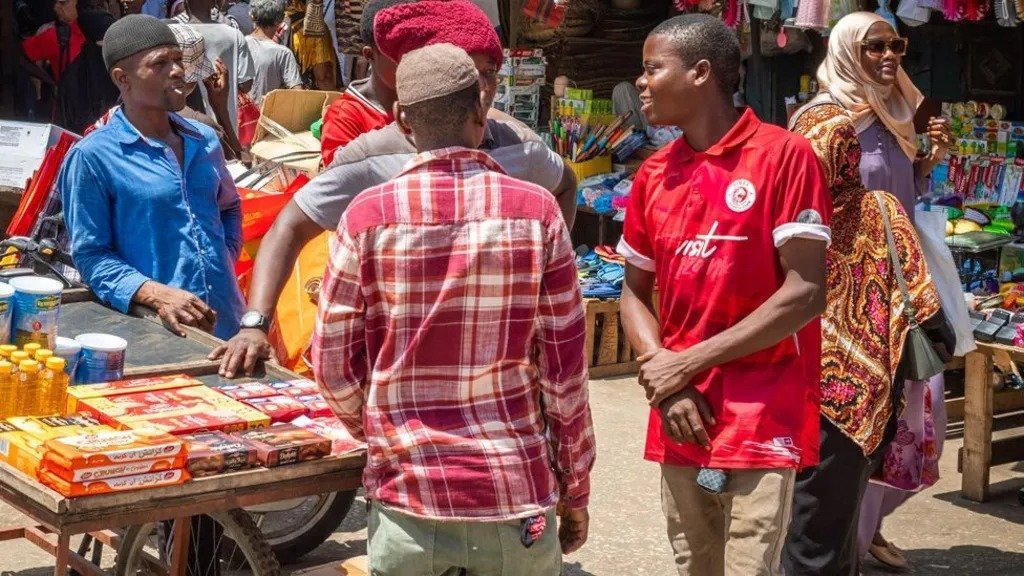
The country has millions of young people already trying to survive economically with extraordinary intensity: selling products online, running small shops, brokering land deals, importing goods from China and Turkey, trading phones, clothes, cosmetics, spare parts, and electronics, driving motorcycles, building logistics businesses, freelancing digitally, and hustling continuously inside an economy where formal industrial employment remains too small to absorb the scale of labour entering the market every year. Walk through Kariakoo in Dar es Salaam, through the commercial districts of Mwanza and Arusha, through the market streets of Dodoma and Mbeya, and the entrepreneurial energy is immediate and overwhelming. It is not timid or unfocused. It is commercially sophisticated in its market reading, adaptive in its logistics improvisation, and operationally resilient in its persistence through infrastructure constraints, regulatory friction, and capital scarcity that would discourage entrepreneurs operating in more forgiving environments.
The entrepreneurial instinct already exists at scale, and diagnosing Tanzania's industrial development challenge as a motivation deficit is not only analytically incorrect but actively harmful, because it directs policy responses toward solutions whose effectiveness depends on a constraint that does not exist while leaving the constraint that does exist largely unaddressed. Conferences teach pitching. Motivational speakers teach mindset. Startup culture teaches branding, networking, and innovation language. Social media celebrates entrepreneurship as personal ambition and discipline. None of that addresses the structural reason that the same commercially capable young people whose market intelligence and operational resilience are visible in every Tanzanian commercial district are running import businesses rather than operating factories: the economy currently makes importing finished goods more financially rational than manufacturing them domestically, and no motivational intervention changes that calculation without changing the financial architecture underneath it.
Why the incentive structure directs energy toward trade rather than production
The mechanism through which Tanzania's financial architecture consistently rewards trading over manufacturing is specific enough to deserve analytical precision rather than general assertion about capital scarcity. It is significantly easier for a young entrepreneur to import finished products and resell them than to build a factory producing those same products locally, and the ease difference is not a reflection of entrepreneurial courage or ambition but of the objective risk profile difference between the two activities that commercial financial institutions assess when deciding whether to extend credit. Import trading requires lower upfront capital because the inventory itself serves as collateral whose value the transaction establishes rather than the operational track record whose absence the manufacturing investor cannot yet demonstrate. It requires shorter repayment cycles because the cash conversion from inventory to revenue is measured in weeks or months rather than the years required for a manufacturing operation to move from machinery acquisition through commissioning through production ramp-up to stable profitability. It requires less technical complexity because distributing manufactured goods does not require the engineering knowledge, quality management systems, and production process expertise that manufacturing them does. It requires fewer infrastructure dependencies because an import trading operation can function adequately with road access and a phone connection in ways that a factory whose production depends on reliable electricity, adequate water supply, and logistics infrastructure capable of moving industrial inputs and outputs cannot.
According to the Bank of Tanzania's Financial Sector Surveillance Report 2023, commercial bank lending in Tanzania remains concentrated in short-tenor commercial transactions whose cash conversion cycles, collateral characteristics, and repayment predictability make them commercially preferable to industrial lending on every metric that conventional banking risk assessment employs. A bank officer evaluating a loan application from a trader importing consumer goods and a loan application from an entrepreneur seeking to establish a manufacturing operation is making a comparison whose outcome the incentive structure of commercial banking determines before the specific merits of either applicant are assessed: the trading operation offers everything that commercial lending risk assessment rewards, while the manufacturing application offers the opposite of almost all of it. The bank officer is not behaving irrationally or failing to serve Tanzania's industrial development. The officer is responding correctly to the incentive structure within which commercial banking operates, and the appropriate response to that institutional behaviour is not to demand different individual decisions but to change the systemic conditions that make those decisions rational.
What the Kariakoo pattern reveals about the structural distortion
Walk through many urban commercial centres in Dar es Salaam and the pattern becomes economically legible rather than simply commercially visible. Entire business districts revolve around imported products: phones assembled elsewhere, electronics manufactured elsewhere, household appliances produced elsewhere, textiles produced elsewhere, processed goods produced elsewhere, spare parts produced elsewhere. Tanzanians distribute them energetically, creatively, and with the market intelligence that comes from years of customer relationship building and competitive landscape navigation. The commercial activity is genuine and the economic contribution of that distribution ecosystem to Tanzania's GDP is real. But distribution alone rarely creates industrial power, and an economy in which the primary commercial activity of its most commercially capable young people is moving goods that other economies produced is an economy that is exporting its industrial learning opportunity to the countries whose factories produced the goods while retaining only the distribution margin.
The deeper issue is what this pattern teaches across generations. Young people increasingly become psychologically oriented toward brokerage rather than production, because the fastest visible wealth in the economy comes from trading, land speculation, imports, commissions, and transactional arbitrage rather than manufacturing. The economy gradually teaches a generation that moving products is safer than making them, not because the generation lacks the ambition to make them but because the financial structure of the economy consistently validates the safety judgement. That orientation becomes economically dangerous over time because countries become wealthy through production complexity rather than transactional circulation, and the generation whose commercial energy is directed toward distribution rather than production is the generation whose accumulated commercial intelligence never converts into the industrial learning that manufacturing ecosystems generate.
What South Korea and China actually built to redirect entrepreneurial energy
South Korea did not industrialise because Korean youth were more motivated, more disciplined, or more commercially ambitious than Tanzanian youth. The Korean state deliberately reduced the risk of productive investment through a specific set of institutional instruments whose combined effect was to make manufacturing more financially rational than trading for the entrepreneurs whose capital allocation decisions collectively determined whether industrial capacity developed or remained underdeveloped. According to Korean Development Institute research, the Korea Development Bank and associated policy finance institutions directed long-tenor concessional credit toward manufacturing sectors considered strategically important, subsidising the risk of industrial investment to levels that commercial financial institutions operating on normal competitive principles would not have reached independently. Export performance requirements attached to the concessional financing created the competitive discipline preventing the subsidised protection from becoming permanent inefficiency insulation: Samsung, Hyundai, and POSCO received the patient capital that manufacturing requires, but its continuation was conditioned on demonstrated international competitiveness rather than domestic market capture.
China scaled the same institutional logic at unprecedented magnitude across the decades of the reform period, directing state bank financing toward manufacturing clusters, industrial zones, export infrastructure, and factory ecosystems whose development converted the commercial energy of hundreds of millions of workers from subsistence agriculture into industrial production that compounded over decades into the productive sophistication that made China globally consequential. According to National Bureau of Statistics of China industrial development data, the Chinese state aligned capital toward manufacturing rather than allowing commercial financial incentives alone to determine the allocation, and the result was the largest and most rapid industrial transformation in economic history. Tanzania's situation is not identical to South Korea's in the 1960s or China's in the 1980s, but the structural principle applies precisely: entrepreneurial energy in developing economies follows the incentive structure that capital allocation creates, and changing the incentive structure requires changing the capital allocation rather than motivating the entrepreneurs.
What Tanzania's infrastructure development makes possible if capital alignment follows
Tanzania increasingly possesses the physical enabling conditions that industrial investment requires, and the infrastructure programme whose pace and scale Uchumi360 has documented across its 2026 coverage is creating the energy, logistics, and connectivity foundation on which manufacturing investment can be commercially viable in ways that were not consistently available to previous generations of Tanzanian industrial investors. According to Tanzania Electric Supply Company operational records, installed electricity generation capacity has crossed approximately 4,000 megawatts, creating an energy surplus whose industrial investment significance extends to the manufacturing operations whose viability the previous generation's power constraints made commercially questionable. According to Standard Chartered Bank's official announcement of 28 April 2026, the USD 2.33 billion SGR financing for Lots 3, 4, and 5 restructures logistics economics along the Central Corridor in ways that reduce the transport cost component of manufacturing investment for corridor-adjacent facilities. According to Tanzania Petroleum Development Corporation data, natural gas reserves of approximately 57 trillion cubic feet provide the feedstock for fertiliser production, industrial energy systems, and petrochemical manufacturing whose domestic economic significance extends well beyond the LNG export revenues that most public discussion concentrates on.
The physical foundation is becoming more serious. What must become equally serious is the financial architecture whose alignment toward industrial production would allow Tanzania's young entrepreneurs to convert their commercial capability into manufacturing operations rather than continuing to concentrate their energy in the import distribution activities that the current incentive structure consistently rewards over production. The Development Bank of Tanzania's industrial lending expansion, the pension sector's long-horizon capital deployment toward manufacturing investment, and the procurement preferences for locally manufactured goods that Tanzania's Public Procurement Act permits are the specific instruments whose implementation would begin changing the financial rationality calculation that directs entrepreneurial energy toward trading rather than factories. Tanzania's young people do not need another conference telling them to think bigger. They need a financial system that makes building a factory as commercially rational as importing a container.
FAQ
Why is motivation not the constraint on Tanzania's industrial development? Because Tanzania's commercial economy is already populated by millions of young people demonstrating extraordinary commercial intensity in trading, import distribution, and logistics businesses that reflect genuine market intelligence and operational resilience. The constraint is financial rather than motivational: the capital allocation structure consistently makes importing more rational than manufacturing, and changing the motivation of people operating rationally within that structure produces no change in the structure itself. According to Bank of Tanzania Financial Sector Surveillance Report 2023, private sector credit remains concentrated in commercial and trade activities rather than manufacturing financing, confirming that the constraint is institutional rather than individual.
Why does the economy currently reward trading over manufacturing? Because commercial banking systems naturally prefer activities generating faster and more predictable repayment. Import trading requires lower upfront capital, shorter repayment cycles, clearer collateral in imported inventory, and faster cash conversion than manufacturing investment whose machinery collateral is sector-specific, whose revenue depends on operational learning not yet achieved, and whose repayment timeline extends across years of production ramp-up. The bank officer making this comparison is responding correctly to commercial banking's incentive structure rather than failing to serve Tanzania's development, which is why addressing the constraint requires changing the systemic conditions rather than motivating individual banks or entrepreneurs differently.
What did South Korea do to redirect entrepreneurial energy toward manufacturing? According to Korean Development Institute research, the Korean state directed long-tenor concessional credit toward manufacturing sectors through the Korea Development Bank and associated policy finance institutions, subsidising the risk of industrial investment to levels that commercial financial institutions would not have reached independently. Export performance requirements conditioned the continuation of support on demonstrated international competitiveness rather than domestic market capture, preventing the protection from becoming permanent inefficiency insulation. The Korean model succeeded because it changed the financial rationality calculation that entrepreneurs faced rather than attempting to change the entrepreneurs themselves.
What financial system changes would make manufacturing as rational as importing for Tanzania's entrepreneurs? Development Bank of Tanzania expansion toward machinery financing and long-tenor industrial lending at terms manufacturing investment requires. Pension fund regulatory framework evolution allowing long-horizon manufacturing investment. Procurement preferences for locally manufactured goods systematically applied under Tanzania's Public Procurement Act. Industrial energy pricing in manufacturing zones calibrated to hydropower generation costs. Blended finance structures combining concessional first-loss capital with commercial bank lending toward manufacturing transactions. These instruments change the financial rationality calculation rather than the motivational framing that leaves the calculation unchanged.
How does Tanzania's infrastructure investment connect to the entrepreneurial energy argument? Tanzania's electricity surplus, SGR logistics infrastructure, port expansion, and natural gas reserves create the physical enabling conditions that manufacturing investment requires, conditions whose absence in previous decades made industrial investment commercially questionable even when financial incentives had been adequate. The infrastructure improvement changes the physical production risk without changing the financial allocation risk, which means the infrastructure investment's productive potential depends on the financial system alignment whose development must accompany the physical construction rather than following it after the infrastructure has been absorbed by import distribution rather than industrial production.
 Uchumi360
Business Intelligence
Uchumi360
Business Intelligence
- Bank of Tanzania, Financial Sector Surveillance Report 2023
- Commercial bank lending structure and manufacturing credit gap
- Available at bot.go.tz
- Korean Development Institute, South Korea industrial policy and directed credit research
- Korea Development Bank lending to manufacturing sectors
- Available at kdi.re.kr
- National Bureau of Statistics of China, manufacturing development and state financing data across the reform period
- Available at stats.gov.cn
- Tanzania Electric Supply Company, operational records
- Available at tanesco.co.tz
- Tanzania Petroleum Development Corporation, natural gas reserve data
- Available at tpdc.go.tz
- Standard Chartered Bank, SGR financing announcement, 28 April 2026
- Available at sc.com
- African Development Bank, SME financing and manufacturing credit gap across Sub-Saharan Africa
- Available at afdb.org
- World Bank, Doing Business indicators
- Manufacturing risk premium in Tanzania
- Available at worldbank.org
- Tanzania Public Procurement Act and associated procurement preference regulations
- Available at ppra.go.tz
- Development Bank of Tanzania, mandate and lending portfolio documentation
- Available at dbt.go.tz
Uchumi360 covers business, investment, and economic policy across East, Central, and Southern Africa.
For the serious reader
You read to the end. That places you in a small group.
Uchumi360 is built for readers who demand precision over speed, structure over sentiment, and analysis that holds uncomfortable conclusions rather than softening them. If this work sharpens how you think about Africa's economy, help us keep building the infrastructure behind it.
Institutional Partners
Commission intelligence. Shape the conversation.
Uchumi360 works with development finance institutions, investment firms, sovereign bodies, and strategic organisations across the coverage region. Institutional partnership unlocks:
- Commissioned sector and country intelligence reports
- Branded research series under your institution's authority
- Exclusive data briefings for internal strategy teams
- Speaking and editorial presence at Uchumi360 events
- Co-published investment outlooks for your markets
Support Our Work
Independent analysis has a cost. Help us bear it.
Uchumi360 does not carry advertising. It does not take editorial direction from sponsors. Every article is produced without commercial compromise. Your contribution funds the reporting, research, and editorial infrastructure that keeps this analysis free from influence.
Secure checkout: One-time and monthly support are processed securely. Add payment credentials to enable checkout here.
Stay Connected
Keep up with every new insight.
Follow our latest analysis, policy coverage, and market intelligence as soon as it is published. If you need something specific, reach out directly and we will point you to the right research.
